
How to Use atmega328 diagram: Examples, Pinouts, and Specs
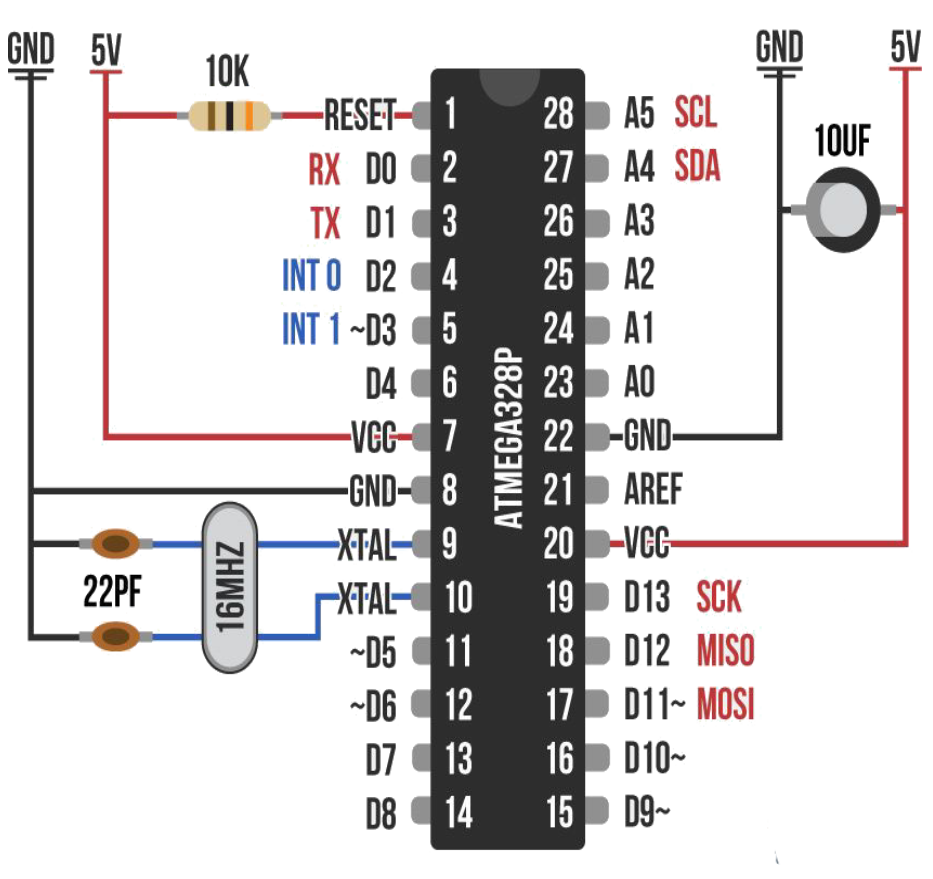
 Design with atmega328 diagram in Cirkit Designer
Introduction
The ATmega328 is an 8-bit microcontroller from the AVR family, widely used in embedded systems and microcontroller-based projects. It is the core component of popular development boards like the Arduino UNO. The ATmega328 diagram provides a visual representation of the microcontroller, detailing its pin configuration, internal architecture, and connections for interfacing with other components in a circuit.
Explore Projects Built with atmega328 diagram
 Open Project in Cirkit Designer
 Open Project in Cirkit Designer
 Open Project in Cirkit Designer
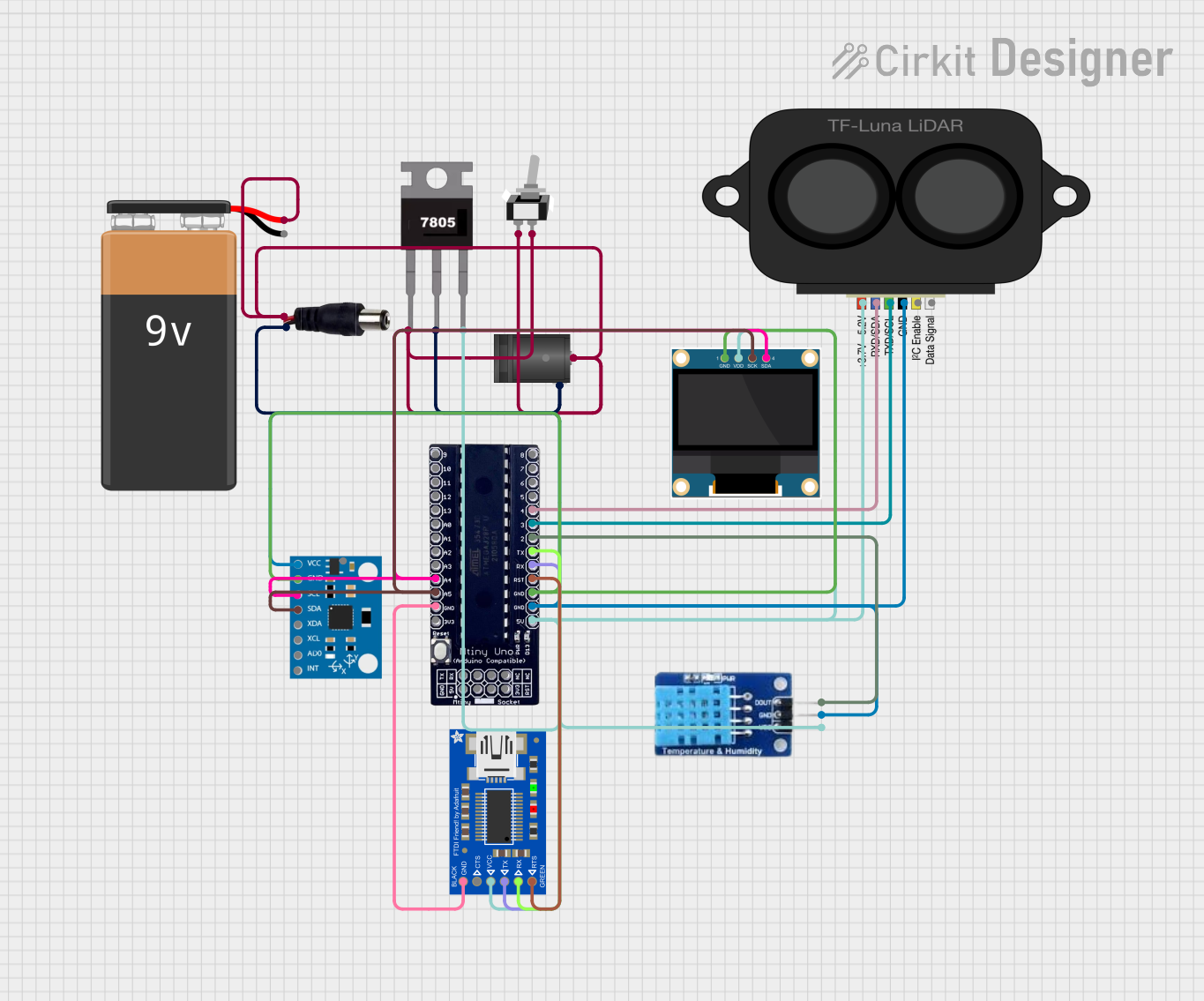 Open Project in Cirkit Designer
Explore Projects Built with atmega328 diagram
Open Project in Cirkit DesignerOpen Project in Cirkit DesignerOpen Project in Cirkit DesignerOpen Project in Cirkit DesignerCommon Applications and Use Cases
- Microcontroller-based development boards (e.g., Arduino UNO)
- Home automation systems
- Robotics and IoT devices
- Data acquisition systems
- Signal processing and control systems
Technical Specifications
The ATmega328 microcontroller is designed for high performance and low power consumption. Below are its key technical specifications:
- Architecture: 8-bit AVR RISC
- Operating Voltage: 1.8V to 5.5V
- Flash Memory: 32 KB
- SRAM: 2 KB
- EEPROM: 1 KB
- Clock Speed: Up to 20 MHz
- I/O Pins: 23 programmable I/O lines
- ADC: 10-bit, 6-channel ADC
- Timers: Two 8-bit timers and one 16-bit timer
- Communication Interfaces: UART, SPI, I2C
- Power Consumption: Low-power modes available for energy-efficient operation
Pin Configuration and Descriptions
The ATmega328 has a total of 28 pins in its PDIP (Plastic Dual In-line Package) form factor. Below is the pin configuration and description:
| Pin Number | Pin Name | Description |
|---|---|---|
| 1 | PC6 (RESET) | Reset input. Active low. |
| 2 | PD0 (RXD) | UART Receive (RX) for serial communication. |
| 3 | PD1 (TXD) | UART Transmit (TX) for serial communication. |
| 4 | PD2 | Digital I/O pin. External interrupt INT0. |
| 5 | PD3 | Digital I/O pin. External interrupt INT1. PWM output (OC2B). |
| 6 | PD4 | Digital I/O pin. Timer/Counter0 external clock input (T0). |
| 7 | VCC | Supply voltage (2.7V to 5.5V). |
| 8 | GND | Ground. |
| 9 | PB6 (XTAL1) | External clock input or crystal oscillator pin 1. |
| 10 | PB7 (XTAL2) | External clock input or crystal oscillator pin 2. |
| 11 | PD5 | Digital I/O pin. PWM output (OC0B). |
| 12 | PD6 | Digital I/O pin. PWM output (OC0A). |
| 13 | PD7 | Digital I/O pin. |
| 14 | PB0 | Digital I/O pin. PWM output (OC1A). |
| 15 | PB1 | Digital I/O pin. PWM output (OC1B). |
| 16 | PB2 | Digital I/O pin. SPI Chip Select (SS). |
| 17 | PB3 | Digital I/O pin. SPI MOSI (Master Out Slave In). |
| 18 | PB4 | Digital I/O pin. SPI MISO (Master In Slave Out). |
| 19 | PB5 | Digital I/O pin. SPI Clock (SCK). |
| 20 | AVCC | Supply voltage for ADC. |
| 21 | AREF | Analog reference voltage for ADC. |
| 22 | GND | Ground. |
| 23 | PC0 (ADC0) | Analog input channel 0. |
| 24 | PC1 (ADC1) | Analog input channel 1. |
| 25 | PC2 (ADC2) | Analog input channel 2. |
| 26 | PC3 (ADC3) | Analog input channel 3. |
| 27 | PC4 (ADC4) | Analog input channel 4. I2C SDA (data line). |
| 28 | PC5 (ADC5) | Analog input channel 5. I2C SCL (clock line). |
Usage Instructions
The ATmega328 is versatile and can be used in a variety of circuits. Below are the steps and considerations for using it effectively:
How to Use the ATmega328 in a Circuit
- Power Supply: Connect the VCC pin to a regulated power source (2.7V to 5.5V) and the GND pin to ground.
- Clock Source: Use an external crystal oscillator (e.g., 16 MHz) connected to XTAL1 and XTAL2, along with two 22pF capacitors to stabilize the clock.
- Reset Pin: Connect the RESET pin to a pull-up resistor (e.g., 10kΩ) to ensure proper operation. Optionally, add a push-button for manual reset.
- I/O Pins: Configure the digital and analog pins as needed for your application. Use pull-up or pull-down resistors for unused pins to avoid floating states.
- Communication Interfaces: Use UART, SPI, or I2C for interfacing with other devices like sensors, displays, or modules.
Example: Connecting the ATmega328 to an Arduino UNO
The ATmega328 is the microcontroller used in the Arduino UNO. Below is an example of how to blink an LED using the ATmega328 with Arduino code:
// Blink an LED connected to digital pin 13 (PB5 on ATmega328)

// Define the LED pin
const int ledPin = 13;

void setup() {
  // Set the LED pin as an output
  pinMode(ledPin, OUTPUT);
}

void loop() {
  // Turn the LED on
  digitalWrite(ledPin, HIGH);
  delay(1000); // Wait for 1 second

  // Turn the LED off
  digitalWrite(ledPin, LOW);
  delay(1000); // Wait for 1 second
}
Best Practices
- Use decoupling capacitors (e.g., 0.1µF) near the VCC and GND pins to reduce noise.
- Avoid leaving unused pins floating; connect them to ground or VCC through resistors.
- Ensure proper heat dissipation if operating at high frequencies or under heavy loads.
Troubleshooting and FAQs
Common Issues and Solutions
Microcontroller Not Responding:
- Check the power supply voltage and connections.
- Verify the RESET pin is properly connected with a pull-up resistor.
- Ensure the clock source (crystal oscillator) is functioning correctly.
Incorrect ADC Readings:
- Verify the AREF pin is connected to the correct reference voltage.
- Ensure the analog input pins are not floating.
Communication Failure (UART, SPI, I2C):
- Double-check the wiring and pin connections for the communication interface.
- Ensure the baud rate or clock speed matches between devices.
Program Upload Fails:
- Confirm the bootloader is correctly installed on the ATmega328.
- Check the serial connection and ensure the correct COM port is selected.
FAQs
Q: Can I use the ATmega328 without an external crystal oscillator?
A: Yes, the ATmega328 has an internal 8 MHz oscillator, but for higher precision, an external crystal is recommended.
Q: What is the maximum current the I/O pins can source or sink?
A: Each I/O pin can source or sink up to 40 mA, but it is recommended to limit the current to 20 mA for safe operation.
Q: How do I program the ATmega328?
A: You can program the ATmega328 using an Arduino UNO as an ISP (In-System Programmer) or with a dedicated AVR programmer.
Q: Can I use the ATmega328 for low-power applications?
A: Yes, the ATmega328 supports various low-power modes, such as Power-down and Idle, to reduce power consumption.
This concludes the documentation for the ATmega328 diagram. For further assistance, refer to the ATmega328 datasheet or community forums.