
How to Use ir sensor: Examples, Pinouts, and Specs
 Design with ir sensor in Cirkit Designer
Introduction
An infrared (IR) sensor detects infrared radiation, which is electromagnetic radiation with wavelengths longer than visible light. IR sensors are widely used in various applications, including proximity sensing, motion detection, and remote control systems. These sensors are versatile, cost-effective, and easy to integrate into electronic circuits, making them a popular choice for hobbyists and professionals alike.
Common applications of IR sensors include:
- Obstacle detection in robotics
- Line-following robots
- Motion detection for security systems
- Remote control signal reception
- Automatic door systems
Explore Projects Built with ir sensor
 Open Project in Cirkit Designer
 Open Project in Cirkit Designer
 Open Project in Cirkit Designer
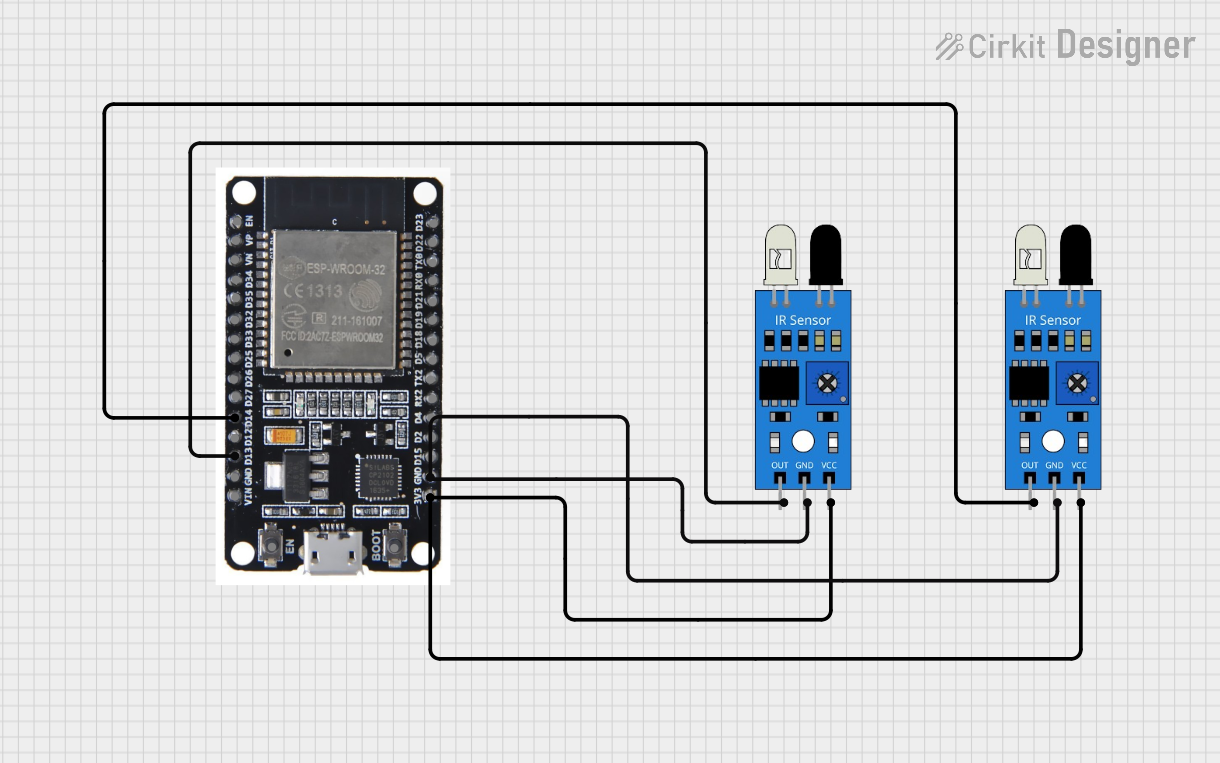 Open Project in Cirkit Designer
Explore Projects Built with ir sensor
Open Project in Cirkit DesignerOpen Project in Cirkit DesignerOpen Project in Cirkit DesignerOpen Project in Cirkit DesignerTechnical Specifications
Below are the general technical specifications for a typical IR sensor module:
| Parameter | Value |
|---|---|
| Operating Voltage | 3.3V to 5V |
| Operating Current | 20mA (typical) |
| Detection Range | 2 cm to 30 cm (varies by model) |
| Output Type | Digital (High/Low) or Analog |
| Wavelength Sensitivity | ~940 nm (infrared light spectrum) |
| Response Time | ~10 ms |
| Operating Temperature | -25°C to 85°C |
Pin Configuration
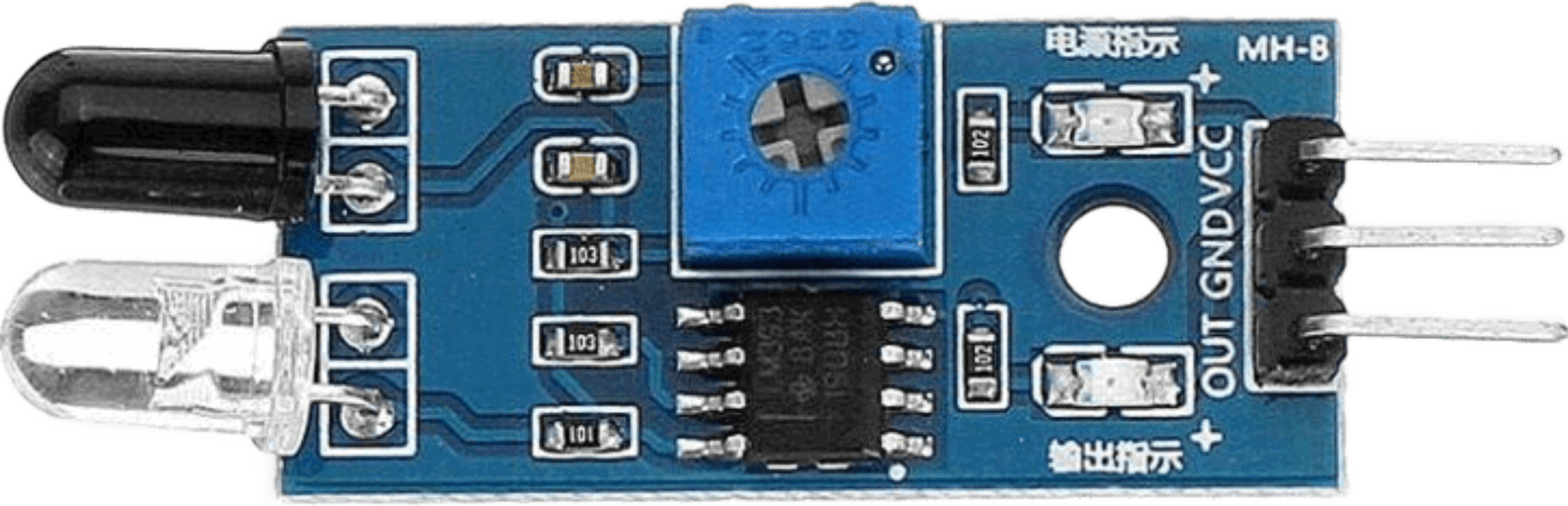
The pin configuration for a standard 3-pin IR sensor module is as follows:
| Pin | Name | Description |
|---|---|---|
| 1 | VCC | Power supply pin (3.3V to 5V) |
| 2 | GND | Ground pin |
| 3 | OUT | Output pin (Digital or Analog, depending on the model) |
Usage Instructions
How to Use the IR Sensor in a Circuit
- Power the Sensor: Connect the VCC pin to a 3.3V or 5V power source and the GND pin to the ground of your circuit.
- Connect the Output: Attach the OUT pin to a microcontroller's input pin (e.g., Arduino) or to another circuit component that processes the sensor's output.
- Position the Sensor: Place the IR sensor so that it faces the object or area you want to monitor. Ensure there are no obstructions between the sensor and the target.
- Read the Output: The sensor's output will typically be HIGH (1) when no object is detected and LOW (0) when an object is within range. For analog models, the output voltage will vary based on the distance of the object.
Important Considerations and Best Practices
- Ambient Light Interference: IR sensors can be affected by sunlight or other strong light sources. Use shielding or filters to minimize interference.
- Reflective Surfaces: Highly reflective surfaces may cause inaccurate readings. Test the sensor with your specific application to ensure reliability.
- Power Supply: Ensure a stable power supply to avoid erratic behavior.
- Distance Calibration: Adjust the potentiometer (if available) on the sensor module to fine-tune the detection range.
Example: Connecting an IR Sensor to an Arduino UNO
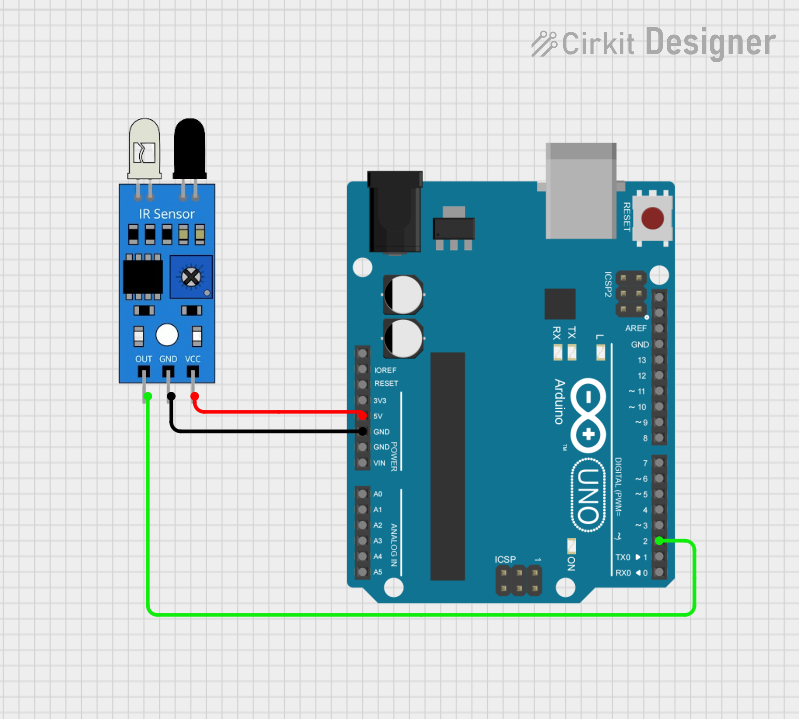
Below is an example of how to connect and use a digital IR sensor with an Arduino UNO:
Circuit Connections
- Connect the VCC pin of the IR sensor to the 5V pin on the Arduino.
- Connect the GND pin of the IR sensor to the GND pin on the Arduino.
- Connect the OUT pin of the IR sensor to digital pin 2 on the Arduino.
Arduino Code
// IR Sensor Example Code
// This code reads the digital output of an IR sensor and prints the status
// to the Serial Monitor.

const int irSensorPin = 2; // IR sensor output connected to digital pin 2
int sensorValue = 0;       // Variable to store the sensor's output

void setup() {
  pinMode(irSensorPin, INPUT); // Set the IR sensor pin as input
  Serial.begin(9600);          // Initialize serial communication at 9600 baud
}

void loop() {
  sensorValue = digitalRead(irSensorPin); // Read the sensor's output

  if (sensorValue == LOW) {
    // If the sensor detects an object, the output is LOW
    Serial.println("Object detected!");
  } else {
    // If no object is detected, the output is HIGH
    Serial.println("No object detected.");
  }

  delay(500); // Wait for 500 milliseconds before the next reading
}
Troubleshooting and FAQs
Common Issues and Solutions
Sensor Not Detecting Objects
- Cause: Incorrect wiring or insufficient power supply.
- Solution: Double-check the connections and ensure the power supply matches the sensor's requirements.
False Detections
- Cause: Ambient light interference or reflective surfaces.
- Solution: Use the sensor in a controlled environment or add shielding to block unwanted light.
Inconsistent Readings
- Cause: Unstable power supply or improper positioning.
- Solution: Use a regulated power source and ensure the sensor is properly aligned with the target.
Output Always HIGH or LOW
- Cause: Faulty sensor or incorrect pin connections.
- Solution: Test the sensor with a multimeter or replace it if necessary. Verify the wiring.
FAQs
Q: Can I use an IR sensor outdoors?
A: Yes, but you may need to shield the sensor from direct sunlight to avoid interference.
Q: How do I increase the detection range of my IR sensor?
A: If your sensor has a potentiometer, adjust it to increase the range. Alternatively, use a sensor model with a longer detection range.
Q: Can an IR sensor detect transparent objects?
A: IR sensors may struggle to detect transparent objects, as infrared light can pass through them. Use a different type of sensor for such applications.
Q: Is it possible to use multiple IR sensors in one project?
A: Yes, but ensure each sensor is positioned to avoid interference from the others. Use separate input pins for each sensor on your microcontroller.