
How to Use CD4048B: Examples, Pinouts, and Specs
 Design with CD4048B in Cirkit Designer
Introduction
The CD4048B is a CMOS digital logic integrated circuit (IC) manufactured by Texas Instruments. It functions as a versatile 4-input NAND gate and is widely used in digital circuits for implementing logic functions. The IC is designed to operate over a broad range of supply voltages, making it suitable for low-power and high-performance applications. Its robust design ensures reliable operation in various environments.
Explore Projects Built with CD4048B
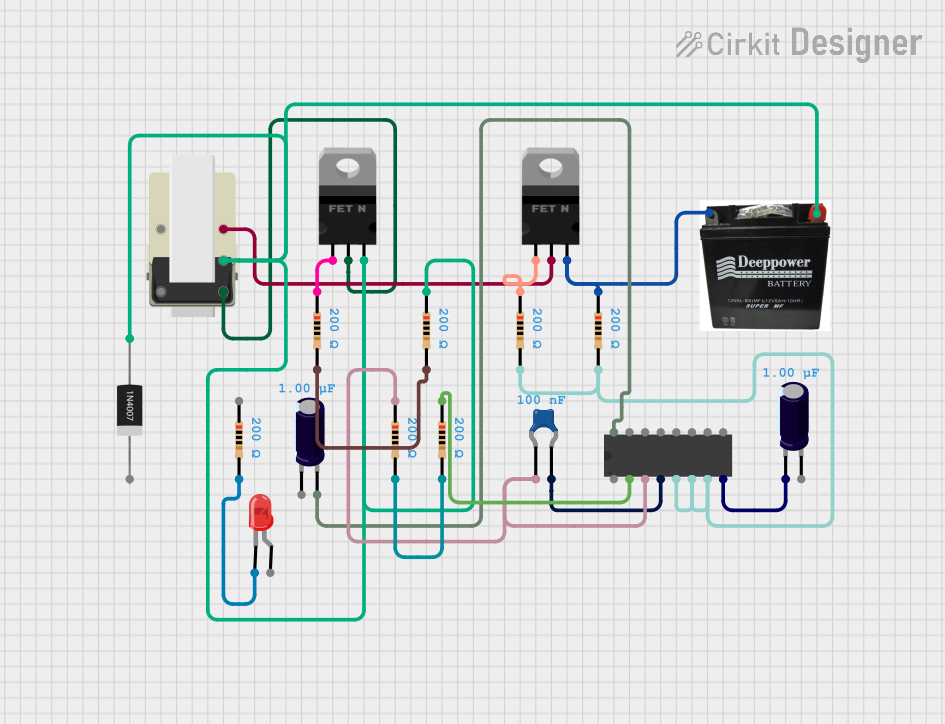 Open Project in Cirkit Designer
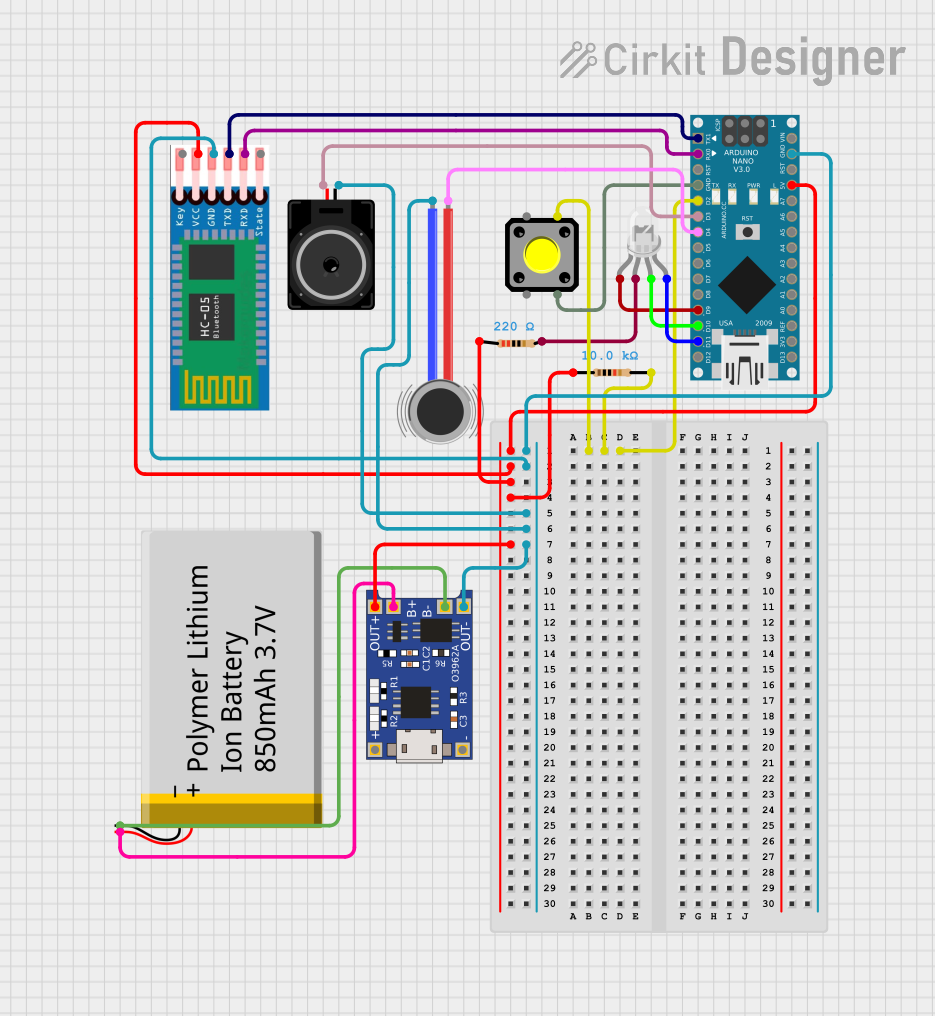 Open Project in Cirkit Designer
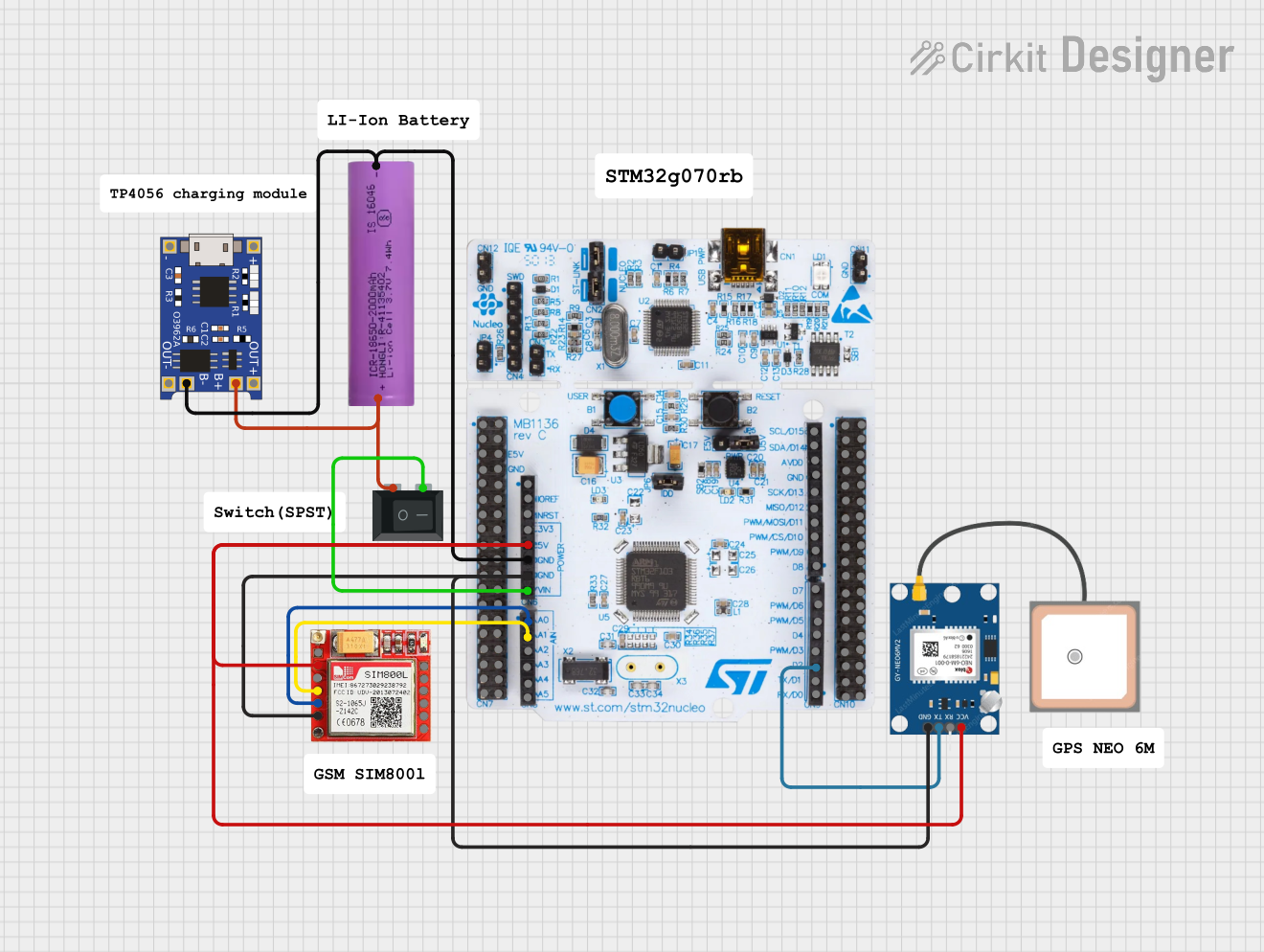 Open Project in Cirkit Designer
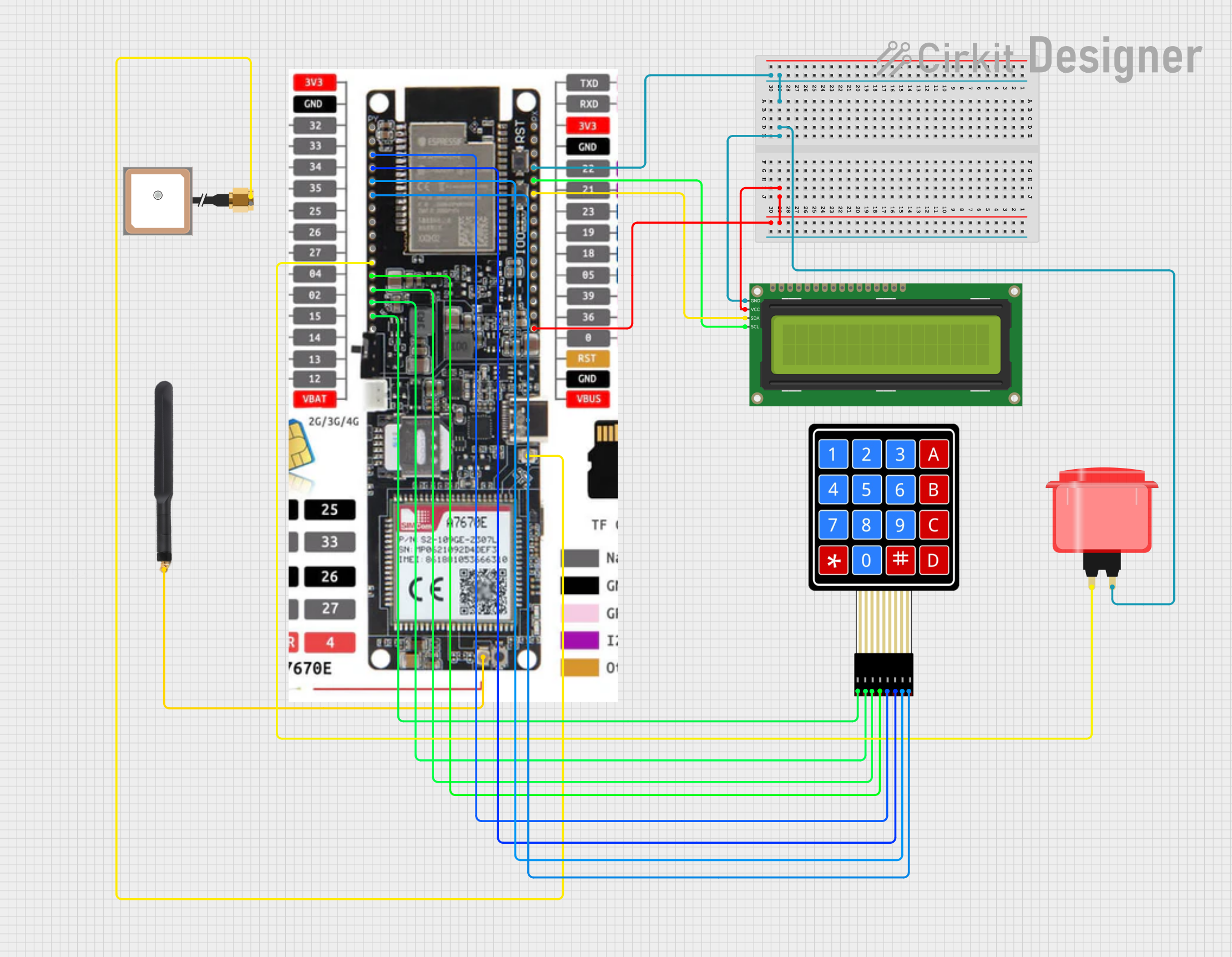 Open Project in Cirkit Designer
Explore Projects Built with CD4048B
Open Project in Cirkit DesignerOpen Project in Cirkit DesignerOpen Project in Cirkit DesignerOpen Project in Cirkit DesignerCommon Applications
- Digital logic circuits
- Signal processing
- Logic function implementation
- Microcontroller-based systems
- Industrial automation and control systems
Technical Specifications
Key Technical Details
| Parameter | Value |
|---|---|
| Manufacturer | Texas Instruments |
| Part Number | CD4048B |
| Logic Function | 4-input NAND gate |
| Supply Voltage Range (VDD) | 3V to 15V |
| Input Voltage Range (VIN) | 0V to VDD |
| Output Voltage Range (VOUT) | 0V to VDD |
| Maximum Supply Current | 1 µA (at 5V, typical) |
| Propagation Delay | 60 ns (typical at 5V) |
| Operating Temperature Range | -55°C to +125°C |
| Package Types | PDIP, SOIC, TSSOP |
Pin Configuration and Descriptions
The CD4048B is typically available in a 16-pin package. Below is the pinout and description:
| Pin Number | Pin Name | Description |
|---|---|---|
| 1 | A | Input A for the NAND gate |
| 2 | B | Input B for the NAND gate |
| 3 | C | Input C for the NAND gate |
| 4 | D | Input D for the NAND gate |
| 5 | NC | No Connection |
| 6 | NC | No Connection |
| 7 | VSS | Ground (0V) |
| 8 | Y | Output of the NAND gate |
| 9 | NC | No Connection |
| 10 | NC | No Connection |
| 11 | NC | No Connection |
| 12 | NC | No Connection |
| 13 | NC | No Connection |
| 14 | NC | No Connection |
| 15 | NC | No Connection |
| 16 | VDD | Positive Supply Voltage |
Note: NC pins are not internally connected and can be left floating.
Usage Instructions
How to Use the CD4048B in a Circuit
- Power Supply: Connect the VDD pin (Pin 16) to a positive supply voltage (3V to 15V) and the VSS pin (Pin 7) to ground.
- Inputs: Connect the logic inputs (A, B, C, D) to the desired signals. These inputs accept standard CMOS logic levels.
- Output: The output (Y) provides the NAND gate result. Connect this pin to the next stage of your circuit.
- Bypass Capacitor: Place a 0.1 µF ceramic capacitor close to the VDD and VSS pins to filter noise and stabilize the power supply.
Important Considerations and Best Practices
- Ensure the input voltage levels do not exceed the supply voltage (VDD) to avoid damage.
- Avoid leaving input pins floating; connect unused inputs to VDD or VSS.
- Use pull-up or pull-down resistors if required to maintain stable logic levels.
- Operate the IC within the specified temperature and voltage ranges for reliable performance.
Example: Connecting CD4048B to an Arduino UNO
The CD4048B can be interfaced with an Arduino UNO to perform logic operations. Below is an example of how to use the IC with Arduino:
Circuit Connections
- Connect VDD (Pin 16) to the Arduino's 5V pin.
- Connect VSS (Pin 7) to the Arduino's GND pin.
- Connect inputs A, B, C, and D (Pins 1, 2, 3, 4) to Arduino digital pins 2, 3, 4, and 5, respectively.
- Connect the output Y (Pin 8) to an LED with a current-limiting resistor.
Arduino Code
// Define input pins connected to the CD4048B
const int inputA = 2;
const int inputB = 3;
const int inputC = 4;
const int inputD = 5;

// Define output pin connected to the LED
const int outputY = 8;

void setup() {
  // Set input pins as outputs to drive the CD4048B
  pinMode(inputA, OUTPUT);
  pinMode(inputB, OUTPUT);
  pinMode(inputC, OUTPUT);
  pinMode(inputD, OUTPUT);

  // Set output pin as input to read the NAND gate result
  pinMode(outputY, INPUT);

  // Initialize inputs to LOW
  digitalWrite(inputA, LOW);
  digitalWrite(inputB, LOW);
  digitalWrite(inputC, LOW);
  digitalWrite(inputD, LOW);
}

void loop() {
  // Example: Set inputs to HIGH and observe the output
  digitalWrite(inputA, HIGH);
  digitalWrite(inputB, HIGH);
  digitalWrite(inputC, HIGH);
  digitalWrite(inputD, HIGH);

  // Read the output of the NAND gate
  int outputState = digitalRead(outputY);

  // Use the output state (e.g., turn on an LED)
  if (outputState == LOW) {
    // NAND gate output is LOW, turn off LED
    digitalWrite(LED_BUILTIN, LOW);
  } else {
    // NAND gate output is HIGH, turn on LED
    digitalWrite(LED_BUILTIN, HIGH);
  }

  delay(1000); // Wait for 1 second
}
Troubleshooting and FAQs
Common Issues and Solutions
No Output Signal:
- Ensure the power supply is connected correctly to VDD and VSS.
- Verify that all input pins are connected to valid logic levels (HIGH or LOW).
Unstable Output:
- Add a bypass capacitor (0.1 µF) near the power supply pins to reduce noise.
- Check for loose connections or poor soldering on the PCB.
Output Always HIGH or LOW:
- Confirm that the input logic levels meet the CMOS voltage thresholds.
- Verify that the IC is not damaged due to overvoltage or incorrect wiring.
FAQs
Q1: Can the CD4048B operate at 3.3V?
Yes, the CD4048B can operate at supply voltages as low as 3V, making it compatible with 3.3V systems.
Q2: What is the maximum fan-out of the CD4048B?
The maximum fan-out depends on the supply voltage and the connected load. Refer to the datasheet for detailed fan-out specifications.
Q3: Can I use the CD4048B for analog signals?
No, the CD4048B is designed for digital logic signals and does not support analog signal processing.
Q4: What happens if I leave an input pin floating?
Floating input pins can cause unpredictable behavior. Always connect unused inputs to VDD or VSS.
This concludes the documentation for the CD4048B. For further details, refer to the official Texas Instruments datasheet.