
How to Use IR2104: Examples, Pinouts, and Specs
 Design with IR2104 in Cirkit Designer
Introduction
The IR2104 is a high and low side driver IC designed to drive N-channel MOSFETs and IGBTs in half-bridge and full-bridge configurations. It is widely used in motor control, power conversion, and other high-voltage applications. The IR2104 features a high voltage capability of up to 600V, built-in dead time control to prevent shoot-through, and a compact design that simplifies circuit implementation.
Explore Projects Built with IR2104
 Open Project in Cirkit Designer
 Open Project in Cirkit Designer
 Open Project in Cirkit Designer
 Open Project in Cirkit Designer
Explore Projects Built with IR2104
Open Project in Cirkit DesignerOpen Project in Cirkit DesignerOpen Project in Cirkit DesignerOpen Project in Cirkit DesignerCommon Applications
- Motor control systems (e.g., BLDC and stepper motors)
- DC-DC and AC-DC power converters
- Uninterruptible Power Supplies (UPS)
- Solar inverters
- Industrial automation systems
Technical Specifications
Key Technical Details
| Parameter | Value |
|---|---|
| High-Side Floating Voltage (VB) | Up to 600V |
| Gate Drive Voltage (VCC) | 10V to 20V |
| Logic Input Voltage (VIN) | 0V to 5V |
| Dead Time Control | Built-in (typical 520ns) |
| Output Current (Source) | 130mA |
| Output Current (Sink) | 270mA |
| Propagation Delay | 120ns (typical) |
| Operating Temperature | -40°C to +125°C |
| Package Type | DIP-8, SOIC-8 |
Pin Configuration and Descriptions
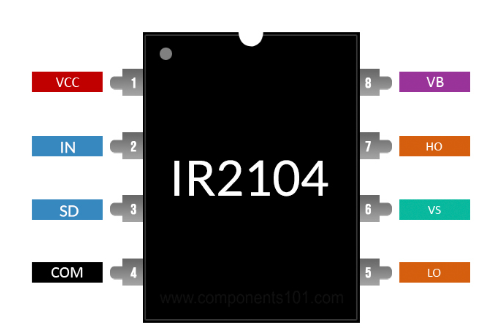
The IR2104 is an 8-pin IC. Below is the pinout and description:
| Pin No. | Pin Name | Description |
|---|---|---|
| 1 | VCC | Low-side and logic fixed supply voltage (10V to 20V). |
| 2 | IN | Logic input for controlling the high-side and low-side outputs. |
| 3 | SD | Shutdown input (active low). Disables both high-side and low-side outputs. |
| 4 | COM | Ground reference for the low-side driver and logic. |
| 5 | LO | Low-side output for driving the low-side MOSFET/IGBT. |
| 6 | VS | High-side floating supply return. Connects to the source of the high-side MOSFET. |
| 7 | HO | High-side output for driving the high-side MOSFET/IGBT. |
| 8 | VB | High-side floating supply voltage. |
Usage Instructions
How to Use the IR2104 in a Circuit
- Power Supply: Connect VCC to a stable 10V-20V power supply. Ensure proper decoupling with a capacitor (e.g., 0.1µF ceramic capacitor) close to the VCC pin.
- Logic Inputs: Drive the IN pin with a 0V-5V logic signal to control the high-side and low-side outputs. Use the SD pin to enable or disable the driver (active low).
- High-Side Floating Supply: Connect VB to a bootstrap circuit (diode and capacitor) to provide the necessary voltage for the high-side driver.
- MOSFET/IGBT Connections: Connect the HO pin to the gate of the high-side MOSFET/IGBT and the LO pin to the gate of the low-side MOSFET/IGBT.
- Grounding: Ensure a solid ground connection at the COM pin for proper operation.
Important Considerations
- Bootstrap Circuit: Use a fast recovery diode (e.g., UF4007) and a bootstrap capacitor (e.g., 0.1µF to 1µF) to ensure proper high-side operation.
- Dead Time: The IR2104 has a built-in dead time to prevent shoot-through. Avoid adding external dead time unless necessary.
- Voltage Ratings: Ensure that the high-side floating voltage (VB) does not exceed 600V.
- Heat Dissipation: If operating at high frequencies or driving large MOSFETs, ensure proper heat dissipation for the IC.
Example: Using IR2104 with Arduino UNO
Below is an example of how to control the IR2104 using an Arduino UNO to drive a half-bridge circuit:
// Example: Controlling IR2104 with Arduino UNO
// Connect IN pin of IR2104 to Arduino pin 9
// Connect SD pin of IR2104 to Arduino pin 8

#define IN_PIN 9  // Arduino pin connected to IR2104 IN pin
#define SD_PIN 8  // Arduino pin connected to IR2104 SD pin

void setup() {
  pinMode(IN_PIN, OUTPUT);  // Set IN pin as output
  pinMode(SD_PIN, OUTPUT);  // Set SD pin as output

  digitalWrite(SD_PIN, HIGH);  // Enable the IR2104 driver
}

void loop() {
  digitalWrite(IN_PIN, HIGH);  // Turn on high-side MOSFET
  delay(1000);                 // Wait for 1 second
  digitalWrite(IN_PIN, LOW);   // Turn on low-side MOSFET
  delay(1000);                 // Wait for 1 second
}
Notes:
- Ensure proper connections between the Arduino, IR2104, and the MOSFETs.
- Use appropriate pull-down resistors on the IN and SD pins to avoid floating inputs.
Troubleshooting and FAQs
Common Issues and Solutions
No Output on HO or LO Pins:
- Check the VCC supply voltage (should be between 10V and 20V).
- Verify that the SD pin is set to HIGH (logic 1) to enable the driver.
- Ensure proper bootstrap circuit connections for the high-side driver.
High-Side MOSFET Not Turning On:
- Verify the bootstrap capacitor and diode are functioning correctly.
- Check that the VB voltage is sufficiently higher than the source voltage of the high-side MOSFET.
Overheating of the IR2104:
- Ensure the IC is not driving MOSFETs with excessive gate capacitance at high frequencies.
- Add a heatsink or improve ventilation if necessary.
Shoot-Through in the MOSFETs:
- Verify that the dead time is sufficient to prevent simultaneous conduction of high-side and low-side MOSFETs.
- Avoid external circuitry that interferes with the IR2104's built-in dead time.
FAQs
Q1: Can the IR2104 drive P-channel MOSFETs?
A1: No, the IR2104 is specifically designed for N-channel MOSFETs and IGBTs.
Q2: What is the maximum switching frequency of the IR2104?
A2: The maximum switching frequency depends on the load and gate capacitance of the MOSFETs. Typically, it can operate up to 500kHz with proper design.
Q3: Can I use the IR2104 for a full-bridge configuration?
A3: Yes, you can use two IR2104 ICs to drive a full-bridge circuit.
Q4: Is the IR2104 suitable for low-voltage applications?
A4: The IR2104 is optimized for high-voltage applications. For low-voltage designs, consider using a dedicated low-voltage gate driver.
Q5: Do I need external dead time control?
A5: The IR2104 has a built-in dead time, so external dead time control is generally not required.