
How to Use SD Card module: Examples, Pinouts, and Specs
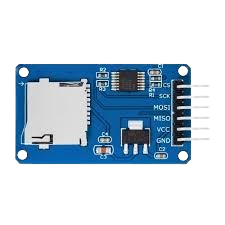
 Design with SD Card module in Cirkit Designer
Introduction
The SD Card Module is a compact and versatile component designed to interface SD cards with microcontrollers. It enables the storage and retrieval of data, making it an essential tool for projects requiring large amounts of non-volatile memory. This module is widely used in applications such as data logging, file storage, multimedia playback, and firmware updates.
Common applications and use cases:
- Data logging for sensors in IoT projects
- Storing configuration files or firmware
- Multimedia storage for audio, video, or images
- File-based communication between microcontrollers and external systems
Explore Projects Built with SD Card module
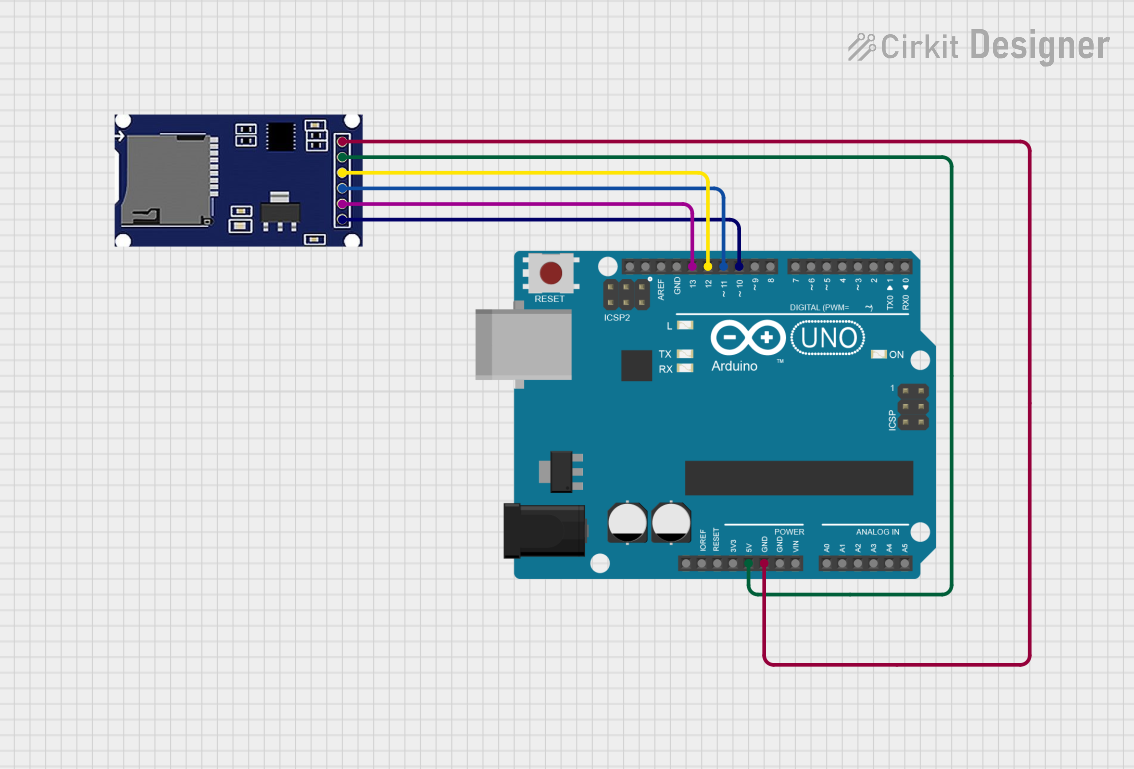 Open Project in Cirkit Designer
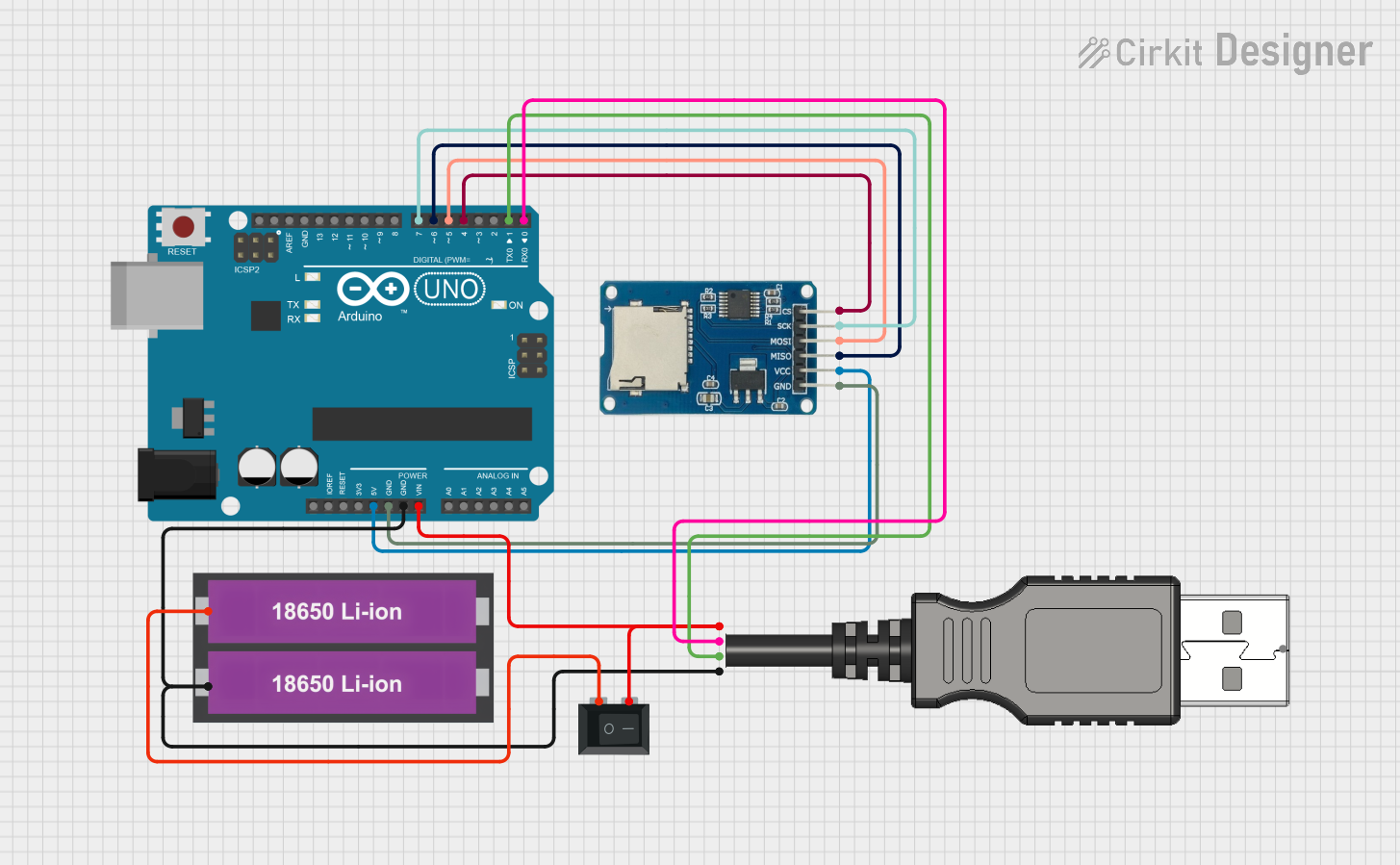 Open Project in Cirkit Designer
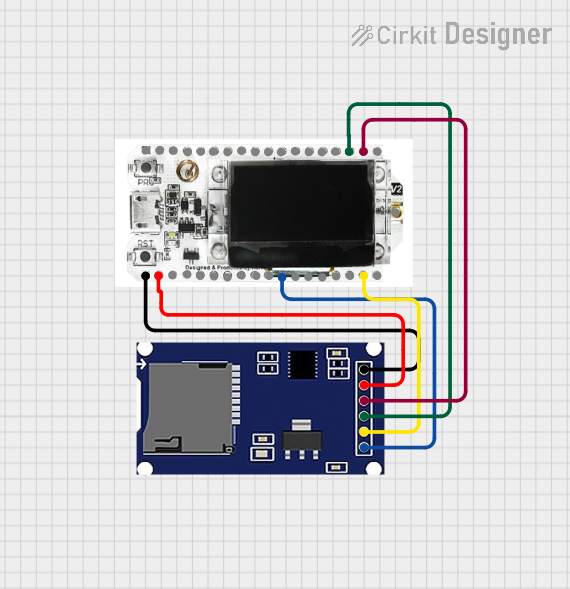 Open Project in Cirkit Designer
 Open Project in Cirkit Designer
Explore Projects Built with SD Card module
Open Project in Cirkit DesignerOpen Project in Cirkit DesignerOpen Project in Cirkit DesignerOpen Project in Cirkit DesignerTechnical Specifications
- Operating Voltage: 3.3V (logic level) with onboard voltage regulator for 5V input
- Current Consumption: ~100mA (varies with SD card activity)
- Supported SD Card Types: Standard SD and microSD cards (FAT16/FAT32 formatted)
- Communication Protocol: SPI (Serial Peripheral Interface)
- Dimensions: Typically 42mm x 24mm x 12mm (varies by manufacturer)
Pin Configuration and Descriptions
The SD Card Module typically has 6 pins. Below is the pinout and description:
| Pin | Name | Description |
|---|---|---|
| 1 | GND | Ground connection |
| 2 | VCC | Power supply input (3.3V or 5V, depending on the module) |
| 3 | MISO | Master In Slave Out - SPI data output from the SD card to the microcontroller |
| 4 | MOSI | Master Out Slave In - SPI data input from the microcontroller to the SD card |
| 5 | SCK | Serial Clock - SPI clock signal |
| 6 | CS | Chip Select - Used to select the SD card module during SPI communication |
Usage Instructions
How to Use the SD Card Module in a Circuit
- Power the Module: Connect the
VCCpin to a 5V or 3.3V power source (check your module's specifications) and theGNDpin to ground. - Connect SPI Pins: Connect the
MISO,MOSI,SCK, andCSpins to the corresponding SPI pins on your microcontroller. - Insert SD Card: Ensure the SD card is formatted as FAT16 or FAT32 before inserting it into the module.
- Initialize the Module: Use an appropriate library (e.g., the Arduino SD library) to initialize the module and access the SD card.
Important Considerations and Best Practices
- Voltage Levels: Ensure the module is compatible with your microcontroller's logic level (3.3V or 5V). Most modules have onboard level shifters for 5V compatibility.
- SD Card Formatting: Always format the SD card as FAT16 or FAT32. Other formats may not be supported.
- SPI Speed: Use a suitable SPI clock speed. High speeds may cause communication errors with some SD cards.
- Pull-up Resistors: Some modules may require external pull-up resistors on the SPI lines for reliable communication.
- File System Library: Use a reliable library, such as the Arduino SD library, to handle file operations.
Example Code for Arduino UNO
Below is an example of how to use the SD Card Module with an Arduino UNO:
#include <SPI.h>
#include <SD.h>

// Define the Chip Select (CS) pin for the SD card module
const int chipSelect = 10;

void setup() {
  // Initialize serial communication for debugging
  Serial.begin(9600);
  while (!Serial) {
    ; // Wait for the serial port to connect (for native USB boards)
  }

  Serial.println("Initializing SD card...");

  // Initialize the SD card
  if (!SD.begin(chipSelect)) {
    Serial.println("SD card initialization failed!");
    return; // Stop if the SD card cannot be initialized
  }
  Serial.println("SD card initialized successfully.");

  // Create or open a file on the SD card
  File dataFile = SD.open("example.txt", FILE_WRITE);

  // Check if the file opened successfully
  if (dataFile) {
    dataFile.println("Hello, SD card!"); // Write data to the file
    dataFile.close(); // Close the file
    Serial.println("Data written to example.txt.");
  } else {
    Serial.println("Error opening example.txt for writing.");
  }
}

void loop() {
  // Nothing to do here
}
Troubleshooting and FAQs
Common Issues and Solutions
SD Card Initialization Fails:
- Ensure the SD card is properly inserted into the module.
- Check that the SD card is formatted as FAT16 or FAT32.
- Verify the
CSpin is correctly defined in your code and connected to the correct pin on the microcontroller.
File Not Found or Cannot Be Opened:
- Double-check the file name and ensure it matches exactly, including case sensitivity.
- Ensure the file exists on the SD card if you are trying to read it.
Corrupted Data or Communication Errors:
- Use shorter SPI cables to reduce noise.
- Lower the SPI clock speed in your code.
- Add pull-up resistors to the SPI lines if necessary.
Module Not Detected:
- Verify the power supply voltage and current are sufficient for the module and SD card.
- Check all connections for loose wires or incorrect pin assignments.
FAQs
Q: Can I use microSD cards with this module?
A: Yes, most SD Card Modules support both standard SD and microSD cards using an adapter.
Q: What is the maximum SD card size supported?
A: This depends on the module and library used. Typically, cards up to 32GB (FAT32) are supported.
Q: Can I use multiple SD Card Modules on the same SPI bus?
A: Yes, but each module must have a unique CS pin to avoid conflicts.
Q: Why is my SD card not detected after formatting?
A: Ensure the card is formatted as FAT16 or FAT32. ExFAT and NTFS are not supported by most libraries.
By following this documentation, you can effectively integrate the SD Card Module into your projects for reliable data storage and retrieval.