
How to Use 0-50V 4A DC power supply filter board: Examples, Pinouts, and Specs
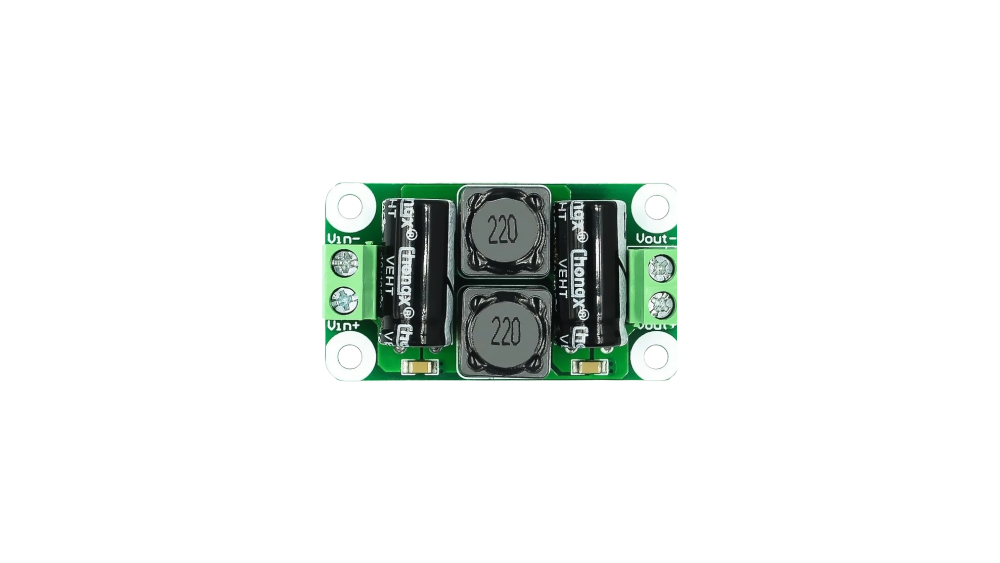
 Design with 0-50V 4A DC power supply filter board in Cirkit Designer
Introduction
The 0-50V 4A DC Power Supply Filter Board, manufactured in Mainland China, is a versatile circuit board designed to filter and stabilize the output of a DC power supply. It ensures clean and reliable power delivery by reducing noise, ripple, and other unwanted fluctuations in the power supply. This component is ideal for applications requiring stable DC power, such as powering sensitive electronic devices, audio equipment, and microcontroller-based systems.
Explore Projects Built with 0-50V 4A DC power supply filter board
 Open Project in Cirkit Designer
 Open Project in Cirkit Designer
 Open Project in Cirkit Designer
 Open Project in Cirkit Designer
Explore Projects Built with 0-50V 4A DC power supply filter board
Open Project in Cirkit DesignerOpen Project in Cirkit DesignerOpen Project in Cirkit DesignerOpen Project in Cirkit DesignerCommon Applications and Use Cases
- Powering microcontrollers and development boards (e.g., Arduino, Raspberry Pi)
- Audio amplifiers and other audio equipment
- Laboratory power supplies
- Industrial control systems
- LED lighting systems
- Any application requiring low-noise, stable DC power
Technical Specifications
The following table outlines the key technical specifications of the 0-50V 4A DC Power Supply Filter Board:
| Parameter | Specification |
|---|---|
| Input Voltage Range | 0-50V DC |
| Output Voltage Range | 0-50V DC (same as input) |
| Maximum Current | 4A |
| Ripple Reduction | High efficiency |
| Dimensions | Varies by manufacturer (e.g., 50x30mm) |
| Operating Temperature | -20°C to 85°C |
| PCB Material | FR4 (standard PCB material) |
Pin Configuration and Descriptions
The filter board typically has the following pin configuration:
| Pin Name | Description |
|---|---|
| VIN+ | Positive input voltage terminal |
| VIN- | Negative input voltage terminal (ground) |
| VOUT+ | Positive output voltage terminal |
| VOUT- | Negative output voltage terminal (ground) |
Usage Instructions
How to Use the Component in a Circuit
Connect the Input Voltage:
- Connect the positive terminal of your DC power supply to the
VIN+pin. - Connect the negative terminal of your DC power supply to the
VIN-pin.
- Connect the positive terminal of your DC power supply to the
Connect the Output Load:
- Connect the positive terminal of your load (e.g., microcontroller, LED, etc.) to the
VOUT+pin. - Connect the negative terminal of your load to the
VOUT-pin.
- Connect the positive terminal of your load (e.g., microcontroller, LED, etc.) to the
Power On:
- Turn on the DC power supply. The filter board will stabilize the input voltage and provide a clean output to your load.
Verify Output:
- Use a multimeter to measure the output voltage and ensure it matches the input voltage.
Important Considerations and Best Practices
- Input Voltage Range: Ensure the input voltage does not exceed 50V DC to avoid damaging the board.
- Current Limit: Do not exceed the maximum current rating of 4A to prevent overheating or failure.
- Heat Dissipation: If operating near the maximum current, ensure adequate ventilation or use a heatsink to dissipate heat.
- Polarity: Double-check the polarity of the input and output connections to avoid damage.
- Capacitor Ratings: The onboard capacitors are rated for specific voltages. Do not exceed these ratings.
Example: Using with an Arduino UNO
To power an Arduino UNO with the filter board, follow these steps:
- Connect a 12V DC power supply to the
VIN+andVIN-pins of the filter board. - Connect the
VOUT+andVOUT-pins to the Arduino'sVINandGNDpins, respectively. - Turn on the power supply. The filter board will provide a stable 12V to the Arduino.
Here is an example Arduino code to blink an LED while powered through the filter board:
// Simple LED Blink Example
// This code blinks an LED connected to pin 13 of the Arduino UNO.
// Ensure the Arduino is powered through the filter board for stable operation.

void setup() {
  pinMode(13, OUTPUT); // Set pin 13 as an output
}

void loop() {
  digitalWrite(13, HIGH); // Turn the LED on
  delay(1000);            // Wait for 1 second
  digitalWrite(13, LOW);  // Turn the LED off
  delay(1000);            // Wait for 1 second
}
Troubleshooting and FAQs
Common Issues and Solutions
| Issue | Possible Cause | Solution |
|---|---|---|
| No output voltage | Incorrect wiring or loose connections | Verify all connections and polarity. |
| Excessive heat on the board | Overcurrent or high input voltage | Reduce load current or input voltage. |
| Output voltage fluctuates | Insufficient input voltage stability | Use a more stable DC power supply. |
| Noise or ripple in output | High-frequency interference | Add additional filtering capacitors. |
FAQs
Can this board handle AC input?
- No, this board is designed for DC input only. Applying AC voltage will damage the board.
What happens if I exceed the 4A current limit?
- Exceeding the current limit may cause overheating, damage to the components, or failure of the board.
Can I use this board with a battery?
- Yes, the board can be used with a DC battery as long as the voltage is within the 0-50V range.
Is the output voltage adjustable?
- No, the output voltage is the same as the input voltage. This board is designed for filtering, not regulation.
By following this documentation, you can effectively use the 0-50V 4A DC Power Supply Filter Board in your projects to ensure clean and stable power delivery.