
How to Use 8192 CPR Enconder AMT102 8192: Examples, Pinouts, and Specs
 Design with 8192 CPR Enconder AMT102 8192 in Cirkit Designer
Introduction
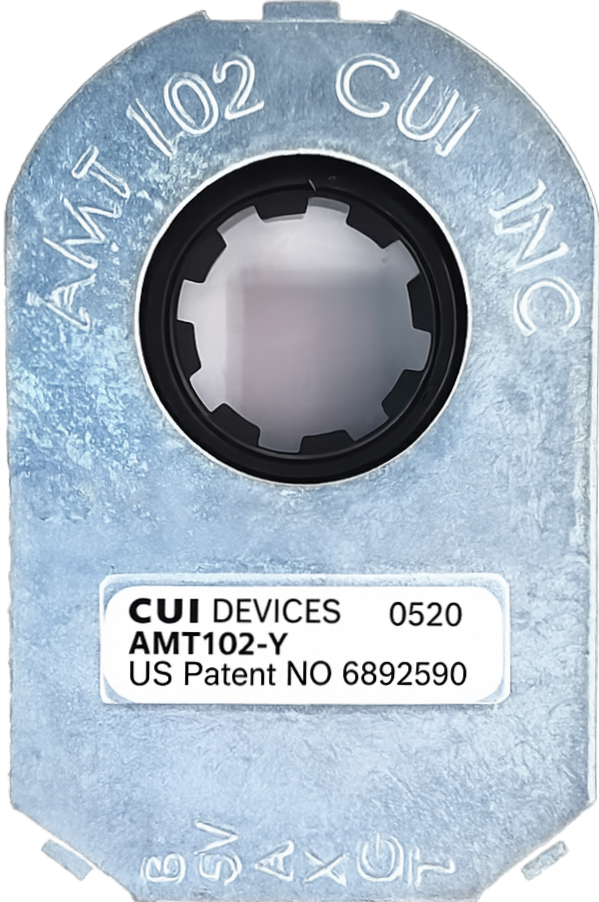
The AMT102 is a high-resolution rotary encoder manufactured by AMT, offering 8192 counts per revolution (CPR). This encoder is designed to provide precise position feedback, making it ideal for applications requiring high accuracy and reliability. Its compact design and robust construction ensure dependable performance, even in demanding industrial environments.
Explore Projects Built with 8192 CPR Enconder AMT102 8192
 Open Project in Cirkit Designer
 Open Project in Cirkit Designer
 Open Project in Cirkit Designer
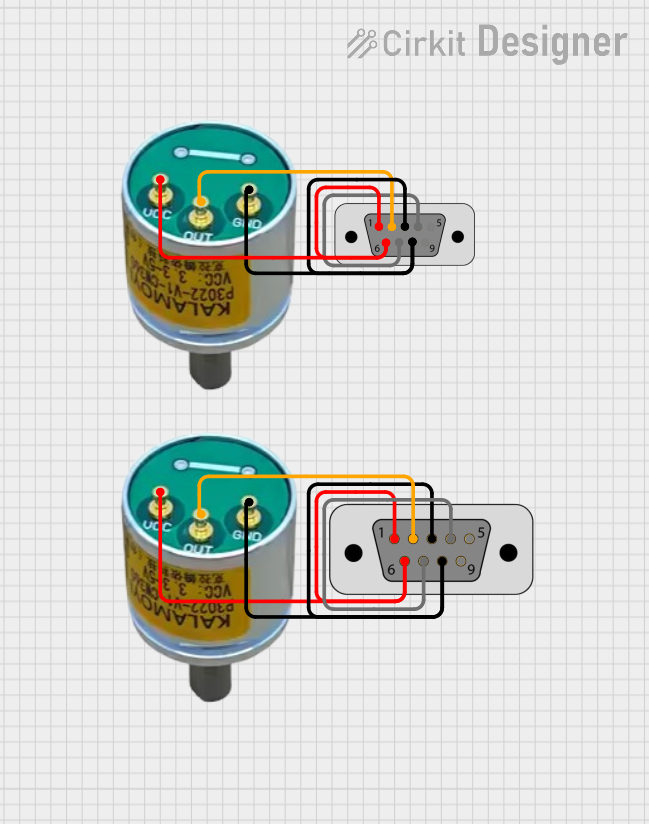 Open Project in Cirkit Designer
Explore Projects Built with 8192 CPR Enconder AMT102 8192
Open Project in Cirkit DesignerOpen Project in Cirkit DesignerOpen Project in Cirkit DesignerOpen Project in Cirkit DesignerCommon Applications
- Robotics: Precise motor control and position feedback
- CNC Machines: Accurate axis positioning
- Industrial Automation: Monitoring and controlling rotary motion
- 3D Printers: Ensuring precise movement of print heads
- Servo Motors: High-resolution feedback for closed-loop systems
Technical Specifications
Key Technical Details
| Parameter | Value |
|---|---|
| Manufacturer | AMT |
| Model | AMT102 |
| Resolution | 8192 CPR |
| Supply Voltage | 4.5V to 5.5V |
| Current Consumption | 10 mA (typical) |
| Output Signal Type | Quadrature (A, B) |
| Operating Temperature | -40°C to +125°C |
| Mounting Options | Modular, adjustable mounting |
| Shaft Diameter Support | 2mm to 8mm (with adapters) |
Pin Configuration and Descriptions
The AMT102 encoder typically uses a 6-pin connector for interfacing. Below is the pinout:
| Pin Number | Name | Description |
|---|---|---|
| 1 | VCC | Power supply input (4.5V to 5.5V) |
| 2 | GND | Ground connection |
| 3 | A | Quadrature output channel A |
| 4 | B | Quadrature output channel B |
| 5 | Z | Index pulse output (1 pulse per revolution) |
| 6 | NC | Not connected (reserved for future use) |
Usage Instructions
How to Use the AMT102 in a Circuit
- Power Supply: Connect the VCC pin to a regulated 5V power source and the GND pin to the ground of your circuit.
- Signal Connections:
- Connect the A and B pins to the input pins of your microcontroller or motor driver to read the quadrature signals.
- Optionally, connect the Z pin if you need an index pulse for absolute positioning.
- Mounting: Secure the encoder to the motor shaft using the provided mounting kit. Ensure proper alignment to avoid signal errors.
- Signal Reading: Use a microcontroller or dedicated encoder interface to decode the quadrature signals and determine the position or speed.
Important Considerations and Best Practices
- Debouncing: Use software or hardware debouncing to filter out noise in the quadrature signals.
- Alignment: Ensure the encoder is properly aligned with the motor shaft to prevent mechanical stress and signal distortion.
- Shielding: Use shielded cables for signal lines to minimize electromagnetic interference (EMI).
- Index Pulse: If using the Z pin, ensure your system can handle the single pulse per revolution for absolute positioning.
Example: Connecting to an Arduino UNO
Below is an example of how to connect and read the AMT102 encoder using an Arduino UNO:
Circuit Connections
| Encoder Pin | Arduino Pin |
|---|---|
| VCC | 5V |
| GND | GND |
| A | Pin 2 |
| B | Pin 3 |
Arduino Code
// Example code to read the AMT102 encoder with Arduino UNO
// Connect encoder A and B outputs to Arduino pins 2 and 3 (interrupt pins)

volatile int position = 0; // Variable to store encoder position

void setup() {
  pinMode(2, INPUT); // Set pin 2 as input for channel A
  pinMode(3, INPUT); // Set pin 3 as input for channel B

  // Attach interrupts to handle encoder signals
  attachInterrupt(digitalPinToInterrupt(2), readEncoder, CHANGE);
  attachInterrupt(digitalPinToInterrupt(3), readEncoder, CHANGE);

  Serial.begin(9600); // Initialize serial communication
}

void loop() {
  // Print the current position to the Serial Monitor
  Serial.print("Position: ");
  Serial.println(position);
  delay(100); // Delay for readability
}

void readEncoder() {
  // Read the current state of channel A and B
  int stateA = digitalRead(2);
  int stateB = digitalRead(3);

  // Determine direction based on quadrature signal
  if (stateA == stateB) {
    position++; // Clockwise rotation
  } else {
    position--; // Counterclockwise rotation
  }
}
Troubleshooting and FAQs
Common Issues and Solutions
No Output Signals
- Cause: Incorrect wiring or power supply issues.
- Solution: Verify all connections and ensure the encoder is receiving 5V power.
Inconsistent Position Readings
- Cause: Mechanical misalignment or noise in the signal.
- Solution: Check the encoder mounting and use shielded cables to reduce noise.
Index Pulse Not Detected
- Cause: Z pin not connected or improperly configured.
- Solution: Ensure the Z pin is connected to the correct input and verify your system's handling of the index pulse.
High Current Consumption
- Cause: Short circuit or damaged encoder.
- Solution: Inspect the wiring for shorts and replace the encoder if necessary.
FAQs
Q: Can the AMT102 be used with a 3.3V system?
A: No, the AMT102 requires a supply voltage of 4.5V to 5.5V. Use a level shifter if interfacing with a 3.3V system.
Q: How do I calculate the rotational speed using the encoder?
A: Measure the time between pulses on channel A or B and calculate the speed using the formula:
Speed (RPM) = (Pulses per second / CPR) * 60.
Q: Is the encoder resistant to dust and moisture?
A: The AMT102 is designed for industrial environments but is not fully sealed. Use additional protection in harsh conditions.