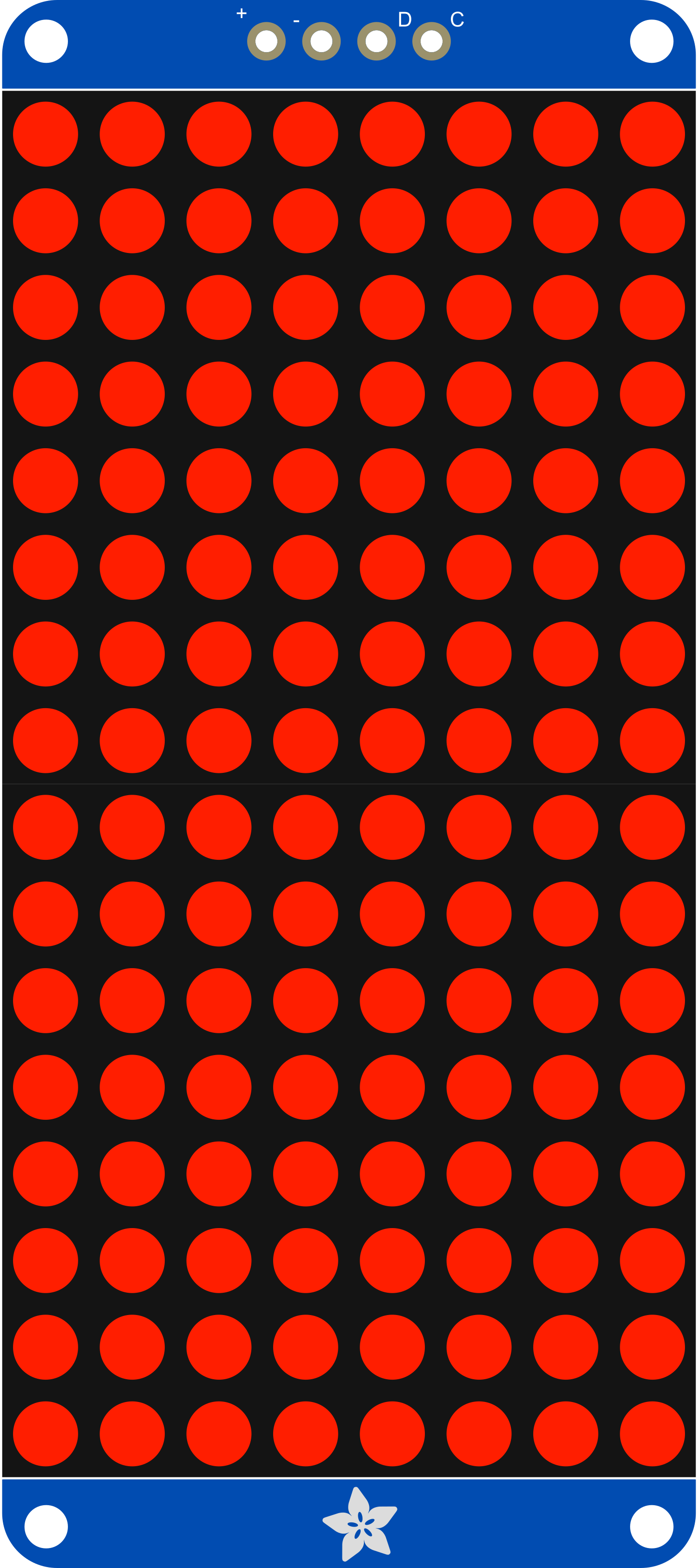
The Adafruit 16x8 LED Matrix Backpack is a versatile and easy-to-use accessory designed to drive a 16x8 grid of LEDs, providing a bright red display for a variety of projects. This component is ideal for creating scrolling messages, animations, or for building your own custom display. It is commonly used in wearables, digital scoreboards, clocks, and small games.
Explore Projects Built with Adafruit 16x8 LED Matrix Backpack Red
Use Cirkit Designer to design, explore, and prototype these projects online. Some projects support real-time simulation. Click "Open Project" to start designing instantly!
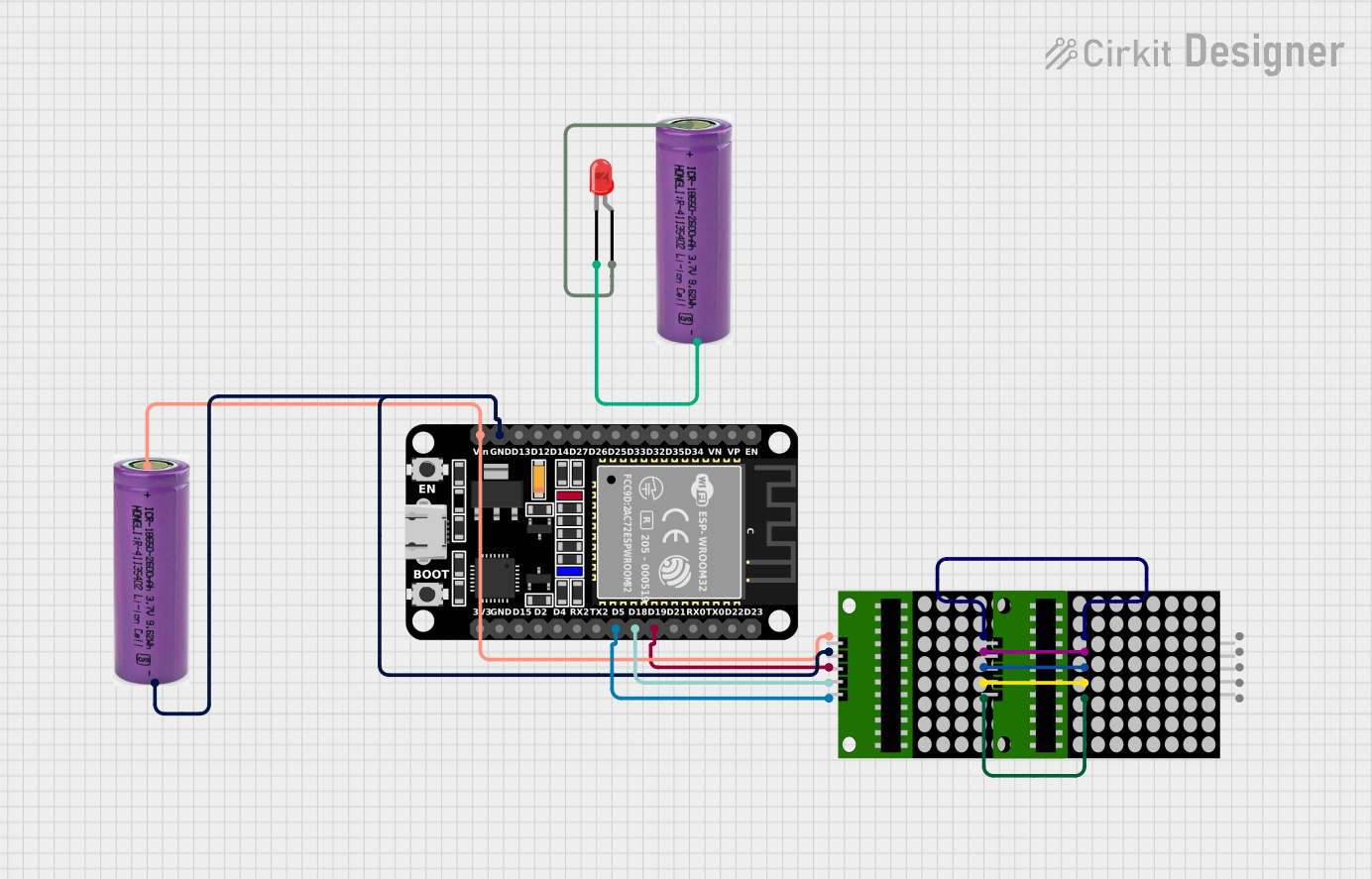
This circuit features an ESP32 microcontroller connected to two cascaded 8x8 LED matrix displays, powered by a 3.3V battery. The ESP32 drives the displays to show time and other information, with the code indicating functionality for connecting to WiFi, synchronizing time via NTP, and displaying data on the matrices using custom fonts. Additionally, there is a separate 3.3V battery powering a red LED, which appears to function as a simple indicator light.
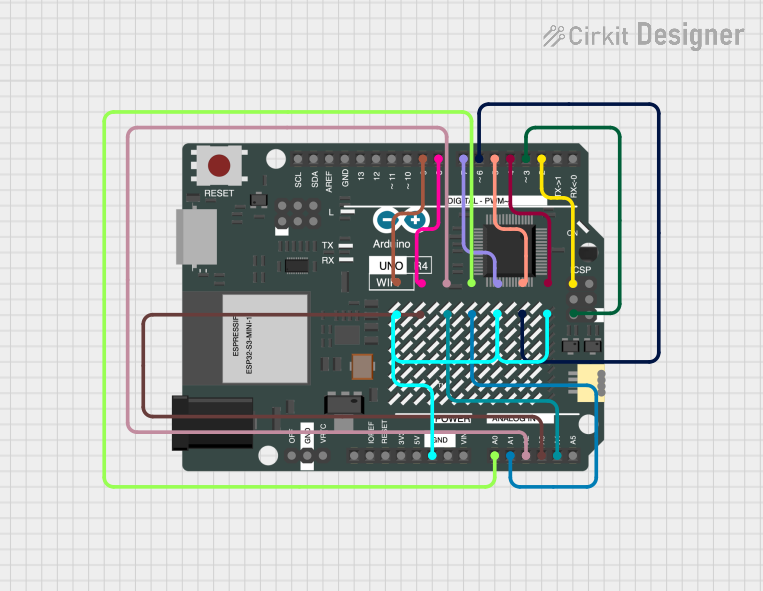
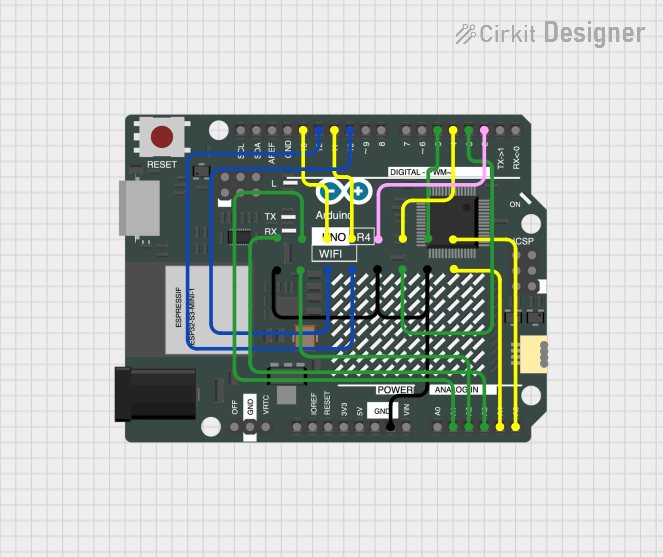
This circuit connects an Arduino UNO R4 WiFi microcontroller to a 64x32 LED matrix display. The Arduino is configured to control the LED matrix, sending color data and control signals to display various colors across the matrix. The embedded code on the Arduino cycles through a range of colors, filling the entire LED matrix with each color in sequence.
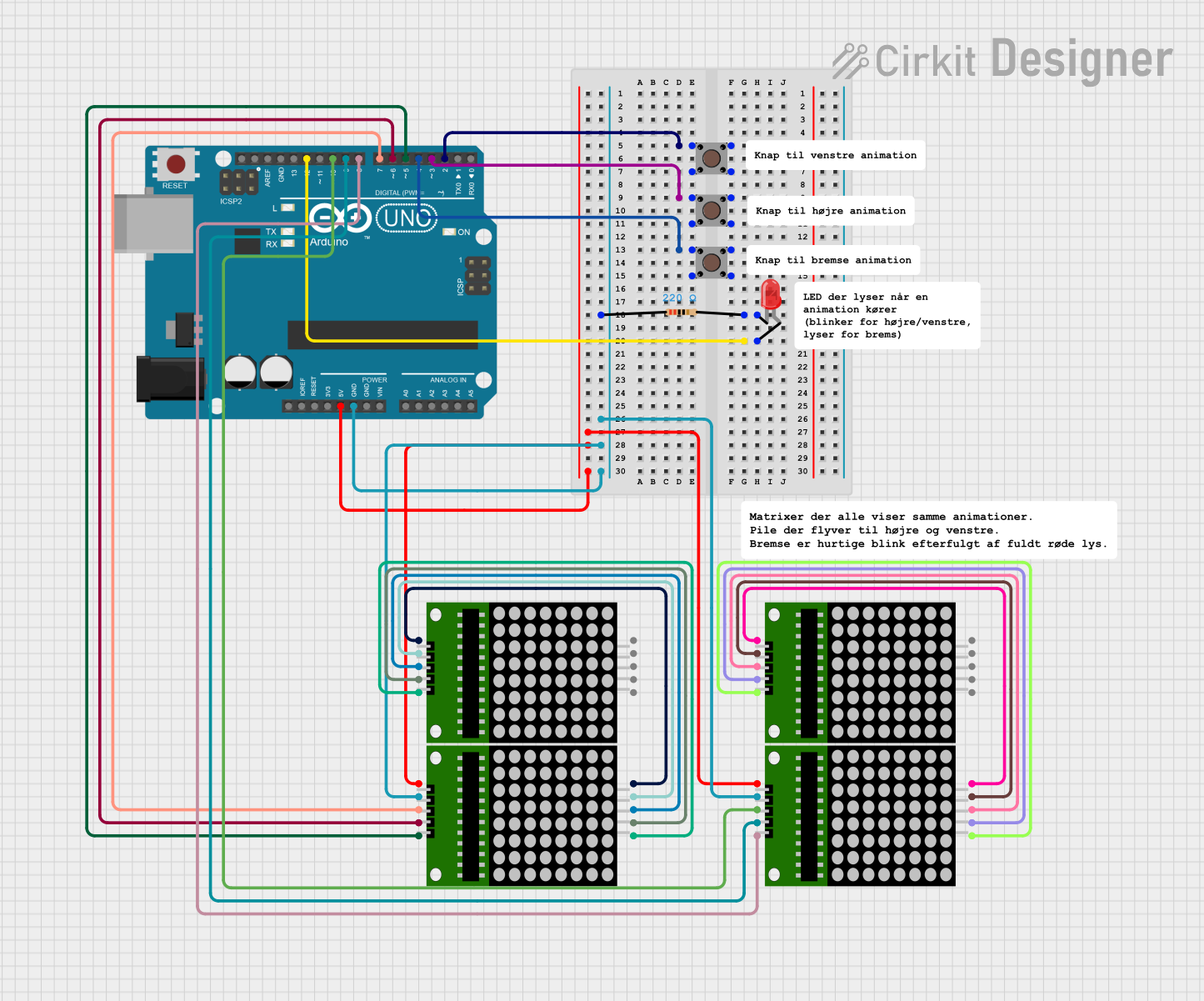
This circuit features an Arduino UNO microcontroller connected to multiple 8x8 LED matrix displays and pushbuttons. The pushbuttons are interfaced with digital pins D2, D3, and D4 on the Arduino for input, while the LED matrices are connected to digital pins D5 through D10 for control signals. Additionally, there is a single red LED with a series resistor connected to pin D12, likely used as an indicator light.
This circuit consists of an Arduino UNO R4 WiFi microcontroller connected to a 64x32 LED matrix. The Arduino controls the LED matrix by sending signals to various pins to display different colors and patterns, as defined in the embedded code.
Power Connections: Connect the VCC pin to a 5V supply and the GND pin to ground.
I2C Connections: Connect the SDA and SCL pins to your microcontroller's I2C data and clock lines.
Address Selection: The ADDR0, ADDR1, and ADDR2 pins can be connected to ground or VCC to set the I2C address of the device. This allows multiple matrices to be controlled on the same I2C bus.
Important Considerations and Best Practices
Ensure that your power supply can handle the maximum current draw when all LEDs are on.
Use pull-up resistors on the SDA and SCL lines if your microcontroller does not have built-in pull-ups.
To prevent damage, do not exceed the recommended operating voltage.
When chaining multiple LED matrices, ensure that the I2C addresses are set correctly to avoid conflicts.
Example Code for Arduino UNO
#include <Wire.h>
#include <Adafruit_GFX.h>
#include <Adafruit_LEDBackpack.h>

Adafruit_8x16matrix matrix = Adafruit_8x16matrix();

void setup() {
  matrix.begin(0x70); // Initialize the matrix with its I2C address
  matrix.setBrightness(10); // Set the brightness to a value between 0 and 15
  matrix.clear(); // Clear the matrix display
}

void loop() {
  matrix.clear(); // Clear the matrix display
  matrix.setCursor(0, 0); // Set cursor at top-left corner
  matrix.print(F("Hello")); // Print a message to the matrix
  matrix.writeDisplay(); // Update the display with the new data
  delay(500); // Wait for half a second
}
Troubleshooting and FAQs
Common Issues Users Might Face
LEDs Not Lighting Up: Ensure that the power supply is connected correctly and that the I2C lines are properly connected to the microcontroller.
Dim Display: Check the brightness setting in your code and ensure that the power supply can deliver sufficient current.
Garbled Display: Make sure that the I2C address is set correctly and that there are no conflicts on the I2C bus.
Solutions and Tips for Troubleshooting
Double-check wiring connections and solder joints for any loose connections or shorts.
Use a multimeter to verify that the correct voltage is present at the VCC pin.
If using multiple LED matrices, ensure that each matrix has a unique I2C address.
Check the microcontroller's I2C pull-up resistor configuration.
FAQs
Q: Can I use this LED matrix with a 3.3V microcontroller?
A: Yes, but ensure that the logic levels are compatible with the matrix's I2C interface.
Q: How many of these LED matrices can I chain together?
A: You can chain up to 8 matrices on the same I2C bus by setting unique addresses using the ADDR pins.
Q: Can I use this matrix with programming environments other than Arduino?
A: Yes, as long as the environment supports I2C communication and you have the necessary libraries for the HT16K33 driver IC.
This documentation provides a comprehensive guide to using the Adafruit 16x8 LED Matrix Backpack Red with an Arduino UNO or similar microcontroller. For further assistance, consult the Adafruit support forums or the product's official page.

 Open Project in Cirkit Designer