
How to Use VEML7700 - Ambient Optical Sensor: Examples, Pinouts, and Specs
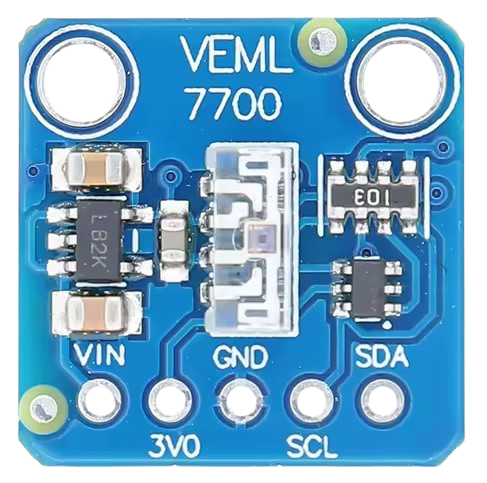
 Design with VEML7700 - Ambient Optical Sensor in Cirkit Designer
Introduction
The VEML7700 is a high-precision digital ambient light sensor manufactured by SAMIROB. It is designed to measure ambient light levels with exceptional accuracy, thanks to its integrated photodiodes, amplifiers, and analog-to-digital converter (ADC). The sensor provides a digital output that corresponds to the intensity of ambient light, making it ideal for applications requiring automatic brightness adjustment or energy-efficient lighting.
Explore Projects Built with VEML7700 - Ambient Optical Sensor
 Open Project in Cirkit Designer
 Open Project in Cirkit Designer
 Open Project in Cirkit Designer
 Open Project in Cirkit Designer
Explore Projects Built with VEML7700 - Ambient Optical Sensor
Open Project in Cirkit DesignerOpen Project in Cirkit DesignerOpen Project in Cirkit DesignerOpen Project in Cirkit DesignerCommon Applications and Use Cases
- Display Brightness Control: Automatically adjusts screen brightness based on ambient light conditions.
- Energy-Saving Lighting: Optimizes lighting systems by dimming or brightening lights as needed.
- Smart Home Devices: Enhances user experience in smart lighting and home automation systems.
- Industrial Applications: Monitors light levels in factories or warehouses for energy efficiency.
- Consumer Electronics: Used in smartphones, tablets, and laptops for adaptive brightness.
Technical Specifications
The VEML7700 is a versatile sensor with the following key specifications:
| Parameter | Value |
|---|---|
| Operating Voltage (VDD) | 2.5V to 3.6V |
| Communication Interface | I²C (up to 400 kHz) |
| Ambient Light Range | 0.003 lux to 120,000 lux |
| Resolution | 16-bit |
| Operating Temperature | -25°C to +85°C |
| Power Consumption | 2 µA (typical in shutdown mode) |
| Package Type | Surface-Mount (6-pin) |
Pin Configuration and Descriptions
The VEML7700 has a 6-pin configuration, as detailed below:
| Pin Name | Pin Number | Description |
|---|---|---|
| VDD | 1 | Power supply input (2.5V to 3.6V). |
| GND | 2 | Ground connection. |
| SDA | 3 | I²C data line for communication. |
| SCL | 4 | I²C clock line for communication. |
| INT | 5 | Interrupt output (optional, configurable). |
| NC | 6 | No connection (leave unconnected). |
Usage Instructions
How to Use the VEML7700 in a Circuit
- Power Supply: Connect the VDD pin to a 3.3V power source and the GND pin to ground.
- I²C Communication: Connect the SDA and SCL pins to the corresponding I²C pins on your microcontroller. Use pull-up resistors (typically 4.7 kΩ) on both lines.
- Interrupt Pin (Optional): If using the interrupt feature, connect the INT pin to a GPIO pin on your microcontroller. Otherwise, leave it unconnected.
- Initialization: Configure the sensor via I²C by writing to its control registers. Refer to the datasheet for register details.
Important Considerations and Best Practices
- Pull-Up Resistors: Ensure proper pull-up resistors are used on the SDA and SCL lines for reliable I²C communication.
- Ambient Light Placement: Place the sensor in a location where it can accurately measure ambient light without obstructions.
- Power Supply Decoupling: Add a 0.1 µF capacitor close to the VDD pin to reduce noise and ensure stable operation.
- I²C Address: The default I²C address of the VEML7700 is
0x10. Ensure no address conflicts if multiple devices are on the same bus.
Example Code for Arduino UNO
Below is an example of how to interface the VEML7700 with an Arduino UNO to read ambient light levels:
#include <Wire.h>

// VEML7700 I2C address
#define VEML7700_ADDR 0x10

// Register addresses
#define VEML7700_ALS_CONF 0x00  // Configuration register
#define VEML7700_ALS_DATA 0x04  // Ambient light data register

void setup() {
  Wire.begin();  // Initialize I2C communication
  Serial.begin(9600);  // Initialize serial communication for debugging

  // Configure the VEML7700
  Wire.beginTransmission(VEML7700_ADDR);
  Wire.write(VEML7700_ALS_CONF);  // Point to configuration register
  Wire.write(0x00);  // Low byte of configuration (default settings)
  Wire.write(0x00);  // High byte of configuration (default settings)
  Wire.endTransmission();

  Serial.println("VEML7700 initialized.");
}

void loop() {
  uint16_t ambientLight = readAmbientLight();
  Serial.print("Ambient Light (lux): ");
  Serial.println(ambientLight);
  delay(1000);  // Wait 1 second before next reading
}

uint16_t readAmbientLight() {
  uint16_t data = 0;

  // Request ambient light data
  Wire.beginTransmission(VEML7700_ADDR);
  Wire.write(VEML7700_ALS_DATA);  // Point to ambient light data register
  Wire.endTransmission();

  // Read 2 bytes of data
  Wire.requestFrom(VEML7700_ADDR, 2);
  if (Wire.available() == 2) {
    data = Wire.read();  // Read low byte
    data |= (Wire.read() << 8);  // Read high byte and combine
  }

  return data;
}
Troubleshooting and FAQs
Common Issues and Solutions
No Data from Sensor:
- Cause: Incorrect I²C wiring or address mismatch.
- Solution: Verify SDA and SCL connections. Ensure the I²C address matches
0x10.
Inaccurate Light Readings:
- Cause: Sensor placement or incorrect configuration.
- Solution: Ensure the sensor is unobstructed and properly configured via the I²C registers.
I²C Communication Errors:
- Cause: Missing pull-up resistors or incorrect clock speed.
- Solution: Add 4.7 kΩ pull-up resistors to SDA and SCL. Ensure the I²C clock speed is ≤ 400 kHz.
FAQs
Q1: Can the VEML7700 measure light in complete darkness?
A1: Yes, the VEML7700 has a very high sensitivity and can measure light levels as low as 0.003 lux.
Q2: What is the maximum distance for I²C communication?
A2: The I²C bus is typically reliable for distances up to 1 meter. For longer distances, consider using I²C bus extenders.
Q3: Can the sensor be used outdoors?
A3: The VEML7700 is not weatherproof. If used outdoors, it must be enclosed in a protective, transparent housing.
Q4: How do I convert raw data to lux?
A4: The raw data from the sensor can be converted to lux using a scaling factor provided in the datasheet.