
How to Use Mean Well HDR-30-5: Examples, Pinouts, and Specs
 Design with Mean Well HDR-30-5 in Cirkit Designer
Introduction
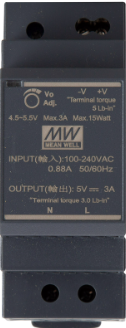
The Mean Well HDR-30-5 is a 30W, 5V, single-output DIN rail power supply designed for industrial and automation applications. Its compact design and high efficiency make it ideal for use in space-constrained environments. The HDR-30-5 is equipped with built-in protections, including short circuit, overload, and overvoltage protection, ensuring reliable operation in demanding conditions.
Explore Projects Built with Mean Well HDR-30-5
 Open Project in Cirkit Designer
 Open Project in Cirkit Designer
 Open Project in Cirkit Designer
 Open Project in Cirkit Designer
Explore Projects Built with Mean Well HDR-30-5
Open Project in Cirkit DesignerOpen Project in Cirkit DesignerOpen Project in Cirkit DesignerOpen Project in Cirkit DesignerCommon Applications and Use Cases
- Industrial control systems
- Building automation
- Factory automation equipment
- IoT devices and sensors
- LED lighting systems
- Security and surveillance systems
Technical Specifications
The following table outlines the key technical specifications of the Mean Well HDR-30-5:
| Parameter | Value |
|---|---|
| Output Voltage | 5V DC |
| Output Current | 0 ~ 4.5A |
| Output Power | 30W |
| Input Voltage Range | 85 ~ 264VAC / 120 ~ 370VDC |
| Efficiency | Up to 85% |
| Operating Temperature | -30°C to +70°C |
| Dimensions | 90 x 54 x 54 mm (H x W x D) |
| Mounting Type | DIN rail (TS-35/7.5 or TS-35/15) |
| Protections | Short circuit, overload, overvoltage |
| Certifications | UL, CE, EAC, CB, RoHS |
Pin Configuration and Descriptions
The HDR-30-5 features screw terminal connections for input and output. The pin configuration is as follows:
| Pin | Label | Description |
|---|---|---|
| 1 | L | AC Line Input |
| 2 | N | AC Neutral Input |
| 3 | -V | DC Output Negative (-) |
| 4 | +V | DC Output Positive (+) |
Usage Instructions
How to Use the HDR-30-5 in a Circuit
- Mounting: Securely mount the HDR-30-5 on a DIN rail (TS-35/7.5 or TS-35/15).
- Input Connection:
- Connect the AC line (L) and neutral (N) wires to the input terminals.
- Ensure the input voltage is within the specified range (85 ~ 264VAC).
- Output Connection:
- Connect the load to the +V and -V output terminals.
- Verify that the load does not exceed the maximum output current (4.5A).
- Power On:
- After verifying all connections, power on the AC supply.
- The HDR-30-5 will provide a stable 5V DC output to the connected load.
Important Considerations and Best Practices
- Ventilation: Ensure adequate ventilation around the power supply to prevent overheating.
- Load Requirements: Do not exceed the maximum output power of 30W to avoid triggering overload protection.
- Wiring: Use appropriately rated wires for both input and output connections.
- Grounding: Proper grounding is recommended to ensure safety and reduce electrical noise.
- Testing: Before connecting sensitive devices, test the output voltage with a multimeter to confirm proper operation.
Example: Connecting to an Arduino UNO
The HDR-30-5 can be used to power an Arduino UNO. Follow these steps:
- Connect the +V terminal of the HDR-30-5 to the Arduino's 5V pin.
- Connect the -V terminal of the HDR-30-5 to the Arduino's GND pin.
- Ensure the HDR-30-5 is powered on and providing a stable 5V output.
Here is an example Arduino sketch to blink an LED when powered by the HDR-30-5:
// Blink an LED connected to pin 13
// Ensure the Arduino is powered by the HDR-30-5 (5V DC)

void setup() {
  pinMode(13, OUTPUT); // Set pin 13 as an output
}

void loop() {
  digitalWrite(13, HIGH); // Turn the LED on
  delay(1000);            // Wait for 1 second
  digitalWrite(13, LOW);  // Turn the LED off
  delay(1000);            // Wait for 1 second
}
Troubleshooting and FAQs
Common Issues and Solutions
No Output Voltage:
- Cause: Input voltage is not within the specified range.
- Solution: Verify the AC input voltage and ensure proper wiring.
Overload Protection Triggered:
- Cause: Load exceeds the maximum output power (30W).
- Solution: Reduce the load to within the specified limits.
Overheating:
- Cause: Insufficient ventilation or operation in high-temperature environments.
- Solution: Improve airflow around the power supply or operate within the recommended temperature range.
Intermittent Output:
- Cause: Loose connections or fluctuating input voltage.
- Solution: Check all connections and ensure a stable input voltage.
FAQs
Q1: Can the HDR-30-5 be used outdoors?
A1: No, the HDR-30-5 is not weatherproof and should only be used in indoor environments or within a protective enclosure.
Q2: What happens if the load exceeds 4.5A?
A2: The HDR-30-5 will activate overload protection, shutting down the output to protect the device and connected equipment.
Q3: Can I use the HDR-30-5 with DC input?
A3: Yes, the HDR-30-5 supports a DC input range of 120 ~ 370VDC.
Q4: Is the HDR-30-5 suitable for sensitive electronics?
A4: Yes, the HDR-30-5 provides a stable 5V DC output, making it suitable for powering sensitive electronics like microcontrollers and sensors.