Cirkit Designer Logo
Cirkit Designer
Your all-in-one circuit design IDE
Home / 
Component Documentation

How to Use SDBK03TA: Examples, Pinouts, and Specs
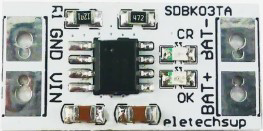

Image of SDBK03TA
Cirkit Designer LogoDesign with SDBK03TA in Cirkit Designer

Introduction

The SDBK03TA is a Schottky barrier rectifier diode designed for high-speed switching applications. It is characterized by its low forward voltage drop and fast recovery time, which contribute to improved efficiency in power management and rectification tasks. This diode is commonly used in applications such as power supplies, DC-DC converters, freewheeling diodes, and polarity protection circuits. Its compact design and reliable performance make it a popular choice for both consumer and industrial electronics.

Explore Projects Built with SDBK03TA
Use Cirkit Designer to design, explore, and prototype these projects online. Some projects support real-time simulation. Click "Open Project" to start designing instantly!
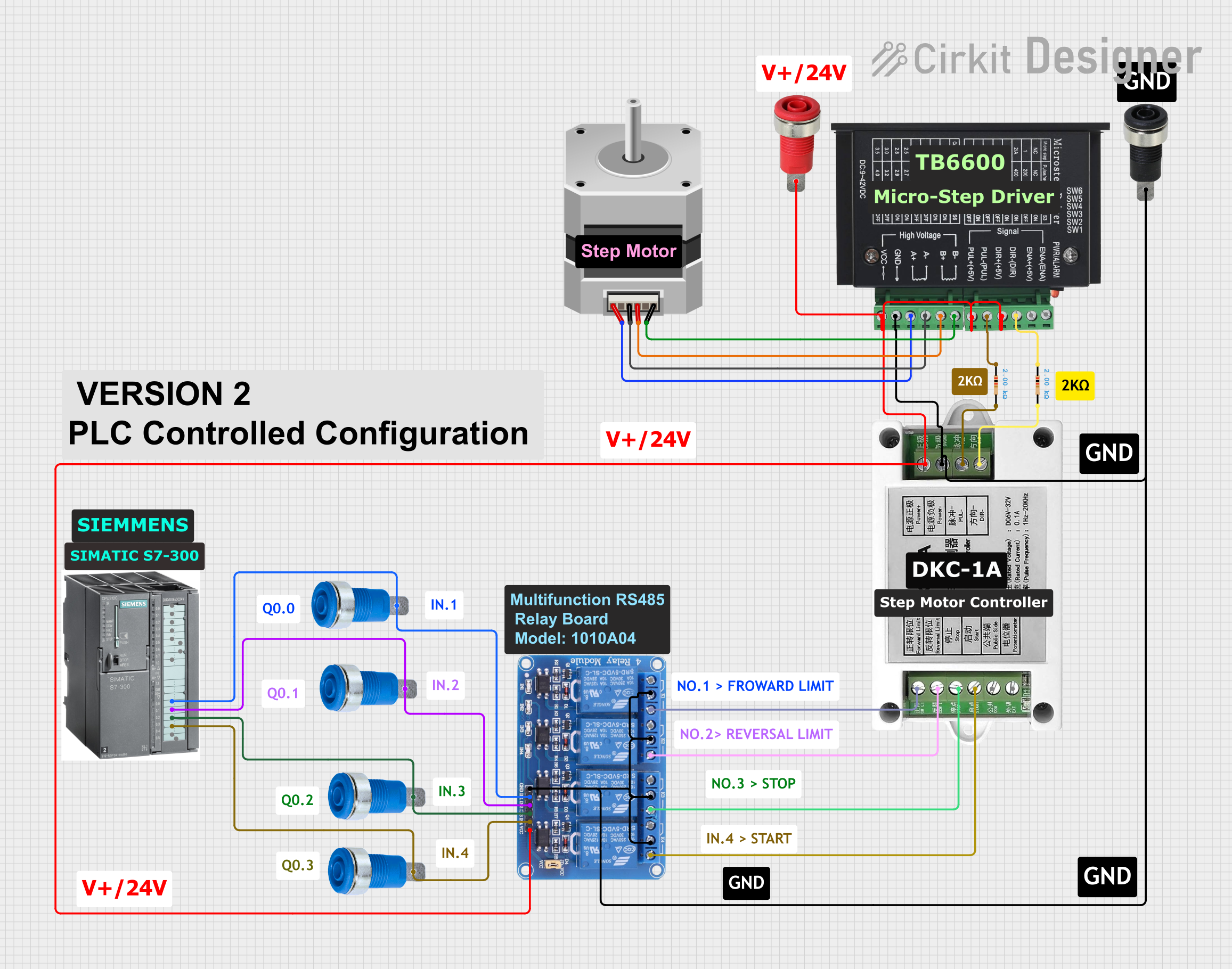
Stepper Motor Control System with SIMATIC S7-300 and TB6600 Driver
Image of Copy of PLC-Based Step Motor Speed and Direction Control System: A project utilizing SDBK03TA in a practical application
This circuit controls a stepper motor using a tb6600 micro stepping motor driver and a DKC-1A stepper motor controller. The system is powered through panel mount banana sockets and includes a relay module for additional control, interfaced with a SIMATIC S7-300 PLC for automation.
Cirkit Designer LogoOpen Project in Cirkit Designer
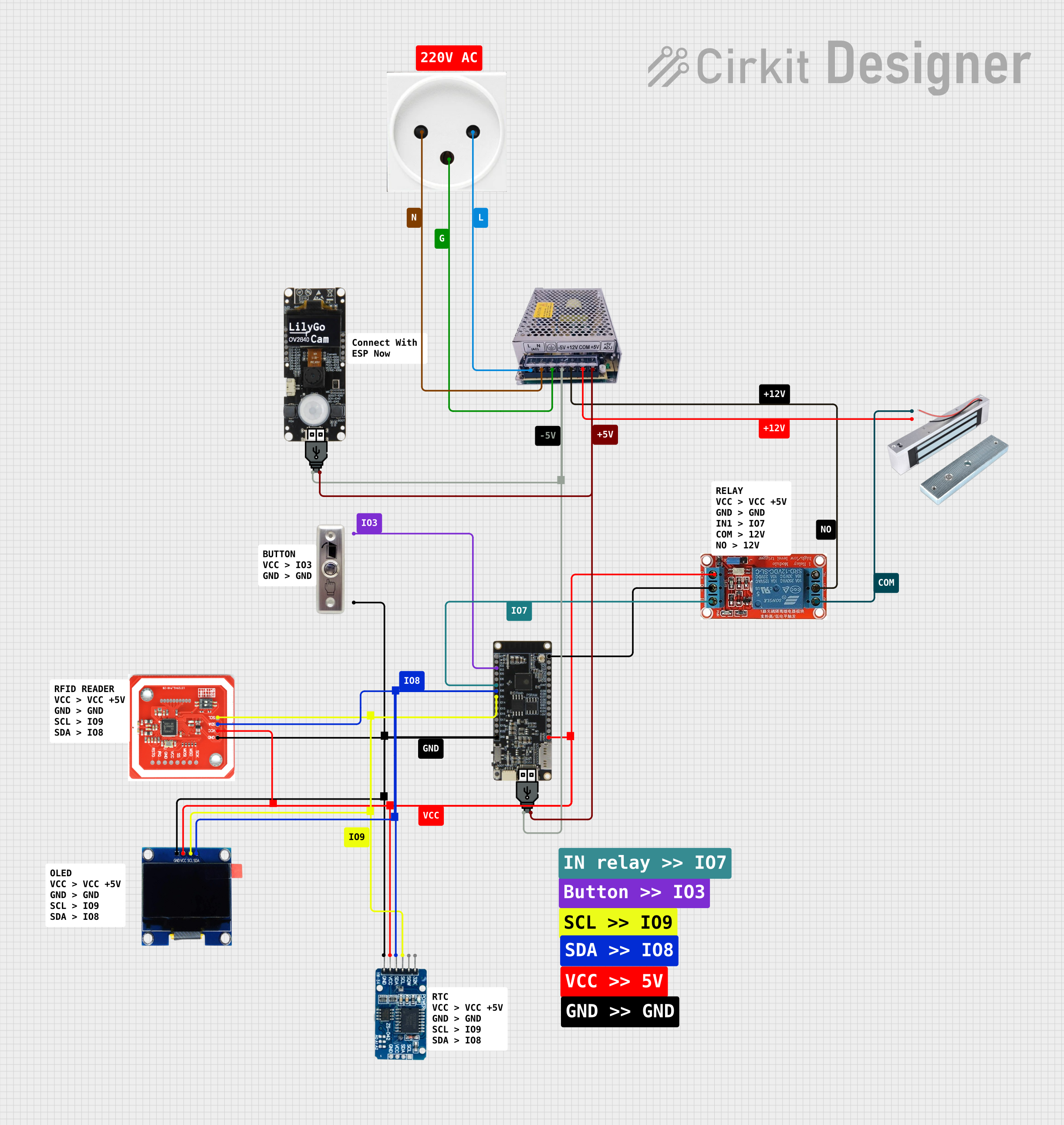
NFC-Enabled Access Control System with Time Logging
Image of doorlock: A project utilizing SDBK03TA in a practical application
This circuit is designed for access control with time tracking capabilities. It features an NFC/RFID reader for authentication, an RTC module (DS3231) for real-time clock functionality, and an OLED display for user interaction. A 12V relay controls a magnetic lock, which is activated upon successful NFC/RFID authentication, and a button switch is likely used for manual operation or input. The T8_S3 microcontroller serves as the central processing unit, interfacing with the NFC/RFID reader, RTC, OLED, and relay to manage the access control logic.
Cirkit Designer LogoOpen Project in Cirkit Designer
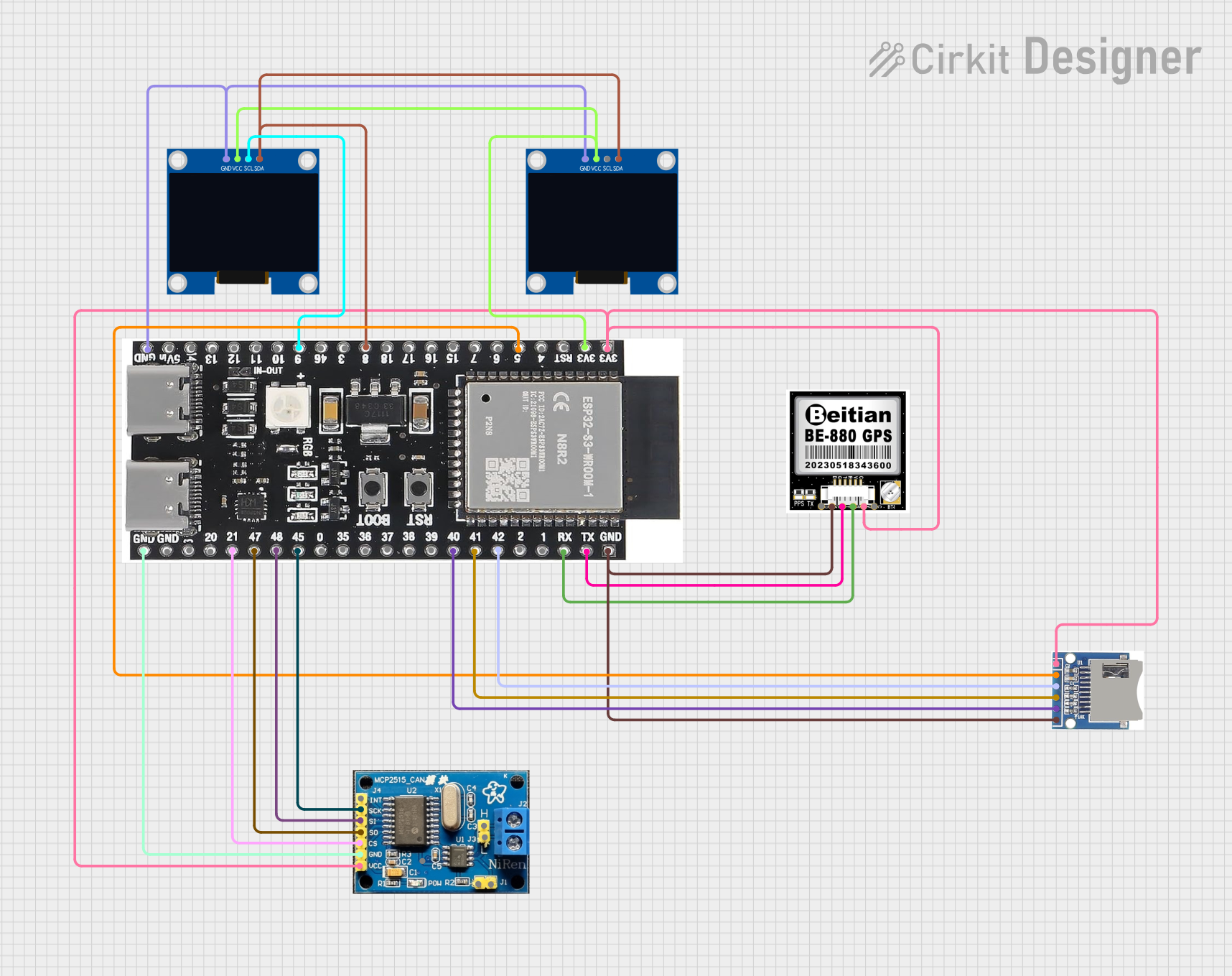
ESP32-S3 GPS and Wind Speed Logger with Dual OLED Displays and CAN Bus
Image of esp32-s3-ellipse: A project utilizing SDBK03TA in a practical application
This circuit features an ESP32-S3 microcontroller interfaced with an SD card module, two OLED displays, a GPS module, and a CAN bus module. The ESP32-S3 records GPS data to the SD card, displays speed on one OLED, and shows wind speed from the CAN bus on the other OLED, providing a comprehensive data logging and display system.
Cirkit Designer LogoOpen Project in Cirkit Designer
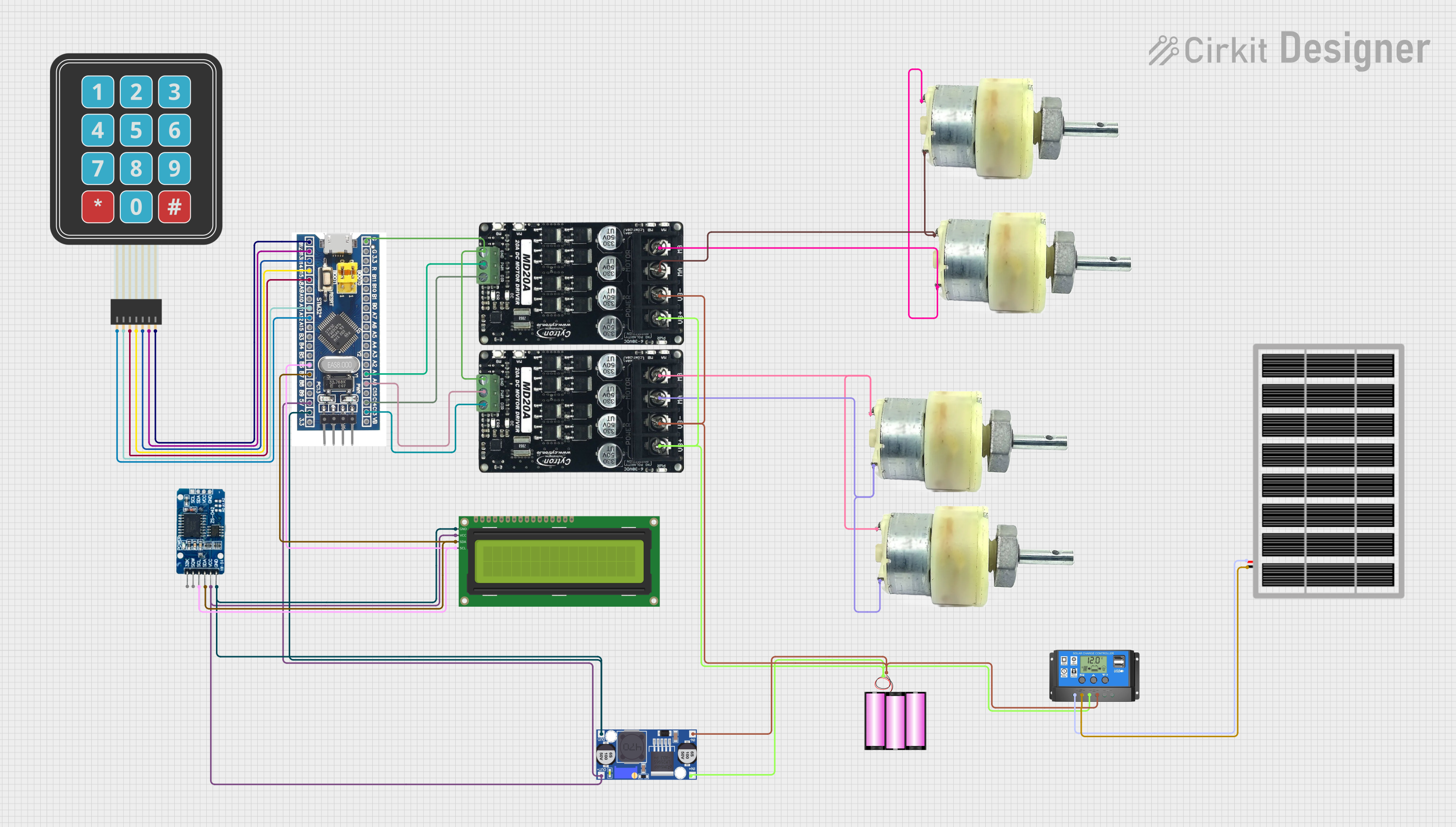
Solar-Powered STM32-Based Automation System with Matrix Keypad and RTC
Image of soloar cleaner : A project utilizing SDBK03TA in a practical application
This circuit features an STM32F103C8T6 microcontroller interfaced with a membrane matrix keypad for input, an RTC DS3231 for real-time clock functionality, and a 16x2 I2C LCD for display. It controls four 12V geared motors through two MD20 CYTRON motor drivers, with the motor power supplied by a 12V battery regulated by a buck converter. The battery is charged via a solar panel connected through a solar charge controller, ensuring a renewable energy source for the system.
Cirkit Designer LogoOpen Project in Cirkit Designer

Explore Projects Built with SDBK03TA

Use Cirkit Designer to design, explore, and prototype these projects online. Some projects support real-time simulation. Click "Open Project" to start designing instantly!
Image of Copy of PLC-Based Step Motor Speed and Direction Control System: A project utilizing SDBK03TA in a practical application
Stepper Motor Control System with SIMATIC S7-300 and TB6600 Driver
This circuit controls a stepper motor using a tb6600 micro stepping motor driver and a DKC-1A stepper motor controller. The system is powered through panel mount banana sockets and includes a relay module for additional control, interfaced with a SIMATIC S7-300 PLC for automation.
Cirkit Designer LogoOpen Project in Cirkit Designer
Image of doorlock: A project utilizing SDBK03TA in a practical application
NFC-Enabled Access Control System with Time Logging
This circuit is designed for access control with time tracking capabilities. It features an NFC/RFID reader for authentication, an RTC module (DS3231) for real-time clock functionality, and an OLED display for user interaction. A 12V relay controls a magnetic lock, which is activated upon successful NFC/RFID authentication, and a button switch is likely used for manual operation or input. The T8_S3 microcontroller serves as the central processing unit, interfacing with the NFC/RFID reader, RTC, OLED, and relay to manage the access control logic.
Cirkit Designer LogoOpen Project in Cirkit Designer
Image of esp32-s3-ellipse: A project utilizing SDBK03TA in a practical application
ESP32-S3 GPS and Wind Speed Logger with Dual OLED Displays and CAN Bus
This circuit features an ESP32-S3 microcontroller interfaced with an SD card module, two OLED displays, a GPS module, and a CAN bus module. The ESP32-S3 records GPS data to the SD card, displays speed on one OLED, and shows wind speed from the CAN bus on the other OLED, providing a comprehensive data logging and display system.
Cirkit Designer LogoOpen Project in Cirkit Designer
Image of soloar cleaner : A project utilizing SDBK03TA in a practical application
Solar-Powered STM32-Based Automation System with Matrix Keypad and RTC
This circuit features an STM32F103C8T6 microcontroller interfaced with a membrane matrix keypad for input, an RTC DS3231 for real-time clock functionality, and a 16x2 I2C LCD for display. It controls four 12V geared motors through two MD20 CYTRON motor drivers, with the motor power supplied by a 12V battery regulated by a buck converter. The battery is charged via a solar panel connected through a solar charge controller, ensuring a renewable energy source for the system.
Cirkit Designer LogoOpen Project in Cirkit Designer

Technical Specifications

Below are the key technical details of the SDBK03TA:

Parameter Value
Maximum Repetitive Voltage 30V
Average Forward Current 3A
Peak Forward Surge Current 50A (8.3ms single half-sine)
Forward Voltage Drop (VF) 0.45V (at 3A, 25°C)
Reverse Current (IR) 0.5mA (at 25°C, VR = 30V)
Operating Temperature Range -55°C to +125°C
Package Type DO-214AC (SMA)

Pin Configuration and Descriptions

The SDBK03TA is a two-terminal device with the following pin configuration:

Pin Name Description
1 Anode Positive terminal of the diode
2 Cathode Negative terminal of the diode

The cathode is typically marked with a stripe on the diode's body for easy identification.

Usage Instructions

How to Use the SDBK03TA in a Circuit

  1. Polarity Matters: Ensure the anode is connected to the positive side of the circuit and the cathode to the negative side. Reversing the polarity may result in improper operation or damage to the diode.
  2. Current and Voltage Ratings: Verify that the circuit's voltage and current requirements do not exceed the diode's maximum ratings (30V and 3A, respectively).
  3. Heat Dissipation: For applications with high current, consider using a heatsink or proper PCB design to manage heat dissipation.
  4. Protection: If used in a power supply, consider adding a fuse or other protection components to safeguard the diode and circuit.

Example Circuit

The SDBK03TA can be used as a rectifier in a simple DC power supply circuit. Below is an example of how it can be connected to an Arduino UNO for polarity protection:

/*
  Example: Using SDBK03TA for polarity protection with Arduino UNO
  - The SDBK03TA is placed in series with the Arduino's power input.
  - This ensures the Arduino is protected from reverse polarity connections.
*/

void setup() {
  // No specific code is required for the diode itself.
  // This example assumes the diode is connected in the power path.
  pinMode(LED_BUILTIN, OUTPUT); // Set built-in LED as output
}

void loop() {
  digitalWrite(LED_BUILTIN, HIGH); // Turn on the LED
  delay(1000);                     // Wait for 1 second
  digitalWrite(LED_BUILTIN, LOW);  // Turn off the LED
  delay(1000);                     // Wait for 1 second
}

Important Considerations

  • Reverse Voltage: Do not exceed the maximum reverse voltage of 30V to avoid breakdown.
  • Surge Current: The diode can handle a peak surge current of 50A for short durations (e.g., during power-on), but prolonged exposure may damage the component.
  • PCB Layout: Minimize the trace length between the diode and other components to reduce resistance and inductance.

Troubleshooting and FAQs

Common Issues and Solutions

  1. Diode Overheating:

    • Cause: Excessive current or insufficient heat dissipation.
    • Solution: Ensure the current does not exceed 3A and improve heat dissipation using a heatsink or proper PCB design.
  2. No Output Voltage:

    • Cause: Incorrect polarity or damaged diode.
    • Solution: Verify the anode and cathode connections. Replace the diode if damaged.
  3. High Reverse Leakage Current:

    • Cause: Operating the diode at high temperatures or exceeding reverse voltage ratings.
    • Solution: Ensure the diode operates within its specified temperature and voltage limits.

FAQs

  • Q: Can the SDBK03TA be used in high-frequency circuits?
    A: Yes, the SDBK03TA's fast recovery time makes it suitable for high-frequency applications.

  • Q: How do I identify the cathode on the diode?
    A: The cathode is marked with a stripe on the diode's body.

  • Q: What happens if I exceed the diode's maximum ratings?
    A: Exceeding the voltage or current ratings can lead to permanent damage or failure of the diode.

By following the guidelines and recommendations in this documentation, you can effectively integrate the SDBK03TA into your electronic designs.