
How to Use LoRa module: Examples, Pinouts, and Specs
 Design with LoRa module in Cirkit Designer
Introduction
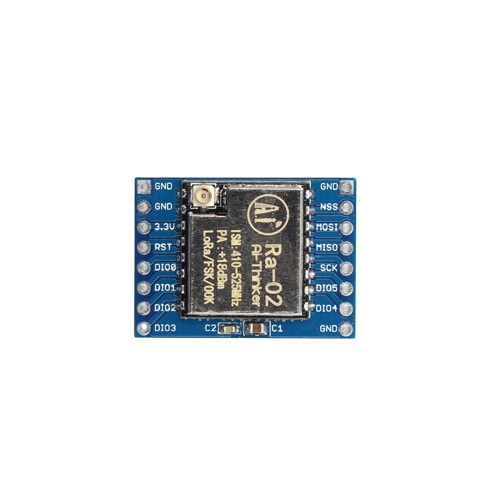
The Ebyte SX1278 - Ra-02 is a LoRa (Long Range) module designed for low-power wireless communication. It operates on the LoRa modulation technology, which enables long-range data transmission with minimal power consumption. This module is ideal for Internet of Things (IoT) applications, where devices and sensors need to communicate over large distances without relying on high-power networks.
Explore Projects Built with LoRa module
 Open Project in Cirkit Designer
 Open Project in Cirkit Designer
 Open Project in Cirkit Designer
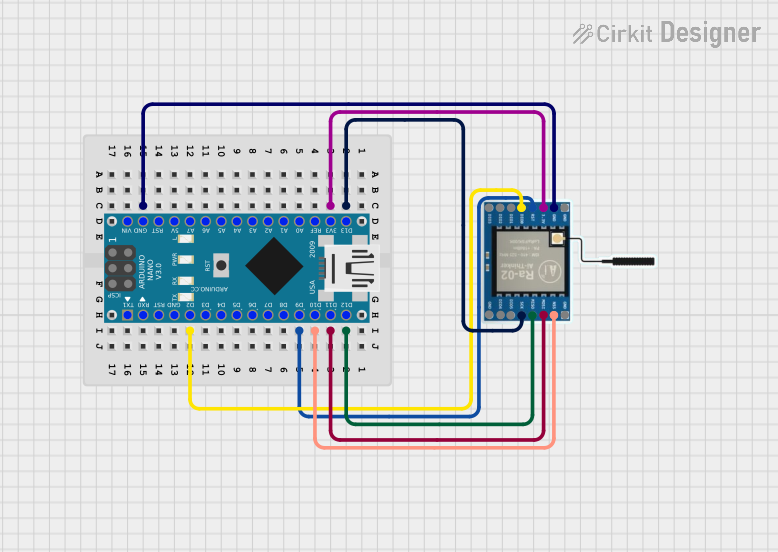 Open Project in Cirkit Designer
Explore Projects Built with LoRa module
Open Project in Cirkit DesignerOpen Project in Cirkit DesignerOpen Project in Cirkit DesignerOpen Project in Cirkit DesignerCommon Applications and Use Cases
- Smart agriculture (e.g., soil moisture sensors, weather stations)
- Industrial automation and monitoring
- Smart cities (e.g., parking sensors, streetlight control)
- Asset tracking and fleet management
- Environmental monitoring (e.g., air quality sensors)
- Home automation and security systems
Technical Specifications
The following table outlines the key technical details of the Ebyte SX1278 - Ra-02 module:
| Parameter | Value |
|---|---|
| Frequency Range | 137 MHz to 525 MHz |
| Modulation Technique | LoRa/FSK/GFSK |
| Output Power | Up to +20 dBm |
| Sensitivity | -139 dBm |
| Data Rate | 0.018 kbps to 37.5 kbps |
| Operating Voltage | 1.8V to 3.7V |
| Current Consumption | 10.8 mA (transmit), 10.3 mA (receive) |
| Communication Interface | SPI |
| Operating Temperature | -40°C to +85°C |
| Dimensions | 16 mm x 16 mm x 2 mm |
Pin Configuration and Descriptions
The Ebyte SX1278 - Ra-02 module has 16 pins. The table below describes each pin:
| Pin Number | Pin Name | Description |
|---|---|---|
| 1 | GND | Ground connection |
| 2 | DIO0 | Digital I/O pin 0 (interrupt output) |
| 3 | DIO1 | Digital I/O pin 1 |
| 4 | DIO2 | Digital I/O pin 2 |
| 5 | DIO3 | Digital I/O pin 3 |
| 6 | DIO4 | Digital I/O pin 4 |
| 7 | DIO5 | Digital I/O pin 5 |
| 8 | GND | Ground connection |
| 9 | MISO | SPI Master In Slave Out |
| 10 | MOSI | SPI Master Out Slave In |
| 11 | SCK | SPI Clock |
| 12 | NSS | SPI Chip Select |
| 13 | RESET | Reset pin (active low) |
| 14 | 3.3V | Power supply (3.3V) |
| 15 | ANT | Antenna connection |
| 16 | GND | Ground connection |
Usage Instructions
How to Use the Component in a Circuit
- Power Supply: Connect the
3.3Vpin to a regulated 3.3V power source and theGNDpins to ground. - SPI Communication: Connect the
MISO,MOSI,SCK, andNSSpins to the corresponding SPI pins on your microcontroller. - Antenna: Attach a suitable 433 MHz antenna to the
ANTpin for optimal signal transmission and reception. - Reset: Use the
RESETpin to initialize the module. Pull it low momentarily to reset the module. - Digital I/O Pins: Use the
DIOpins for interrupts or additional control signals as required by your application.
Important Considerations and Best Practices
- Power Supply: Ensure a stable 3.3V power supply to avoid communication issues.
- Antenna Placement: Place the antenna away from metal objects and other sources of interference for better performance.
- SPI Configuration: Configure the SPI interface on your microcontroller to match the module's requirements (e.g., clock polarity and phase).
- Regulatory Compliance: Ensure compliance with local frequency regulations when using the module.
Example Code for Arduino UNO
Below is an example of how to use the SX1278 - Ra-02 module with an Arduino UNO. This code uses the popular LoRa library.
#include <SPI.h>
#include <LoRa.h>

// Define LoRa module pins
#define NSS 10    // SPI Chip Select
#define RESET 9   // Reset pin
#define DIO0 2    // DIO0 pin for interrupt

void setup() {
  Serial.begin(9600); // Initialize serial communication
  while (!Serial);

  Serial.println("Initializing LoRa module...");

  // Initialize LoRa module
  LoRa.setPins(NSS, RESET, DIO0); // Set module pins
  if (!LoRa.begin(433E6)) {       // Initialize at 433 MHz
    Serial.println("LoRa initialization failed!");
    while (1);
  }

  Serial.println("LoRa module initialized successfully.");
}

void loop() {
  Serial.println("Sending packet...");
  LoRa.beginPacket();            // Start a new packet
  LoRa.print("Hello, LoRa!");    // Add data to the packet
  LoRa.endPacket();              // Send the packet

  delay(5000);                   // Wait 5 seconds before sending again
}
Notes:
- Install the
LoRalibrary in the Arduino IDE before uploading the code. - Modify the frequency (
433E6) if using a different frequency band.
Troubleshooting and FAQs
Common Issues and Solutions
Module Not Responding
- Cause: Incorrect wiring or power supply issues.
- Solution: Double-check all connections and ensure a stable 3.3V power supply.
Poor Signal Range
- Cause: Improper antenna placement or interference.
- Solution: Use a high-quality antenna and place it away from obstructions or interference sources.
SPI Communication Fails
- Cause: Incorrect SPI configuration or wiring.
- Solution: Verify SPI settings (e.g., clock polarity, phase) and ensure proper connections.
LoRa Initialization Fails
- Cause: Incorrect frequency or module pins not set correctly.
- Solution: Ensure the correct frequency is set in the code and verify pin assignments.
FAQs
Can I use the SX1278 - Ra-02 module with 5V microcontrollers?
- Yes, but you must use a level shifter to convert the 5V logic levels to 3.3V.
What is the maximum range of the module?
- The range depends on environmental conditions but can reach up to 10 km in open areas.
Can I use multiple modules in the same network?
- Yes, you can configure multiple modules to communicate by setting unique addresses or channels.
Is the module compatible with other LoRa devices?
- Yes, as long as they operate on the same frequency and use the same LoRa protocol settings.