
How to Use Battery 3.7V 2000mAh: Examples, Pinouts, and Specs
 Design with Battery 3.7V 2000mAh in Cirkit Designer
Introduction
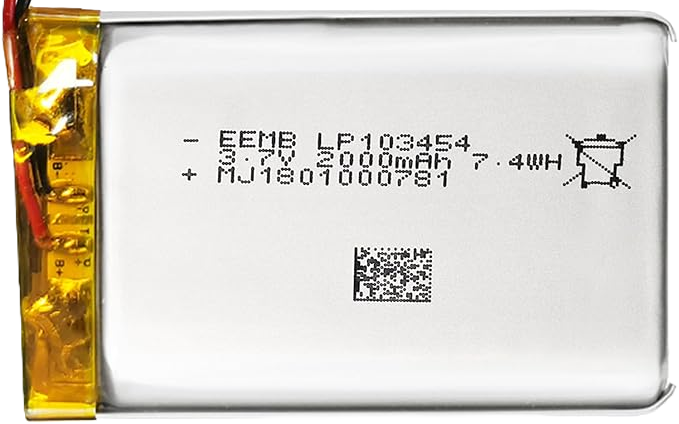
The EEMB LP103454 is a rechargeable lithium-ion battery with a nominal voltage of 3.7V and a capacity of 2000mAh. This compact and lightweight battery is ideal for powering a wide range of portable electronic devices, including IoT devices, wearables, handheld gadgets, and small robotics. Its high energy density and rechargeable nature make it a reliable and eco-friendly power source.
Explore Projects Built with Battery 3.7V 2000mAh
 Open Project in Cirkit Designer
 Open Project in Cirkit Designer
 Open Project in Cirkit Designer
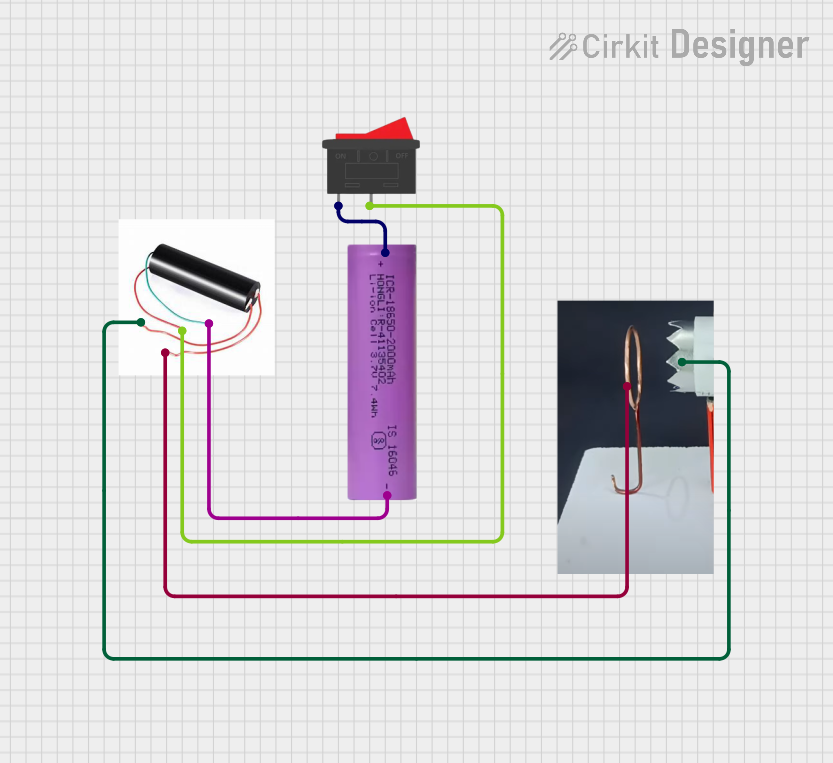 Open Project in Cirkit Designer
Explore Projects Built with Battery 3.7V 2000mAh
Open Project in Cirkit DesignerOpen Project in Cirkit DesignerOpen Project in Cirkit DesignerOpen Project in Cirkit DesignerCommon Applications
- Portable electronic devices (e.g., MP3 players, handheld consoles)
- IoT devices and sensors
- Wearable technology
- Small robotics and drones
- Backup power for embedded systems
Technical Specifications
Key Specifications
| Parameter | Value |
|---|---|
| Manufacturer | EEMB |
| Part Number | LP103454 |
| Battery Type | Lithium-Ion (Li-ion) |
| Nominal Voltage | 3.7V |
| Capacity | 2000mAh |
| Charging Voltage | 4.2V (maximum) |
| Discharge Cut-off Voltage | 2.75V |
| Maximum Discharge Current | 2C (4A) |
| Standard Charge Current | 0.5C (1A) |
| Dimensions (L x W x H) | 10mm x 34mm x 54mm |
| Weight | ~35g |
| Operating Temperature | -20°C to 60°C (discharge) |
| Storage Temperature | -20°C to 45°C |
Pin Configuration
The battery typically has two terminals: Positive (+) and Negative (-). These terminals are connected via wires or tabs for integration into circuits.
| Pin Name | Description | Wire Color (Typical) |
|---|---|---|
| Positive (+) | Battery positive terminal | Red |
| Negative (-) | Battery negative terminal | Black |
Usage Instructions
How to Use the Battery in a Circuit
- Connection: Connect the positive terminal of the battery to the positive rail of your circuit and the negative terminal to the ground. Ensure proper polarity to avoid damage.
- Charging: Use a compatible lithium-ion battery charger with a constant current/constant voltage (CC/CV) charging profile. The charging voltage should not exceed 4.2V, and the charging current should not exceed 1A for standard charging.
- Discharging: Ensure the load does not draw more than the maximum discharge current of 4A. Use a protection circuit module (PCM) to prevent over-discharge, over-current, or short circuits.
- Protection: Always use a battery management system (BMS) or PCM to safeguard the battery from overcharging, over-discharging, and overheating.
Important Considerations
- Polarity: Double-check the polarity before connecting the battery to a circuit.
- Charging Safety: Never charge the battery without a proper lithium-ion charger. Overcharging can lead to overheating or damage.
- Storage: Store the battery in a cool, dry place. Avoid exposure to direct sunlight or high humidity.
- Handling: Do not puncture, crush, or expose the battery to fire or water.
Example: Connecting to an Arduino UNO
The battery can be used to power an Arduino UNO via its Vin pin. Below is an example of how to connect the battery with a step-up converter to provide the required 5V for the Arduino.
Circuit Diagram
- Connect the battery's positive terminal to the input of a step-up converter.
- Connect the step-up converter's output to the Arduino's Vin pin.
- Connect the battery's negative terminal to the Arduino's GND pin.
Sample Code
// Example code to blink an LED on Arduino UNO powered by a 3.7V battery
// Ensure the battery is connected via a step-up converter to provide 5V.

const int ledPin = 13; // Pin connected to the onboard LED

void setup() {
  pinMode(ledPin, OUTPUT); // Set the LED pin as an output
}

void loop() {
  digitalWrite(ledPin, HIGH); // Turn the LED on
  delay(1000);                // Wait for 1 second
  digitalWrite(ledPin, LOW);  // Turn the LED off
  delay(1000);                // Wait for 1 second
}
Troubleshooting and FAQs
Common Issues and Solutions
| Issue | Possible Cause | Solution |
|---|---|---|
| Battery does not charge | Faulty charger or incorrect voltage | Verify the charger and ensure it outputs 4.2V. |
| Battery drains quickly | Excessive load or aging battery | Reduce the load or replace the battery. |
| Battery overheats during charging | Overcharging or faulty charger | Use a proper lithium-ion charger with CC/CV profile. |
| Circuit does not power on | Incorrect polarity or loose connections | Check connections and ensure correct polarity. |
FAQs
Can I use this battery without a protection circuit?
It is not recommended. A protection circuit module (PCM) ensures safe operation by preventing overcharging, over-discharging, and short circuits.How long does it take to fully charge the battery?
With a standard charge current of 1A, it takes approximately 2-3 hours to fully charge the battery.Can I connect multiple batteries in series or parallel?
Yes, but ensure you use a proper battery management system (BMS) to balance the cells and prevent overcharging or over-discharging.What is the lifespan of this battery?
The battery typically lasts for 300-500 charge cycles, depending on usage and charging conditions.
By following the guidelines in this documentation, you can safely and effectively use the EEMB LP103454 3.7V 2000mAh battery in your projects.