
How to Use Differential pressure sensor: Examples, Pinouts, and Specs
 Design with Differential pressure sensor in Cirkit Designer
Introduction
The Sensirion SDP810-125Pa is a high-precision differential pressure sensor designed to measure the pressure difference between two points. It is based on Sensirion's CMOSens® technology, which ensures high accuracy, reliability, and long-term stability. This sensor is ideal for applications requiring precise pressure monitoring, such as HVAC systems, medical devices, industrial process control, and fluid dynamics.
The SDP810-125Pa is factory-calibrated and temperature-compensated, making it easy to integrate into various systems. Its digital I²C interface simplifies communication with microcontrollers and other devices.
Explore Projects Built with Differential pressure sensor
 Open Project in Cirkit Designer
 Open Project in Cirkit Designer
 Open Project in Cirkit Designer
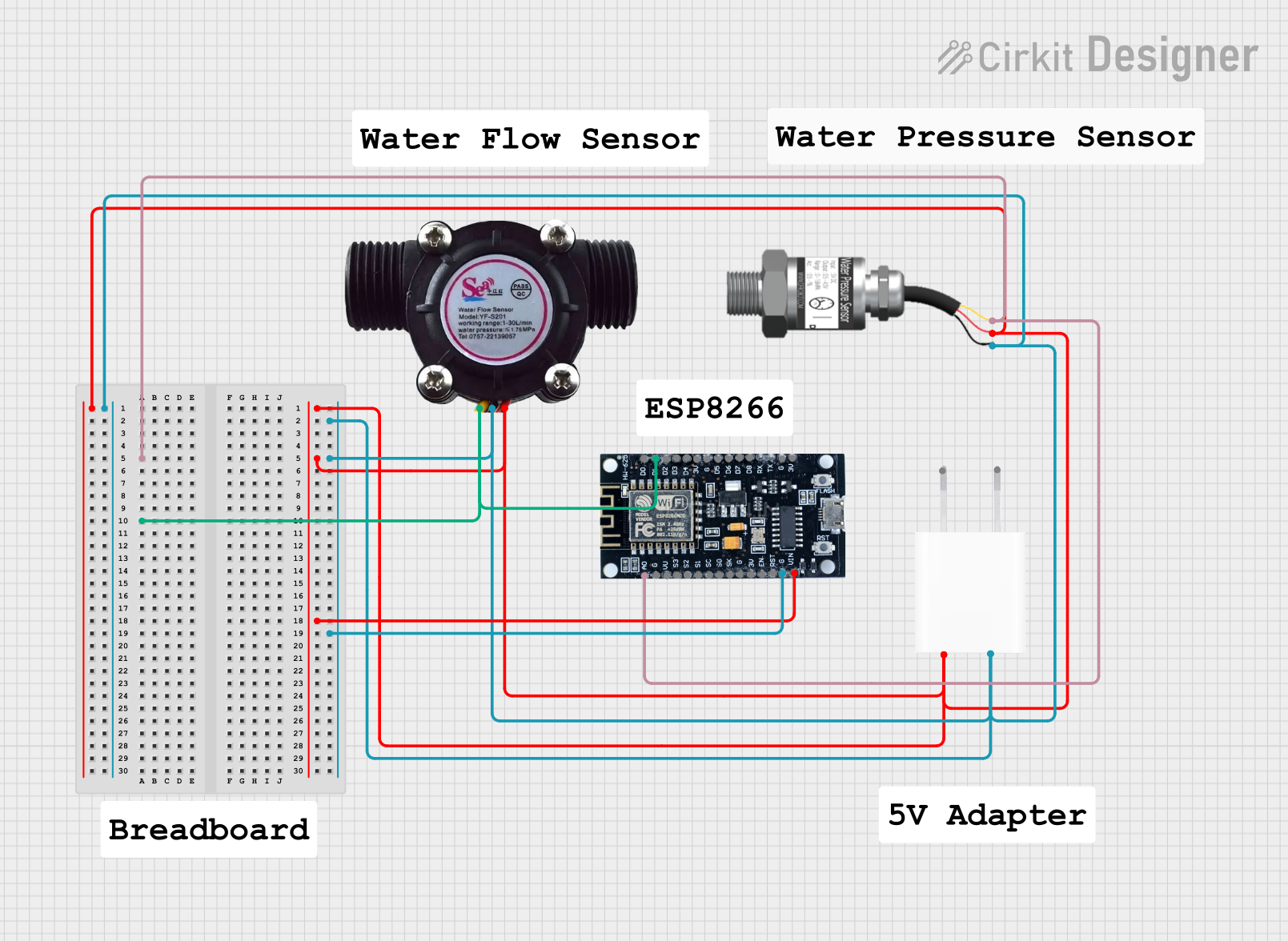 Open Project in Cirkit Designer
Explore Projects Built with Differential pressure sensor
Open Project in Cirkit DesignerOpen Project in Cirkit DesignerOpen Project in Cirkit DesignerOpen Project in Cirkit DesignerTechnical Specifications
Below are the key technical details of the SDP810-125Pa:
General Specifications
| Parameter | Value |
|---|---|
| Measurement Range | ±125 Pa |
| Accuracy | ±3% of reading (typical) |
| Supply Voltage | 3.3 V to 5.5 V |
| Current Consumption | 2.7 mA (typical) |
| Interface | I²C |
| Operating Temperature | -20°C to +85°C |
| Response Time | < 8 ms |
| Dimensions | 24 mm x 14 mm x 10 mm |
Pin Configuration and Descriptions
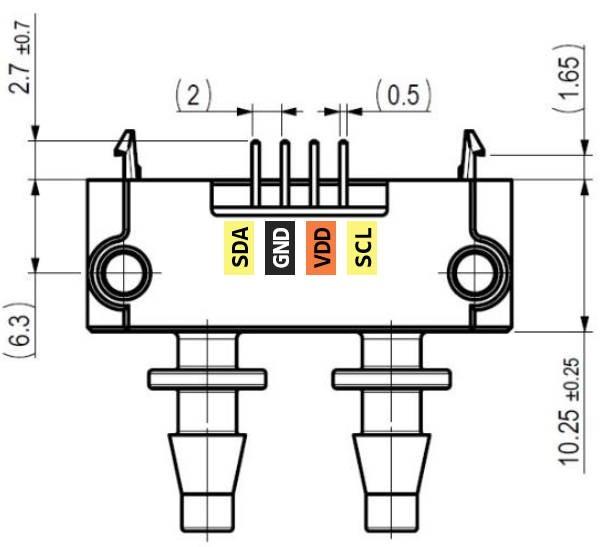
The SDP810-125Pa has a 4-pin connector. The pinout is as follows:
| Pin Number | Name | Description |
|---|---|---|
| 1 | VDD | Power supply (3.3 V to 5.5 V) |
| 2 | GND | Ground |
| 3 | SDA | I²C data line |
| 4 | SCL | I²C clock line |
Usage Instructions
How to Use the SDP810-125Pa in a Circuit
- Power Supply: Connect the VDD pin to a 3.3 V or 5 V power source and the GND pin to the ground.
- I²C Communication: Connect the SDA and SCL pins to the corresponding I²C pins on your microcontroller. Use pull-up resistors (typically 4.7 kΩ) on both SDA and SCL lines if not already present on your board.
- Pressure Ports: Attach tubing to the sensor's two pressure ports. Ensure the tubing is securely connected and free of leaks. The sensor measures the pressure difference between the two ports.
Important Considerations and Best Practices
- Avoid Overpressure: Do not exceed the specified pressure range (±125 Pa) to prevent damage to the sensor.
- Temperature Effects: The sensor is temperature-compensated, but ensure it operates within the specified temperature range (-20°C to +85°C).
- I²C Address: The default I²C address of the sensor is
0x25. Ensure no other devices on the I²C bus share this address. - Mounting: Mount the sensor in a stable position to avoid mechanical stress or vibrations that could affect readings.
Example Code for Arduino UNO
Below is an example of how to interface the SDP810-125Pa with an Arduino UNO using the I²C protocol:
#include <Wire.h>

// SDP810-125Pa I2C address
#define SDP810_ADDRESS 0x25

void setup() {
  Wire.begin(); // Initialize I2C communication
  Serial.begin(9600); // Initialize serial communication for debugging

  Serial.println("SDP810-125Pa Differential Pressure Sensor");
}

void loop() {
  Wire.beginTransmission(SDP810_ADDRESS); // Start communication with sensor
  Wire.write(0x00); // Command to read pressure (depends on sensor datasheet)
  Wire.endTransmission();

  delay(10); // Wait for sensor to process the command

  Wire.requestFrom(SDP810_ADDRESS, 2); // Request 2 bytes of data
  if (Wire.available() == 2) {
    int16_t pressure = (Wire.read() << 8) | Wire.read(); // Combine MSB and LSB
    Serial.print("Pressure (Pa): ");
    Serial.println(pressure / 240.0); // Convert raw data to Pascals
  } else {
    Serial.println("Error: No data received from sensor");
  }

  delay(1000); // Wait 1 second before next reading
}
Troubleshooting and FAQs
Common Issues
No Data Received from Sensor
- Cause: Incorrect I²C wiring or address mismatch.
- Solution: Verify the SDA and SCL connections. Ensure the I²C address matches the sensor's default (
0x25).
Inaccurate Pressure Readings
- Cause: Leaks in the tubing or overpressure.
- Solution: Check the tubing for leaks and ensure the pressure range is within ±125 Pa.
Sensor Not Responding
- Cause: Insufficient power supply or damaged sensor.
- Solution: Ensure the VDD pin is supplied with 3.3 V to 5.5 V. Replace the sensor if damaged.
FAQs
Q1: Can the SDP810-125Pa measure absolute pressure?
No, the SDP810-125Pa is a differential pressure sensor and measures the pressure difference between its two ports.
Q2: Can I use the sensor with a 3.3 V microcontroller?
Yes, the sensor operates with a supply voltage range of 3.3 V to 5.5 V, making it compatible with 3.3 V systems.
Q3: What is the maximum tubing length I can use?
The maximum tubing length depends on the application and the pressure drop across the tubing. Ensure the tubing does not introduce significant resistance or leaks.
Q4: How do I clean the sensor ports?
Use clean, dry air to gently blow out any debris. Avoid using liquids or sharp objects that could damage the sensor.
This concludes the documentation for the Sensirion SDP810-125Pa differential pressure sensor.