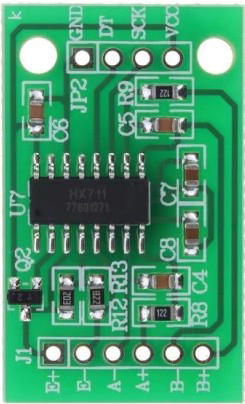
The HX711 AD Module, manufactured by Makro, is a precision 24-bit analog-to-digital converter (ADC) designed for applications requiring high accuracy and stability. It is widely used in weigh scales, industrial control systems, and other applications where small changes in voltage need to be measured. The HX711 simplifies the process of interfacing load cells or other sensors with microcontrollers by providing a high-resolution digital output.
Explore Projects Built with HX711
Use Cirkit Designer to design, explore, and prototype these projects online. Some projects support real-time simulation. Click "Open Project" to start designing instantly!
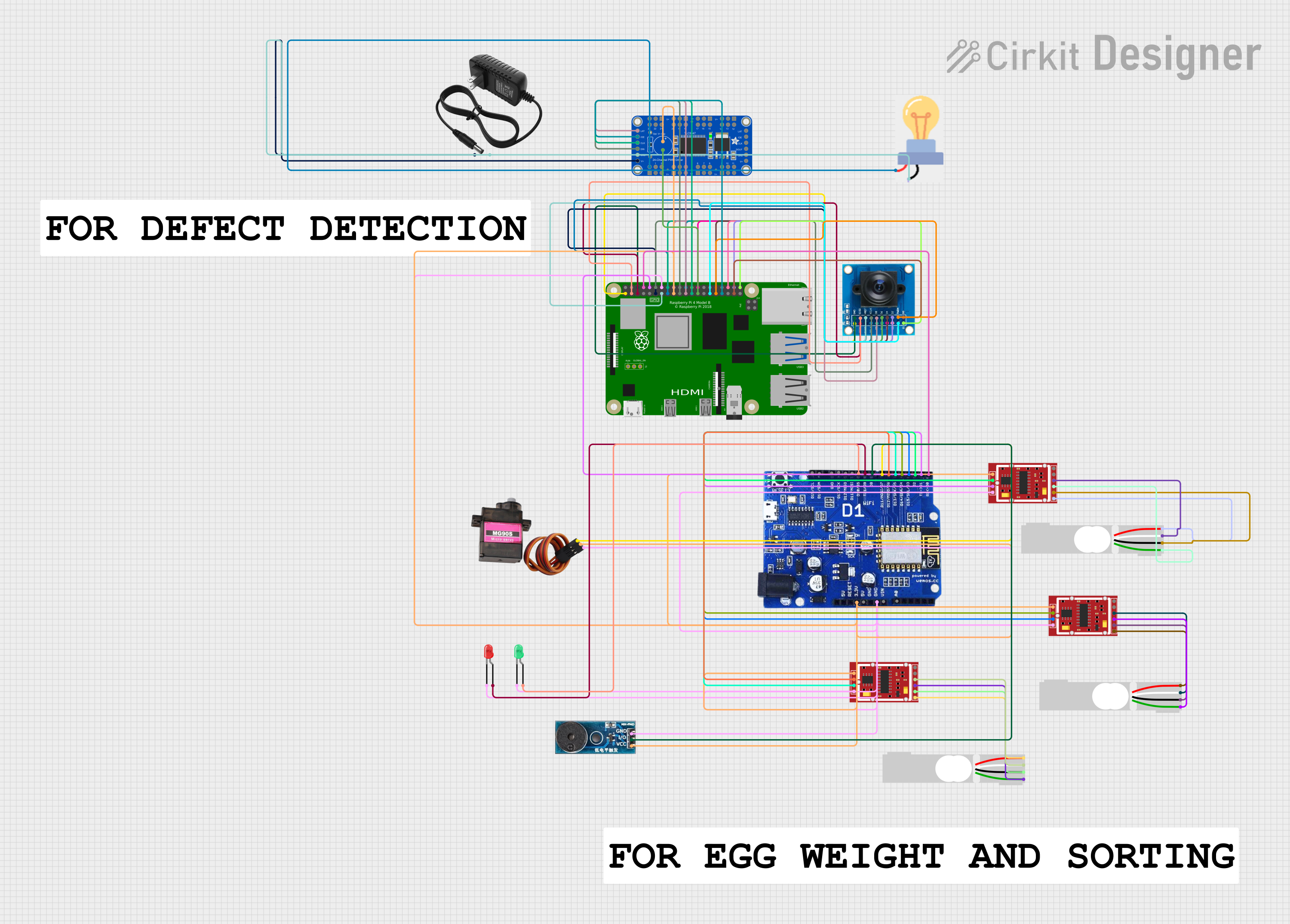
This circuit integrates multiple HX711 weighing sensor modules connected to load cells for weight measurement, an OV7725 camera module interfaced with a Raspberry Pi 4B for image capture, and a WeMOS ESP8266 for wireless communication. Additionally, it includes an Adafruit 24-Channel PWM LED driver for controlling LEDs and a buzzer module for audio alerts.
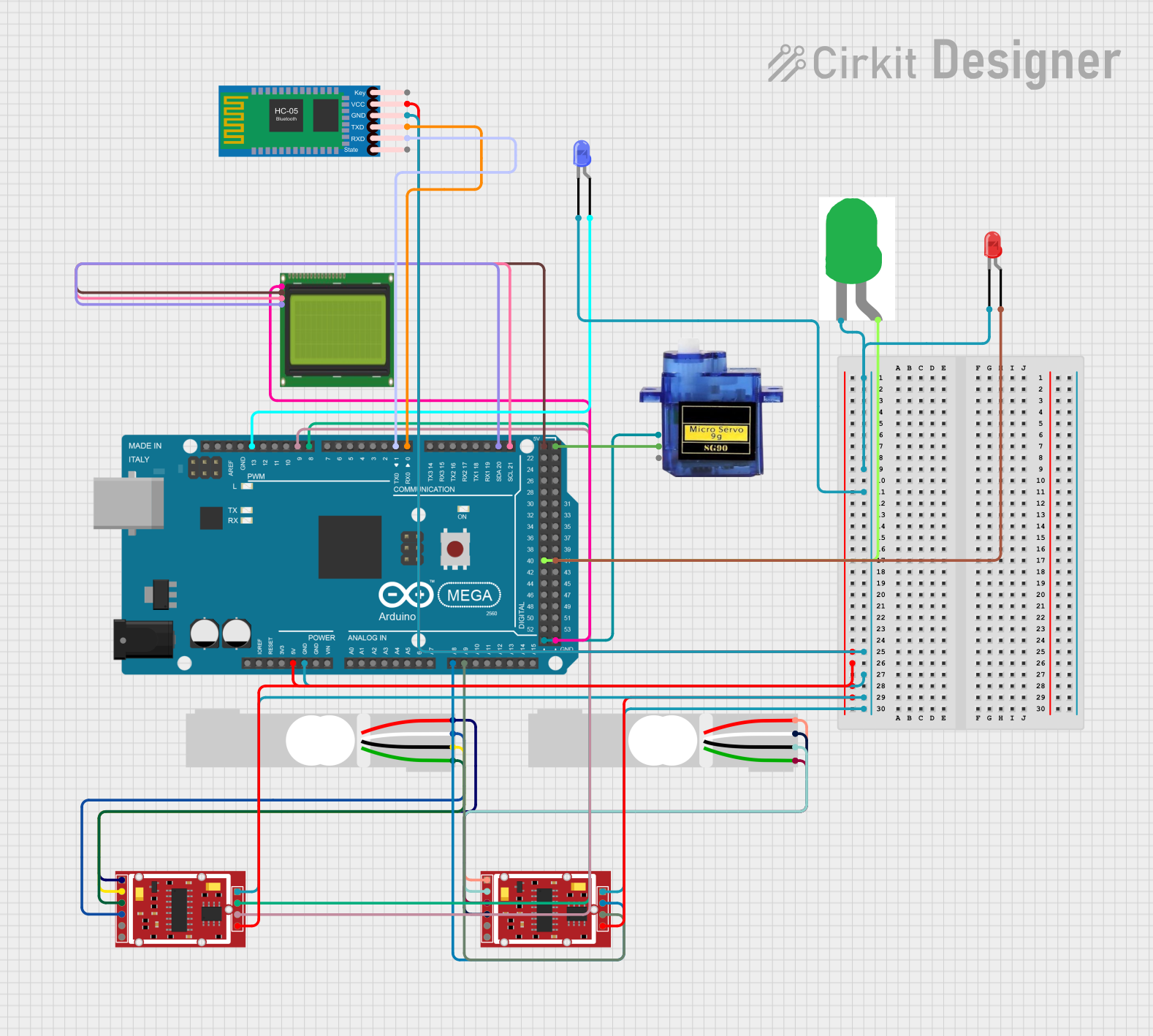
This circuit is a weighing system that uses two load cells connected to HX711 modules for weight measurement, interfaced with an Arduino Mega 2560. The system includes an LCD for displaying weight, a Bluetooth module for wireless communication, and LEDs for status indication, with a micro servo for additional mechanical control.
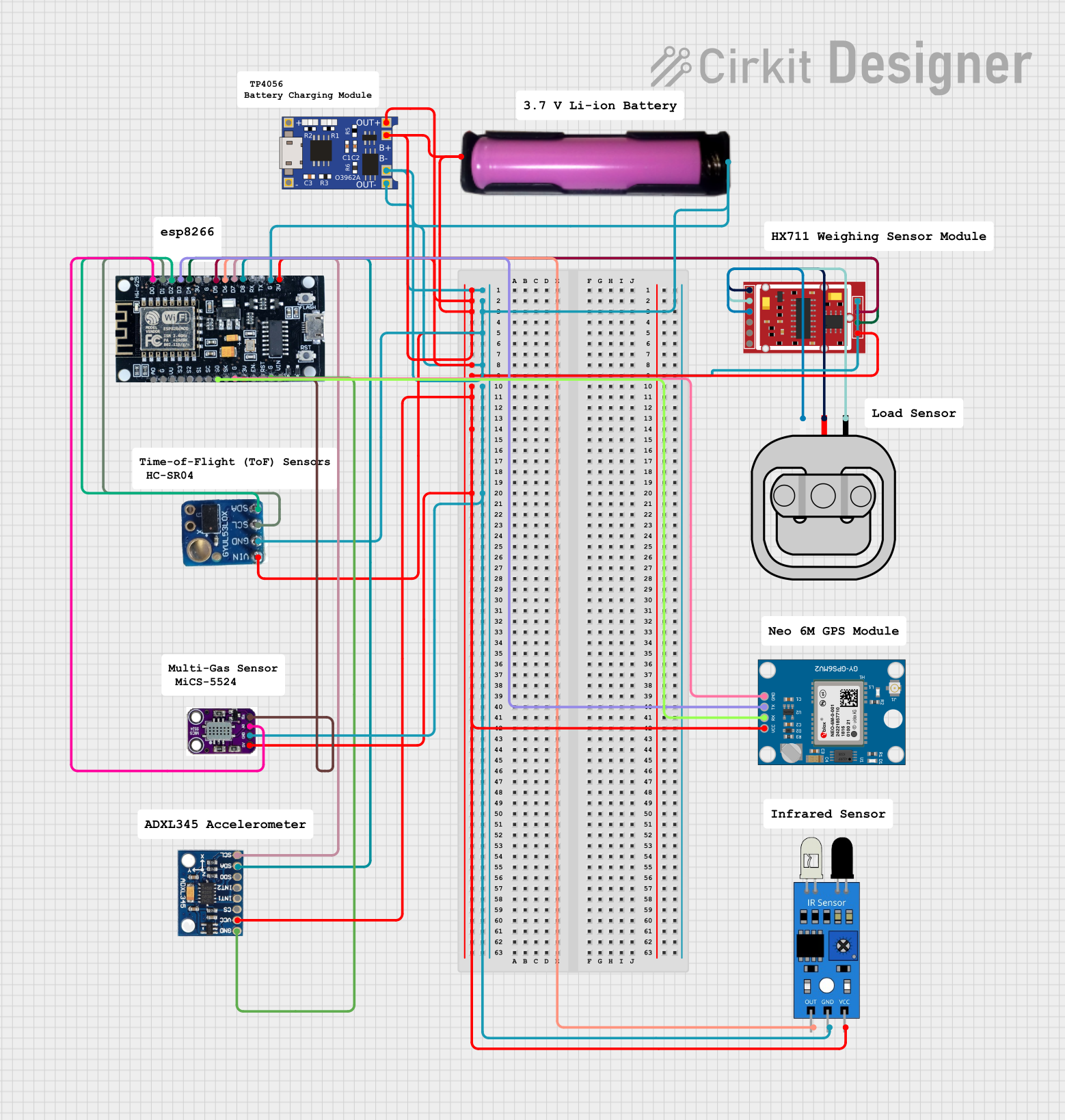
This circuit is a multi-sensor data acquisition system powered by a 18650 battery and managed by an ESP8266 microcontroller. It includes a load sensor interfaced with an HX711 module for weight measurement, an IR sensor, an ADXL345 accelerometer, a VL53L0X distance sensor, and a Neo 6M GPS module for location tracking. The system is designed for wireless data transmission and is supported by a TP4056 module for battery charging.
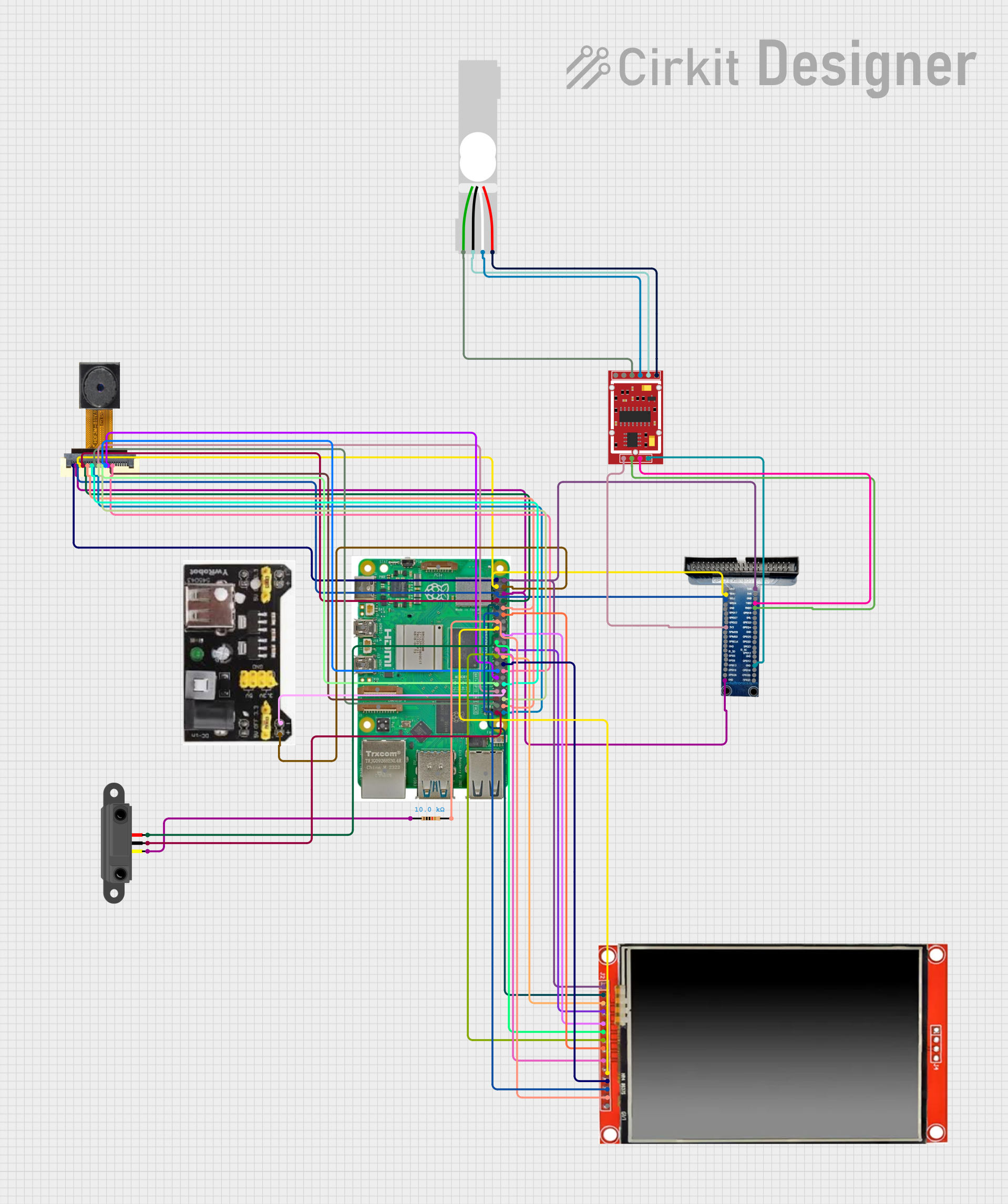
This circuit integrates a Raspberry Pi 5 with an OV2640 camera module, an ILI9488 TFT screen, an infrared proximity sensor, and a load cell with an HX711 sensor module. The system captures images and performs OCR to extract text from documents, displays the text and weight measurements on the TFT screen, and allows data export via WiFi.
Below is an example code to interface the HX711 with an Arduino UNO:
#include "HX711.h" // Include the HX711 library

// Define HX711 pins
#define DT_PIN 3  // Data pin connected to Arduino digital pin 3
#define SCK_PIN 2 // Clock pin connected to Arduino digital pin 2

HX711 scale; // Create an instance of the HX711 class

void setup() {
  Serial.begin(9600); // Initialize serial communication
  scale.begin(DT_PIN, SCK_PIN); // Initialize the HX711 with the defined pins
  Serial.println("HX711 initialized. Place weight on the scale.");
}

void loop() {
  if (scale.is_ready()) { // Check if the HX711 is ready
    long reading = scale.get_units(); // Get the weight reading
    Serial.print("Weight: ");
    Serial.print(reading); // Print the weight value
    Serial.println(" units");
  } else {
    Serial.println("HX711 not ready. Check connections.");
  }
  delay(500); // Wait for 500ms before the next reading
}
Important Considerations
Power Supply: Ensure a stable power supply to avoid noise in the readings.
Calibration: Calibrate the load cell and HX711 for accurate measurements.
Shielding: Use shielded cables for the load cell to minimize interference.
Data Rate: The HX711 supports two data rates (10Hz and 80Hz). Use the slower rate for higher stability.
Troubleshooting and FAQs
Common Issues and Solutions
No Output or Incorrect Readings:
Check the wiring between the HX711, load cell, and microcontroller.
Ensure the load cell is properly connected to Channel A or B.
Verify that the power supply voltage is within the specified range (2.6V to 5.5V).
Fluctuating or Noisy Readings:
Use a stable power source and decoupling capacitors to reduce noise.
Ensure proper grounding of the circuit.
Shield the load cell wires to minimize electromagnetic interference.
HX711 Not Responding:
Verify the DT and SCK pin connections.
Check if the HX711 is in standby mode (current consumption <1µA). If so, reset the module.
FAQs
Q1: Can the HX711 measure multiple load cells simultaneously?
A1: The HX711 has two input channels (A and B), but only one channel can be read at a time. For multiple load cells, use multiple HX711 modules.
Q2: How do I calibrate the HX711?
A2: Calibration involves determining the scale factor by applying a known weight to the load cell and adjusting the readings accordingly. Use the HX711 library's calibration functions for this purpose.
Q3: What is the maximum weight the HX711 can measure?
A3: The maximum weight depends on the load cell's capacity. The HX711 itself does not impose a weight limit but provides high-resolution readings for the connected load cell.
Q4: Can I use the HX711 with a 3.3V microcontroller?
A4: Yes, the HX711 operates at 2.6V to 5.5V, making it compatible with both 3.3V and 5V systems.
By following this documentation, you can effectively integrate the HX711 AD Module into your projects for precise weight and voltage measurements.

 Open Project in Cirkit Designer