
How to Use 433MHz RF Tx: Examples, Pinouts, and Specs
 Design with 433MHz RF Tx in Cirkit Designer
Introduction
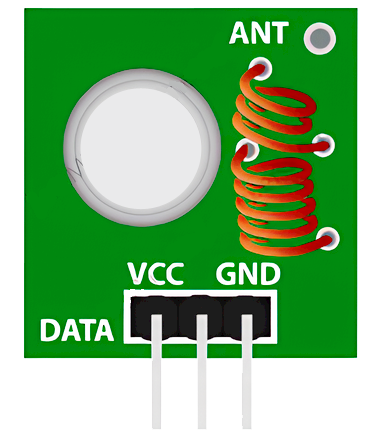
The 433MHz RF Transmitter (FS1000A) is a compact and cost-effective wireless communication module designed to transmit data over short distances using radio frequency signals at 433 MHz. It is widely used in applications such as remote controls, wireless sensors, home automation systems, and other low-power communication systems. This module is ideal for projects requiring simple, reliable, and low-cost wireless data transmission.
Explore Projects Built with 433MHz RF Tx
 Open Project in Cirkit Designer
 Open Project in Cirkit Designer
 Open Project in Cirkit Designer
 Open Project in Cirkit Designer
Explore Projects Built with 433MHz RF Tx
Open Project in Cirkit DesignerOpen Project in Cirkit DesignerOpen Project in Cirkit DesignerOpen Project in Cirkit DesignerTechnical Specifications
The FS1000A RF Transmitter operates efficiently in a variety of environments and is compatible with microcontrollers like Arduino, Raspberry Pi, and other embedded systems.
Key Technical Details
| Parameter | Specification |
|---|---|
| Operating Frequency | 433 MHz |
| Operating Voltage | 3.5V - 12V DC |
| Operating Current | 9 mA (typical at 5V) |
| Transmission Distance | Up to 100 meters (line of sight) |
| Modulation Technique | Amplitude Shift Keying (ASK) |
| Data Rate | Up to 10 kbps |
| Dimensions | 19mm x 19mm x 7mm |
Pin Configuration and Descriptions
The FS1000A module has three pins for interfacing with external circuits.
| Pin Name | Pin Number | Description |
|---|---|---|
| VCC | 1 | Power supply pin (3.5V to 12V DC). |
| DATA | 2 | Data input pin for transmitting digital signals. |
| GND | 3 | Ground pin for completing the circuit. |
Usage Instructions
The FS1000A RF Transmitter is straightforward to use and can be easily integrated into wireless communication systems. Below are the steps and best practices for using the module:
Connecting the FS1000A to a Microcontroller
- Power Supply: Connect the
VCCpin to a regulated power source (3.5V to 12V DC). For most microcontroller applications, 5V is commonly used. - Ground Connection: Connect the
GNDpin to the ground of the power supply and the microcontroller. - Data Input: Connect the
DATApin to the digital output pin of the microcontroller. This pin will transmit the digital signals.
Example Circuit with Arduino UNO
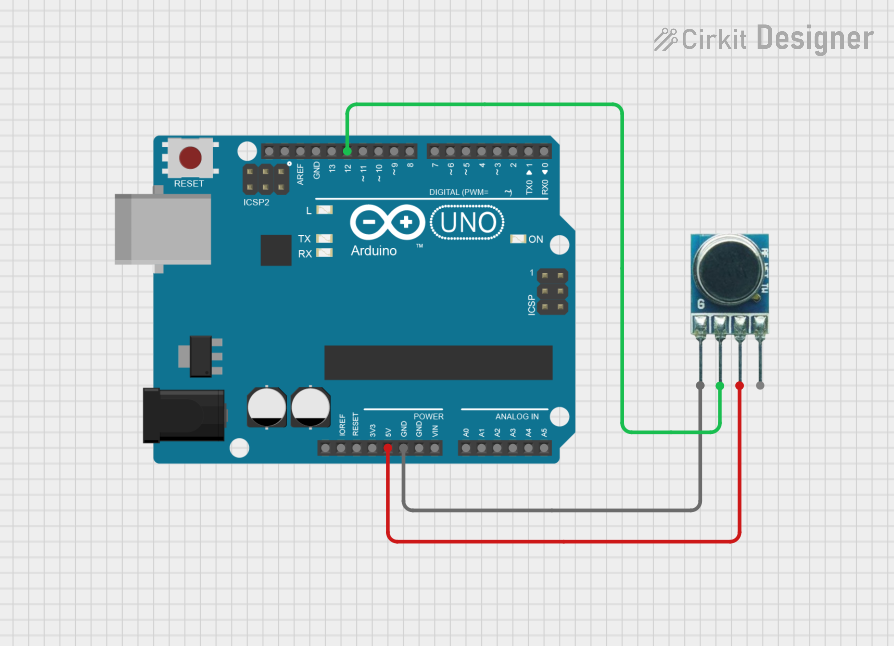
Below is an example of how to connect the FS1000A to an Arduino UNO for transmitting data wirelessly.
Circuit Connections
- Connect the
VCCpin of the FS1000A to the 5V pin of the Arduino. - Connect the
GNDpin of the FS1000A to the GND pin of the Arduino. - Connect the
DATApin of the FS1000A to digital pin 12 of the Arduino.
Example Arduino Code
// Example code to transmit data using the FS1000A RF Transmitter
// Ensure the receiver module is set up to receive the transmitted data

#include <VirtualWire.h> // Include the VirtualWire library for RF communication

void setup() {
  vw_set_tx_pin(12); // Set the data pin for the transmitter
  vw_setup(2000);    // Initialize the library with a baud rate of 2000 bps
}

void loop() {
  const char *msg = "Hello, World!"; // Message to be transmitted

  vw_send((uint8_t *)msg, strlen(msg)); // Send the message
  vw_wait_tx();                         // Wait for the transmission to complete
  delay(1000);                          // Wait 1 second before sending the next message
}
Important Considerations and Best Practices
- Antenna: Attach a 17 cm wire to the antenna pad of the FS1000A to improve transmission range and signal quality.
- Power Supply: Use a stable and noise-free power supply to ensure reliable operation.
- Interference: Avoid placing the module near sources of electromagnetic interference, such as motors or high-frequency circuits.
- Line of Sight: For maximum range, ensure there are minimal obstructions between the transmitter and receiver.
Troubleshooting and FAQs
Common Issues and Solutions
No Signal Received
- Ensure the transmitter and receiver are operating at the same frequency (433 MHz).
- Verify the connections between the FS1000A and the microcontroller.
- Check the power supply voltage and ensure it is within the specified range.
Short Transmission Range
- Attach a 17 cm wire as an antenna to improve the range.
- Ensure there are no significant obstacles or interference sources between the transmitter and receiver.
Data Corruption
- Use error-checking mechanisms in your code to verify the integrity of the transmitted data.
- Reduce the data rate if the environment has high interference.
FAQs
Q: Can the FS1000A transmit analog signals?
A: No, the FS1000A is designed to transmit digital signals only. Use a microcontroller to encode analog signals into digital format before transmission.
Q: What is the maximum range of the FS1000A?
A: The maximum range is up to 100 meters in an open, line-of-sight environment. The range may decrease in indoor or obstructed environments.
Q: Can I use multiple FS1000A modules in the same area?
A: Yes, but ensure that each transmitter uses a unique data protocol to avoid interference.
By following this documentation, you can effectively use the FS1000A RF Transmitter in your wireless communication projects.