
How to Use DC-DC Buck Converter, Adjustable: Examples, Pinouts, and Specs
 Design with DC-DC Buck Converter, Adjustable in Cirkit Designer
Introduction
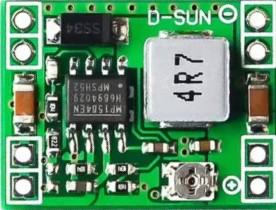
The DC-DC Buck Converter, Adjustable (Manufacturer: AliExpress 1103684944store, Part ID: MP1584EM) is a compact and efficient step-down voltage regulator. It is designed to convert a higher input voltage to a lower, adjustable output voltage with high efficiency. This component is widely used in applications requiring stable and regulated power supply, such as powering microcontrollers, sensors, and other low-voltage devices.
Explore Projects Built with DC-DC Buck Converter, Adjustable
 Open Project in Cirkit Designer
 Open Project in Cirkit Designer
 Open Project in Cirkit Designer
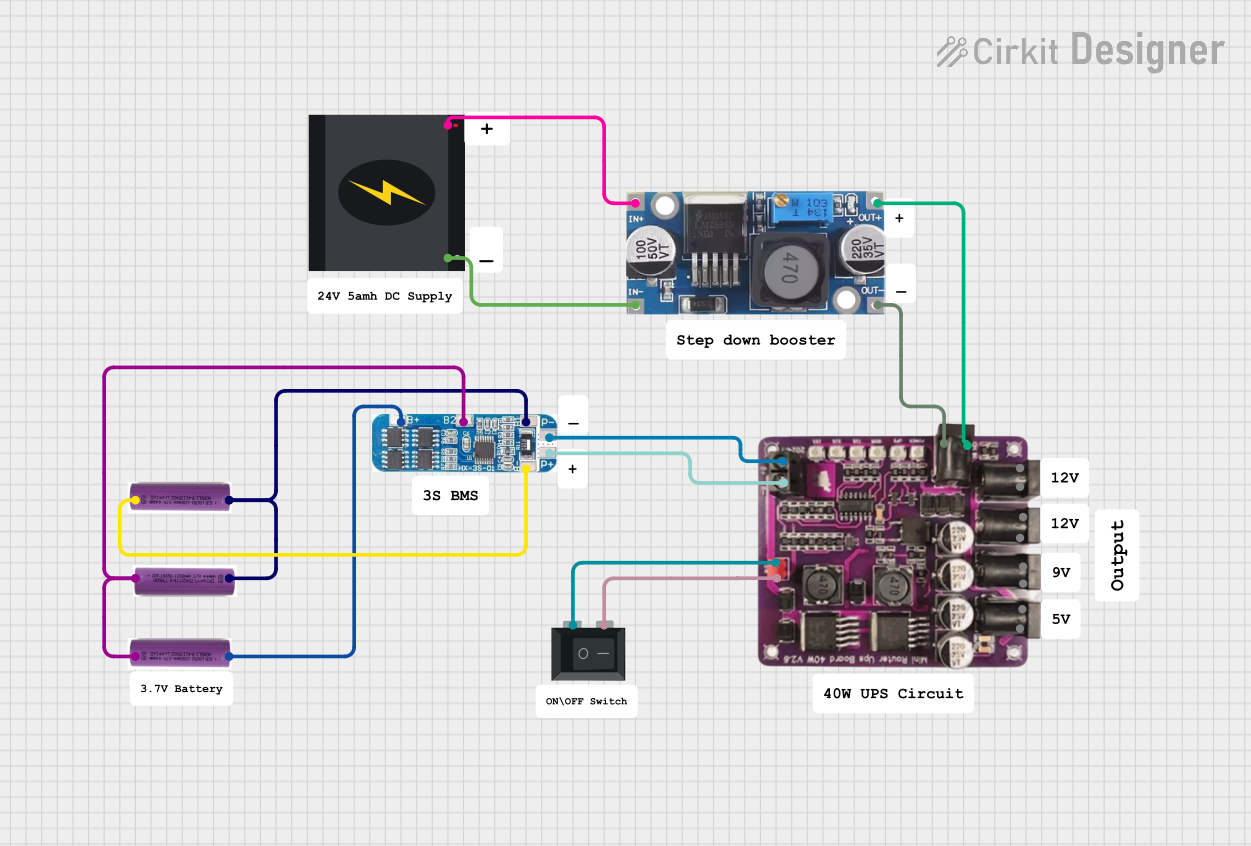 Open Project in Cirkit Designer
Explore Projects Built with DC-DC Buck Converter, Adjustable
Open Project in Cirkit DesignerOpen Project in Cirkit DesignerOpen Project in Cirkit DesignerOpen Project in Cirkit DesignerCommon Applications and Use Cases
- Powering Arduino, Raspberry Pi, and other microcontroller boards
- Battery-powered devices requiring voltage regulation
- LED drivers and lighting systems
- DIY electronics projects
- Robotics and automation systems
Technical Specifications
The following table outlines the key technical details of the MP1584EM DC-DC Buck Converter:
| Parameter | Value |
|---|---|
| Input Voltage Range | 4.5V to 28V |
| Output Voltage Range | 0.8V to 20V (adjustable via potentiometer) |
| Output Current | Up to 3A (peak), 2A (continuous) |
| Efficiency | Up to 92% |
| Switching Frequency | 1.5 MHz |
| Operating Temperature | -40°C to +85°C |
| Dimensions | 22mm x 17mm x 4mm |
Pin Configuration and Descriptions
The MP1584EM module has four pins for input and output connections:
| Pin Name | Description |
|---|---|
| VIN | Positive input voltage (4.5V to 28V) |
| GND | Ground connection for input and output |
| VOUT | Positive output voltage (adjustable, 0.8V to 20V) |
| GND | Ground connection for input and output |
Usage Instructions
How to Use the Component in a Circuit
- Connect Input Voltage: Connect the VIN pin to the positive terminal of your power source (e.g., battery or power supply) and the GND pin to the negative terminal.
- Adjust Output Voltage: Use the onboard potentiometer to adjust the output voltage. Turn the potentiometer clockwise to increase the voltage and counterclockwise to decrease it.
- Connect Load: Connect the VOUT pin to the positive terminal of your load (e.g., microcontroller, sensor) and the GND pin to the negative terminal.
- Verify Output Voltage: Use a multimeter to measure the output voltage before connecting sensitive devices to ensure it matches the required voltage.
Important Considerations and Best Practices
- Heat Dissipation: For continuous currents above 1A, ensure proper heat dissipation by adding a heatsink or improving airflow around the module.
- Input Voltage: Ensure the input voltage is at least 1.5V higher than the desired output voltage for proper regulation.
- Polarity: Double-check the polarity of connections to avoid damaging the module.
- Load Current: Do not exceed the maximum continuous current rating of 2A to prevent overheating or damage.
Example: Using with Arduino UNO
The MP1584EM can be used to power an Arduino UNO by stepping down a 12V input to 5V. Below is an example circuit and Arduino code:
Circuit Connections
- Connect a 12V power source to the VIN and GND pins of the buck converter.
- Adjust the potentiometer to set the output voltage to 5V.
- Connect the VOUT pin to the Arduino UNO's 5V pin and the GND pin to the Arduino's GND.
Arduino Code Example
// Example code to blink an LED using Arduino UNO powered by MP1584EM
// Ensure the buck converter is set to output 5V before connecting to Arduino

const int ledPin = 13; // Built-in LED pin on Arduino UNO

void setup() {
  pinMode(ledPin, OUTPUT); // Set LED pin as output
}

void loop() {
  digitalWrite(ledPin, HIGH); // Turn the LED on
  delay(1000);                // Wait for 1 second
  digitalWrite(ledPin, LOW);  // Turn the LED off
  delay(1000);                // Wait for 1 second
}
Troubleshooting and FAQs
Common Issues and Solutions
No Output Voltage:
- Verify that the input voltage is within the specified range (4.5V to 28V).
- Check all connections for proper polarity and secure contact.
- Ensure the potentiometer is not set to the minimum output voltage (0.8V).
Overheating:
- Reduce the load current if it exceeds 2A.
- Improve heat dissipation by adding a heatsink or increasing airflow.
Output Voltage Fluctuations:
- Ensure the input voltage is stable and not dropping under load.
- Check for loose connections or damaged components.
Cannot Adjust Output Voltage:
- Verify that the potentiometer is functioning correctly. If not, replace it.
- Ensure the input voltage is at least 1.5V higher than the desired output voltage.
FAQs
Q: Can I use this module to charge a lithium-ion battery?
A: Yes, but ensure the output voltage is set to the appropriate charging voltage for your battery (e.g., 4.2V for a single-cell Li-ion battery). Use a current-limiting circuit if required.
Q: Is the module protected against reverse polarity?
A: No, the MP1584EM does not have built-in reverse polarity protection. Always double-check your connections.
Q: Can I use this module with a solar panel?
A: Yes, as long as the solar panel's output voltage is within the module's input range (4.5V to 28V). Ensure the panel provides sufficient current for your load.
Q: What is the maximum efficiency of this module?
A: The MP1584EM can achieve up to 92% efficiency under optimal conditions.