
How to Use CD4026 IC: Examples, Pinouts, and Specs
 Design with CD4026 IC in Cirkit Designer
Introduction
The CD4026 IC, manufactured by IC, is a versatile decade counter and display driver designed to drive 7-segment displays directly. It is capable of counting from 0 to 9 and is widely used in applications requiring numerical displays, such as digital clocks, frequency counters, and event counters. The IC simplifies the process of interfacing a 7-segment display with minimal external components, making it a popular choice for both hobbyists and professionals.
Explore Projects Built with CD4026 IC
 Open Project in Cirkit Designer
 Open Project in Cirkit Designer
 Open Project in Cirkit Designer
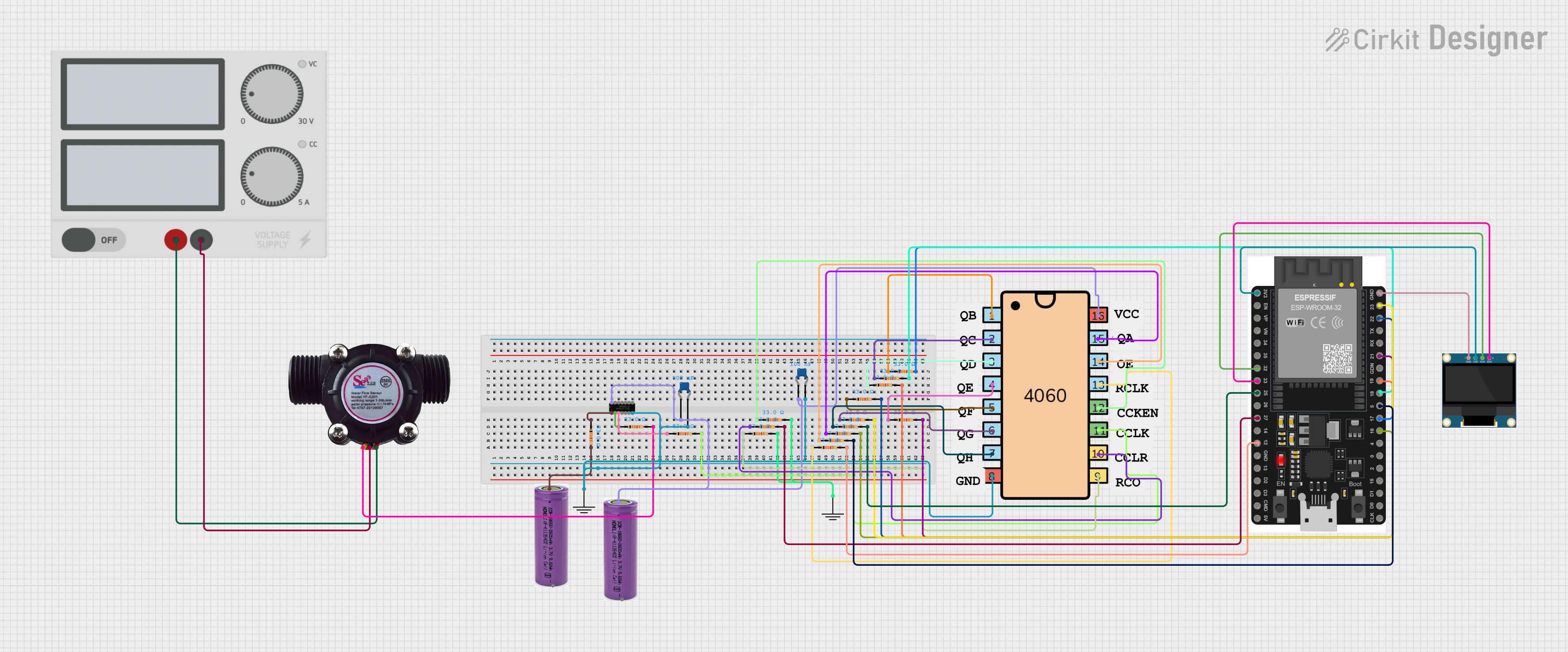 Open Project in Cirkit Designer
Explore Projects Built with CD4026 IC
Open Project in Cirkit DesignerOpen Project in Cirkit DesignerOpen Project in Cirkit DesignerOpen Project in Cirkit DesignerCommon Applications
- Digital clocks
- Frequency counters
- Event counters
- Scoreboards
- Timer circuits
- Simple numerical displays in embedded systems
Technical Specifications
The following table outlines the key technical specifications of the CD4026 IC:
| Parameter | Value |
|---|---|
| Supply Voltage (Vdd) | 3V to 15V |
| Maximum Input Voltage | Vdd |
| Output Current (per pin) | 10mA |
| Operating Temperature | -40°C to +85°C |
| Maximum Clock Frequency | 6 MHz (at 10V supply) |
| Power Dissipation | 500mW |
Pin Configuration and Descriptions
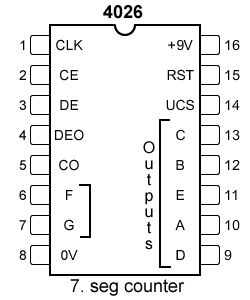
The CD4026 IC comes in a 16-pin Dual Inline Package (DIP). Below is the pin configuration and description:
| Pin Number | Pin Name | Description |
|---|---|---|
| 1 | Clock (CLK) | Input for clock signal; increments the counter on a rising edge. |
| 2 | Enable Input (EN) | Enables or disables the clock input. Active HIGH. |
| 3 | Zero Reset (RST) | Resets the counter to zero when HIGH. |
| 4 | Display Enable | Enables or disables the 7-segment display output. Active HIGH. |
| 5 | Segment 'e' | Output for segment 'e' of the 7-segment display. |
| 6 | Segment 'd' | Output for segment 'd' of the 7-segment display. |
| 7 | Segment 'c' | Output for segment 'c' of the 7-segment display. |
| 8 | Ground (GND) | Ground connection. |
| 9 | Segment 'b' | Output for segment 'b' of the 7-segment display. |
| 10 | Segment 'a' | Output for segment 'a' of the 7-segment display. |
| 11 | Segment 'f' | Output for segment 'f' of the 7-segment display. |
| 12 | Segment 'g' | Output for segment 'g' of the 7-segment display. |
| 13 | Display Enable Out | Output to cascade multiple CD4026 ICs. |
| 14 | Carry Out | Outputs a carry signal for cascading counters. |
| 15 | Clock Inhibit | Disables the clock input when HIGH. |
| 16 | Vdd | Positive power supply. |
Usage Instructions
How to Use the CD4026 IC in a Circuit
- Power Supply: Connect pin 16 (Vdd) to the positive supply voltage (3V to 15V) and pin 8 (GND) to ground.
- Clock Input: Provide a clock signal to pin 1 (CLK). Each rising edge of the clock signal increments the counter by 1.
- Reset Function: To reset the counter to zero, apply a HIGH signal to pin 3 (RST).
- 7-Segment Display: Connect the output pins (5 to 12) to the corresponding segments of a common cathode 7-segment display.
- Enable Display: Ensure pin 4 (Display Enable) is HIGH to activate the 7-segment display output.
- Cascading: Use pin 14 (Carry Out) and pin 13 (Display Enable Out) to cascade multiple CD4026 ICs for counting beyond 9.
Important Considerations
- Use current-limiting resistors (typically 330Ω to 1kΩ) between the segment outputs and the 7-segment display to prevent damage to the IC and display.
- Ensure the clock signal is clean and free of noise to avoid erratic counting.
- If cascading multiple ICs, ensure proper synchronization of the carry-out and clock signals.
Example: Interfacing CD4026 with Arduino UNO
Below is an example of how to use the CD4026 IC with an Arduino UNO to drive a 7-segment display:
// Define pin connections
#define CLK_PIN 2    // Arduino pin connected to CD4026 Clock (Pin 1)
#define RST_PIN 3    // Arduino pin connected to CD4026 Reset (Pin 3)
#define EN_PIN 4     // Arduino pin connected to CD4026 Enable (Pin 2)

void setup() {
  pinMode(CLK_PIN, OUTPUT);  // Set Clock pin as output
  pinMode(RST_PIN, OUTPUT);  // Set Reset pin as output
  pinMode(EN_PIN, OUTPUT);   // Set Enable pin as output

  digitalWrite(RST_PIN, LOW);  // Ensure Reset is LOW initially
  digitalWrite(EN_PIN, HIGH);  // Enable the CD4026 IC
}

void loop() {
  for (int i = 0; i < 10; i++) {  // Count from 0 to 9
    digitalWrite(CLK_PIN, HIGH);  // Generate a clock pulse
    delay(10);                    // Short delay
    digitalWrite(CLK_PIN, LOW);   // Complete the clock pulse
    delay(1000);                  // Wait 1 second before next count
  }

  digitalWrite(RST_PIN, HIGH);  // Reset the counter
  delay(10);                    // Short delay
  digitalWrite(RST_PIN, LOW);   // Complete the reset
}
Notes:
- Ensure the 7-segment display is properly connected to the CD4026 output pins.
- Adjust the delay values in the code to control the counting speed.
Troubleshooting and FAQs
Common Issues and Solutions
The 7-segment display does not light up:
- Ensure the Display Enable pin (pin 4) is HIGH.
- Check the connections between the CD4026 and the 7-segment display.
- Verify that current-limiting resistors are correctly installed.
Erratic counting or skipping numbers:
- Ensure the clock signal is clean and free of noise.
- Use a debouncing circuit or software debouncing if a mechanical switch is used as the clock source.
The counter does not reset:
- Verify that the Reset pin (pin 3) is momentarily set HIGH to reset the counter.
Cascading multiple ICs does not work:
- Check the connections between the Carry Out (pin 14) and the Clock input of the next IC.
- Ensure proper synchronization of the clock and carry signals.
FAQs
Q: Can I use a common anode 7-segment display with the CD4026?
A: No, the CD4026 is designed to drive common cathode 7-segment displays only.
Q: What is the maximum number of CD4026 ICs I can cascade?
A: Theoretically, you can cascade as many as needed, but practical limitations such as signal integrity and power supply constraints should be considered.
Q: Can the CD4026 count in reverse?
A: No, the CD4026 is a unidirectional counter and cannot count in reverse.
Q: What happens if the clock frequency exceeds the maximum limit?
A: The IC may fail to count correctly or may not function at all. Always ensure the clock frequency is within the specified range.