
How to Use DC motor: Examples, Pinouts, and Specs
 Design with DC motor in Cirkit Designer
Introduction
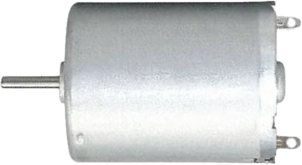
A DC motor is an electromechanical device that converts direct current (DC) electrical energy into mechanical energy, enabling rotational motion. It operates using the interaction between a magnetic field and electric current in its windings to generate torque. DC motors are widely used due to their simplicity, reliability, and ease of control.
Explore Projects Built with DC motor
 Open Project in Cirkit Designer
 Open Project in Cirkit Designer
 Open Project in Cirkit Designer
 Open Project in Cirkit Designer
Explore Projects Built with DC motor
Open Project in Cirkit DesignerOpen Project in Cirkit DesignerOpen Project in Cirkit DesignerOpen Project in Cirkit DesignerCommon Applications and Use Cases
- Robotics: For driving wheels, arms, or other moving parts.
- Fans and blowers: To create airflow in cooling systems or ventilation.
- Electric vehicles: For propulsion systems.
- Conveyor belts: In industrial automation for material handling.
- Toys: To power small moving parts like wheels or propellers.
Technical Specifications
Below are the general technical specifications for a typical DC motor. Note that actual values may vary depending on the specific model.
Key Technical Details
- Operating Voltage: 3V to 24V (common range)
- Operating Current: 100mA to 2A (depending on load and motor size)
- Speed: 1000 to 10,000 RPM (Revolutions Per Minute)
- Torque: 0.1 to 10 N·m (Newton-meters)
- Power Output: 0.1W to 100W
- Motor Type: Brushed or Brushless DC motor
- Shaft Diameter: Typically 2mm to 6mm
Pin Configuration and Descriptions
For a basic brushed DC motor, there are typically two terminals:
| Pin/Terminal | Description |
|---|---|
| Positive (+) | Connect to the positive terminal of the power supply. |
| Negative (-) | Connect to the negative terminal of the power supply. Reversing polarity changes the rotation direction. |
For brushless DC motors, additional control pins may be present, such as Hall sensor outputs or PWM inputs, depending on the motor design.
Usage Instructions
How to Use the Component in a Circuit
- Power Supply: Connect the motor terminals to a DC power source. Ensure the voltage and current ratings match the motor's specifications.
- Direction Control: To change the rotation direction, reverse the polarity of the connections.
- Speed Control: Use a Pulse Width Modulation (PWM) signal to control the motor speed. This can be achieved using a motor driver or microcontroller.
- Motor Driver: For higher current motors, use a motor driver IC (e.g., L298N, L293D) or an H-bridge circuit to safely control the motor.
Important Considerations and Best Practices
- Avoid Overloading: Ensure the motor is not subjected to loads beyond its rated torque to prevent overheating or damage.
- Use a Flyback Diode: When using a motor driver, include a flyback diode to protect the circuit from voltage spikes caused by the motor's inductive load.
- Power Supply: Use a stable power supply to avoid fluctuations that could affect motor performance.
- Heat Dissipation: For high-power motors, ensure proper ventilation or heat sinks to manage heat generation.
- Noise Suppression: Add capacitors across the motor terminals to reduce electrical noise.
Example: Controlling a DC Motor with Arduino UNO
Below is an example of controlling a DC motor using an Arduino UNO and an L298N motor driver.
// Example: Controlling a DC motor with Arduino UNO and L298N motor driver

// Define motor control pins
const int motorPin1 = 9; // IN1 on L298N
const int motorPin2 = 10; // IN2 on L298N
const int enablePin = 11; // ENA on L298N (PWM pin)

void setup() {
  // Set motor control pins as outputs
  pinMode(motorPin1, OUTPUT);
  pinMode(motorPin2, OUTPUT);
  pinMode(enablePin, OUTPUT);
}

void loop() {
  // Rotate motor in one direction
  digitalWrite(motorPin1, HIGH); // Set IN1 high
  digitalWrite(motorPin2, LOW);  // Set IN2 low
  analogWrite(enablePin, 128);   // Set speed (0-255, 128 = 50% duty cycle)
  delay(2000);                   // Run for 2 seconds

  // Stop the motor
  analogWrite(enablePin, 0);     // Set speed to 0
  delay(1000);                   // Wait for 1 second

  // Rotate motor in the opposite direction
  digitalWrite(motorPin1, LOW);  // Set IN1 low
  digitalWrite(motorPin2, HIGH); // Set IN2 high
  analogWrite(enablePin, 128);   // Set speed (50% duty cycle)
  delay(2000);                   // Run for 2 seconds

  // Stop the motor
  analogWrite(enablePin, 0);     // Set speed to 0
  delay(1000);                   // Wait for 1 second
}
Troubleshooting and FAQs
Common Issues and Solutions
Motor Not Spinning:
- Check the power supply voltage and current to ensure it meets the motor's requirements.
- Verify all connections, especially polarity.
- Ensure the motor driver or control circuit is functioning correctly.
Motor Overheating:
- Reduce the load on the motor.
- Check for obstructions or mechanical resistance in the motor's movement.
- Ensure proper ventilation or cooling.
Noisy Operation:
- Add capacitors (e.g., 0.1µF) across the motor terminals to suppress electrical noise.
- Inspect for loose connections or worn-out brushes (for brushed motors).
Inconsistent Speed:
- Use a stable power supply or add a capacitor to smooth out voltage fluctuations.
- Check the PWM signal for proper duty cycle and frequency.
FAQs
Q: Can I connect a DC motor directly to an Arduino?
A: No, the Arduino cannot supply enough current to drive a motor directly. Use a motor driver or transistor circuit.Q: How do I reverse the motor's direction?
A: Swap the positive and negative connections on the motor terminals, or use an H-bridge circuit.Q: What is the difference between brushed and brushless DC motors?
A: Brushed motors use mechanical brushes for commutation, while brushless motors use electronic commutation, offering higher efficiency and durability.Q: Can I control the speed of a DC motor without a motor driver?
A: Yes, you can use a transistor or MOSFET circuit with a PWM signal, but a motor driver is more convenient and safer.
This documentation provides a comprehensive guide to understanding, using, and troubleshooting DC motors in various applications.