
How to Use 5v Boost Converter: Examples, Pinouts, and Specs
 Design with 5v Boost Converter in Cirkit Designer
Introduction
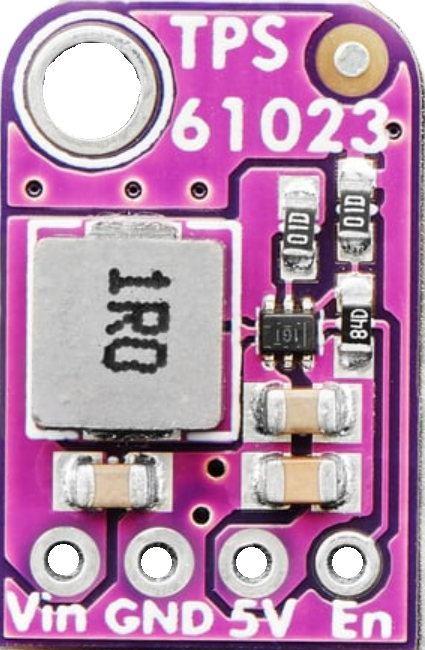
The 5V Boost Converter (Manufacturer: Adafruit, Part ID: TPS61023) is a DC-DC step-up converter designed to increase a lower input voltage to a stable 5V output. This component is ideal for powering devices that require a consistent 5V supply, even when the input voltage is lower, such as in battery-powered applications. Its compact design and high efficiency make it a popular choice for portable electronics, IoT devices, and embedded systems.
Explore Projects Built with 5v Boost Converter
 Open Project in Cirkit Designer
 Open Project in Cirkit Designer
 Open Project in Cirkit Designer
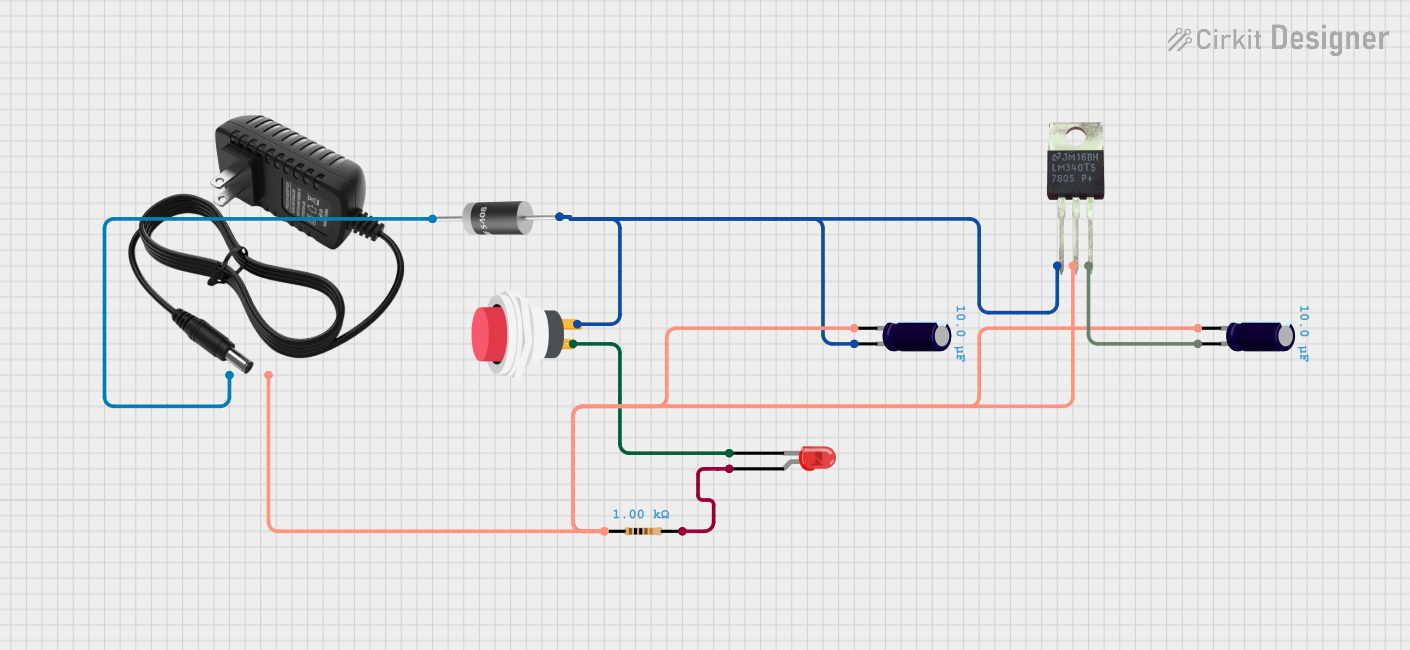 Open Project in Cirkit Designer
Explore Projects Built with 5v Boost Converter
Open Project in Cirkit DesignerOpen Project in Cirkit DesignerOpen Project in Cirkit DesignerOpen Project in Cirkit DesignerCommon Applications
- Powering microcontrollers (e.g., Arduino, Raspberry Pi) from batteries
- Extending the life of single-cell Li-ion or alkaline batteries
- Portable USB-powered devices
- Wearable electronics
- Low-power IoT devices
Technical Specifications
The following table outlines the key technical details of the Adafruit TPS61023 5V Boost Converter:
| Parameter | Value |
|---|---|
| Input Voltage Range | 0.5V to 5.5V |
| Output Voltage | 5V (fixed) |
| Output Current | Up to 1A (depending on input voltage) |
| Efficiency | Up to 90% |
| Switching Frequency | 1.5 MHz |
| Operating Temperature | -40°C to +125°C |
| Dimensions | 17.8mm x 12.7mm x 4.5mm |
Pin Configuration and Descriptions
The 5V Boost Converter typically has the following pinout:
| Pin Name | Description |
|---|---|
| VIN | Input voltage pin. Connect to the power source (e.g., battery). |
| GND | Ground pin. Connect to the ground of the circuit. |
| VOUT | Output voltage pin. Provides the boosted 5V output. |
| EN | Enable pin. Pull high to enable the converter; pull low to disable it. |
| FB | Feedback pin. Used for internal voltage regulation (not typically user-altered). |
Usage Instructions
How to Use the 5V Boost Converter in a Circuit
Connect the Input Voltage (VIN):
- Attach the VIN pin to your power source, such as a single-cell Li-ion battery or a 2x AA battery pack.
- Ensure the input voltage is within the range of 0.5V to 5.5V.
Connect the Ground (GND):
- Connect the GND pin to the ground of your circuit.
Connect the Output Voltage (VOUT):
- Attach the VOUT pin to the device or circuit requiring a 5V power supply.
Enable the Converter:
- Pull the EN pin high (connect to VIN or a logic high signal) to enable the boost converter.
- To disable the converter, pull the EN pin low or leave it unconnected.
Add Decoupling Capacitors:
- Place a capacitor (e.g., 10µF) between VIN and GND to stabilize the input voltage.
- Place another capacitor (e.g., 22µF) between VOUT and GND to smooth the output voltage.
Important Considerations
- Input Voltage Limitations: Ensure the input voltage does not exceed 5.5V to avoid damaging the converter.
- Heat Dissipation: While the TPS61023 is efficient, it may generate heat under high load. Ensure proper ventilation or heat sinking if necessary.
- Load Current: The maximum output current depends on the input voltage. For example, at lower input voltages, the output current capability decreases.
- Noise Sensitivity: Use short, thick wires for connections to minimize noise and voltage drops.
Example: Using the 5V Boost Converter with an Arduino UNO
The following example demonstrates how to power an Arduino UNO using the 5V Boost Converter and a 3.7V Li-ion battery.
Circuit Connections
- Connect the battery's positive terminal to the VIN pin of the boost converter.
- Connect the battery's negative terminal to the GND pin of the boost converter.
- Connect the VOUT pin of the boost converter to the 5V pin of the Arduino UNO.
- Connect the GND pin of the boost converter to the GND pin of the Arduino UNO.
Arduino Code Example
// Example code to blink an LED on pin 13 of Arduino UNO
// This demonstrates the Arduino running on power supplied by the 5V Boost Converter.

void setup() {
  pinMode(13, OUTPUT); // Set pin 13 as an output pin
}

void loop() {
  digitalWrite(13, HIGH); // Turn the LED on
  delay(1000);            // Wait for 1 second
  digitalWrite(13, LOW);  // Turn the LED off
  delay(1000);            // Wait for 1 second
}
Troubleshooting and FAQs
Common Issues and Solutions
No Output Voltage:
- Cause: The EN pin is not pulled high.
- Solution: Ensure the EN pin is connected to VIN or a logic high signal.
Output Voltage is Unstable:
- Cause: Insufficient decoupling capacitors.
- Solution: Add capacitors (e.g., 10µF on VIN and 22µF on VOUT) to stabilize the voltage.
Excessive Heat:
- Cause: High load current or poor ventilation.
- Solution: Reduce the load current or improve airflow around the converter.
Low Efficiency:
- Cause: Input voltage is too close to the output voltage.
- Solution: Use a higher input voltage within the supported range for better efficiency.
FAQs
Q: Can I use the 5V Boost Converter with a 1.5V AA battery?
A: Yes, the TPS61023 can boost a 1.5V input to 5V. However, the output current will be limited due to the low input voltage.
Q: Is the converter suitable for powering USB devices?
A: Yes, as long as the device's current requirement does not exceed the converter's maximum output current (1A).
Q: Can I leave the EN pin unconnected?
A: No, leaving the EN pin unconnected may cause the converter to remain disabled. Pull it high to enable the converter.
Q: What happens if the input voltage exceeds 5.5V?
A: Exceeding 5.5V can damage the converter. Always ensure the input voltage stays within the specified range.
This concludes the documentation for the Adafruit TPS61023 5V Boost Converter.