Cirkit Designer Logo
Cirkit Designer
Your all-in-one circuit design IDE
Home / 
Component Documentation

How to Use IRF2703PBF N-Channel MosFet: Examples, Pinouts, and Specs
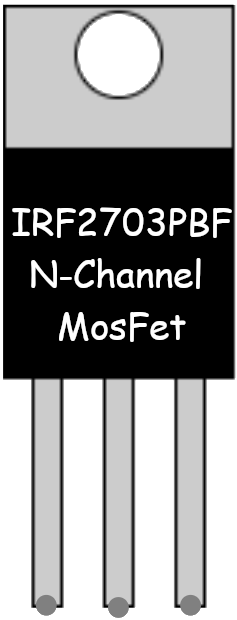

Image of IRF2703PBF N-Channel MosFet
Cirkit Designer LogoDesign with IRF2703PBF N-Channel MosFet in Cirkit Designer

Introduction

The IRF2703PBF is an N-Channel MOSFET designed for high-speed switching applications. It is widely used in circuits requiring efficient power management, motor control, and load switching. This component is known for its low on-resistance (RDS(on)) and fast switching times, which help minimize power losses and improve overall circuit performance.

Explore Projects Built with IRF2703PBF N-Channel MosFet
Use Cirkit Designer to design, explore, and prototype these projects online. Some projects support real-time simulation. Click "Open Project" to start designing instantly!
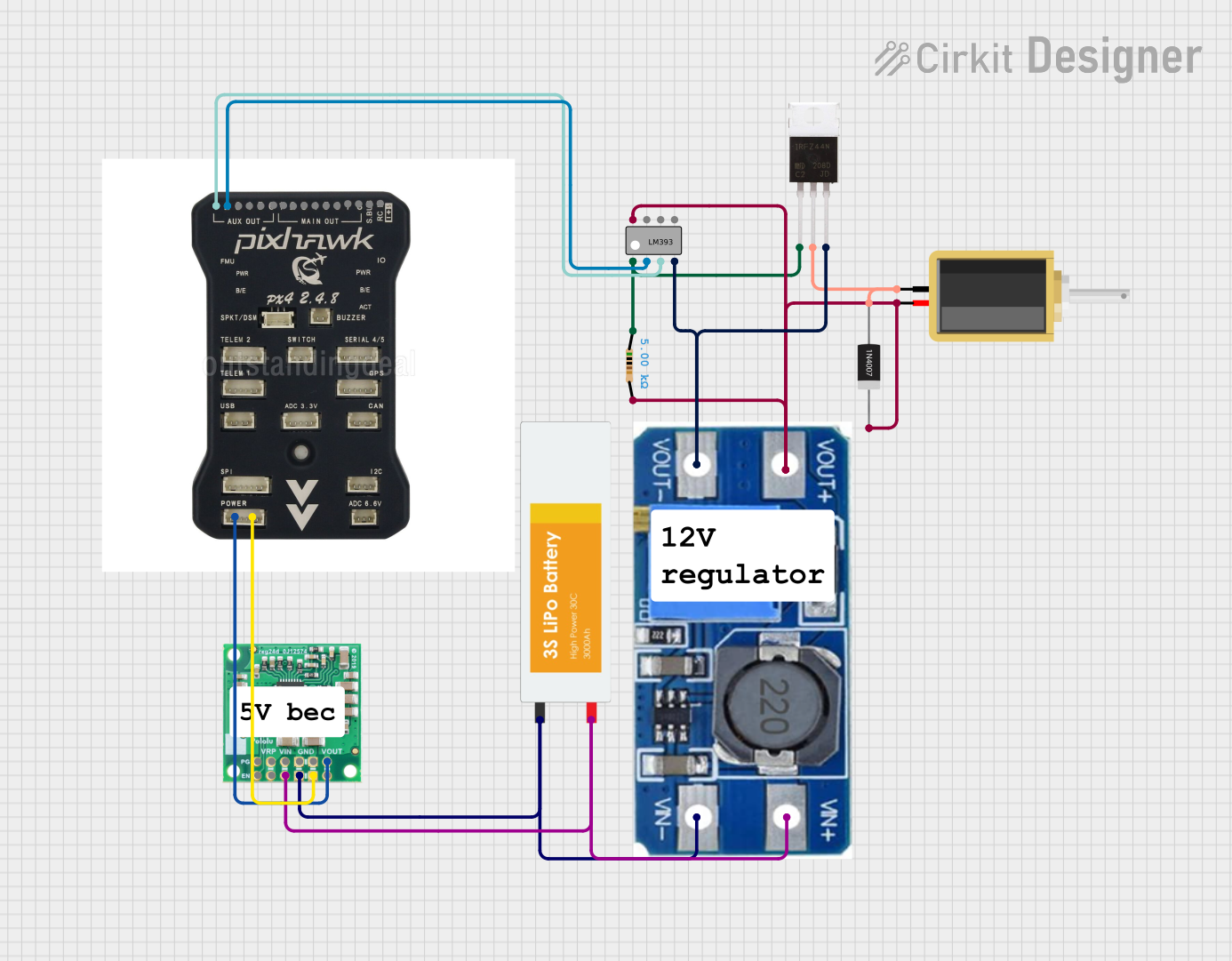
Pixhawk-Controlled Solenoid Driver with Voltage Regulation
Image of solenoid control circuit: A project utilizing IRF2703PBF N-Channel MosFet in a practical application
This circuit uses an LM393 comparator to drive an IRFZ44N MOSFET based on the comparison between two input signals from a pixhawk 2.4.8 flight controller. The MOSFET switches a solenoid, with a diode for back EMF protection, and the system is powered by a Lipo battery with voltage regulation provided by a step-up boost converter and a step-down voltage regulator to ensure stable operation. A resistor is connected to the gate of the MOSFET for proper biasing.
Cirkit Designer LogoOpen Project in Cirkit Designer
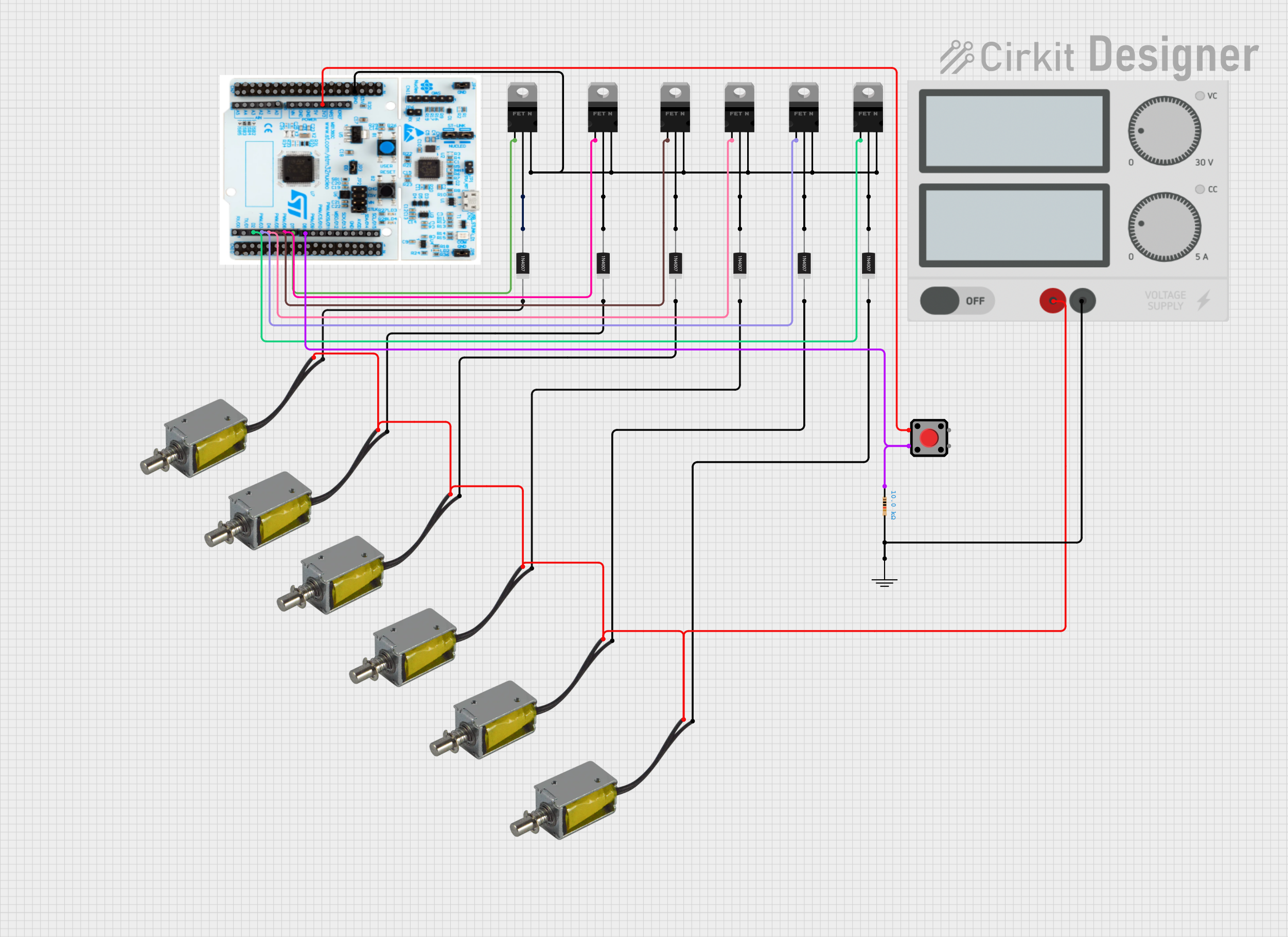
STM32 Nucleo-Controlled Solenoid Actuation System
Image of stm32 braile: A project utilizing IRF2703PBF N-Channel MosFet in a practical application
This circuit appears to be a microcontroller-driven array of push-pull solenoids with flyback diodes for protection. The STM32 Nucleo F303RE microcontroller's GPIO pins are connected to the gates of several nMOS transistors, which act as switches to control the current flow to the solenoids. A pushbutton with a pull-up resistor is also interfaced with the microcontroller for user input, and the power supply is connected to the solenoids with ground return paths through the nMOS transistors.
Cirkit Designer LogoOpen Project in Cirkit Designer
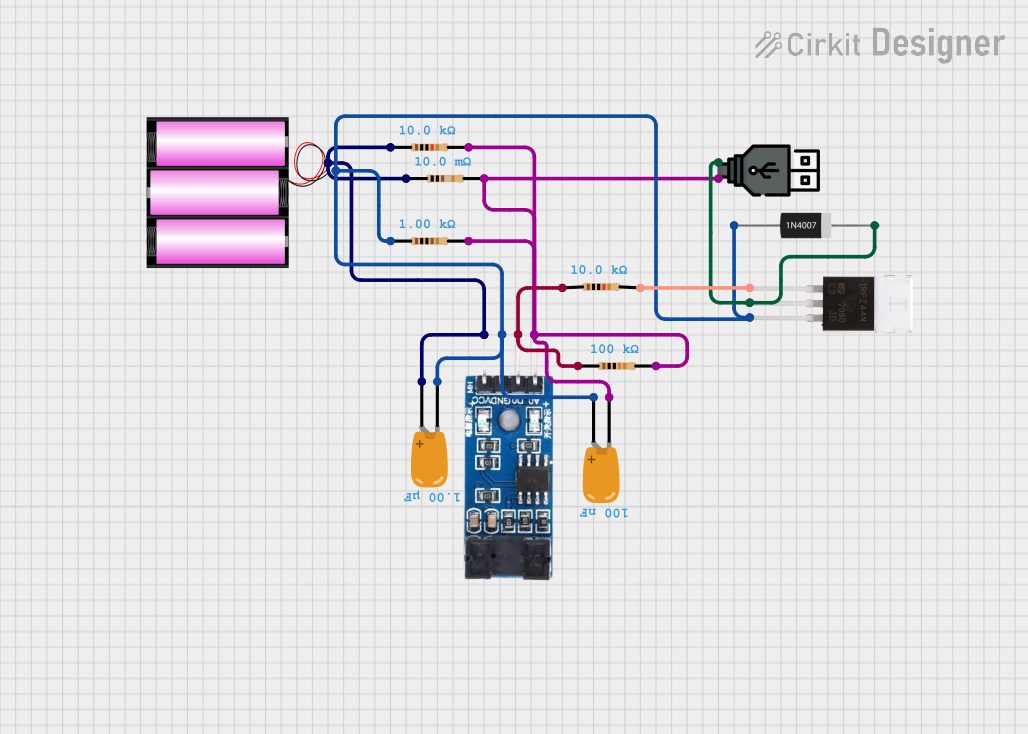
Battery-Powered LM393-Based Voltage Comparator Circuit with MOSFET Control
Image of cut off charger: A project utilizing IRF2703PBF N-Channel MosFet in a practical application
This circuit is a power regulation and control system that uses an LM393 comparator to monitor voltage levels and control a MOSFET (IRFZ44N) for switching. It is powered by a 12V battery and a USB power source, and includes various resistors and capacitors for filtering and stabilization.
Cirkit Designer LogoOpen Project in Cirkit Designer
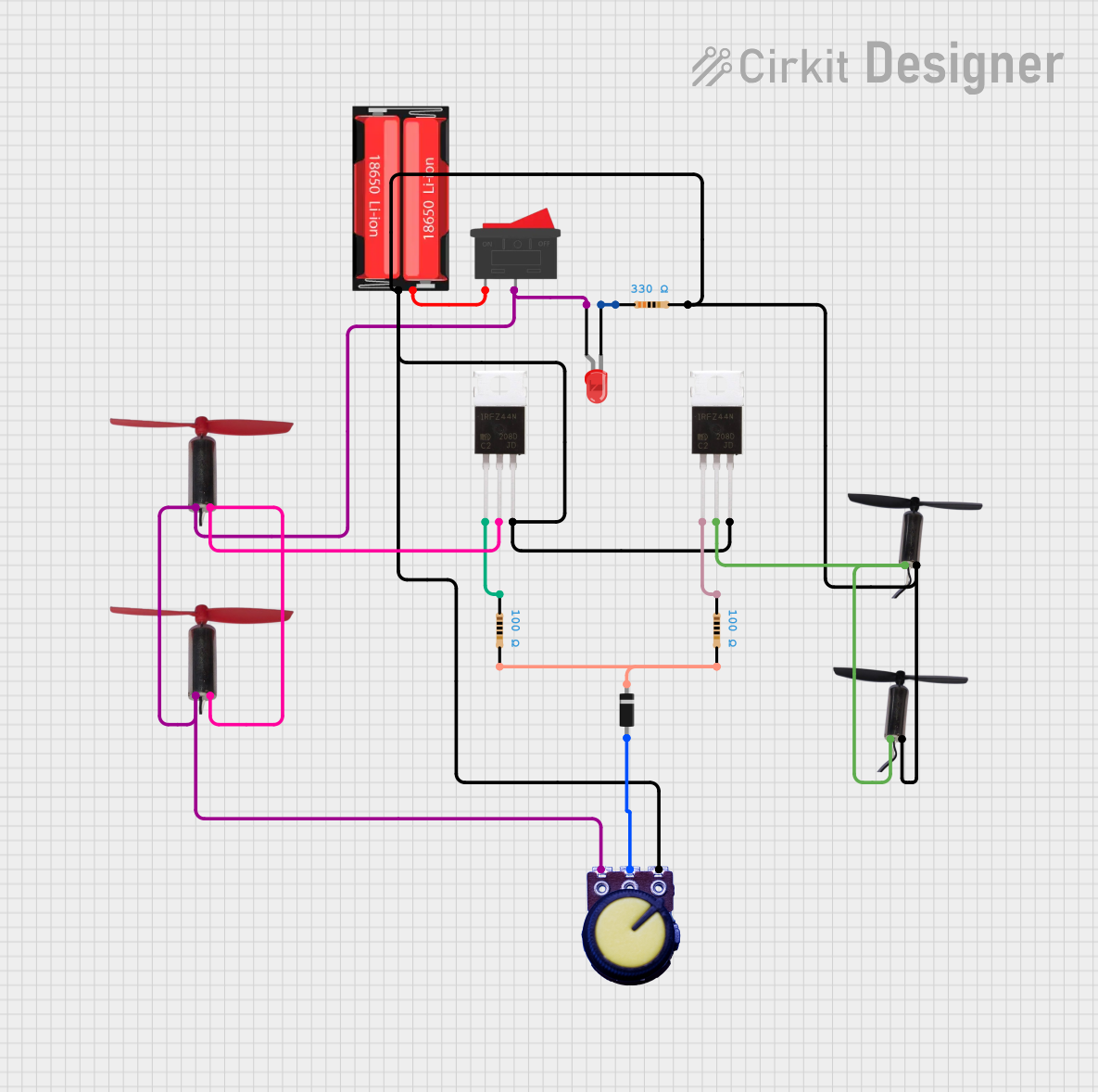
Dual Motor Control Circuit with LED Indicator and Adjustable Speed
Image of Simple Drone: A project utilizing IRF2703PBF N-Channel MosFet in a practical application
This circuit is designed to control the speed and direction of coreless motors using MOSFETs, with a potentiometer providing adjustable speed control for one direction. A rocker switch enables power control, and a red LED serves as a power indicator. Diodes are included for motor back-EMF protection.
Cirkit Designer LogoOpen Project in Cirkit Designer

Explore Projects Built with IRF2703PBF N-Channel MosFet

Use Cirkit Designer to design, explore, and prototype these projects online. Some projects support real-time simulation. Click "Open Project" to start designing instantly!
Image of solenoid control circuit: A project utilizing IRF2703PBF N-Channel MosFet in a practical application
Pixhawk-Controlled Solenoid Driver with Voltage Regulation
This circuit uses an LM393 comparator to drive an IRFZ44N MOSFET based on the comparison between two input signals from a pixhawk 2.4.8 flight controller. The MOSFET switches a solenoid, with a diode for back EMF protection, and the system is powered by a Lipo battery with voltage regulation provided by a step-up boost converter and a step-down voltage regulator to ensure stable operation. A resistor is connected to the gate of the MOSFET for proper biasing.
Cirkit Designer LogoOpen Project in Cirkit Designer
Image of stm32 braile: A project utilizing IRF2703PBF N-Channel MosFet in a practical application
STM32 Nucleo-Controlled Solenoid Actuation System
This circuit appears to be a microcontroller-driven array of push-pull solenoids with flyback diodes for protection. The STM32 Nucleo F303RE microcontroller's GPIO pins are connected to the gates of several nMOS transistors, which act as switches to control the current flow to the solenoids. A pushbutton with a pull-up resistor is also interfaced with the microcontroller for user input, and the power supply is connected to the solenoids with ground return paths through the nMOS transistors.
Cirkit Designer LogoOpen Project in Cirkit Designer
Image of cut off charger: A project utilizing IRF2703PBF N-Channel MosFet in a practical application
Battery-Powered LM393-Based Voltage Comparator Circuit with MOSFET Control
This circuit is a power regulation and control system that uses an LM393 comparator to monitor voltage levels and control a MOSFET (IRFZ44N) for switching. It is powered by a 12V battery and a USB power source, and includes various resistors and capacitors for filtering and stabilization.
Cirkit Designer LogoOpen Project in Cirkit Designer
Image of Simple Drone: A project utilizing IRF2703PBF N-Channel MosFet in a practical application
Dual Motor Control Circuit with LED Indicator and Adjustable Speed
This circuit is designed to control the speed and direction of coreless motors using MOSFETs, with a potentiometer providing adjustable speed control for one direction. A rocker switch enables power control, and a red LED serves as a power indicator. Diodes are included for motor back-EMF protection.
Cirkit Designer LogoOpen Project in Cirkit Designer

Common Applications

  • DC-DC converters
  • Motor drivers
  • Load switching in power management systems
  • High-speed switching circuits
  • Battery-powered devices

Technical Specifications

The IRF2703PBF is optimized for low-voltage applications and offers excellent performance in compact designs. Below are its key technical details:

Parameter Value
Drain-Source Voltage (VDS) 30V
Gate-Source Voltage (VGS) ±20V
Continuous Drain Current (ID) 52A (at 25°C)
Pulsed Drain Current (IDM) 210A
Power Dissipation (PD) 62W
RDS(on) (Max) 0.0085Ω (at VGS = 10V)
Gate Charge (Qg) 45nC
Operating Temperature Range -55°C to +175°C
Package Type D2PAK (TO-263)

Pin Configuration

The IRF2703PBF is available in a D2PAK (TO-263) package with three pins. The pinout is as follows:

Pin Number Pin Name Description
1 Gate (G) Controls the MOSFET switching state
2 Drain (D) Current flows into this terminal
3 Source (S) Current flows out of this terminal
Tab Drain (D) Connected to the drain for heat dissipation

Usage Instructions

The IRF2703PBF is straightforward to use in a variety of circuits. Below are the steps and considerations for integrating it into your design:

How to Use in a Circuit

  1. Gate Control: Connect the gate pin to a control signal (e.g., a microcontroller or driver circuit). Ensure the gate voltage (VGS) is within the specified range (±20V).
  2. Drain-Source Path: Connect the load between the drain and the positive supply voltage. The source pin should be connected to ground or the negative terminal of the power supply.
  3. Gate Resistor: Use a resistor (typically 10Ω to 100Ω) in series with the gate to limit inrush current and prevent oscillations.
  4. Flyback Diode: For inductive loads (e.g., motors), add a flyback diode across the load to protect the MOSFET from voltage spikes during switching.

Example Circuit with Arduino UNO

The IRF2703PBF can be used to control a DC motor with an Arduino UNO. Below is an example circuit and code:

Circuit Connections

  • Gate (G): Connect to Arduino digital pin (e.g., D9) through a 100Ω resistor.
  • Drain (D): Connect to one terminal of the motor.
  • Source (S): Connect to ground.
  • Motor: Connect the other terminal to the positive supply (e.g., 12V).
  • Flyback Diode: Place a diode (e.g., 1N4007) across the motor terminals, with the cathode connected to the positive supply.

Arduino Code

// Example code to control a DC motor using the IRF2703PBF MOSFET
const int motorPin = 9; // Pin connected to the MOSFET gate

void setup() {
  pinMode(motorPin, OUTPUT); // Set the motor pin as an output
}

void loop() {
  // Turn the motor ON
  digitalWrite(motorPin, HIGH); // Apply HIGH signal to the gate
  delay(2000); // Keep the motor running for 2 seconds

  // Turn the motor OFF
  digitalWrite(motorPin, LOW); // Apply LOW signal to the gate
  delay(2000); // Wait for 2 seconds before restarting
}

Best Practices

  • Ensure the gate voltage is sufficient to fully turn on the MOSFET (e.g., 10V for low RDS(on)).
  • Use proper heat sinking or cooling if the MOSFET operates near its maximum current or power dissipation limits.
  • Avoid exceeding the maximum ratings for VDS, VGS, and ID to prevent damage.

Troubleshooting and FAQs

Common Issues

  1. MOSFET Overheating

    • Cause: Insufficient heat dissipation or high RDS(on).
    • Solution: Use a heat sink or improve cooling. Ensure the gate voltage is high enough to minimize RDS(on).
  2. MOSFET Not Switching

    • Cause: Gate voltage is too low or control signal is not functioning.
    • Solution: Verify the gate voltage and ensure the control signal is within the specified range.
  3. Voltage Spikes Damaging the MOSFET

    • Cause: Inductive loads generating back EMF.
    • Solution: Add a flyback diode across the load to suppress voltage spikes.
  4. Low Efficiency

    • Cause: High switching losses or incorrect gate drive.
    • Solution: Use a proper gate resistor and ensure fast switching times.

FAQs

Q1: Can the IRF2703PBF be used with 3.3V logic?
A1: The IRF2703PBF requires a higher gate voltage (e.g., 10V) for optimal performance. Use a gate driver or level shifter if controlling it with 3.3V logic.

Q2: What is the maximum current the IRF2703PBF can handle?
A2: The maximum continuous drain current is 52A at 25°C, but this depends on proper heat dissipation.

Q3: Is the IRF2703PBF suitable for high-frequency switching?
A3: Yes, its low gate charge (Qg) and fast switching characteristics make it suitable for high-frequency applications.

Q4: How do I protect the MOSFET from overvoltage?
A4: Use a TVS diode or zener diode across the drain and source to clamp voltage spikes.