
How to Use Phoenix Edge 75 AMP ESC, 8S / 33.6V with 5 AMP BEC: Examples, Pinouts, and Specs
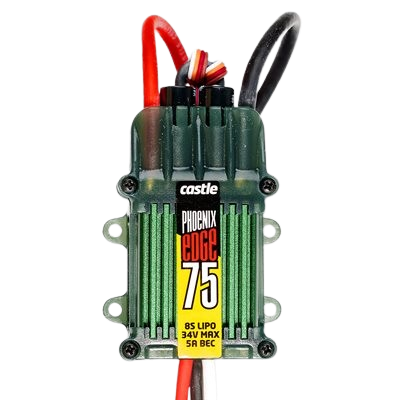
 Design with Phoenix Edge 75 AMP ESC, 8S / 33.6V with 5 AMP BEC in Cirkit Designer
Introduction
The Phoenix Edge 75 AMP ESC is a high-performance electronic speed controller (ESC) designed for demanding applications in RC vehicles, drones, and other motor-driven systems. Manufactured by Phoenix, this ESC is capable of handling up to 75 amps of continuous current and supports 8S lithium polymer (LiPo) batteries, with a maximum voltage of 33.6V. It also features an integrated 5 amp battery eliminator circuit (BEC), which provides regulated power for servos, receivers, and other onboard electronics.
Explore Projects Built with Phoenix Edge 75 AMP ESC, 8S / 33.6V with 5 AMP BEC
 Open Project in Cirkit Designer
 Open Project in Cirkit Designer
 Open Project in Cirkit Designer
 Open Project in Cirkit Designer
Explore Projects Built with Phoenix Edge 75 AMP ESC, 8S / 33.6V with 5 AMP BEC
Open Project in Cirkit DesignerOpen Project in Cirkit DesignerOpen Project in Cirkit DesignerOpen Project in Cirkit DesignerCommon Applications
- Remote-controlled (RC) airplanes, helicopters, and drones
- High-performance RC cars and boats
- Robotics and automation systems
- Custom motor control projects requiring precise speed and power regulation
Technical Specifications
The following table outlines the key technical details of the Phoenix Edge 75 AMP ESC:
| Parameter | Specification |
|---|---|
| Manufacturer | Phoenix |
| Part ID | ESC |
| Continuous Current Rating | 75 Amps |
| Input Voltage Range | 2S to 8S LiPo (7.4V to 33.6V) |
| BEC Output | 5 Amps @ 5.0V (regulated) |
| Maximum Motor Poles | 14 |
| Operating Temperature Range | -20°C to 105°C |
| Dimensions | 2.2 x 1.5 x 0.6 inches (56 x 38 x 15 mm) |
| Weight | 2.2 oz (62 grams) |
Pin Configuration and Descriptions
The Phoenix Edge 75 AMP ESC has the following key connections:
| Pin/Connector | Description |
|---|---|
| Battery Input | Connects to the positive (+) and negative (-) terminals of the LiPo battery. |
| Motor Output | Three wires (A, B, C) connect to the brushless motor. |
| Signal Input | Standard 3-pin servo connector for throttle signal from the receiver. |
| BEC Output | Provides 5V regulated power for servos, receivers, or other devices. |
| USB Port | For firmware updates and configuration using Phoenix software. |
Usage Instructions
How to Use the Phoenix Edge 75 AMP ESC in a Circuit
- Connect the Battery: Attach the LiPo battery to the ESC's battery input terminals, ensuring correct polarity.
- Connect the Motor: Connect the three motor wires (A, B, C) to the brushless motor. If the motor spins in the wrong direction, swap any two wires.
- Connect the Receiver: Plug the ESC's signal input connector into the throttle channel of your RC receiver.
- Power the System: Turn on the transmitter first, then connect the battery to the ESC. The ESC will initialize and emit a series of beeps to indicate readiness.
- Calibrate Throttle: Follow the ESC's manual to calibrate the throttle range for optimal performance.
Important Considerations and Best Practices
- Battery Compatibility: Ensure the LiPo battery used is within the 2S to 8S range (7.4V to 33.6V).
- Cooling: Avoid overheating by providing adequate airflow or heat dissipation, especially in high-current applications.
- Firmware Updates: Use the USB port to update the ESC firmware via Phoenix's official software for improved performance and features.
- BEC Usage: Do not exceed the 5A limit of the integrated BEC when powering external devices.
Example Code for Arduino UNO
The Phoenix Edge ESC can be controlled using an Arduino UNO by generating a PWM signal. Below is an example code snippet:
#include <Servo.h> // Include the Servo library for PWM signal generation

Servo esc; // Create a Servo object to control the ESC

void setup() {
  esc.attach(9); // Attach the ESC signal wire to pin 9 on the Arduino
  esc.writeMicroseconds(1000); // Send minimum throttle signal (1000 µs)
  delay(2000); // Wait for 2 seconds to allow ESC initialization
}

void loop() {
  esc.writeMicroseconds(1500); // Send mid-throttle signal (1500 µs)
  delay(5000); // Run motor at mid-throttle for 5 seconds

  esc.writeMicroseconds(1000); // Send minimum throttle signal (1000 µs)
  delay(5000); // Stop motor for 5 seconds
}
Note: Ensure the ESC is properly calibrated before using it with an Arduino. Refer to the ESC's manual for calibration instructions.
Troubleshooting and FAQs
Common Issues and Solutions
Motor Does Not Spin
- Cause: Incorrect wiring or throttle signal.
- Solution: Verify motor connections (A, B, C) and ensure the throttle signal is properly calibrated.
ESC Overheating
- Cause: Excessive current draw or poor ventilation.
- Solution: Reduce load on the motor or improve cooling with a fan or heat sink.
BEC Not Powering Devices
- Cause: Exceeding the 5A BEC limit.
- Solution: Use an external BEC or power source for high-current devices.
Beeping Sounds
- Cause: ESC is in programming mode or detecting an error.
- Solution: Refer to the ESC's manual for beep code meanings and resolve the issue accordingly.
FAQs
Can I use this ESC with a brushed motor? No, the Phoenix Edge 75 AMP ESC is designed for brushless motors only.
What happens if I connect a battery with a voltage higher than 33.6V? Connecting a battery with a voltage higher than the rated 33.6V can damage the ESC permanently.
Can I disable the BEC? Yes, the BEC can be disabled via the Phoenix software if an external power source is preferred.
Is the ESC waterproof? No, the ESC is not waterproof. Use waterproofing measures if operating in wet conditions.
This documentation provides a comprehensive guide to using the Phoenix Edge 75 AMP ESC effectively and safely. For further assistance, consult the manufacturer's manual or support resources.