The ProtoSnap - Pro Mini is an innovative prototyping solution that combines a variety of electronic components on a single, compact protoboard. At the heart of this platform is an Arduino-compatible Pro Mini microcontroller, which allows users to program and control the integrated components with ease. This makes the ProtoSnap - Pro Mini an ideal choice for hobbyists, educators, and prototyping professionals who require a quick and efficient way to develop and test their ideas.
Common applications of the ProtoSnap - Pro Mini include:
Rapid prototyping of electronic circuits
Educational projects for learning electronics and programming
Development of wearable technology
IoT device creation
Small-scale automation projects
Explore Projects Built with ProtoSnap - Pro Mini
Use Cirkit Designer to design, explore, and prototype these projects online. Some projects support real-time simulation. Click "Open Project" to start designing instantly!
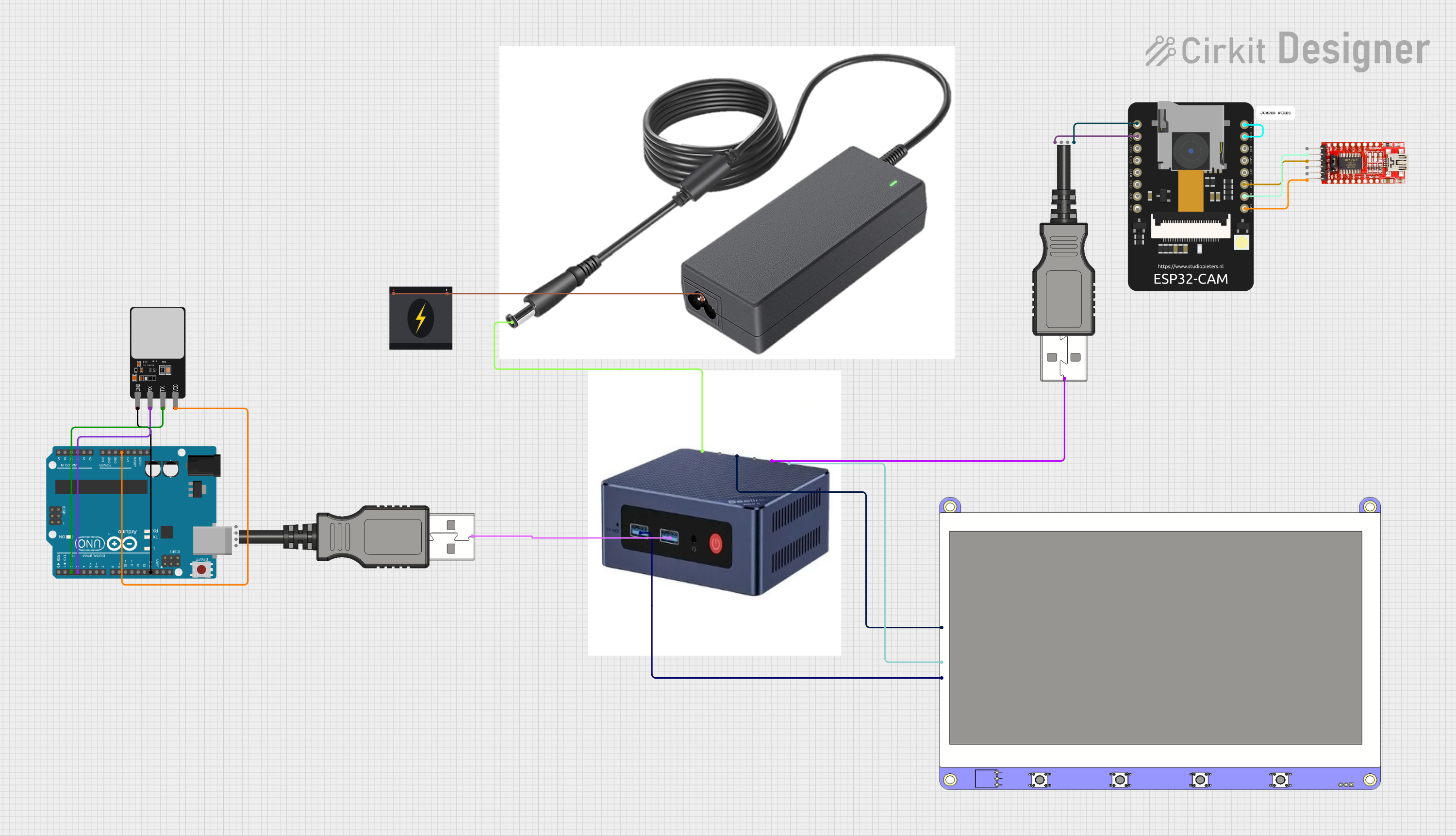
This circuit features a Beelink MINI S12 N95 computer connected to a 7-inch display via HDMI for video output and two USB connections for power and touch screen functionality. An Arduino UNO is interfaced with a fingerprint scanner for biometric input. The Beelink MINI S12 N95 is powered by a PC power supply, which in turn is connected to a 240V power source. Additionally, an ESP32 CAM module is powered and programmed via a USB plug and an FTDI programmer, respectively, for wireless camera capabilities.
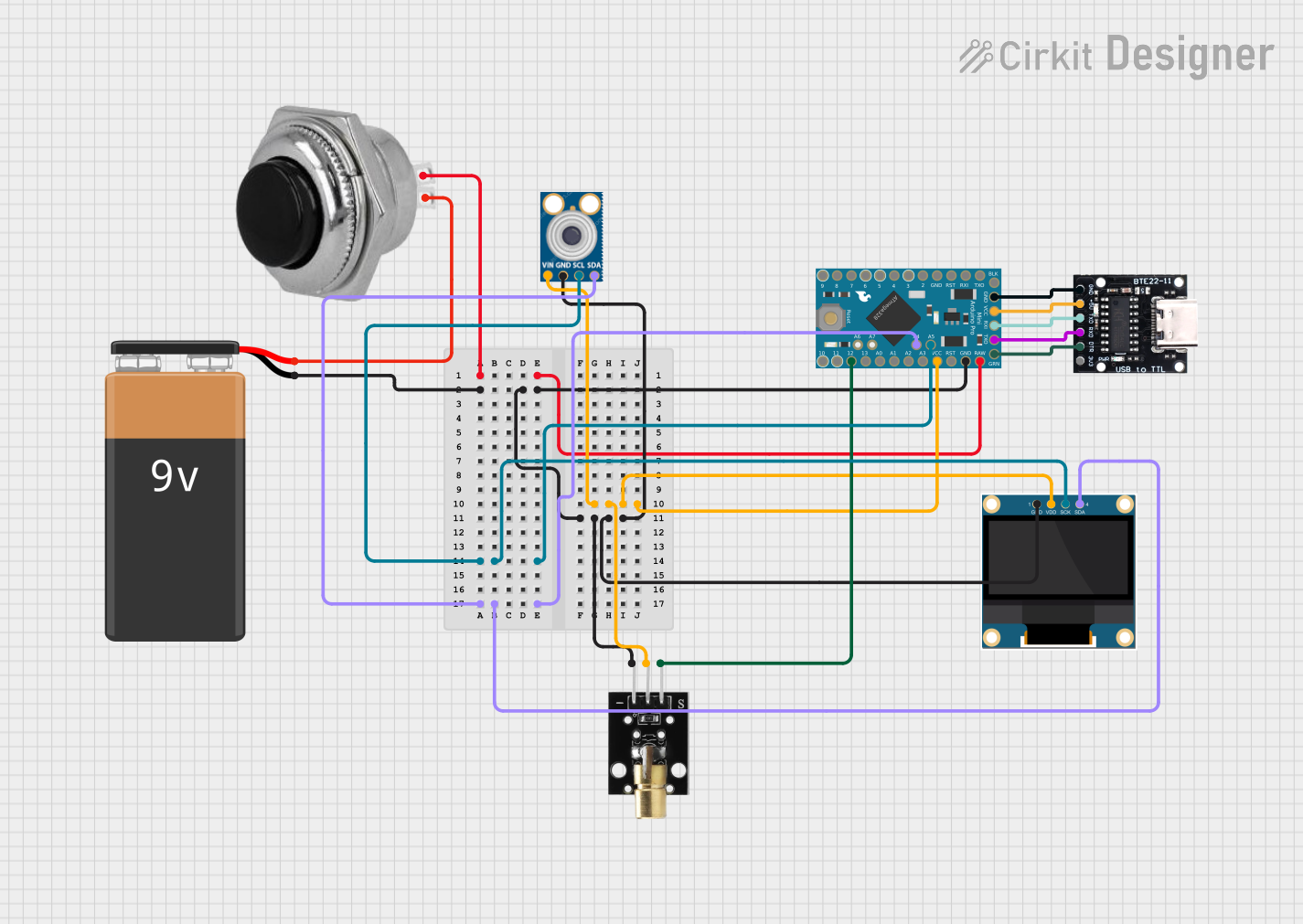
This circuit features an Arduino Pro Mini microcontroller interfaced with a USB Serial TTL for programming and power, a momentary switch for user input, and a 9V battery for power supply. It includes a KY-008 laser emitter, a 0.96" OLED display, and an MLX90614 temperature sensor, all connected to the Arduino for a potential temperature measurement and display application.
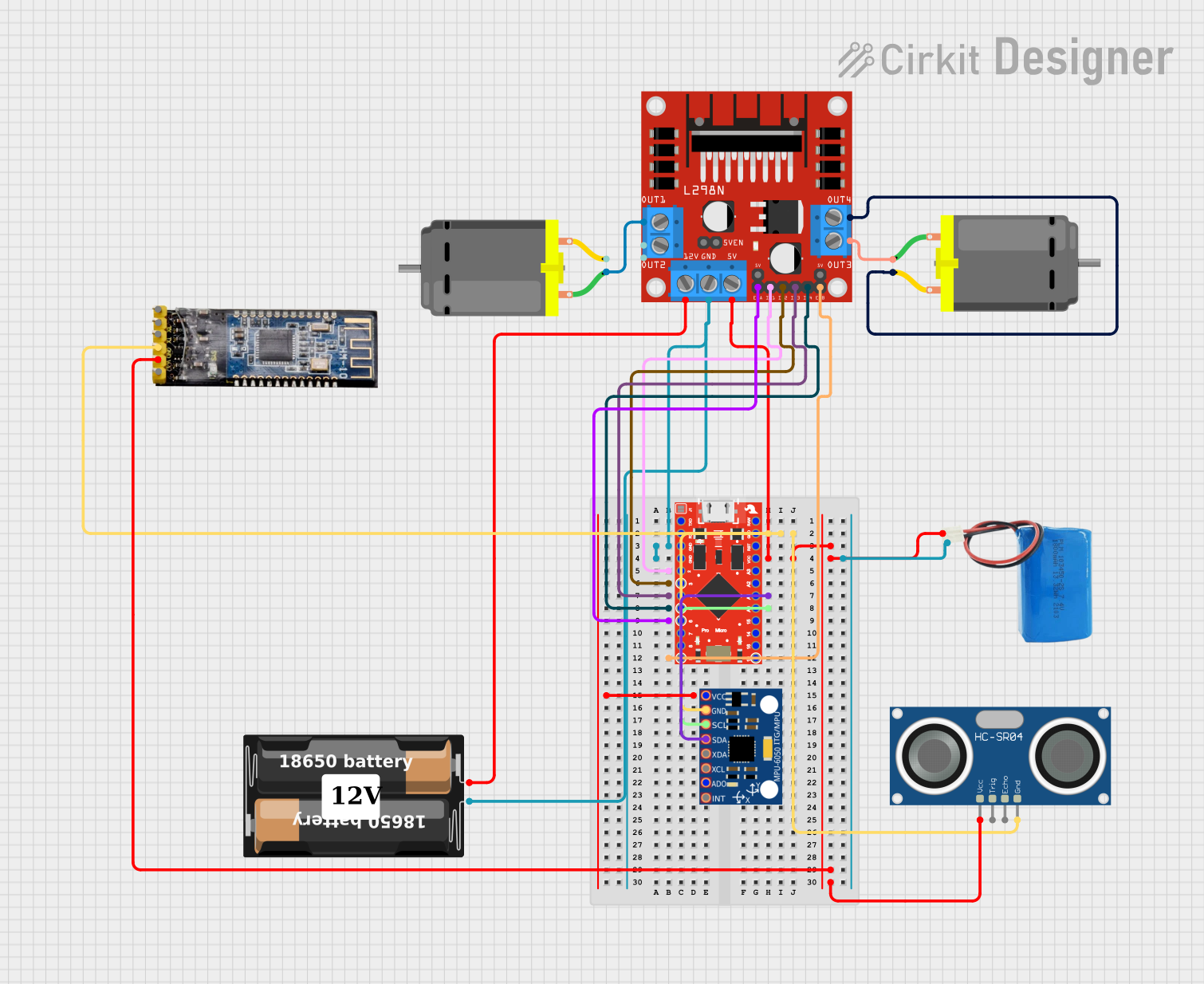
This circuit features a SparkFun Pro Micro microcontroller interfaced with an L298N DC motor driver to control two DC motors, an HC-SR04 ultrasonic sensor for distance measurement, a Bluetooth module HM-10 for wireless communication, and an MPU-6050 for motion tracking. The Pro Micro is responsible for processing sensor data and managing motor speeds and directions via the motor driver. Power is supplied by a 5V battery connected to the Pro Micro and a separate battery case providing 12V to the motor driver.
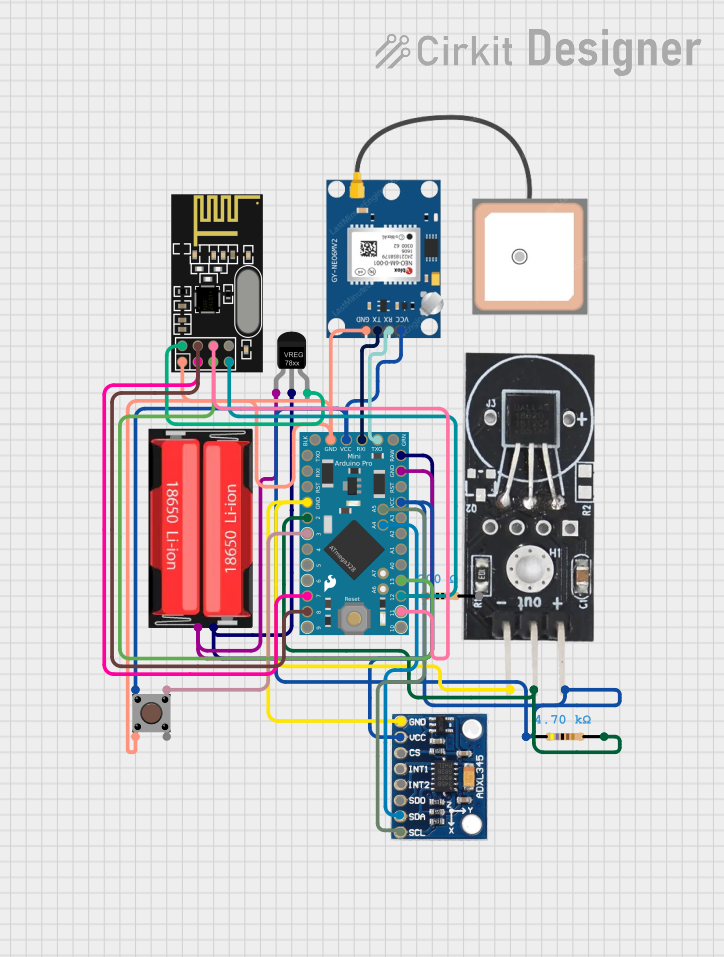
This circuit features an Arduino Pro Mini as the central microcontroller, interfaced with a GPS NEO 6M module for location tracking, an ADXL345 accelerometer for motion sensing, a DS18B20 temperature sensor for environmental monitoring, and an NRF24L01 module for wireless communication. The circuit is powered by an 18650 Li-Ion battery through a voltage regulator, ensuring stable power supply to the components. A pushbutton is included for user input, and resistors are used for pull-up/down configurations and current limiting purposes.
Digital input/output pins, PWM on pins 3, 5, 6, 9, 10, and 11
14-21
Analog Pins
Analog input pins A0-A7
22
AREF
Analog reference voltage for the ADC
23
GND
Ground
24
RST
Reset pin, can be used to externally reset the microcontroller
25
VCC
Positive supply voltage for the microcontroller
26
GND
Ground
27
RAW
Raw voltage input for onboard voltage regulator
28
GND
Ground
29
RXI
Receive data (serial communication)
30
TXO
Transmit data (serial communication)
31
GND
Ground
32
BLK
Blocked, reserved for future use
Usage Instructions
Integrating the ProtoSnap - Pro Mini into a Circuit
Powering the Board: Connect a power supply to the RAW and GND pins if using an unregulated power source, or to the VCC and GND pins if using a regulated 3.3V or 5V supply.
Programming the Board: Use a USB-to-serial breakout board or cable to connect the RXI and TXO pins to your computer for programming the Pro Mini via the Arduino IDE.
Using Digital and Analog Pins: Connect sensors, actuators, and other components to the digital and analog pins as required for your project. Ensure that the connected devices are compatible with the operating voltage of the Pro Mini.
Resetting the Board: If necessary, the RESET pin can be used to manually reset the microcontroller.
Important Considerations and Best Practices
Always verify the power supply voltage and current ratings before connecting to the ProtoSnap - Pro Mini to prevent damage.
When connecting components to the I/O pins, ensure that the total current does not exceed the maximum rating for each pin and for the microcontroller as a whole.
Use pull-up or pull-down resistors with digital inputs to ensure a stable state when switches or sensors are disconnected.
Avoid placing the board in environments with extreme temperatures, humidity, or where it may be subjected to mechanical stress.
Troubleshooting and FAQs
Common Issues
Q: Why is my ProtoSnap - Pro Mini not responding to the uploaded sketch?
A: Ensure that the correct board and port are selected in the Arduino IDE. Check the wiring, especially the USB-to-serial connections, and verify that the correct drivers are installed.
Q: How can I reset the Pro Mini if it's not responding?
A: Briefly connect the RESET pin to GND to manually reset the microcontroller.
Q: I'm having trouble with serial communication, what should I do?
A: Check the baud rate settings and ensure that the RXI and TXO pins are correctly connected. Also, make sure that no other devices are using the same serial port.
Solutions and Tips for Troubleshooting
Double-check all connections and ensure that they are secure and correct.
Use a multimeter to verify voltages at different points in the circuit.
If you encounter unexpected behavior, simplify your setup to isolate the issue.
Consult the Arduino community forums and the manufacturer's support resources for additional assistance.
Example Code for Arduino UNO
// Blink an LED connected to pin 13 of the ProtoSnap - Pro Mini

void setup() {
  pinMode(13, OUTPUT); // Set pin 13 as an output
}

void loop() {
  digitalWrite(13, HIGH); // Turn the LED on
  delay(1000);            // Wait for a second
  digitalWrite(13, LOW);  // Turn the LED off
  delay(1000);            // Wait for a second
}
Note: This example assumes that an LED is connected to pin 13 with a suitable current-limiting resistor. Always ensure that the components you connect are rated for the voltage and current supplied by the ProtoSnap - Pro Mini pins.


 Open Project in Cirkit Designer