Cirkit Designer Logo
Cirkit Designer
Your all-in-one circuit design IDE
Home / 
Component Documentation

How to Use Si4599: Examples, Pinouts, and Specs
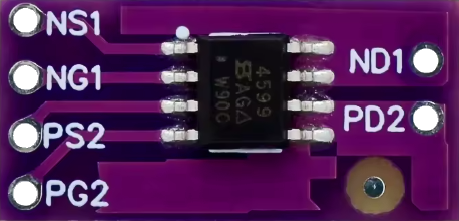

Image of Si4599
Cirkit Designer LogoDesign with Si4599 in Cirkit Designer

Introduction

The Si4599 is a high-performance N-channel MOSFET designed for efficient power management in a wide range of applications. It features low on-resistance (RDS(on)) and fast switching capabilities, making it ideal for use in power conversion, motor control, and load switching circuits. Its robust design ensures reliable operation in demanding environments, while its compact package allows for space-saving designs.

Explore Projects Built with Si4599
Use Cirkit Designer to design, explore, and prototype these projects online. Some projects support real-time simulation. Click "Open Project" to start designing instantly!
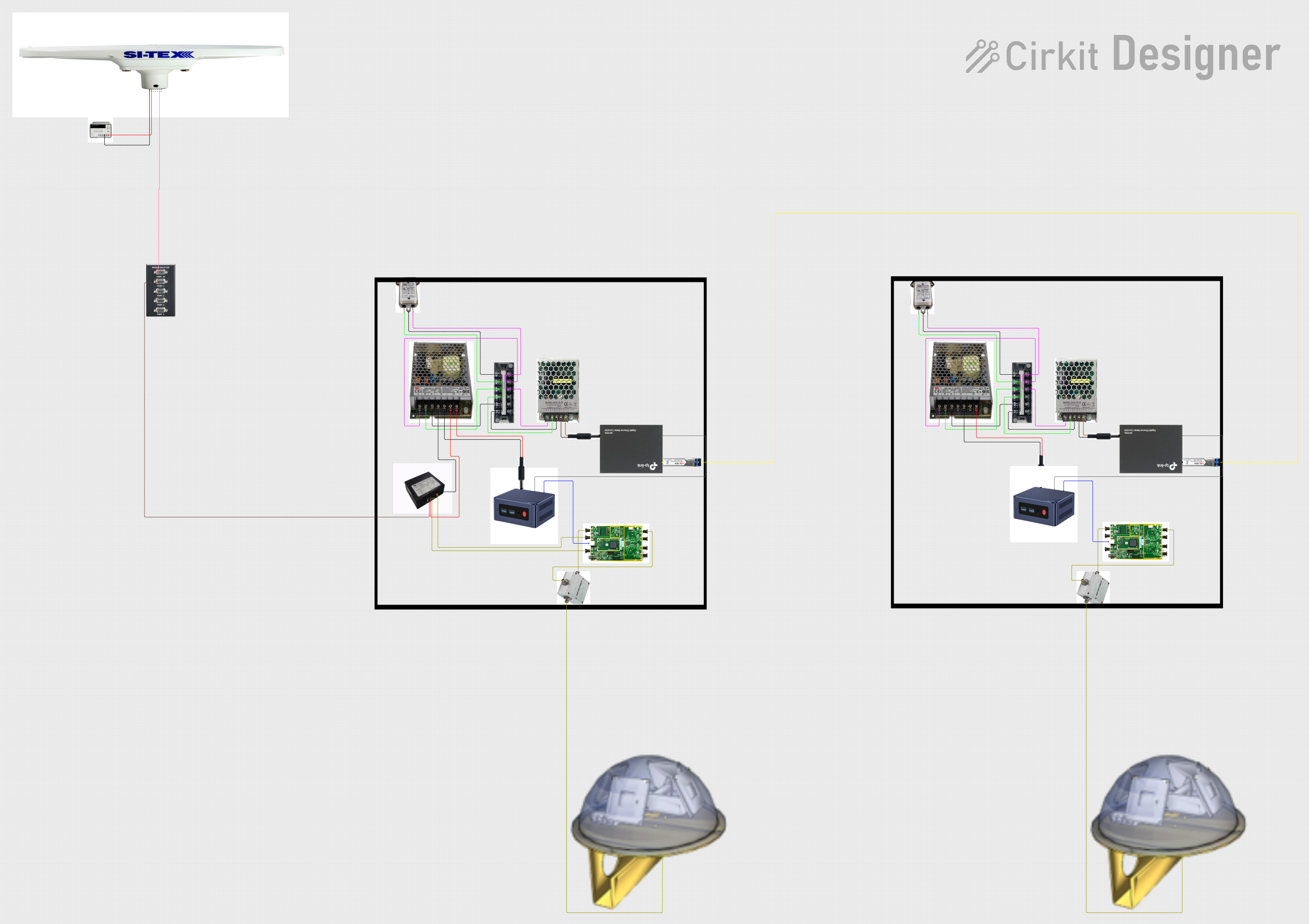
Satellite-Based Timing and Navigation System with SDR and Atomic Clock Synchronization
Image of GPS 시스템 측정 구성도_Confirm: A project utilizing Si4599 in a practical application
This circuit appears to be a complex system involving power supply management, GPS and timing synchronization, and data communication. It includes a SI-TEX G1 Satellite Compass for GPS data, an XHTF1021 Atomic Rubidium Clock for precise timing, and Ettus USRP B200 units for software-defined radio communication. Power is supplied through various SMPS units and distributed via terminal blocks and DC jacks. Data communication is facilitated by Beelink MINI S12 N95 computers, RS232 splitters, and a 1000BASE-T Media Converter for network connectivity. RF Directional Couplers are used to interface antennas with the USRP units, and the entire system is likely contained within cases for protection and organization.
Cirkit Designer LogoOpen Project in Cirkit Designer
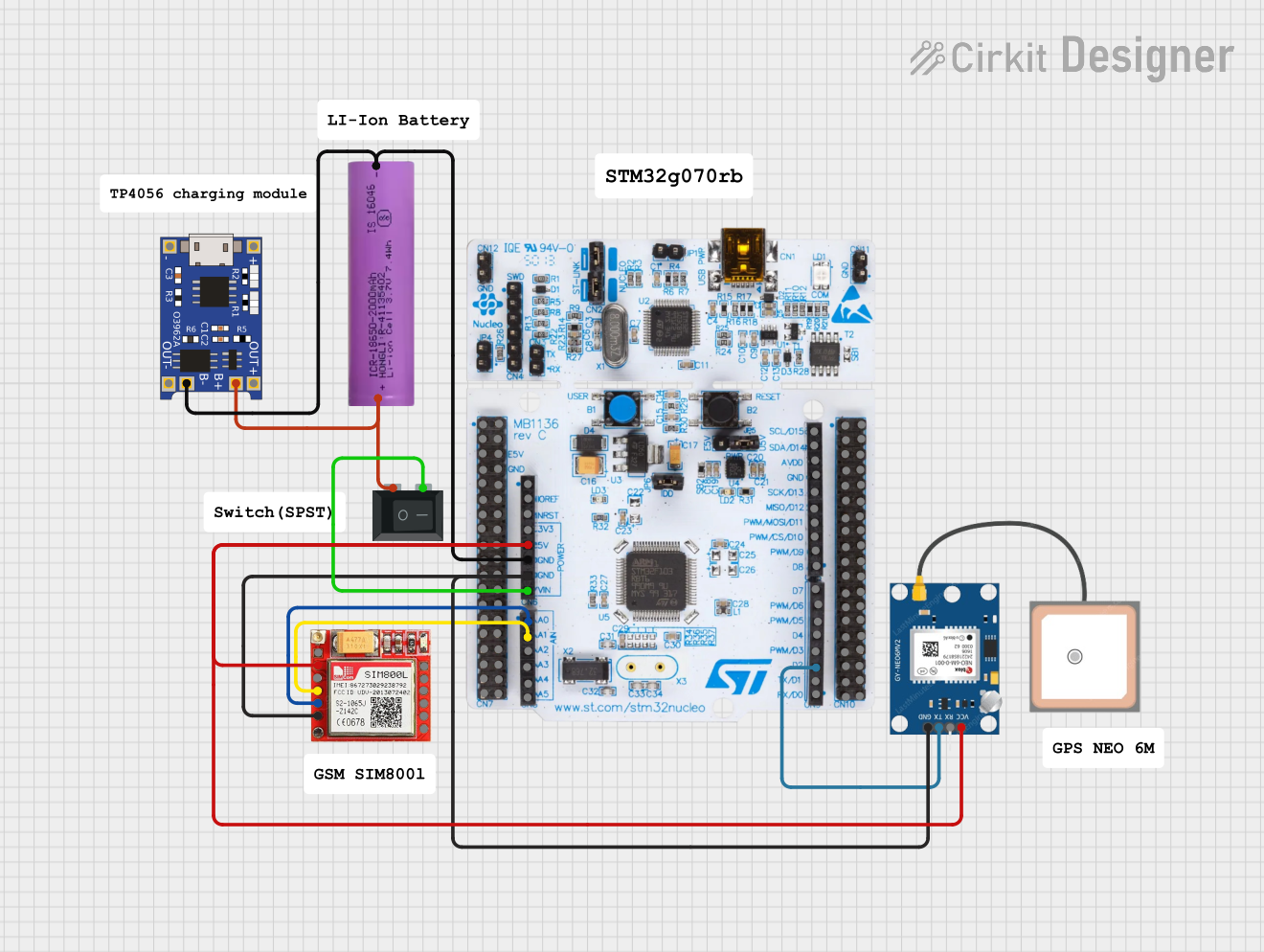
Battery-Powered Emergency Alert System with NUCLEO-F072RB, SIM800L, and GPS NEO 6M
Image of women safety: A project utilizing Si4599 in a practical application
This circuit is an emergency alert system that uses a NUCLEO-F072RB microcontroller to send SMS alerts and make calls via a SIM800L GSM module, while obtaining location data from a GPS NEO 6M module. The system is powered by a Li-ion battery and includes a TP4056 module for battery charging and protection, with a rocker switch to control power to the microcontroller.
Cirkit Designer LogoOpen Project in Cirkit Designer
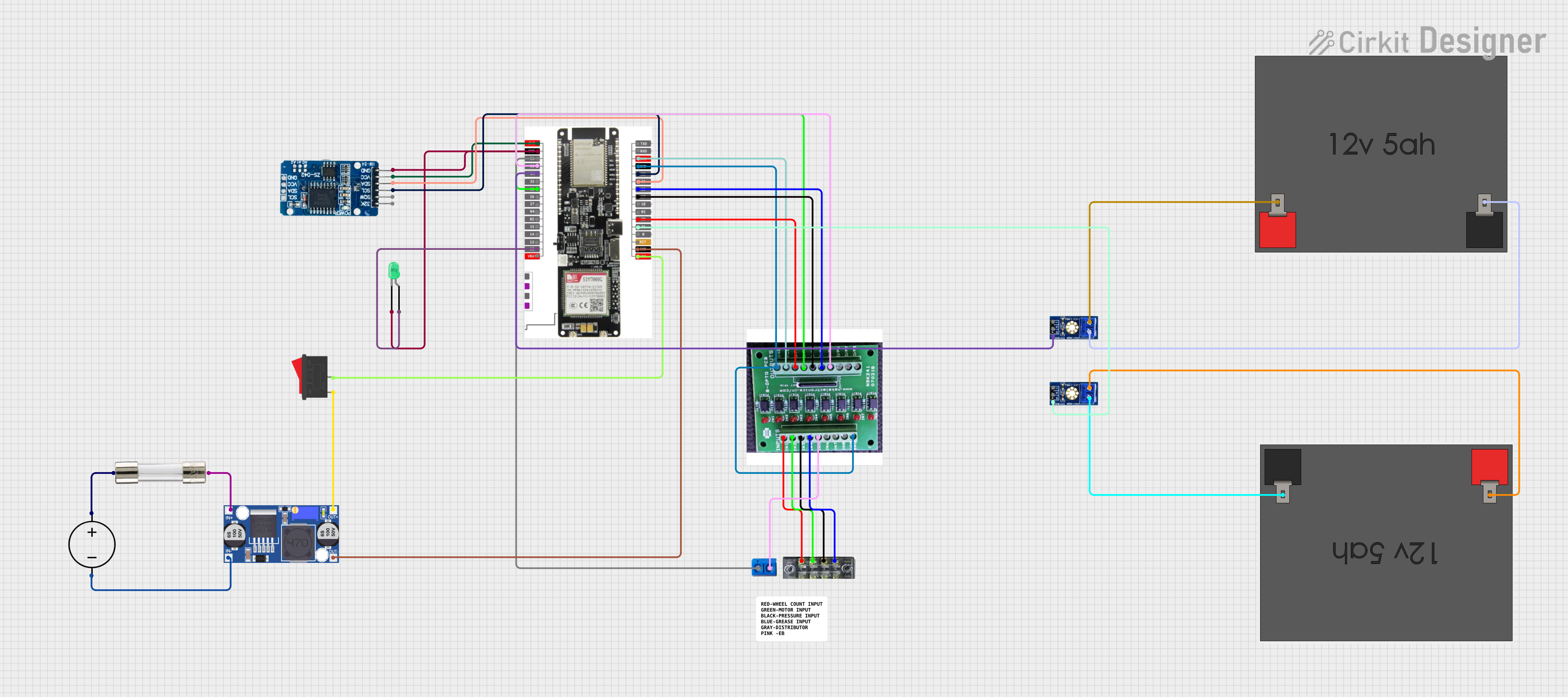
Cellular-Enabled IoT Device with Real-Time Clock and Power Management
Image of LRCM PHASE 2 BASIC: A project utilizing Si4599 in a practical application
This circuit features a LilyGo-SIM7000G module for cellular communication and GPS functionality, interfaced with an RTC DS3231 for real-time clock capabilities. It includes voltage sensing through two voltage sensor modules, and uses an 8-channel opto-coupler for isolating different parts of the circuit. Power management is handled by a buck converter connected to a DC power source and batteries, with a fuse for protection and a rocker switch for on/off control. Additionally, there's an LED for indication purposes.
Cirkit Designer LogoOpen Project in Cirkit Designer
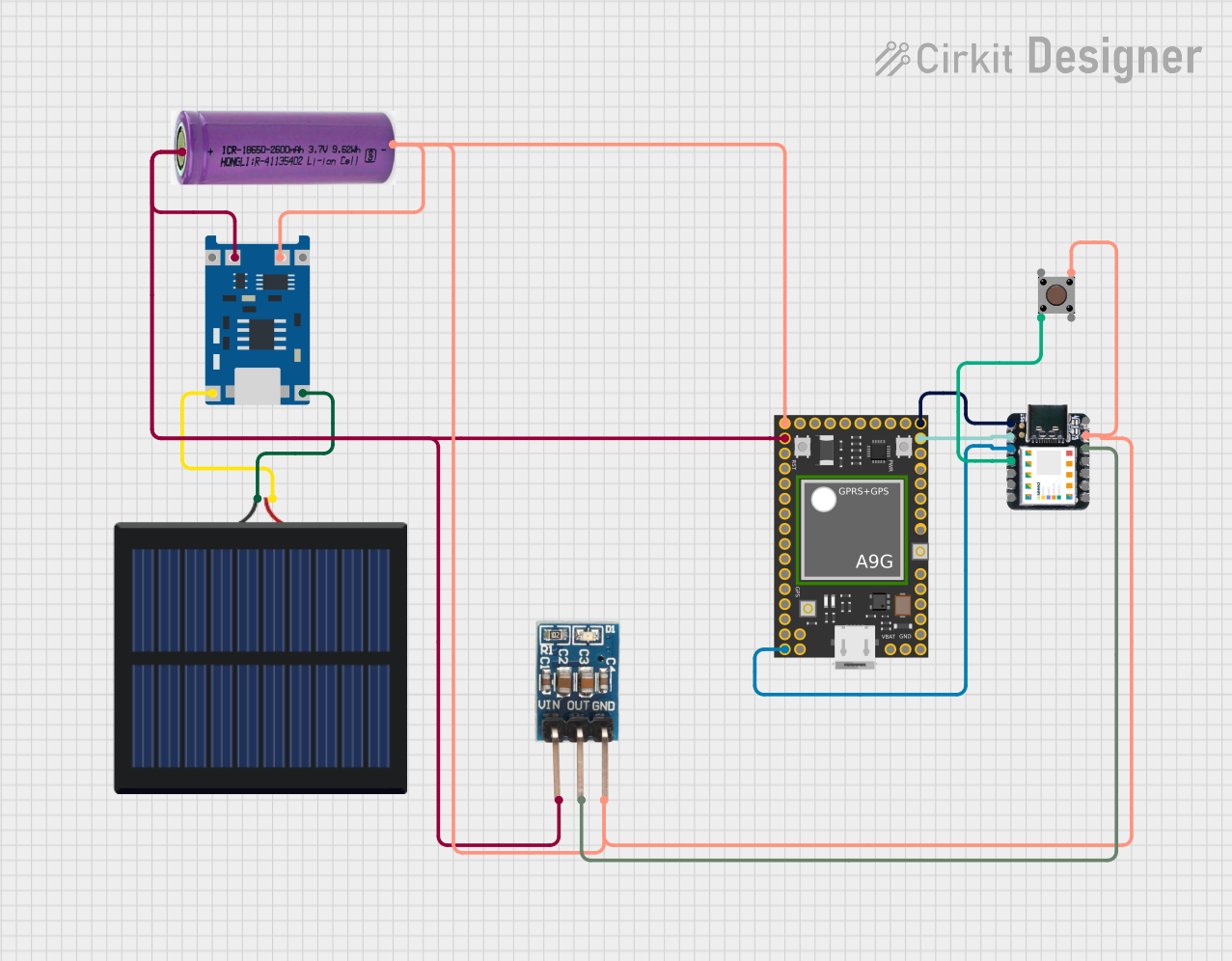
Solar-Powered GSM/GPRS+GPS Tracker with Seeeduino XIAO
Image of SOS System : A project utilizing Si4599 in a practical application
This circuit features an Ai Thinker A9G development board for GSM/GPRS and GPS/BDS connectivity, interfaced with a Seeeduino XIAO microcontroller for control and data processing. A solar cell, coupled with a TP4056 charging module, charges a 3.3V battery, which powers the system through a 3.3V regulator ensuring stable operation. The circuit likely serves for remote data communication and location tracking, with the capability to be powered by renewable energy and interfaced with additional sensors or input devices via the Seeeduino XIAO.
Cirkit Designer LogoOpen Project in Cirkit Designer

Explore Projects Built with Si4599

Use Cirkit Designer to design, explore, and prototype these projects online. Some projects support real-time simulation. Click "Open Project" to start designing instantly!
Image of GPS 시스템 측정 구성도_Confirm: A project utilizing Si4599 in a practical application
Satellite-Based Timing and Navigation System with SDR and Atomic Clock Synchronization
This circuit appears to be a complex system involving power supply management, GPS and timing synchronization, and data communication. It includes a SI-TEX G1 Satellite Compass for GPS data, an XHTF1021 Atomic Rubidium Clock for precise timing, and Ettus USRP B200 units for software-defined radio communication. Power is supplied through various SMPS units and distributed via terminal blocks and DC jacks. Data communication is facilitated by Beelink MINI S12 N95 computers, RS232 splitters, and a 1000BASE-T Media Converter for network connectivity. RF Directional Couplers are used to interface antennas with the USRP units, and the entire system is likely contained within cases for protection and organization.
Cirkit Designer LogoOpen Project in Cirkit Designer
Image of women safety: A project utilizing Si4599 in a practical application
Battery-Powered Emergency Alert System with NUCLEO-F072RB, SIM800L, and GPS NEO 6M
This circuit is an emergency alert system that uses a NUCLEO-F072RB microcontroller to send SMS alerts and make calls via a SIM800L GSM module, while obtaining location data from a GPS NEO 6M module. The system is powered by a Li-ion battery and includes a TP4056 module for battery charging and protection, with a rocker switch to control power to the microcontroller.
Cirkit Designer LogoOpen Project in Cirkit Designer
Image of LRCM PHASE 2 BASIC: A project utilizing Si4599 in a practical application
Cellular-Enabled IoT Device with Real-Time Clock and Power Management
This circuit features a LilyGo-SIM7000G module for cellular communication and GPS functionality, interfaced with an RTC DS3231 for real-time clock capabilities. It includes voltage sensing through two voltage sensor modules, and uses an 8-channel opto-coupler for isolating different parts of the circuit. Power management is handled by a buck converter connected to a DC power source and batteries, with a fuse for protection and a rocker switch for on/off control. Additionally, there's an LED for indication purposes.
Cirkit Designer LogoOpen Project in Cirkit Designer
Image of SOS System : A project utilizing Si4599 in a practical application
Solar-Powered GSM/GPRS+GPS Tracker with Seeeduino XIAO
This circuit features an Ai Thinker A9G development board for GSM/GPRS and GPS/BDS connectivity, interfaced with a Seeeduino XIAO microcontroller for control and data processing. A solar cell, coupled with a TP4056 charging module, charges a 3.3V battery, which powers the system through a 3.3V regulator ensuring stable operation. The circuit likely serves for remote data communication and location tracking, with the capability to be powered by renewable energy and interfaced with additional sensors or input devices via the Seeeduino XIAO.
Cirkit Designer LogoOpen Project in Cirkit Designer

Common Applications

  • DC-DC converters
  • Motor drivers
  • Load switches
  • Battery management systems
  • LED drivers

Technical Specifications

The Si4599 is optimized for high efficiency and low power loss. Below are its key technical specifications:

Parameter Value
Drain-Source Voltage (VDS) 30 V
Gate-Source Voltage (VGS) ±20 V
Continuous Drain Current (ID) 20 A (at 25°C)
Pulsed Drain Current (IDM) 80 A
On-Resistance (RDS(on)) 4.5 mΩ (at VGS = 10 V)
Total Gate Charge (Qg) 13 nC
Power Dissipation (PD) 3.1 W (at 25°C)
Operating Temperature Range -55°C to +150°C
Package Type PowerPAK® SO-8

Pin Configuration and Descriptions

The Si4599 is available in a PowerPAK® SO-8 package with the following pinout:

Pin Number Pin Name Description
1, 2, 3 Source (S) Source terminal of the MOSFET
4 Gate (G) Gate terminal for controlling the MOSFET
5, 6, 7, 8 Drain (D) Drain terminal of the MOSFET
Tab Drain (D) Connected to the drain for heat dissipation

Usage Instructions

The Si4599 is straightforward to use in a variety of circuits. Below are the steps and considerations for integrating it into your design:

Basic Circuit Example

To use the Si4599 as a switch, connect the source terminal to ground, the drain terminal to the load, and the gate terminal to a control signal. A resistor (typically 10 kΩ) can be added between the gate and source to ensure the MOSFET remains off when no control signal is applied.

Example Circuit with Arduino UNO

The Si4599 can be controlled using an Arduino UNO to switch a load (e.g., an LED or motor). Below is an example:

// Define the MOSFET gate pin
const int mosfetGatePin = 9; // Connect this pin to the Si4599 gate

void setup() {
  pinMode(mosfetGatePin, OUTPUT); // Set the gate pin as an output
}

void loop() {
  digitalWrite(mosfetGatePin, HIGH); // Turn the MOSFET on
  delay(1000); // Keep it on for 1 second
  digitalWrite(mosfetGatePin, LOW);  // Turn the MOSFET off
  delay(1000); // Keep it off for 1 second
}

Important Considerations

  1. Gate Drive Voltage: Ensure the gate voltage (VGS) is within the specified range (±20 V). For optimal performance, use a gate voltage of 10 V.
  2. Thermal Management: The Si4599 can dissipate significant power. Use proper heat sinking or PCB thermal design to prevent overheating.
  3. Load Protection: Add a flyback diode across inductive loads (e.g., motors) to protect the MOSFET from voltage spikes during switching.

Troubleshooting and FAQs

Common Issues

  1. MOSFET Not Switching Properly

    • Cause: Insufficient gate drive voltage.
    • Solution: Ensure the gate voltage is at least 10 V for full enhancement.
  2. Excessive Heat Generation

    • Cause: High current or inadequate thermal management.
    • Solution: Check the load current and improve heat dissipation using a heatsink or thermal vias.
  3. MOSFET Always On or Off

    • Cause: Floating gate or incorrect wiring.
    • Solution: Add a pull-down resistor (e.g., 10 kΩ) between the gate and source to ensure proper operation.

FAQs

  1. Can the Si4599 be used with 3.3 V logic?

    • Yes, but the on-resistance (RDS(on)) will be higher compared to a 10 V gate drive. For optimal performance, use a gate driver or level shifter to provide 10 V.
  2. What is the maximum load current the Si4599 can handle?

    • The Si4599 can handle up to 20 A continuously at 25°C, but ensure proper thermal management to avoid overheating.
  3. Is the Si4599 suitable for high-frequency switching?

    • Yes, the Si4599 has a low total gate charge (Qg), making it suitable for high-frequency applications.

By following these guidelines and best practices, the Si4599 can be effectively used in a variety of power management and switching applications.