
How to Use JF-0530B solenoid : Examples, Pinouts, and Specs
 Design with JF-0530B solenoid in Cirkit Designer
Introduction
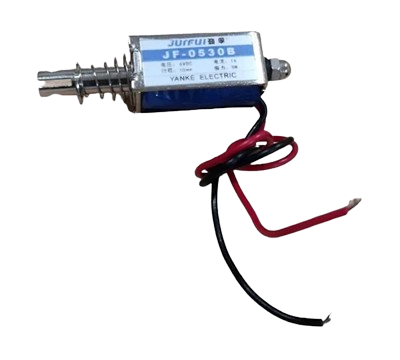
The JF-0530B solenoid, manufactured by Junfui (Part ID: Nano), is an electromechanical device designed to convert electrical energy into linear motion. It operates by energizing a coil of wire to generate a magnetic field, which pulls a movable plunger. This solenoid is compact, reliable, and versatile, making it suitable for a wide range of applications.
Explore Projects Built with JF-0530B solenoid
 Open Project in Cirkit Designer
 Open Project in Cirkit Designer
 Open Project in Cirkit Designer
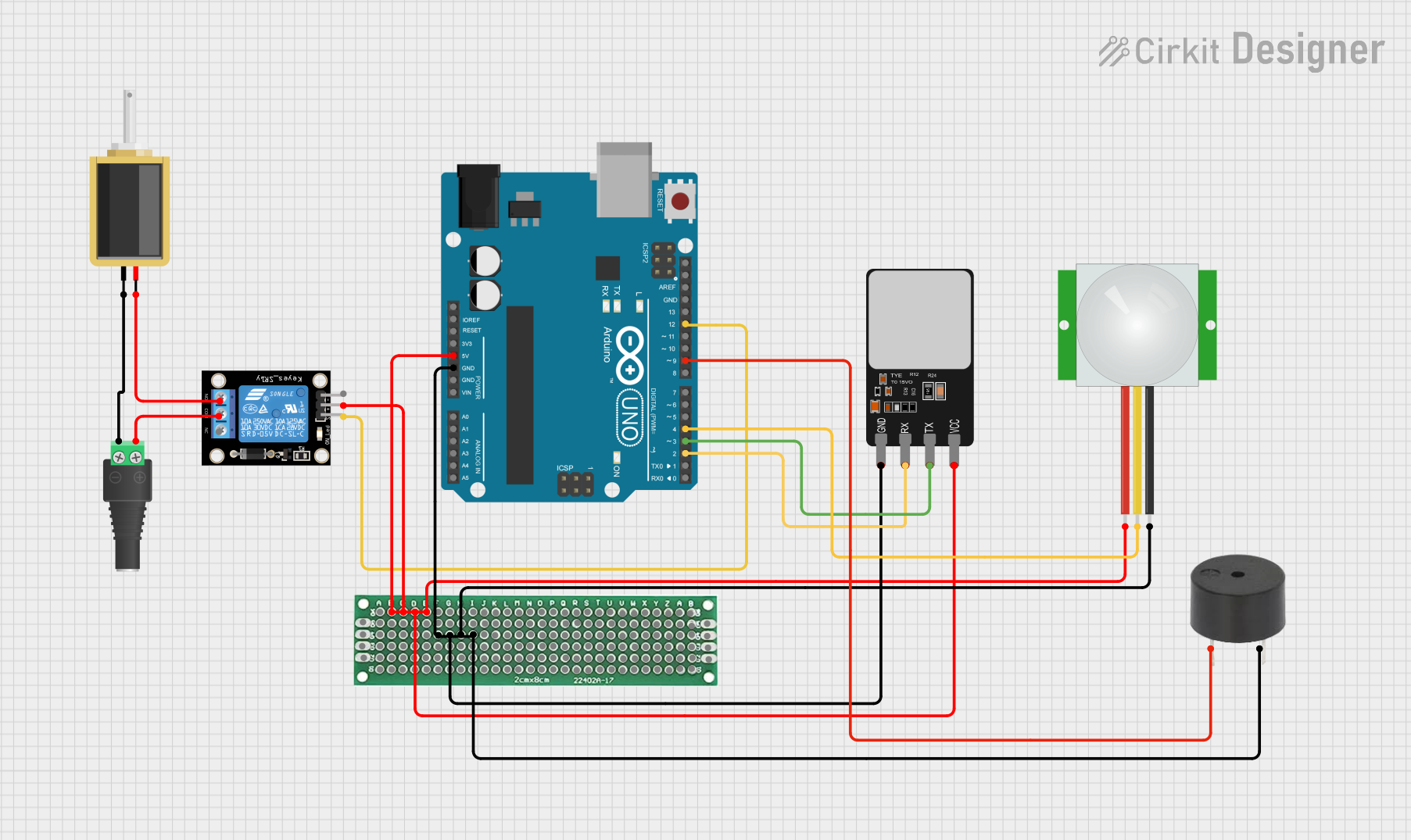 Open Project in Cirkit Designer
Explore Projects Built with JF-0530B solenoid
Open Project in Cirkit DesignerOpen Project in Cirkit DesignerOpen Project in Cirkit DesignerOpen Project in Cirkit DesignerCommon Applications and Use Cases
- Door locks: Used in electronic locking mechanisms for secure access control.
- Automated systems: Ideal for activating switches or controlling valves in industrial automation.
- Vending machines: Commonly used to release items or control dispensing mechanisms.
- Robotics: Provides linear motion for robotic arms or grippers.
- Home appliances: Found in devices like washing machines and dishwashers for controlling water flow.
Technical Specifications
Below are the key technical details for the JF-0530B solenoid:
| Parameter | Value |
|---|---|
| Manufacturer | Junfui |
| Part ID | Nano |
| Operating Voltage | 6V DC |
| Current Consumption | 1.1A |
| Power Rating | 6.6W |
| Stroke Length | 10mm |
| Force | 300g at 10mm stroke |
| Coil Resistance | ~5.5Ω |
| Dimensions | 30mm x 15mm x 15mm |
| Weight | 50g |
| Duty Cycle | 50% (recommended for longevity) |
Pin Configuration and Descriptions
The JF-0530B solenoid has two terminals for electrical connections:
| Pin | Description |
|---|---|
| + | Positive terminal (connect to 6V DC power supply) |
| - | Negative terminal (connect to ground) |
Usage Instructions
How to Use the JF-0530B Solenoid in a Circuit
- Power Supply: Connect the solenoid to a 6V DC power source. Ensure the power supply can provide at least 1.1A of current.
- Control Circuit: Use a transistor or MOSFET to control the solenoid. A diode should be placed across the solenoid terminals to protect the circuit from voltage spikes caused by the collapsing magnetic field when the solenoid is turned off.
- Activation: Apply 6V DC to the solenoid to energize the coil and pull the plunger. Remove the voltage to release the plunger.
Circuit Example with Arduino UNO
Below is an example of how to control the JF-0530B solenoid using an Arduino UNO and an NPN transistor (e.g., 2N2222):
// Define the pin connected to the transistor's base
const int solenoidPin = 9;

void setup() {
  pinMode(solenoidPin, OUTPUT); // Set the solenoid pin as an output
}

void loop() {
  digitalWrite(solenoidPin, HIGH); // Activate the solenoid
  delay(1000);                     // Keep it on for 1 second
  digitalWrite(solenoidPin, LOW);  // Deactivate the solenoid
  delay(1000);                     // Wait for 1 second
}
Important Considerations and Best Practices
- Diode Protection: Always use a flyback diode (e.g., 1N4007) across the solenoid terminals to prevent damage to the control circuit.
- Duty Cycle: Operate the solenoid within the recommended 50% duty cycle to avoid overheating.
- Power Supply: Ensure the power supply is stable and capable of providing sufficient current.
- Mounting: Secure the solenoid firmly to prevent movement during operation.
Troubleshooting and FAQs
Common Issues and Solutions
Solenoid Not Activating
- Cause: Insufficient power supply or loose connections.
- Solution: Verify the power supply voltage and current. Check all connections.
Overheating
- Cause: Exceeding the recommended duty cycle or prolonged activation.
- Solution: Operate within the 50% duty cycle and allow cooling periods.
Voltage Spikes Damaging Circuit
- Cause: Missing or faulty flyback diode.
- Solution: Install a flyback diode across the solenoid terminals.
Weak or No Linear Motion
- Cause: Excessive load or mechanical obstruction.
- Solution: Ensure the load does not exceed 300g and check for obstructions.
FAQs
Q: Can I use a higher voltage to increase the solenoid's force?
A: No, exceeding the rated 6V DC can damage the coil and reduce the solenoid's lifespan.
Q: What type of transistor should I use to control the solenoid?
A: Use an NPN transistor (e.g., 2N2222) or an N-channel MOSFET with a current rating of at least 1.5A.
Q: Can the solenoid be used continuously?
A: No, the solenoid is designed for intermittent use with a 50% duty cycle to prevent overheating.
Q: How do I mount the solenoid?
A: Use screws or brackets to secure the solenoid to a stable surface, ensuring proper alignment of the plunger.
This concludes the documentation for the JF-0530B solenoid. Follow the guidelines above for safe and effective operation.