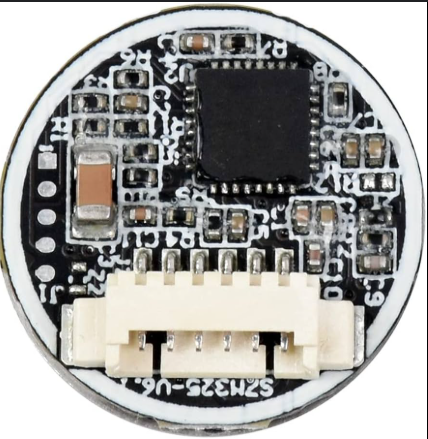
The Waveshare UART Capacitive Fingerprint Sensor (Type D) is a biometric device designed to capture and analyze the unique patterns of a person's fingerprint for identification and authentication purposes. This sensor uses capacitive technology to ensure high accuracy and reliability in fingerprint recognition. It communicates via a UART interface, making it easy to integrate into a wide range of microcontroller-based systems.
Explore Projects Built with finger print sensor
Use Cirkit Designer to design, explore, and prototype these projects online. Some projects support real-time simulation. Click "Open Project" to start designing instantly!
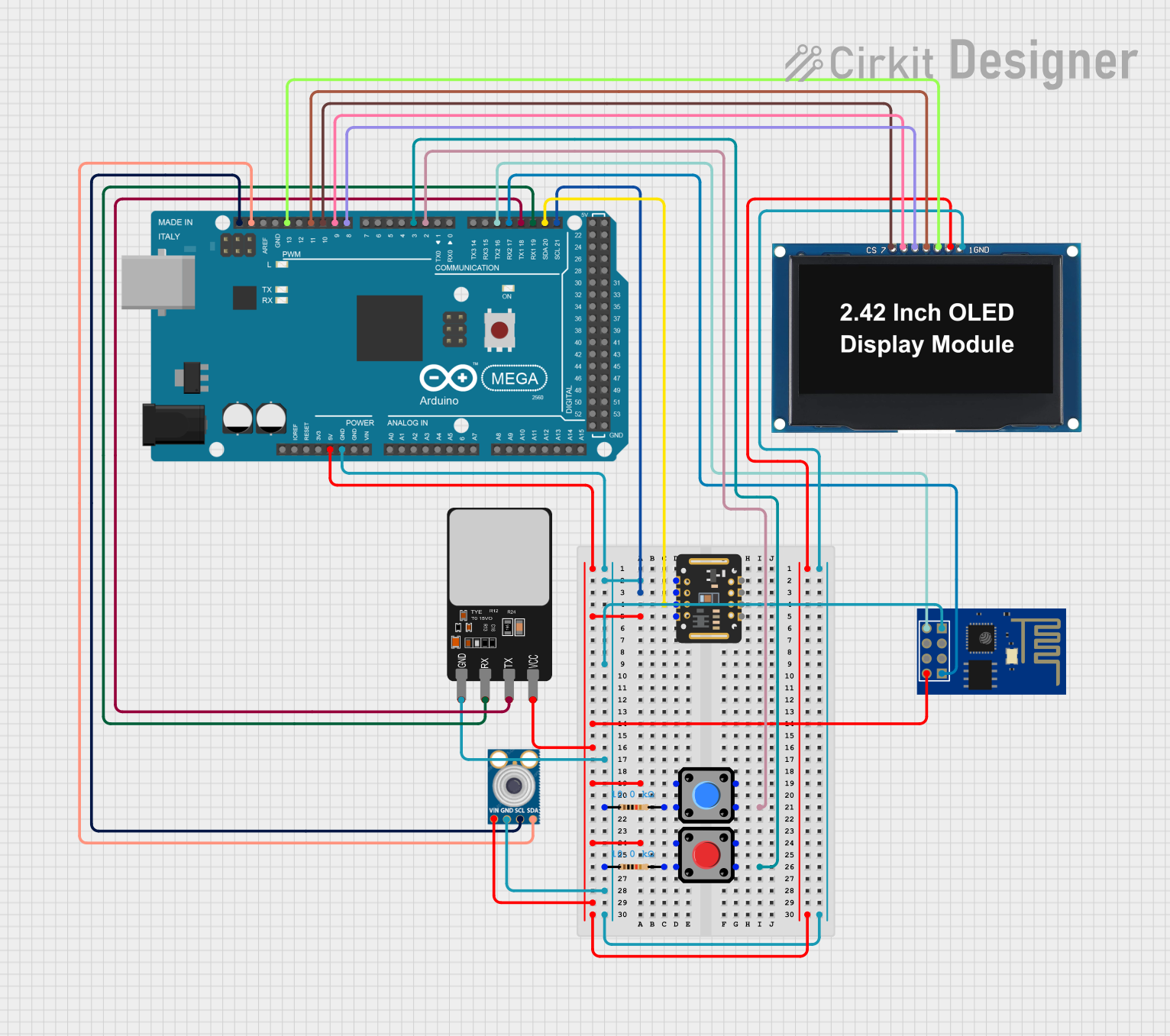
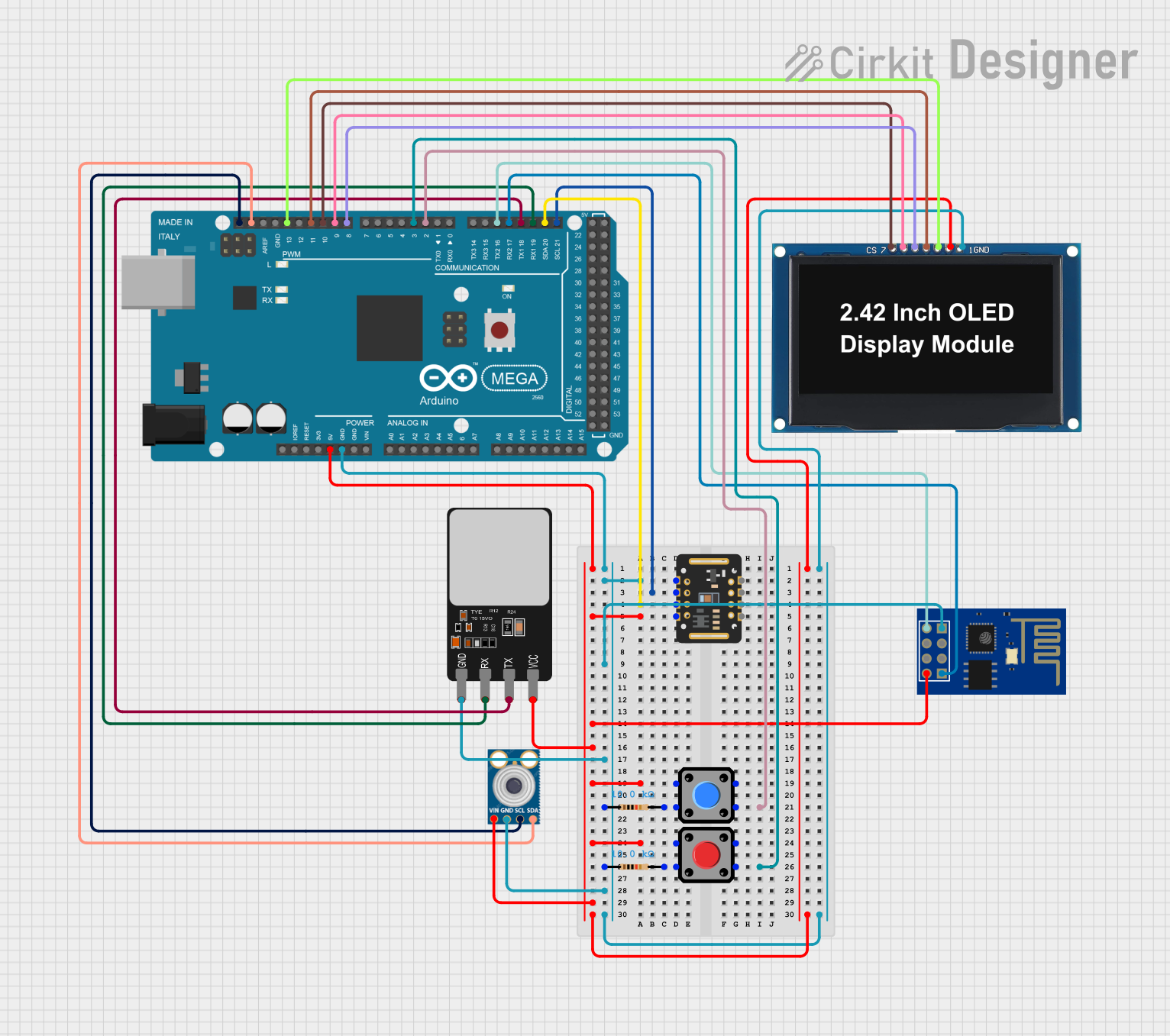
This is a multi-functional sensor system controlled by an Arduino Mega 2560, designed to read biometric data from a pulse oximeter and an infrared thermometer, authenticate using a fingerprint scanner, display information on an OLED screen, and transmit data wirelessly via an ESP8266 module. User inputs can be received through two pushbuttons, and the system's power distribution is managed through common ground and voltage supply nets.
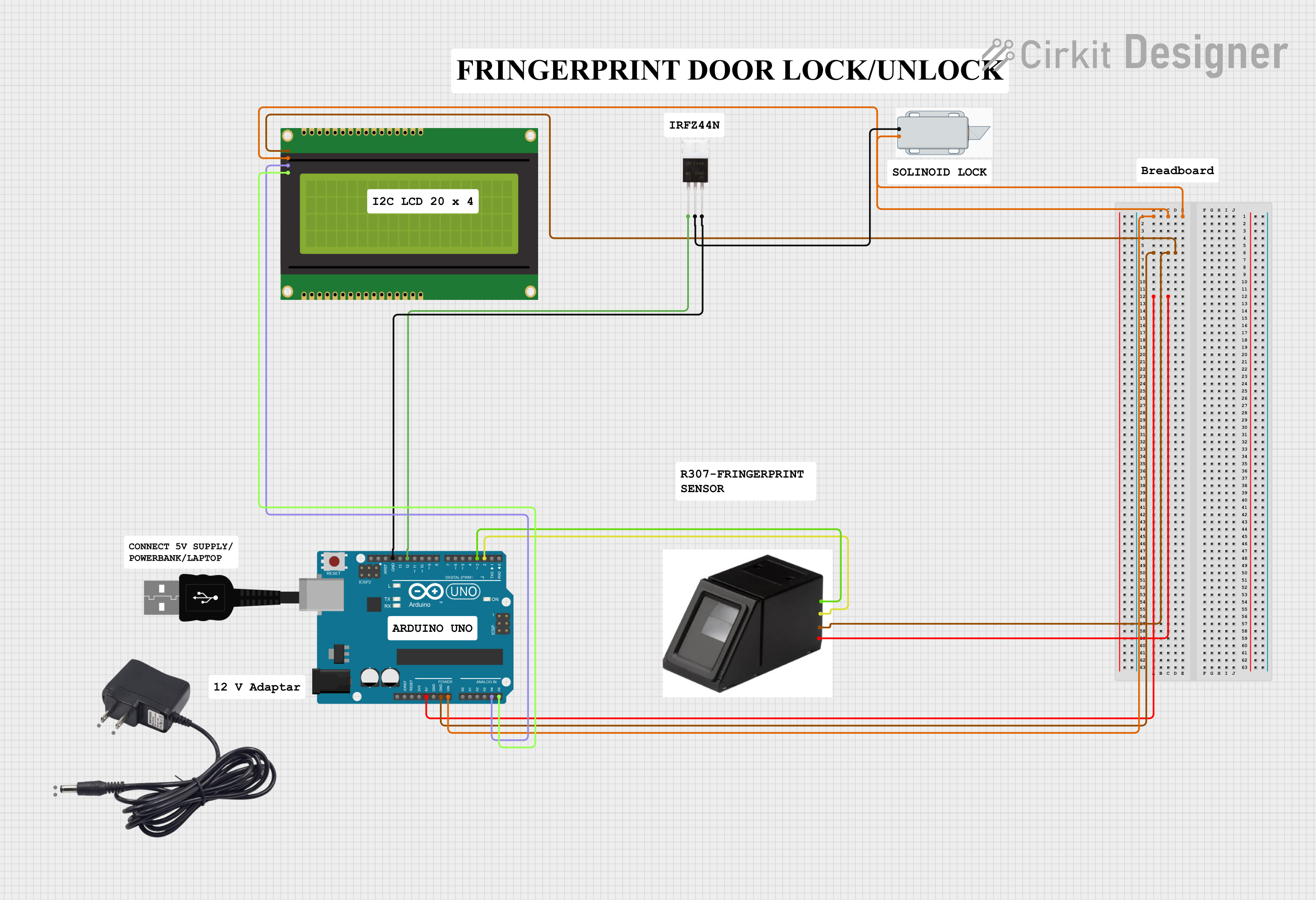
This circuit is a fingerprint-based access control system. It uses an Arduino UNO to interface with a fingerprint sensor and a 20x4 I2C LCD panel for user interaction, and controls a 12V solenoid lock via an IRFZ44N MOSFET. The system allows users to enroll and verify fingerprints, displaying status messages on the LCD and actuating the solenoid lock upon successful verification.
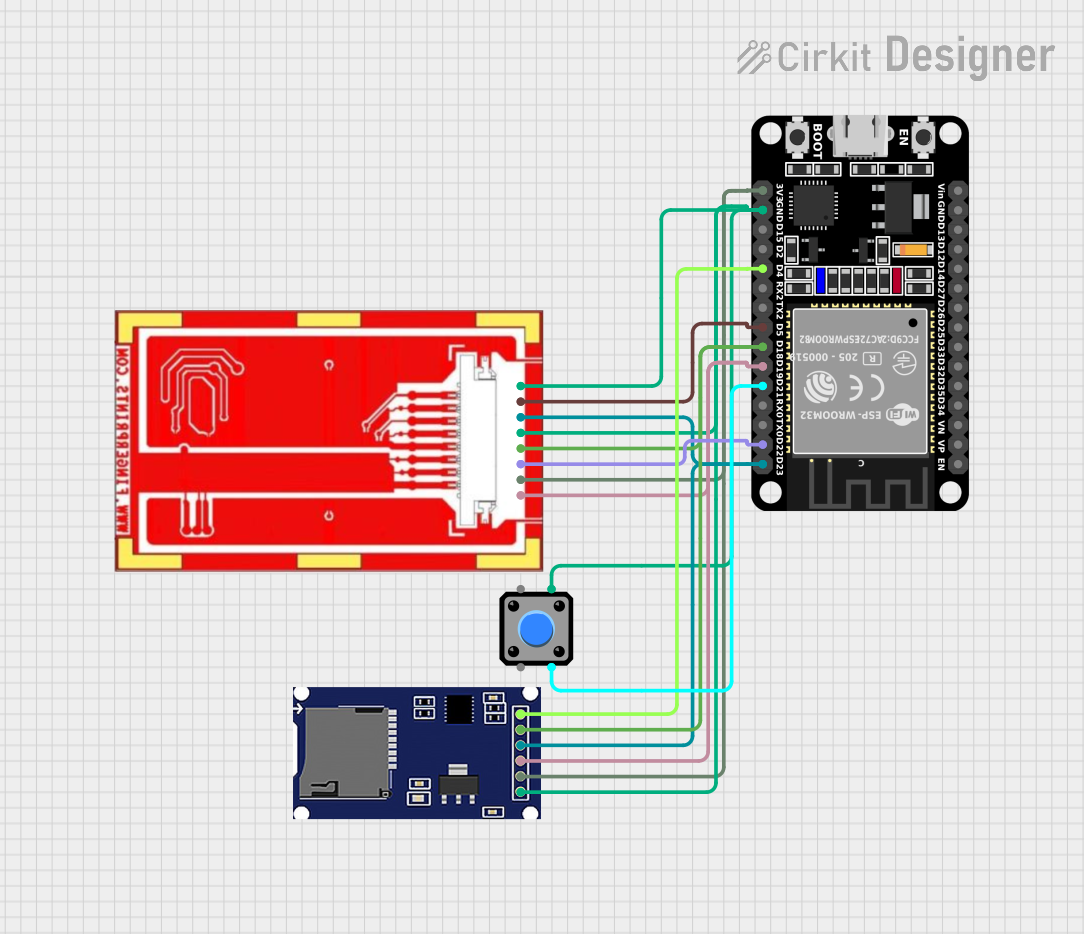
This circuit is a fingerprint capture and storage system using an ESP32 microcontroller. It interfaces with a fingerprint sensor to capture fingerprint images and stores them on an SD card. A pushbutton is used to trigger the fingerprint capture process.
This circuit is a biometric and environmental monitoring system that uses an Arduino Mega 2560 to interface with a fingerprint scanner, an OLED display, a WiFi module, and various sensors including a MAX30102 pulse oximeter and an MLX90614 infrared thermometer. The system is designed to capture biometric data, display information, and communicate wirelessly.
Below are the key technical details and pin configuration for the Waveshare UART Capacitive Fingerprint Sensor (Type D):
Key Technical Details
Parameter
Value
Supply Voltage
3.3V to 6V
Operating Current
< 120mA
Communication Interface
UART (TTL level)
Baud Rate
Default: 57600 bps
Fingerprint Capacity
200 fingerprints
Image Resolution
508 DPI
Recognition Time
< 1 second
False Acceptance Rate
< 0.001%
False Rejection Rate
< 1.0%
Operating Temperature
-20°C to +60°C
Dimensions
33mm x 20mm x 10mm
Pin Configuration and Descriptions
Pin Name
Pin Number
Description
VCC
1
Power supply input (3.3V to 6V)
GND
2
Ground
TX
3
UART Transmit (to MCU RX)
RX
4
UART Receive (to MCU TX)
Usage Instructions
How to Use the Component in a Circuit
Power Supply: Connect the VCC pin to a 3.3V to 6V power source and the GND pin to the ground of your circuit.
UART Communication: Connect the TX pin of the sensor to the RX pin of your microcontroller and the RX pin of the sensor to the TX pin of your microcontroller.
Initialization: Use the appropriate UART library or commands to initialize communication with the sensor. The default baud rate is 57600 bps.
Fingerprint Enrollment: Use the sensor's commands to enroll fingerprints. Each fingerprint is stored in the sensor's internal memory.
Fingerprint Matching: Send a command to capture and match a fingerprint against the stored database.
Important Considerations and Best Practices
Ensure the sensor is powered within the specified voltage range to avoid damage.
Avoid placing the sensor in environments with excessive dust, moisture, or direct sunlight, as these can affect performance.
Clean the sensor surface regularly to maintain accuracy.
Use a stable power supply to prevent communication errors.
When connecting to an Arduino or other microcontroller, ensure the UART pins are properly configured.
Example: Connecting to an Arduino UNO
Below is an example of how to use the fingerprint sensor with an Arduino UNO:
Circuit Connections
Fingerprint Sensor Pin
Arduino UNO Pin
VCC
5V
GND
GND
TX
D2 (via SoftwareSerial)
RX
D3 (via SoftwareSerial)
Arduino Code Example
#include <SoftwareSerial.h>

// Define the pins for SoftwareSerial
SoftwareSerial mySerial(2, 3); // RX, TX

void setup() {
  Serial.begin(9600); // Initialize Serial Monitor
  mySerial.begin(57600); // Initialize fingerprint sensor communication

  Serial.println("Initializing Fingerprint Sensor...");
  delay(1000);

  // Example command to check if the sensor is connected
  mySerial.write(0x55); // Replace with actual command for your sensor
  delay(500);

  if (mySerial.available()) {
    Serial.println("Fingerprint Sensor is ready!");
  } else {
    Serial.println("Failed to initialize the sensor. Check connections.");
  }
}

void loop() {
  // Add fingerprint enrollment or matching logic here
}
Troubleshooting and FAQs
Common Issues and Solutions
Sensor Not Responding
Cause: Incorrect wiring or baud rate mismatch.
Solution: Double-check the wiring and ensure the baud rate is set to 57600 bps.
Fingerprint Not Recognized
Cause: Poor fingerprint placement or dirty sensor surface.
Solution: Ensure the finger is placed flat on the sensor and clean the sensor surface.
Communication Errors
Cause: Unstable power supply or noisy UART signals.
Solution: Use a stable power source and ensure proper UART connections.
Sensor Fails to Initialize
Cause: Incorrect power supply voltage.
Solution: Verify that the VCC pin is receiving 3.3V to 6V.
FAQs
Q1: Can the sensor store fingerprints permanently?
A1: Yes, the sensor can store up to 200 fingerprints in its internal memory, which are retained even after power is removed.
Q2: Can I use this sensor with a Raspberry Pi?
A2: Yes, the sensor can be used with a Raspberry Pi via its UART interface. Use the GPIO pins for UART communication.
Q3: How do I reset the sensor's database?
A3: Use the appropriate command from the sensor's datasheet to clear all stored fingerprints.
Q4: What is the maximum cable length for UART communication?
A4: For reliable communication, keep the cable length under 1 meter. Use shielded cables for longer distances.
This documentation provides all the necessary details to get started with the Waveshare UART Capacitive Fingerprint Sensor (Type D). For advanced features, refer to the manufacturer's datasheet.

 Open Project in Cirkit Designer