
How to Use SN75175: Examples, Pinouts, and Specs
 Design with SN75175 in Cirkit Designer
Introduction
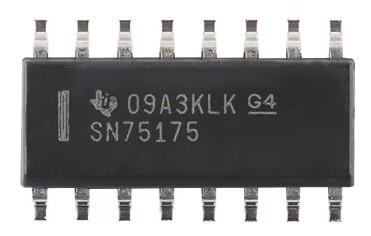
The SN75175 is a quad differential line driver designed for high-speed data transmission over twisted-pair cables. It is widely used in communication systems due to its ability to provide robust and reliable data transfer in noisy environments. The component is compliant with RS-485 and RS-422 standards, making it ideal for industrial automation, networking, and other applications requiring long-distance, high-speed communication.
Explore Projects Built with SN75175
 Open Project in Cirkit Designer
 Open Project in Cirkit Designer
 Open Project in Cirkit Designer
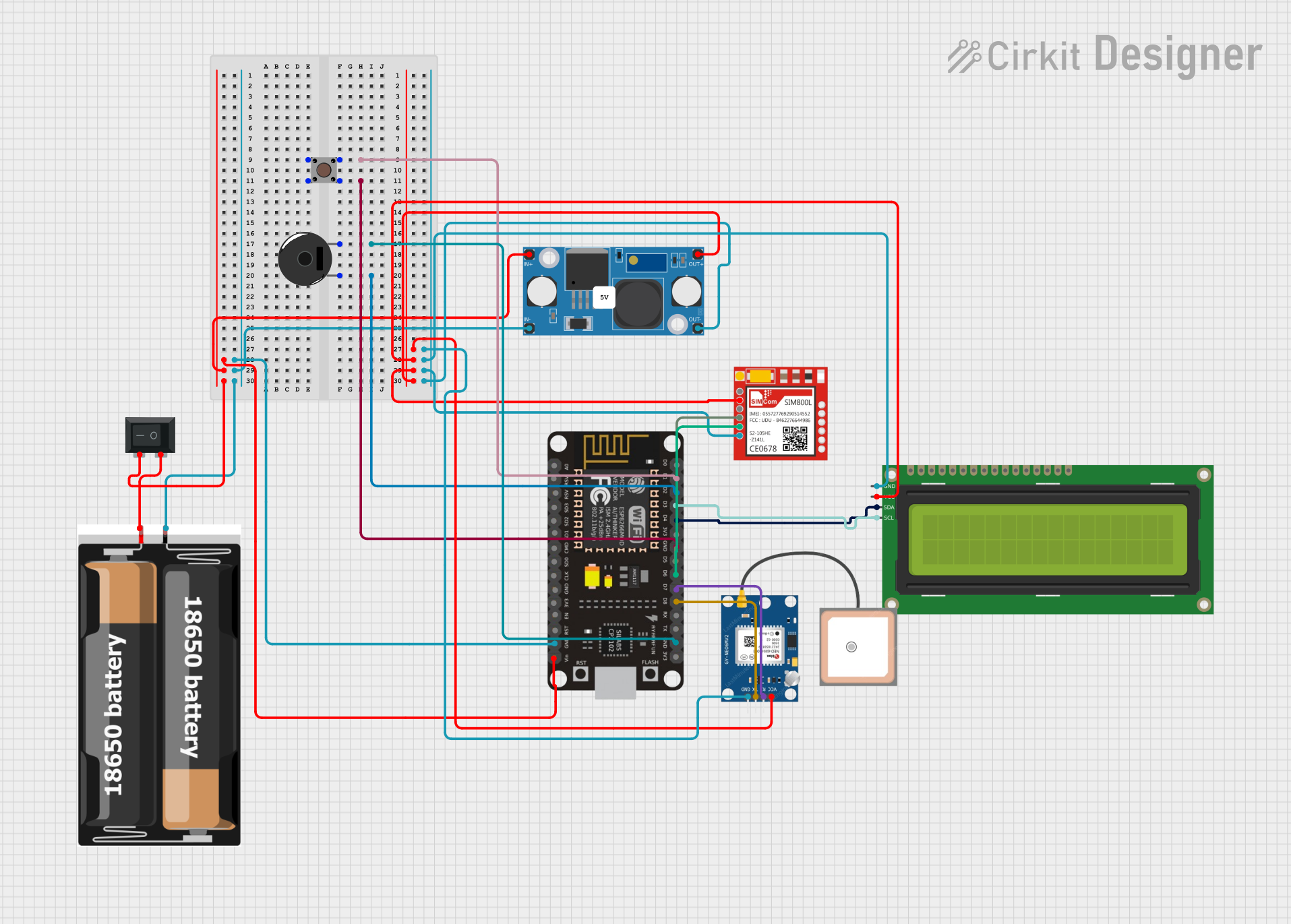 Open Project in Cirkit Designer
Explore Projects Built with SN75175
Open Project in Cirkit DesignerOpen Project in Cirkit DesignerOpen Project in Cirkit DesignerOpen Project in Cirkit DesignerCommon Applications and Use Cases
- RS-485 and RS-422 communication systems
- Industrial automation and control systems
- Networking equipment
- Data acquisition systems
- Long-distance data transmission over twisted-pair cables
Technical Specifications
Key Technical Details
- Supply Voltage (Vcc): 4.75V to 5.25V
- Input Voltage Range: -7V to +12V
- Output Voltage Range: -7V to +12V
- Data Rate: Up to 10 Mbps
- Operating Temperature Range: 0°C to 70°C
- Power Consumption: Low power design
- Differential Output Voltage: ±2V minimum
- Short-Circuit Protection: Yes
- Compliance Standards: RS-485, RS-422
Pin Configuration and Descriptions
The SN75175 is available in a 16-pin DIP (Dual Inline Package). Below is the pinout and description:
| Pin Number | Pin Name | Description |
|---|---|---|
| 1 | A1 | Non-inverting input for Driver 1 |
| 2 | B1 | Inverting input for Driver 1 |
| 3 | Y1 | Non-inverting output for Driver 1 |
| 4 | Z1 | Inverting output for Driver 1 |
| 5 | A2 | Non-inverting input for Driver 2 |
| 6 | B2 | Inverting input for Driver 2 |
| 7 | Y2 | Non-inverting output for Driver 2 |
| 8 | Z2 | Inverting output for Driver 2 |
| 9 | GND | Ground |
| 10 | Z3 | Inverting output for Driver 3 |
| 11 | Y3 | Non-inverting output for Driver 3 |
| 12 | B3 | Inverting input for Driver 3 |
| 13 | A3 | Non-inverting input for Driver 3 |
| 14 | Z4 | Inverting output for Driver 4 |
| 15 | Y4 | Non-inverting output for Driver 4 |
| 16 | Vcc | Positive power supply (4.75V to 5.25V) |
Usage Instructions
How to Use the SN75175 in a Circuit
- Power Supply: Connect the Vcc pin (Pin 16) to a regulated 5V power supply and the GND pin (Pin 9) to ground.
- Input Signals: Provide differential input signals to the A and B pins of each driver (e.g., A1 and B1 for Driver 1).
- Output Signals: The corresponding differential outputs (Y and Z pins) will provide the amplified signals for transmission over twisted-pair cables.
- Termination Resistors: For RS-485 applications, use termination resistors at the ends of the twisted-pair cable to minimize signal reflections.
- Enable/Disable Drivers: Ensure proper control of the input signals to enable or disable the drivers as needed.
Important Considerations and Best Practices
- Use decoupling capacitors (e.g., 0.1 µF) close to the Vcc pin to reduce noise and stabilize the power supply.
- Ensure the input voltage levels are within the specified range (-7V to +12V) to avoid damage to the device.
- For long-distance communication, use twisted-pair cables with proper shielding to minimize electromagnetic interference (EMI).
- Avoid exceeding the maximum data rate of 10 Mbps to ensure reliable operation.
Example: Connecting SN75175 to an Arduino UNO
The SN75175 can be used with an Arduino UNO for RS-485 communication. Below is an example of how to send data using the SN75175:
Circuit Connections
- Connect the Arduino's digital output pin (e.g., D2) to the A1 pin of the SN75175.
- Connect the corresponding B1 pin to ground.
- Connect the Y1 and Z1 pins to the twisted-pair cable for data transmission.
- Connect Vcc and GND of the SN75175 to a 5V power supply and ground, respectively.
Arduino Code Example
// Example code to send data using SN75175 with Arduino UNO
const int dataPin = 2; // Pin connected to A1 of SN75175

void setup() {
  pinMode(dataPin, OUTPUT); // Set data pin as output
}

void loop() {
  digitalWrite(dataPin, HIGH); // Send a HIGH signal
  delay(1000); // Wait for 1 second
  digitalWrite(dataPin, LOW); // Send a LOW signal
  delay(1000); // Wait for 1 second
}
Troubleshooting and FAQs
Common Issues and Solutions
No Output Signal:
- Cause: Incorrect power supply or loose connections.
- Solution: Verify that Vcc is connected to a 5V regulated power supply and GND is properly grounded.
Signal Distortion:
- Cause: Missing or incorrect termination resistors.
- Solution: Add 120-ohm termination resistors at both ends of the twisted-pair cable.
Overheating:
- Cause: Short circuit on the output pins.
- Solution: Check for short circuits and ensure proper wiring.
Low Data Rate:
- Cause: Excessive cable length or poor cable quality.
- Solution: Use high-quality twisted-pair cables and ensure the cable length is within RS-485 specifications.
FAQs
Q1: Can the SN75175 be used for single-ended signals?
A1: No, the SN75175 is designed for differential signaling and is not suitable for single-ended signals.
Q2: What is the maximum cable length supported by the SN75175?
A2: The maximum cable length depends on the data rate and cable quality. For RS-485, it typically supports up to 1200 meters at lower data rates.
Q3: Is the SN75175 compatible with 3.3V systems?
A3: No, the SN75175 requires a 5V power supply. Use a level shifter if interfacing with 3.3V systems.
Q4: Can I use the SN75175 for bidirectional communication?
A4: No, the SN75175 is a line driver and does not support bidirectional communication. Use an RS-485 transceiver for bidirectional communication.