
How to Use DC-DC 40V-32V 12A: Examples, Pinouts, and Specs
 Design with DC-DC 40V-32V 12A in Cirkit Designer
Introduction
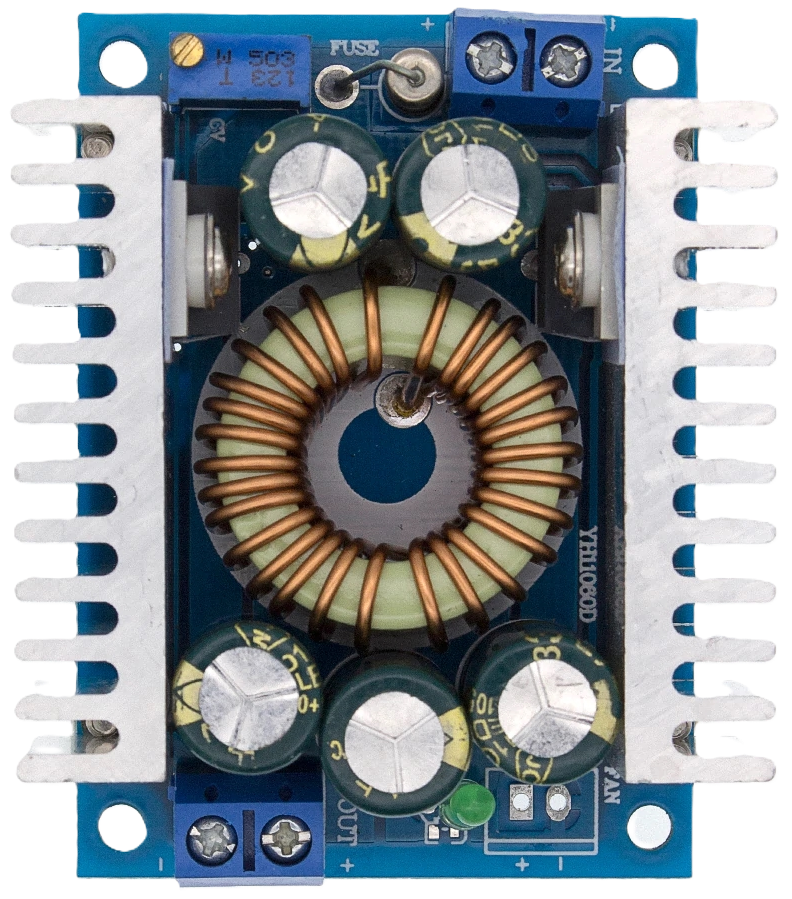
The DC-DC 40V-32V 12A (Manufacturer: SZYTF, Part ID: DCDC12A) is a high-efficiency step-down DC-DC converter designed to regulate and step down input voltages from 40V to 32V. It provides a maximum output current of 12A, making it suitable for high-power applications. This component is widely used in power supply systems, battery charging circuits, and industrial equipment where precise voltage regulation is required.
Explore Projects Built with DC-DC 40V-32V 12A
 Open Project in Cirkit Designer
 Open Project in Cirkit Designer
 Open Project in Cirkit Designer
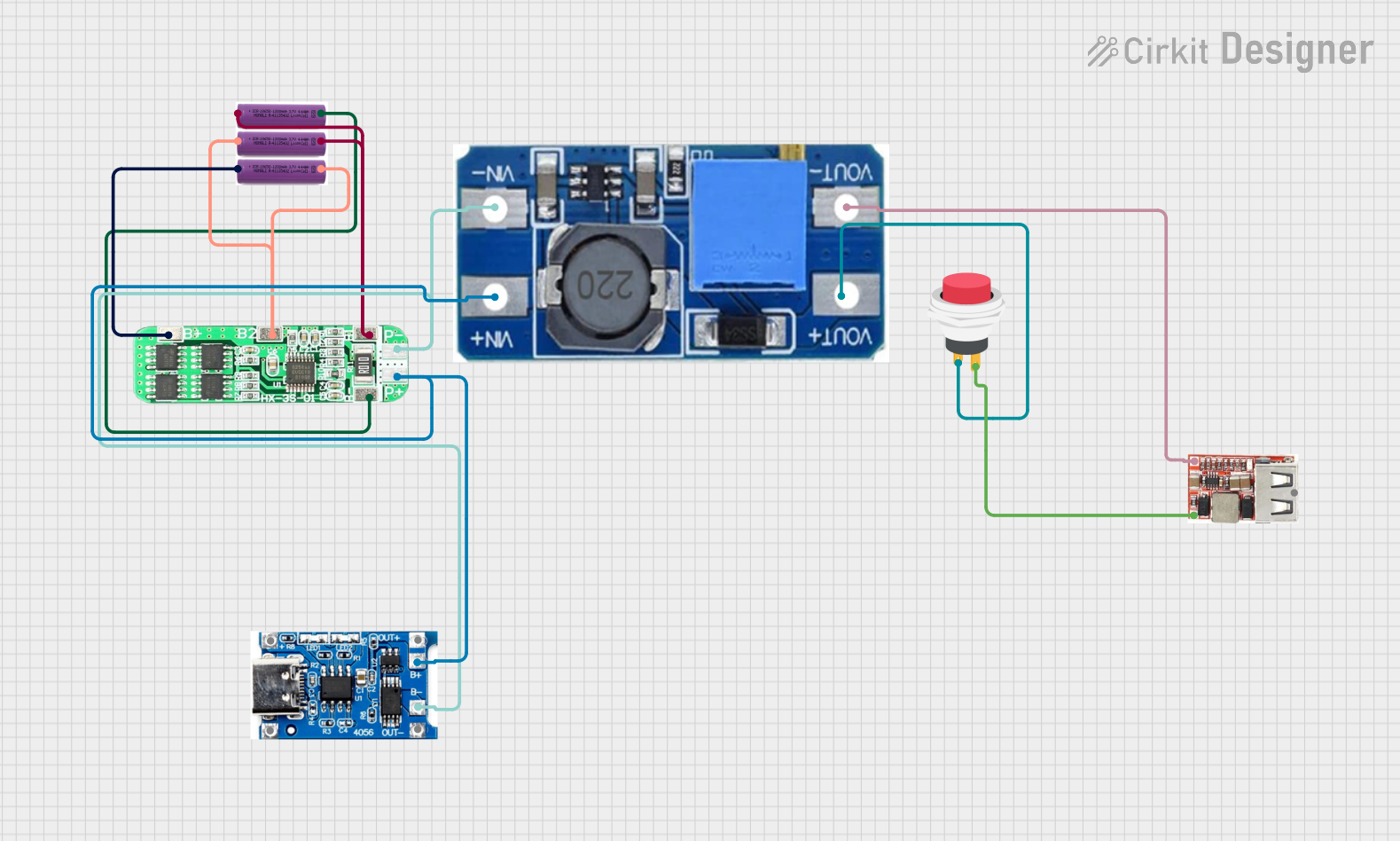 Open Project in Cirkit Designer
Explore Projects Built with DC-DC 40V-32V 12A
Open Project in Cirkit DesignerOpen Project in Cirkit DesignerOpen Project in Cirkit DesignerOpen Project in Cirkit DesignerCommon Applications
- Power supply units for industrial and consumer electronics
- Battery charging systems
- Voltage regulation in automotive and renewable energy systems
- LED drivers and motor controllers
Technical Specifications
Key Specifications
| Parameter | Value |
|---|---|
| Input Voltage Range | 40V (maximum) |
| Output Voltage Range | 32V (fixed) |
| Maximum Output Current | 12A |
| Efficiency | Up to 95% |
| Operating Temperature | -40°C to +85°C |
| Dimensions | 60mm x 50mm x 20mm |
| Manufacturer | SZYTF |
| Part ID | DCDC12A |
Pin Configuration and Descriptions
The DC-DC 40V-32V 12A converter typically has four main terminals for input and output connections. Below is the pin configuration:
| Pin Name | Description |
|---|---|
| VIN+ | Positive input voltage (up to 40V) |
| VIN- | Negative input voltage (ground) |
| VOUT+ | Positive output voltage (32V) |
| VOUT- | Negative output voltage (ground) |
Usage Instructions
How to Use the Component in a Circuit
- Input Voltage Connection: Connect the input voltage source (e.g., a 40V DC power supply) to the
VIN+andVIN-terminals. Ensure the input voltage does not exceed 40V to avoid damaging the converter. - Output Voltage Connection: Connect the load to the
VOUT+andVOUT-terminals. The output voltage is fixed at 32V. - Heat Dissipation: Since the converter can handle high currents (up to 12A), ensure proper heat dissipation by attaching a heatsink or using active cooling (e.g., a fan) if necessary.
- Wiring: Use thick wires for both input and output connections to handle high currents and minimize voltage drops.
Important Considerations and Best Practices
- Input Voltage Range: Always ensure the input voltage is within the specified range (up to 40V). Exceeding this limit can permanently damage the component.
- Load Current: Do not exceed the maximum output current of 12A. Overloading the converter may cause overheating or failure.
- Polarity: Double-check the polarity of the input and output connections. Reversing the polarity can damage the converter.
- Cooling: For continuous high-current applications, ensure adequate cooling to maintain optimal performance and prevent thermal shutdown.
Example: Using the DC-DC Converter with an Arduino UNO
The DC-DC 40V-32V 12A converter can be used to power an Arduino UNO by stepping down a higher voltage source to 32V. Below is an example circuit and Arduino code to monitor the output voltage using an analog pin.
Circuit Setup
- Connect a 40V DC power supply to the
VIN+andVIN-terminals of the converter. - Connect the
VOUT+terminal to the Arduino's VIN pin (via a voltage divider if necessary to step down to 5V for analog input). - Connect the
VOUT-terminal to the Arduino's GND pin.
Arduino Code
// Arduino code to monitor the output voltage of the DC-DC converter
const int voltagePin = A0; // Analog pin to read the voltage
float voltage = 0.0;       // Variable to store the calculated voltage

void setup() {
  Serial.begin(9600); // Initialize serial communication
}

void loop() {
  int sensorValue = analogRead(voltagePin); // Read the analog input
  // Convert the analog reading to voltage
  // Assuming a 10-bit ADC and a reference voltage of 5V
  voltage = sensorValue * (5.0 / 1023.0);

  // Print the voltage to the Serial Monitor
  Serial.print("Output Voltage: ");
  Serial.print(voltage);
  Serial.println(" V");

  delay(1000); // Wait for 1 second before the next reading
}
Troubleshooting and FAQs
Common Issues and Solutions
| Issue | Possible Cause | Solution |
|---|---|---|
| No output voltage | Incorrect wiring or polarity | Verify all connections and polarity. |
| Overheating | Excessive load or insufficient cooling | Reduce load or improve heat dissipation. |
| Output voltage fluctuates | Input voltage instability | Use a stable input power source. |
| Converter not working after use | Input voltage exceeded 40V | Replace the component and ensure proper input voltage. |
FAQs
Can I adjust the output voltage?
- No, the output voltage is fixed at 32V and cannot be adjusted.
What type of cooling is recommended for high-current applications?
- A heatsink with active cooling (e.g., a fan) is recommended for continuous operation at high currents.
Can this converter be used with a battery as the input source?
- Yes, as long as the battery voltage does not exceed 40V.
What happens if the input voltage drops below 32V?
- The converter may not function correctly, and the output voltage will drop below the specified 32V.
By following this documentation, users can effectively integrate the DC-DC 40V-32V 12A converter into their projects and ensure reliable performance.