
How to Use 5V PSU: Examples, Pinouts, and Specs
 Design with 5V PSU in Cirkit Designer
Introduction
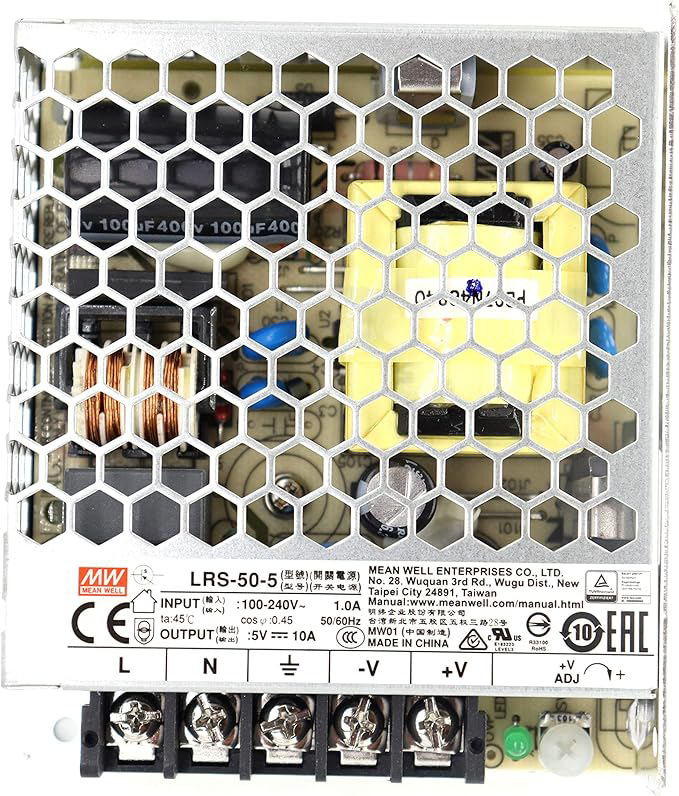
A 5V Power Supply Unit (PSU) provides a stable 5-volt output to power electronic circuits and devices, ensuring consistent voltage for reliable operation. It is a fundamental component in electronics, commonly used to power microcontrollers, sensors, LEDs, and other low-voltage devices. The 5V PSU is essential for projects requiring a reliable and regulated power source.
Explore Projects Built with 5V PSU
 Open Project in Cirkit Designer
 Open Project in Cirkit Designer
 Open Project in Cirkit Designer
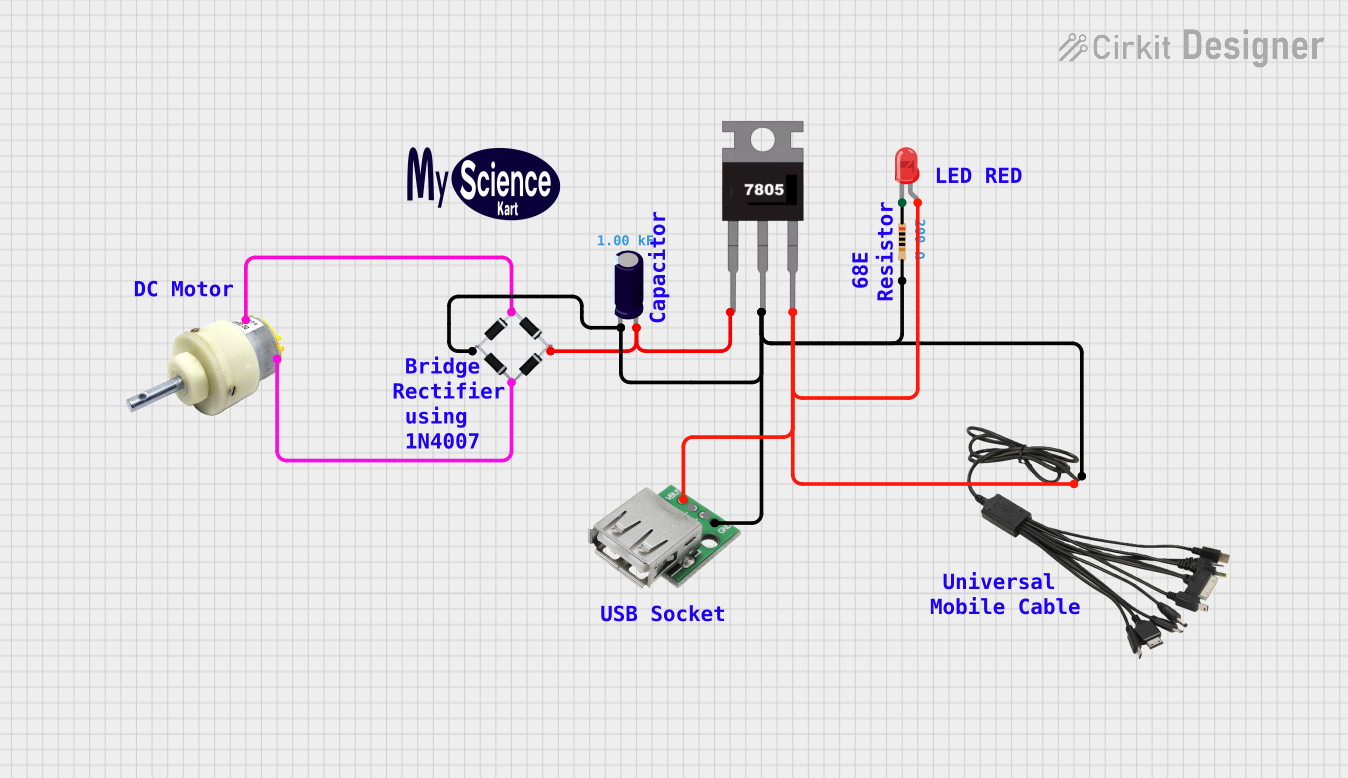 Open Project in Cirkit Designer
Explore Projects Built with 5V PSU
Open Project in Cirkit DesignerOpen Project in Cirkit DesignerOpen Project in Cirkit DesignerOpen Project in Cirkit DesignerCommon Applications and Use Cases
- Powering microcontrollers like Arduino, Raspberry Pi, and ESP32.
- Supplying power to sensors, actuators, and small motors.
- Driving LED strips and displays.
- Providing a stable voltage source for breadboard prototyping.
- Charging USB-powered devices.
Technical Specifications
The following table outlines the key technical details of a typical 5V PSU:
| Parameter | Specification |
|---|---|
| Input Voltage Range | 100-240V AC (for AC-DC PSUs) |
| Output Voltage | 5V DC ± 0.1V |
| Output Current | 500mA to 3A (varies by model) |
| Power Rating | 2.5W to 15W |
| Efficiency | ≥ 80% |
| Ripple and Noise | ≤ 50mV |
| Protection Features | Overcurrent, Overvoltage, Short Circuit |
Pin Configuration and Descriptions
For a typical 5V PSU with a DC barrel jack or screw terminal output:
| Pin/Terminal | Description |
|---|---|
| V+ (Positive) | Provides the regulated 5V DC output. |
| V- (Negative) | Ground connection for the circuit. |
For USB-powered 5V PSUs:
| Pin | Description |
|---|---|
| VBUS | 5V DC output (positive terminal). |
| GND | Ground connection (negative terminal). |
Usage Instructions
How to Use the 5V PSU in a Circuit
- Connect the Input Power Source:
- For AC-DC PSUs, plug the unit into a standard AC outlet.
- For USB-powered PSUs, connect the USB cable to a compatible power source.
- Connect the Output Terminals:
- Attach the V+ terminal to the positive rail of your circuit.
- Attach the V- terminal to the ground rail of your circuit.
- Verify Connections:
- Double-check all connections to ensure proper polarity and avoid short circuits.
- Power On:
- Turn on the PSU (if it has a power switch) or connect it to the input power source.
Important Considerations and Best Practices
- Check Current Requirements: Ensure the PSU can supply sufficient current for all connected devices.
- Avoid Overloading: Do not exceed the PSU's maximum current rating to prevent damage.
- Use Proper Heat Dissipation: If the PSU gets warm during operation, ensure adequate ventilation.
- Polarity Matters: Always connect the V+ and V- terminals correctly to avoid damaging your circuit.
- Use Decoupling Capacitors: Add capacitors (e.g., 10µF and 0.1µF) near sensitive components to reduce noise.
Example: Using a 5V PSU with an Arduino UNO
The 5V PSU can be used to power an Arduino UNO via its VIN pin or USB port. Below is an example of connecting a 5V PSU to an Arduino UNO and controlling an LED:
Circuit Connections
- Connect the PSU's V+ to the Arduino's VIN pin (or USB port for USB-powered PSUs).
- Connect the PSU's V- to the Arduino's GND pin.
- Connect an LED to pin 13 of the Arduino with a 220-ohm resistor in series.
Arduino Code
// Simple LED Blink Example
// This code blinks an LED connected to pin 13 of the Arduino UNO.

void setup() {
  pinMode(13, OUTPUT); // Set pin 13 as an output pin
}

void loop() {
  digitalWrite(13, HIGH); // Turn the LED on
  delay(1000);            // Wait for 1 second
  digitalWrite(13, LOW);  // Turn the LED off
  delay(1000);            // Wait for 1 second
}
Troubleshooting and FAQs
Common Issues and Solutions
No Output Voltage:
- Cause: Input power is not connected or PSU is faulty.
- Solution: Verify the input power source and check the PSU's fuse or internal components.
Voltage Drops Under Load:
- Cause: PSU is overloaded or insufficient current capacity.
- Solution: Use a PSU with a higher current rating or reduce the load.
Excessive Heat:
- Cause: PSU is operating near its maximum power rating.
- Solution: Ensure proper ventilation or use a PSU with a higher power rating.
Noise or Ripple in Output:
- Cause: Poor filtering or high-frequency interference.
- Solution: Add decoupling capacitors or use a PSU with better ripple suppression.
FAQs
Q: Can I use a 5V PSU to charge my phone?
A: Yes, if the PSU has a USB output and meets the current requirements of your phone.
Q: What happens if I reverse the polarity of the connections?
A: Reversing polarity can damage your circuit. Always double-check connections before powering on.
Q: Can I use a 5V PSU to power a 3.3V device?
A: No, a 5V PSU will damage 3.3V devices. Use a voltage regulator or a step-down converter.
Q: How do I know if my PSU is overloaded?
A: Symptoms of overloading include voltage drops, excessive heat, or the PSU shutting down. Reduce the load or use a higher-rated PSU.