
How to Use LRS-50-5: Examples, Pinouts, and Specs
 Design with LRS-50-5 in Cirkit Designer
Introduction
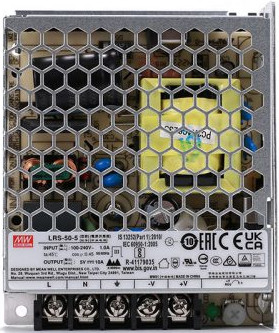
The LRS-50-5 is a 50W single-output switching power supply manufactured by Mean Well. It delivers a stable 5V DC output and is designed for a wide range of applications requiring efficient and reliable power conversion. This compact and lightweight power supply is equipped with built-in protections, including short circuit, overload, and overvoltage protection, ensuring safe and consistent operation.
Explore Projects Built with LRS-50-5
 Open Project in Cirkit Designer
 Open Project in Cirkit Designer
 Open Project in Cirkit Designer
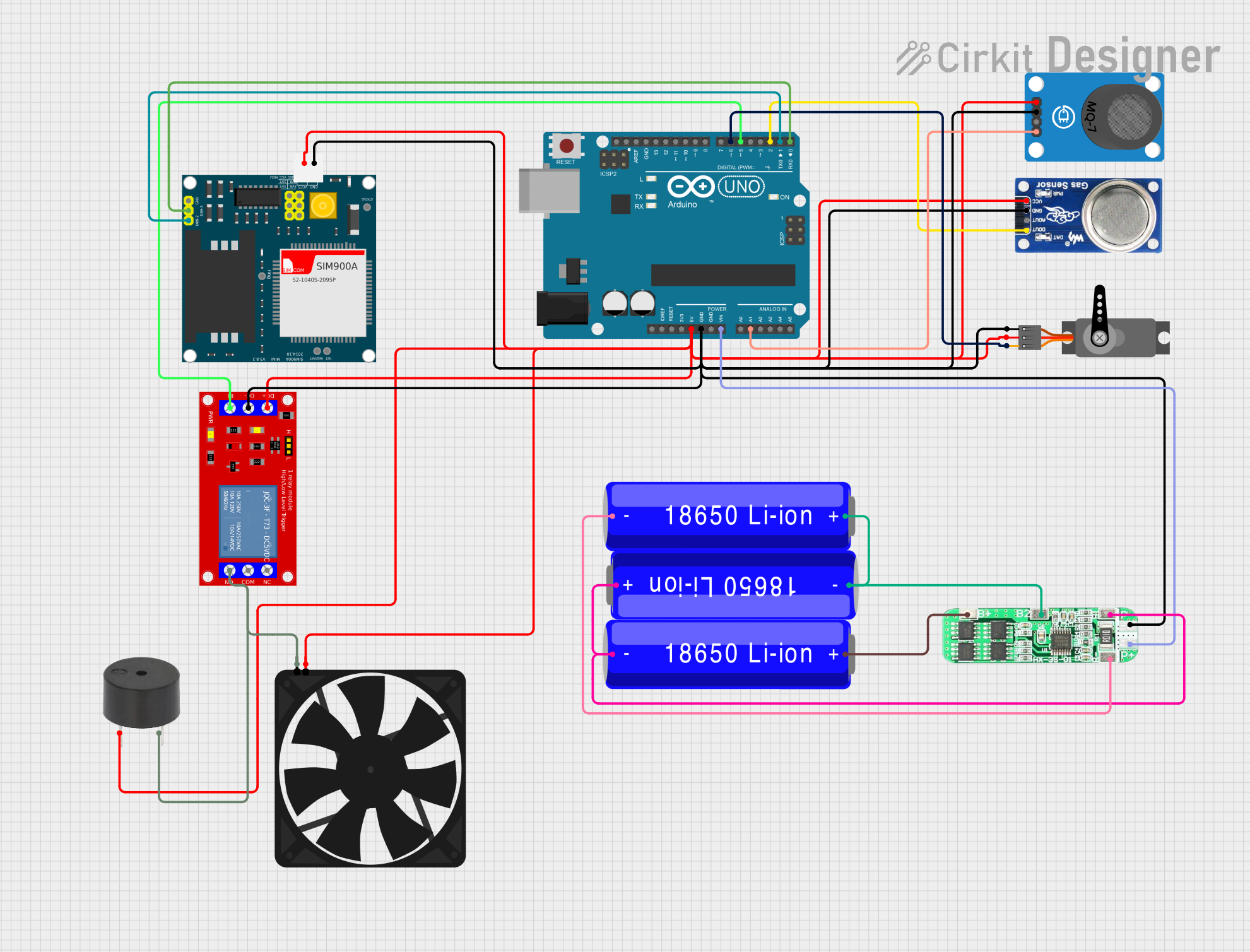 Open Project in Cirkit Designer
Explore Projects Built with LRS-50-5
Open Project in Cirkit DesignerOpen Project in Cirkit DesignerOpen Project in Cirkit DesignerOpen Project in Cirkit DesignerCommon Applications
- Industrial automation systems
- LED lighting and signage
- IoT devices and embedded systems
- Consumer electronics
- Test and measurement equipment
Technical Specifications
Key Specifications
| Parameter | Value |
|---|---|
| Input Voltage Range | 85-264 VAC / 120-370 VDC |
| Output Voltage | 5V DC |
| Output Current | 10A |
| Output Power | 50W |
| Efficiency | Up to 86% |
| Ripple and Noise | ≤80mVp-p |
| Operating Temperature | -30°C to +70°C |
| Dimensions | 99 x 82 x 30 mm (L x W x H) |
| Weight | 0.3 kg |
| Protections | Short circuit, overload, overvoltage |
Pin Configuration and Descriptions
The LRS-50-5 features screw terminal connections for input and output. Below is the pin configuration:
| Pin Label | Description |
|---|---|
| AC/L | Live input for AC mains |
| AC/N | Neutral input for AC mains |
| +V | Positive DC output (5V) |
| -V | Negative DC output (Ground) |
| FG | Frame Ground (Earth connection) |
Usage Instructions
How to Use the LRS-50-5 in a Circuit
Input Connection:
- Connect the AC mains supply to the
AC/L(Live) andAC/N(Neutral) terminals. - Ensure the input voltage is within the specified range (85-264 VAC).
- Optionally, connect the
FGterminal to earth ground for improved safety and EMI performance.
- Connect the AC mains supply to the
Output Connection:
- Connect the load to the
+V(positive) and-V(negative) terminals. - Ensure the load does not exceed the maximum output current of 10A.
- Connect the load to the
Mounting:
- Secure the power supply in a well-ventilated area to prevent overheating.
- Avoid placing the unit near heat sources or in environments with excessive humidity.
Power On:
- After verifying all connections, power on the AC mains supply.
- Measure the output voltage to confirm it is 5V before connecting sensitive devices.
Important Considerations
- Load Regulation: Ensure the load is within the rated power range (50W max) to maintain stable operation.
- Ventilation: Maintain adequate airflow around the power supply to prevent overheating.
- Safety: Always disconnect the power supply from the mains before making any wiring changes.
- Fusing: Use an appropriate fuse on the input side for additional protection.
Example: Using LRS-50-5 with an Arduino UNO
The LRS-50-5 can be used to power an Arduino UNO and other peripherals. Below is an example wiring and code snippet:
Wiring
- Connect the
+Vterminal of the LRS-50-5 to the Arduino'sVINpin. - Connect the
-Vterminal of the LRS-50-5 to the Arduino'sGNDpin. - Ensure the LRS-50-5 is properly connected to the AC mains supply.
Arduino Code
// Example code to blink an LED connected to pin 13 of the Arduino UNO
// Ensure the LRS-50-5 is providing a stable 5V to the Arduino's VIN pin

void setup() {
  pinMode(13, OUTPUT); // Set pin 13 as an output
}

void loop() {
  digitalWrite(13, HIGH); // Turn the LED on
  delay(1000);            // Wait for 1 second
  digitalWrite(13, LOW);  // Turn the LED off
  delay(1000);            // Wait for 1 second
}
Troubleshooting and FAQs
Common Issues and Solutions
| Issue | Possible Cause | Solution |
|---|---|---|
| No output voltage | Incorrect input wiring | Verify AC mains connections to AC/L and AC/N. |
| Output voltage too low or unstable | Overloaded output | Reduce the load to within the rated 50W. |
| Overheating | Poor ventilation or excessive ambient temperature | Ensure proper airflow and reduce ambient temperature. |
| Device not powering on | Blown fuse or internal fault | Check and replace the input fuse if necessary. |
FAQs
Can the LRS-50-5 be used with DC input?
- Yes, the LRS-50-5 supports DC input in the range of 120-370 VDC.
Is the output voltage adjustable?
- Yes, the output voltage can be fine-tuned using the built-in potentiometer.
What type of fuse should I use on the input side?
- Use a fuse rated for 3A at 250V for optimal protection.
Can I use the LRS-50-5 outdoors?
- The LRS-50-5 is not weatherproof. Use it in a dry, indoor environment or within a suitable enclosure.
By following this documentation, users can effectively integrate the LRS-50-5 into their projects and ensure reliable operation.