
How to Use ESP-WROOM-32: Examples, Pinouts, and Specs
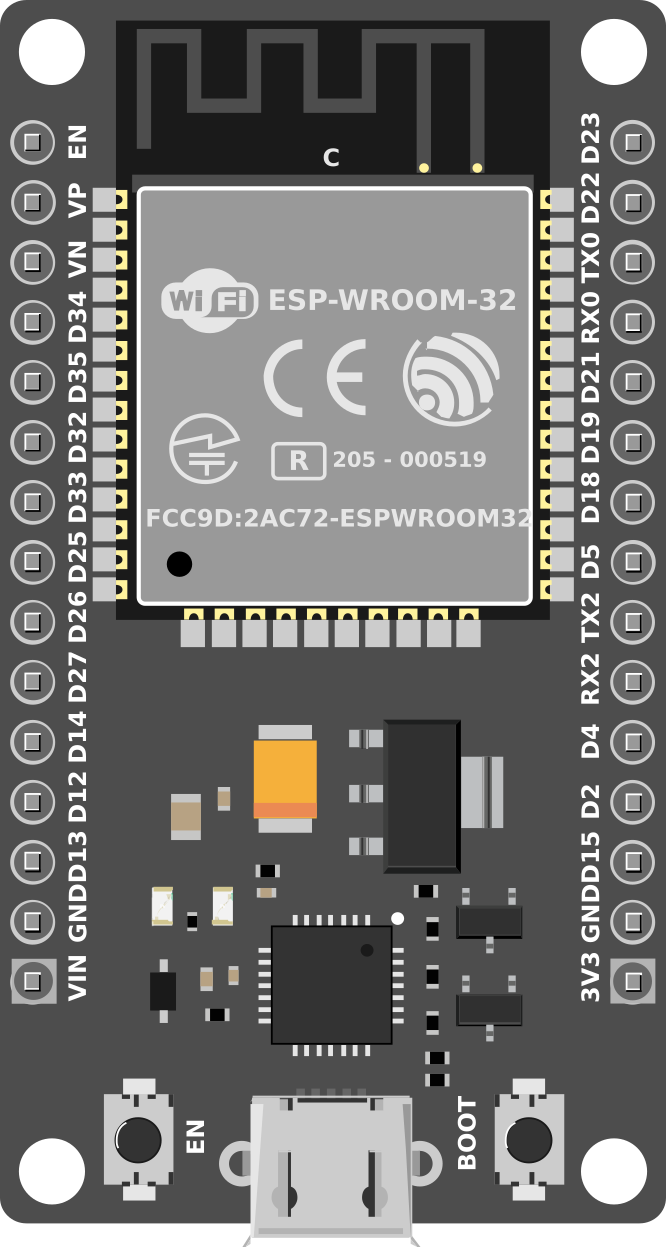
 Design with ESP-WROOM-32 in Cirkit Designer
Introduction
The ESP-WROOM-32 is a powerful Wi-Fi and Bluetooth module based on the ESP32 chip. It is designed for Internet of Things (IoT) applications, offering dual-core processing, low power consumption, and a wide range of GPIO options. This module is highly versatile and can be used in projects requiring wireless communication, sensor integration, or edge computing.
Explore Projects Built with ESP-WROOM-32
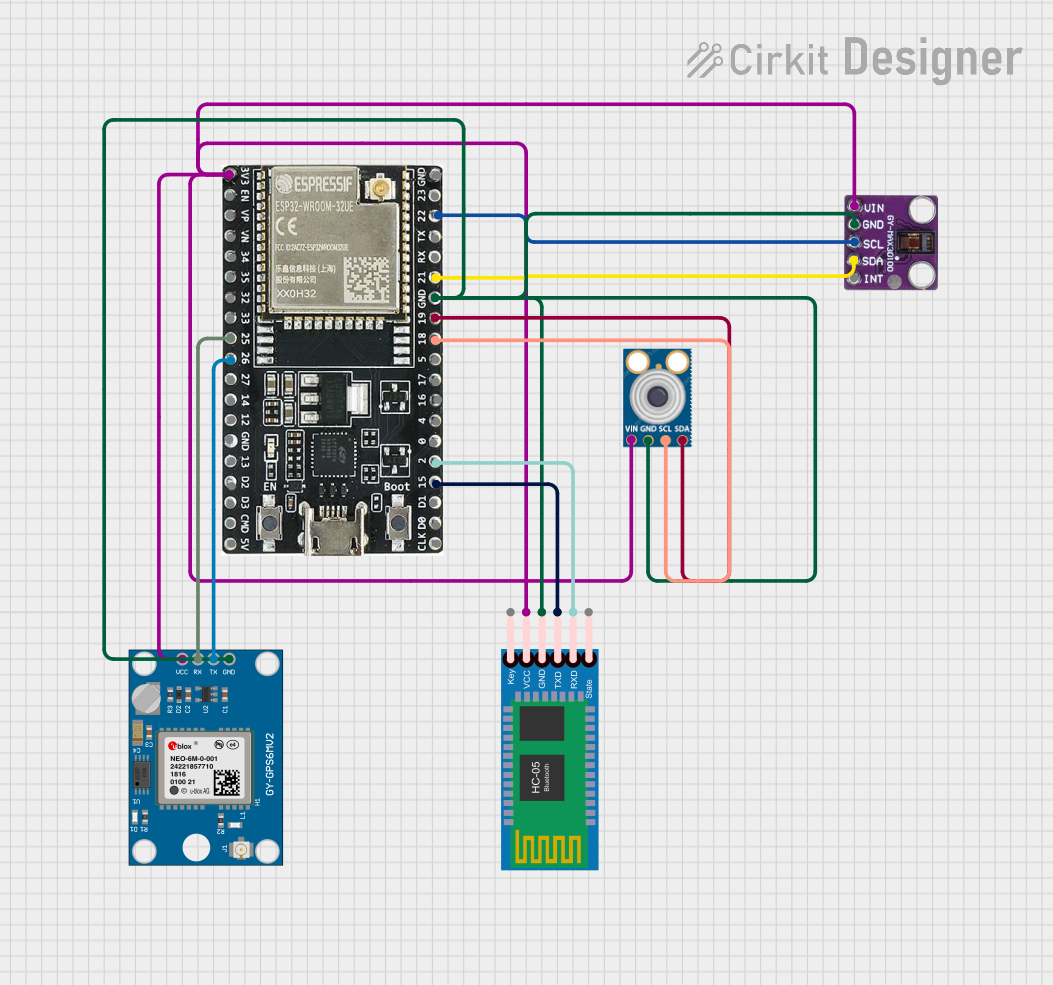 Open Project in Cirkit Designer
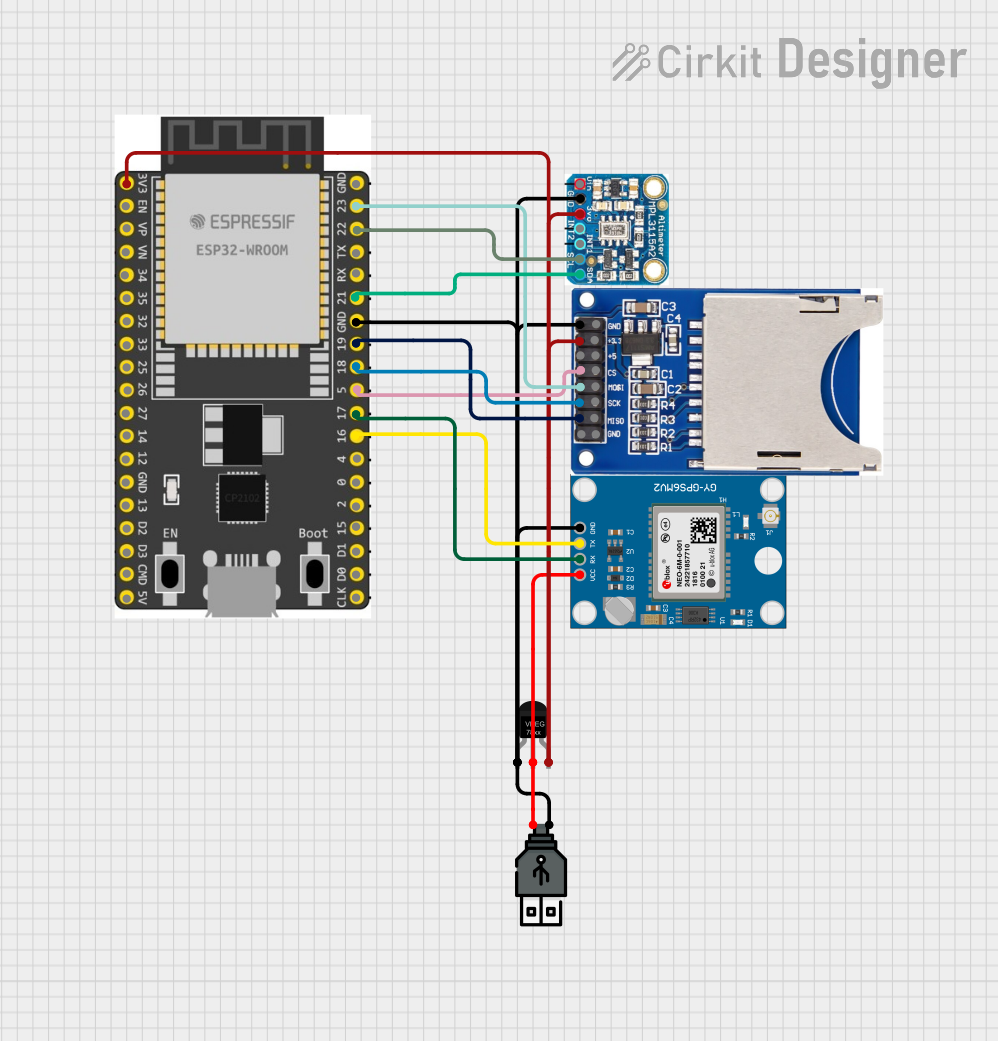 Open Project in Cirkit Designer
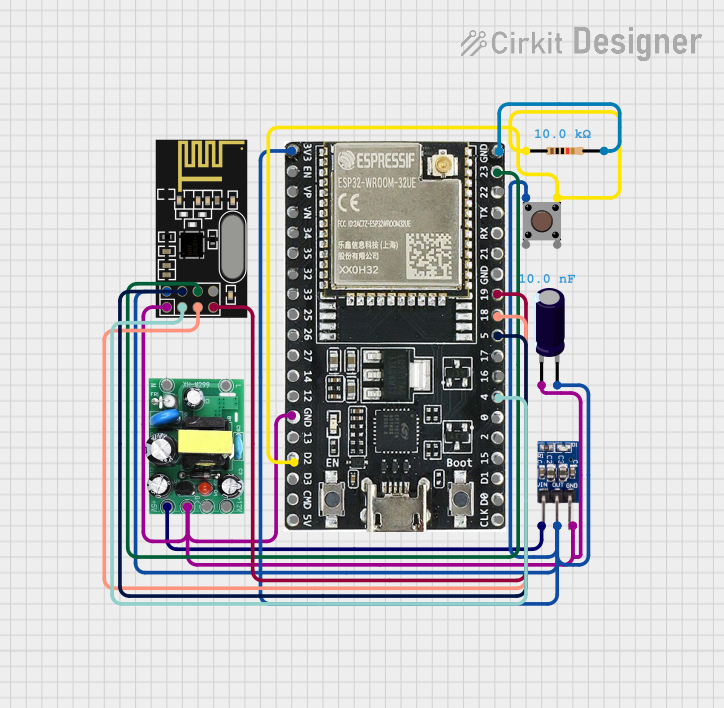 Open Project in Cirkit Designer
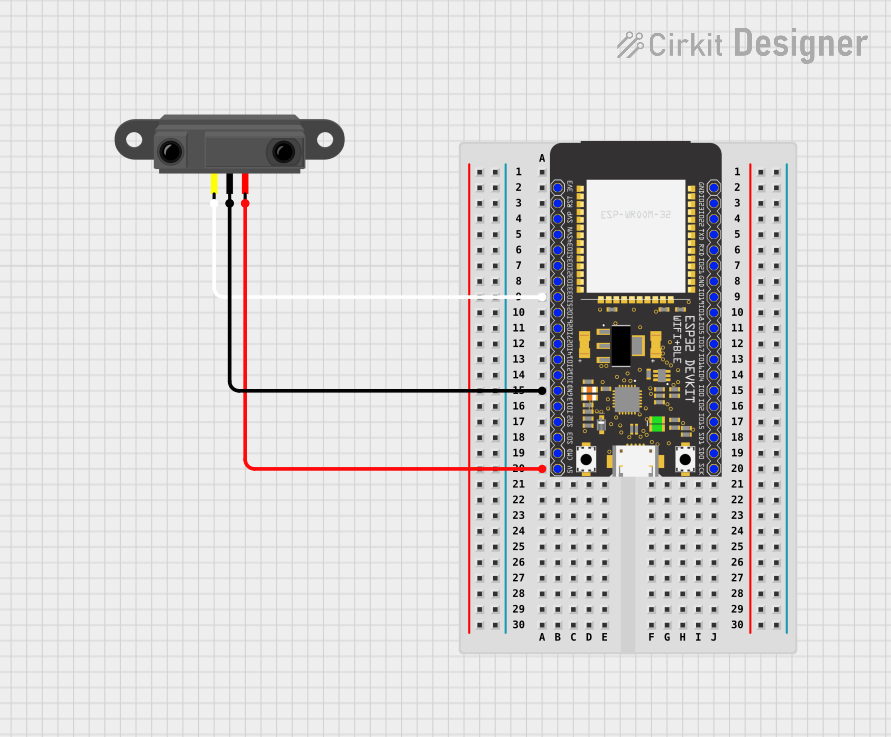 Open Project in Cirkit Designer
Explore Projects Built with ESP-WROOM-32
Open Project in Cirkit DesignerOpen Project in Cirkit DesignerOpen Project in Cirkit DesignerOpen Project in Cirkit DesignerCommon Applications and Use Cases
- Smart home devices (e.g., smart lights, thermostats)
- Wearable technology
- Industrial IoT systems
- Wireless sensor networks
- Robotics and automation
- Prototyping and development of connected devices
Technical Specifications
The ESP-WROOM-32 module is built around the ESP32-D0WDQ6 chip, which integrates Wi-Fi and Bluetooth capabilities. Below are the key technical details:
General Specifications
| Parameter | Value |
|---|---|
| Microcontroller | ESP32-D0WDQ6 |
| Wireless Connectivity | Wi-Fi 802.11 b/g/n, Bluetooth v4.2 BR/EDR |
| CPU | Dual-core Xtensa® 32-bit LX6 |
| Clock Speed | Up to 240 MHz |
| Flash Memory | 4 MB (default) |
| SRAM | 520 KB |
| Operating Voltage | 3.0V to 3.6V |
| Power Consumption | Ultra-low power modes available |
| Operating Temperature | -40°C to 85°C |
Pin Configuration and Descriptions
The ESP-WROOM-32 module has 38 pins. Below is a table of the most commonly used pins:
| Pin Number | Pin Name | Functionality |
|---|---|---|
| 1 | EN | Enable pin (active high) |
| 2 | IO0 | GPIO0, used for boot mode selection |
| 3 | IO2 | GPIO2, general-purpose I/O |
| 4 | IO4 | GPIO4, general-purpose I/O |
| 5 | IO5 | GPIO5, general-purpose I/O |
| 6 | IO12 | GPIO12, ADC2 channel 5 |
| 7 | IO13 | GPIO13, ADC2 channel 4 |
| 8 | IO14 | GPIO14, ADC2 channel 6 |
| 9 | IO15 | GPIO15, ADC2 channel 3 |
| 10 | IO16 | GPIO16, general-purpose I/O |
| 11 | IO17 | GPIO17, general-purpose I/O |
| 12 | GND | Ground |
| 13 | 3V3 | 3.3V power supply |
Note: Some GPIO pins have specific functions or limitations. For example, GPIO0 is used for boot mode selection, and certain pins are input-only or have pull-up/down resistors.
Usage Instructions
How to Use the ESP-WROOM-32 in a Circuit
- Power Supply: Connect the module to a stable 3.3V power source. Avoid exceeding 3.6V to prevent damage.
- Boot Mode: To upload code, connect GPIO0 to GND and reset the module. After uploading, disconnect GPIO0 from GND.
- Programming: Use the UART interface (TX/RX pins) to program the module via a USB-to-serial adapter or development board.
- GPIO Usage: Connect sensors, actuators, or other peripherals to the GPIO pins. Refer to the pin configuration table for details.
Important Considerations and Best Practices
- Voltage Levels: Ensure all connected peripherals operate at 3.3V logic levels. Use level shifters if necessary.
- Power Supply: Use a decoupling capacitor (e.g., 10 µF) near the power pins to stabilize the voltage.
- Antenna Placement: Avoid placing metal objects near the module's antenna to ensure optimal wireless performance.
- Deep Sleep Mode: Use the deep sleep mode to reduce power consumption in battery-powered applications.
Example Code for Arduino UNO
The ESP-WROOM-32 can be programmed using the Arduino IDE. Below is an example of how to connect the module to a Wi-Fi network:
#include <WiFi.h> // Include the Wi-Fi library for ESP32

const char* ssid = "Your_SSID";       // Replace with your Wi-Fi network name
const char* password = "Your_Password"; // Replace with your Wi-Fi password

void setup() {
  Serial.begin(115200); // Initialize serial communication at 115200 baud
  delay(1000);          // Wait for a moment to stabilize

  Serial.println("Connecting to Wi-Fi...");
  WiFi.begin(ssid, password); // Start connecting to the Wi-Fi network

  while (WiFi.status() != WL_CONNECTED) {
    delay(500); // Wait for connection
    Serial.print(".");
  }

  Serial.println("\nConnected to Wi-Fi!");
  Serial.print("IP Address: ");
  Serial.println(WiFi.localIP()); // Print the assigned IP address
}

void loop() {
  // Add your main code here
}
Note: Replace
Your_SSIDandYour_Passwordwith your Wi-Fi credentials.
Troubleshooting and FAQs
Common Issues and Solutions
Module Not Responding
- Cause: Incorrect power supply or wiring.
- Solution: Ensure the module is powered with 3.3V and all connections are secure.
Wi-Fi Connection Fails
- Cause: Incorrect SSID or password.
- Solution: Double-check the Wi-Fi credentials in your code.
Upload Fails
- Cause: GPIO0 not connected to GND during boot mode.
- Solution: Connect GPIO0 to GND, reset the module, and try uploading again.
Random Resets
- Cause: Insufficient power supply or unstable voltage.
- Solution: Use a stable 3.3V power source and add decoupling capacitors.
FAQs
Q: Can the ESP-WROOM-32 operate on 5V?
A: No, the module operates at 3.3V. Use a voltage regulator or level shifter for 5V systems.Q: How do I reset the module?
A: Pull the EN pin low momentarily to reset the module.Q: Can I use the ESP-WROOM-32 with Bluetooth and Wi-Fi simultaneously?
A: Yes, the ESP32 chip supports simultaneous use of Wi-Fi and Bluetooth.Q: What is the maximum range of the Wi-Fi connection?
A: The range depends on environmental factors but typically extends up to 100 meters in open space.
This documentation provides a comprehensive guide to using the ESP-WROOM-32 module effectively in your projects.