
How to Use 24v 300w 12.5A PSU: Examples, Pinouts, and Specs
 Design with 24v 300w 12.5A PSU in Cirkit Designer
Introduction
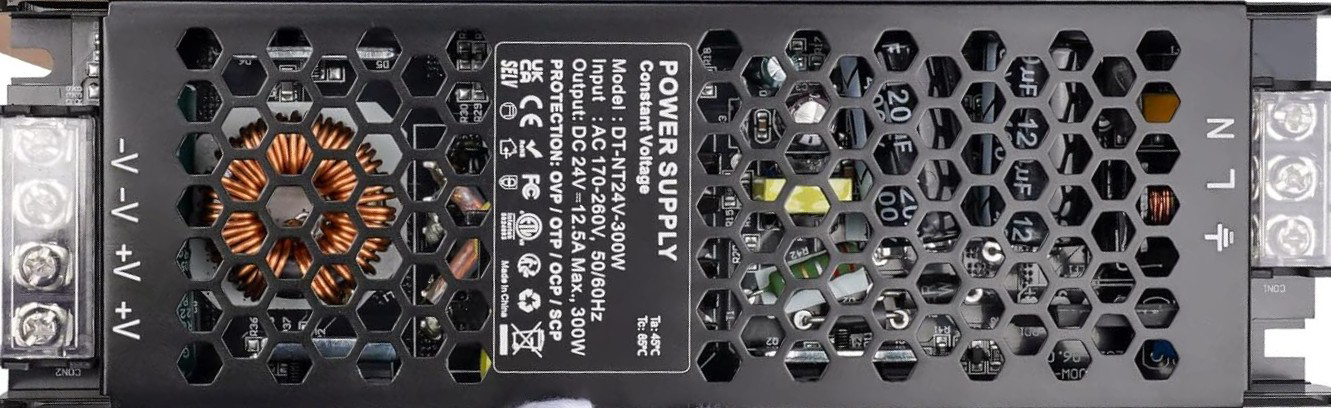
The Reylax DT-NT24V-300W is a high-performance power supply unit (PSU) designed to convert standard AC mains voltage into a stable 24V DC output. With a maximum power output of 300 watts and a current capacity of 12.5 amps, this PSU is ideal for powering a wide range of electronic devices, industrial equipment, and DIY projects. Its robust design ensures reliable operation in demanding environments.
Explore Projects Built with 24v 300w 12.5A PSU
 Open Project in Cirkit Designer
 Open Project in Cirkit Designer
 Open Project in Cirkit Designer
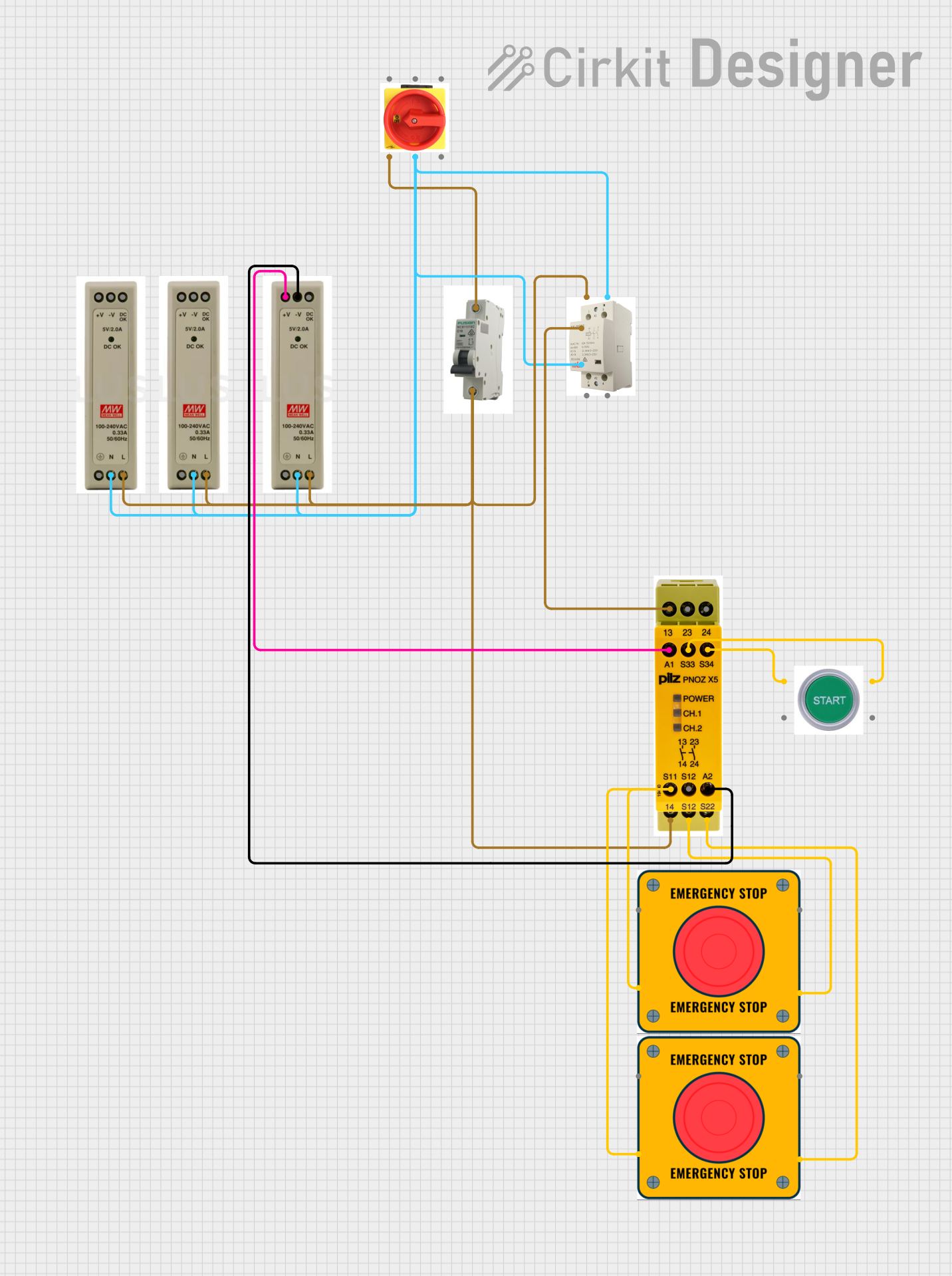 Open Project in Cirkit Designer
Explore Projects Built with 24v 300w 12.5A PSU
Open Project in Cirkit DesignerOpen Project in Cirkit DesignerOpen Project in Cirkit DesignerOpen Project in Cirkit DesignerCommon Applications and Use Cases
- Powering industrial control systems and automation equipment
- Driving high-power DC motors and actuators
- Supplying power to LED lighting systems
- Providing a stable power source for laboratory and testing equipment
- Supporting DIY electronics projects requiring high current
Technical Specifications
Below are the key technical details of the Reylax DT-NT24V-300W:
| Parameter | Value |
|---|---|
| Manufacturer | Reylax |
| Part ID | DT-NT24V-300W |
| Input Voltage Range | 100-240V AC, 50/60Hz |
| Output Voltage | 24V DC |
| Maximum Output Power | 300W |
| Maximum Output Current | 12.5A |
| Efficiency | ≥ 85% |
| Operating Temperature | -10°C to +50°C |
| Cooling Method | Built-in fan (active cooling) |
| Dimensions | 215mm x 115mm x 50mm |
| Weight | 1.2 kg |
| Protection Features | Overload, overvoltage, |
| short-circuit protection |
Pin Configuration and Descriptions
The PSU features screw terminal connections for both input and output. Below is the pin configuration:
Input Terminals
| Pin | Label | Description |
|---|---|---|
| 1 | L | Live AC input (100-240V AC) |
| 2 | N | Neutral AC input |
| 3 | GND | Earth/ground connection |
Output Terminals
| Pin | Label | Description |
|---|---|---|
| 1 | +V | Positive 24V DC output |
| 2 | -V | Negative 24V DC output (ground) |
Usage Instructions
How to Use the Component in a Circuit
- Mounting the PSU: Secure the PSU in a well-ventilated area to ensure proper cooling. Avoid placing it near heat sources or in enclosed spaces without airflow.
- Connecting the Input:
- Connect the L terminal to the live wire of the AC mains.
- Connect the N terminal to the neutral wire of the AC mains.
- Connect the GND terminal to the earth/ground wire for safety.
- Connecting the Output:
- Connect the +V terminal to the positive input of your load or circuit.
- Connect the -V terminal to the ground or negative input of your load or circuit.
- Powering On:
- Ensure all connections are secure and correct.
- Switch on the AC mains power to activate the PSU.
Important Considerations and Best Practices
- Load Requirements: Ensure the total load does not exceed 300W or 12.5A to prevent overloading the PSU.
- Ventilation: Maintain at least 10cm of clearance around the PSU for proper airflow.
- Wiring: Use appropriately rated wires for both input and output connections to handle the current safely.
- Polarity: Double-check the polarity of the output connections to avoid damaging your devices.
- Safety: Always disconnect the PSU from the mains before making any wiring changes.
Example: Using the PSU with an Arduino UNO
The Reylax DT-NT24V-300W can be used to power an Arduino UNO via a DC-DC step-down converter (e.g., a buck converter) to step down the 24V output to 5V. Below is an example setup:
- Connect the PSU's +V and -V terminals to the input of the DC-DC step-down converter.
- Adjust the step-down converter to output 5V DC.
- Connect the 5V output of the converter to the Arduino UNO's 5V and GND pins.
Sample Arduino Code
// Example code to blink an LED connected to pin 13 of the Arduino UNO
// Ensure the Arduino is powered via the 5V output of the step-down converter

void setup() {
  pinMode(13, OUTPUT); // Set pin 13 as an output
}

void loop() {
  digitalWrite(13, HIGH); // Turn the LED on
  delay(1000);            // Wait for 1 second
  digitalWrite(13, LOW);  // Turn the LED off
  delay(1000);            // Wait for 1 second
}
Troubleshooting and FAQs
Common Issues and Solutions
PSU Does Not Power On:
- Check the AC mains connection and ensure the input voltage is within the specified range (100-240V AC).
- Verify that the fuse inside the PSU is not blown.
No Output Voltage:
- Ensure the load is connected properly to the output terminals.
- Check for any overload or short circuit on the output side.
Overheating:
- Ensure the PSU is not overloaded (maximum 300W or 12.5A).
- Verify that the cooling fan is operational and the PSU is in a well-ventilated area.
Output Voltage Fluctuations:
- Check for loose connections on the input or output terminals.
- Ensure the input voltage is stable and within the specified range.
FAQs
Q1: Can I use this PSU to charge a 24V battery?
A1: No, this PSU is not designed for battery charging as it lacks the necessary current regulation and charging profiles. Use a dedicated battery charger for this purpose.
Q2: Is the PSU suitable for outdoor use?
A2: No, the PSU is not weatherproof. It should only be used in dry, indoor environments.
Q3: Can I connect multiple devices to the PSU?
A3: Yes, as long as the total power consumption does not exceed 300W or 12.5A.
Q4: What happens if the PSU is overloaded?
A4: The PSU has built-in overload protection and will shut down to prevent damage. Reduce the load and restart the PSU.