
How to Use BH Smart stepping motor: Examples, Pinouts, and Specs
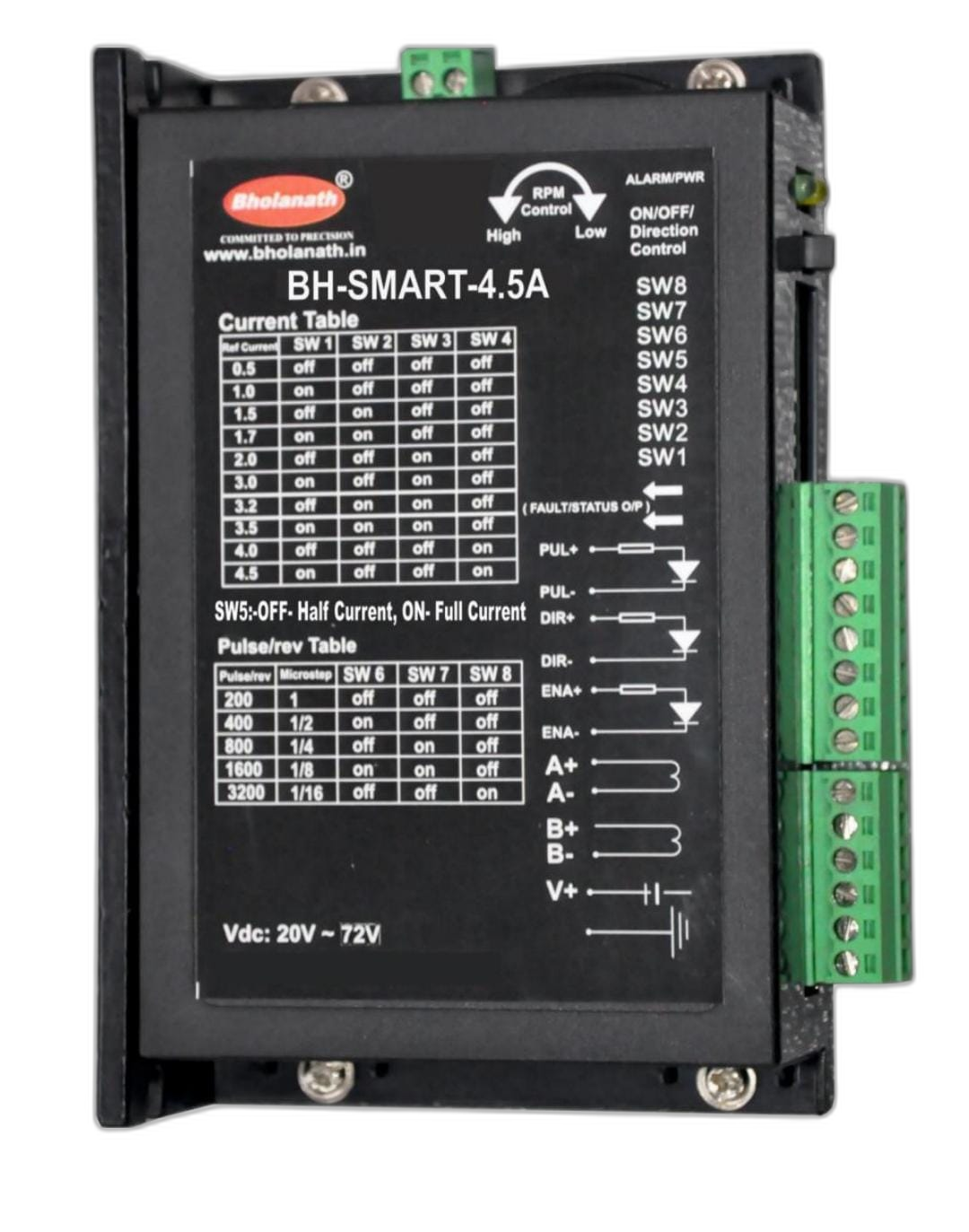
 Design with BH Smart stepping motor in Cirkit Designer
Introduction
The BH Smart Stepping Motor (Manufacturer Part ID: 212) by BHolanath is a precision motor designed to move in discrete steps, enabling accurate control of position and speed. This motor is ideal for applications requiring precise movement and repeatability, such as robotics, CNC machines, and 3D printers. Its ability to maintain position without feedback makes it a reliable choice for a wide range of automation and motion control systems.
Explore Projects Built with BH Smart stepping motor
 Open Project in Cirkit Designer
 Open Project in Cirkit Designer
 Open Project in Cirkit Designer
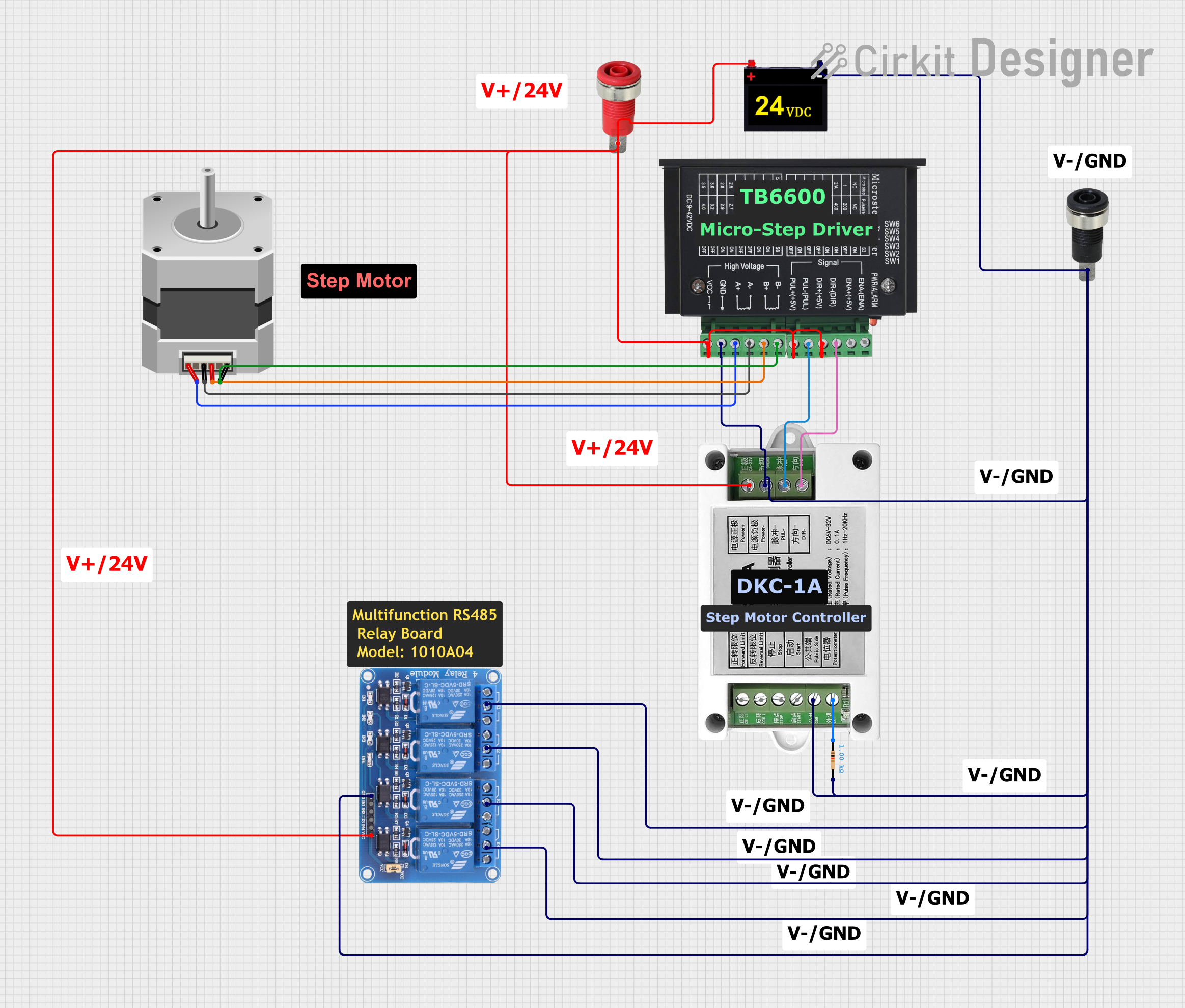 Open Project in Cirkit Designer
Explore Projects Built with BH Smart stepping motor
Open Project in Cirkit DesignerOpen Project in Cirkit DesignerOpen Project in Cirkit DesignerOpen Project in Cirkit DesignerCommon Applications
- Robotics for precise arm or wheel movement
- CNC machines for accurate cutting and engraving
- 3D printers for controlled extrusion and positioning
- Camera gimbals for smooth and precise motion
- Industrial automation systems
Technical Specifications
The following table outlines the key technical details of the BH Smart Stepping Motor:
| Parameter | Value |
|---|---|
| Manufacturer | BHolanath |
| Part ID | 212 |
| Step Angle | 1.8° per step |
| Operating Voltage | 12V to 24V |
| Rated Current | 1.5A per phase |
| Holding Torque | 0.5 Nm |
| Number of Phases | 2 |
| Resistance per Phase | 2.5Ω |
| Inductance per Phase | 3.2 mH |
| Shaft Diameter | 5 mm |
| Dimensions | 42 mm x 42 mm x 48 mm |
| Weight | 350 g |
Pin Configuration and Descriptions
The BH Smart Stepping Motor has four wires for its bipolar configuration. The pinout is as follows:
| Wire Color | Function | Description |
|---|---|---|
| Red | Phase A+ | Positive terminal of Phase A |
| Blue | Phase A- | Negative terminal of Phase A |
| Green | Phase B+ | Positive terminal of Phase B |
| Black | Phase B- | Negative terminal of Phase B |
Usage Instructions
How to Use the Component in a Circuit
- Power Supply: Ensure the motor is powered with a voltage between 12V and 24V, as per the specifications. Use a regulated power supply to avoid voltage fluctuations.
- Driver Circuit: Use a compatible stepper motor driver (e.g., A4988 or DRV8825) to control the motor. The driver will handle the current regulation and step sequencing.
- Connections:
- Connect the motor wires to the driver as per the pin configuration.
- Connect the driver to a microcontroller (e.g., Arduino UNO) for step and direction control.
- Microcontroller Programming: Write a program to send step and direction signals to the driver. The number of steps determines the rotation angle, and the step frequency controls the speed.
Important Considerations and Best Practices
- Current Limiting: Set the current limit on the driver to 1.5A to prevent overheating or damage to the motor.
- Cooling: If the motor operates continuously at high speeds or torque, consider adding a heatsink or fan for cooling.
- Step Resolution: Use microstepping (if supported by the driver) for smoother motion and reduced vibration.
- Avoid Stalling: Do not exceed the motor's torque limit to avoid losing steps or stalling.
Example Code for Arduino UNO
Below is an example code to control the BH Smart Stepping Motor using an A4988 driver and an Arduino UNO:
// Define pins for step and direction
const int stepPin = 3;  // Pin connected to STEP on the driver
const int dirPin = 4;   // Pin connected to DIR on the driver

void setup() {
  // Set the step and direction pins as outputs
  pinMode(stepPin, OUTPUT);
  pinMode(dirPin, OUTPUT);

  // Set initial direction
  digitalWrite(dirPin, HIGH); // HIGH for clockwise, LOW for counterclockwise
}

void loop() {
  // Rotate the motor 200 steps (1 full revolution for 1.8° step angle)
  for (int i = 0; i < 200; i++) {
    digitalWrite(stepPin, HIGH); // Generate a step pulse
    delayMicroseconds(1000);     // Wait 1 ms (adjust for speed control)
    digitalWrite(stepPin, LOW);  // End the step pulse
    delayMicroseconds(1000);     // Wait 1 ms
  }

  // Change direction
  digitalWrite(dirPin, !digitalRead(dirPin)); // Toggle direction
  delay(1000); // Wait 1 second before the next rotation
}
Notes on the Code
- Adjust the
delayMicroseconds()values to control the motor speed. - Ensure the current limit on the driver matches the motor's rated current (1.5A).
Troubleshooting and FAQs
Common Issues and Solutions
Motor Not Moving:
- Cause: Incorrect wiring or loose connections.
- Solution: Double-check the wiring and ensure all connections are secure.
Motor Vibrates but Does Not Rotate:
- Cause: Incorrect step sequence or insufficient current.
- Solution: Verify the step sequence in the code and ensure the driver current limit is set correctly.
Overheating:
- Cause: Excessive current or prolonged operation at high torque.
- Solution: Reduce the current limit on the driver and add cooling if necessary.
Skipping Steps:
- Cause: Exceeding the motor's torque limit.
- Solution: Reduce the load or use a motor with higher torque.
Noisy Operation:
- Cause: Full-step mode or high-speed operation.
- Solution: Use microstepping and ensure the motor is mounted securely.
FAQs
Q: Can I use this motor with a 5V power supply?
A: No, the motor requires a minimum of 12V for proper operation.Q: What is the maximum speed of the motor?
A: The maximum speed depends on the driver and load but is typically around 1000 RPM.Q: Can I use this motor in a unipolar configuration?
A: No, this is a bipolar stepper motor and is not compatible with unipolar configurations.Q: How do I calculate the number of steps for a specific angle?
A: Use the formula:Steps = (Angle / Step Angle). For example, for 90°,Steps = 90 / 1.8 = 50.
By following this documentation, users can effectively integrate the BH Smart Stepping Motor into their projects for precise and reliable motion control.