
How to Use bme680: Examples, Pinouts, and Specs
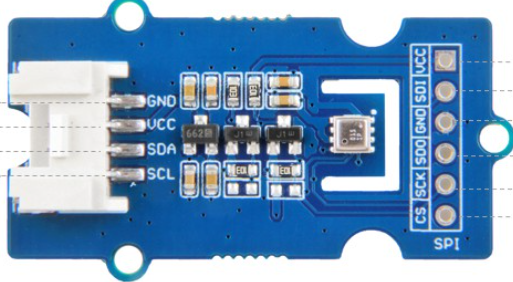
 Design with bme680 in Cirkit Designer
Introduction
The BME680 is a versatile environmental sensor developed by Bosch Sensortec. It is capable of measuring temperature, humidity, barometric pressure, and gas concentrations, including volatile organic compounds (VOCs). This makes it an ideal choice for applications requiring air quality monitoring, weather stations, and Internet of Things (IoT) devices. Its compact size and low power consumption make it suitable for portable and battery-powered systems.
Explore Projects Built with bme680
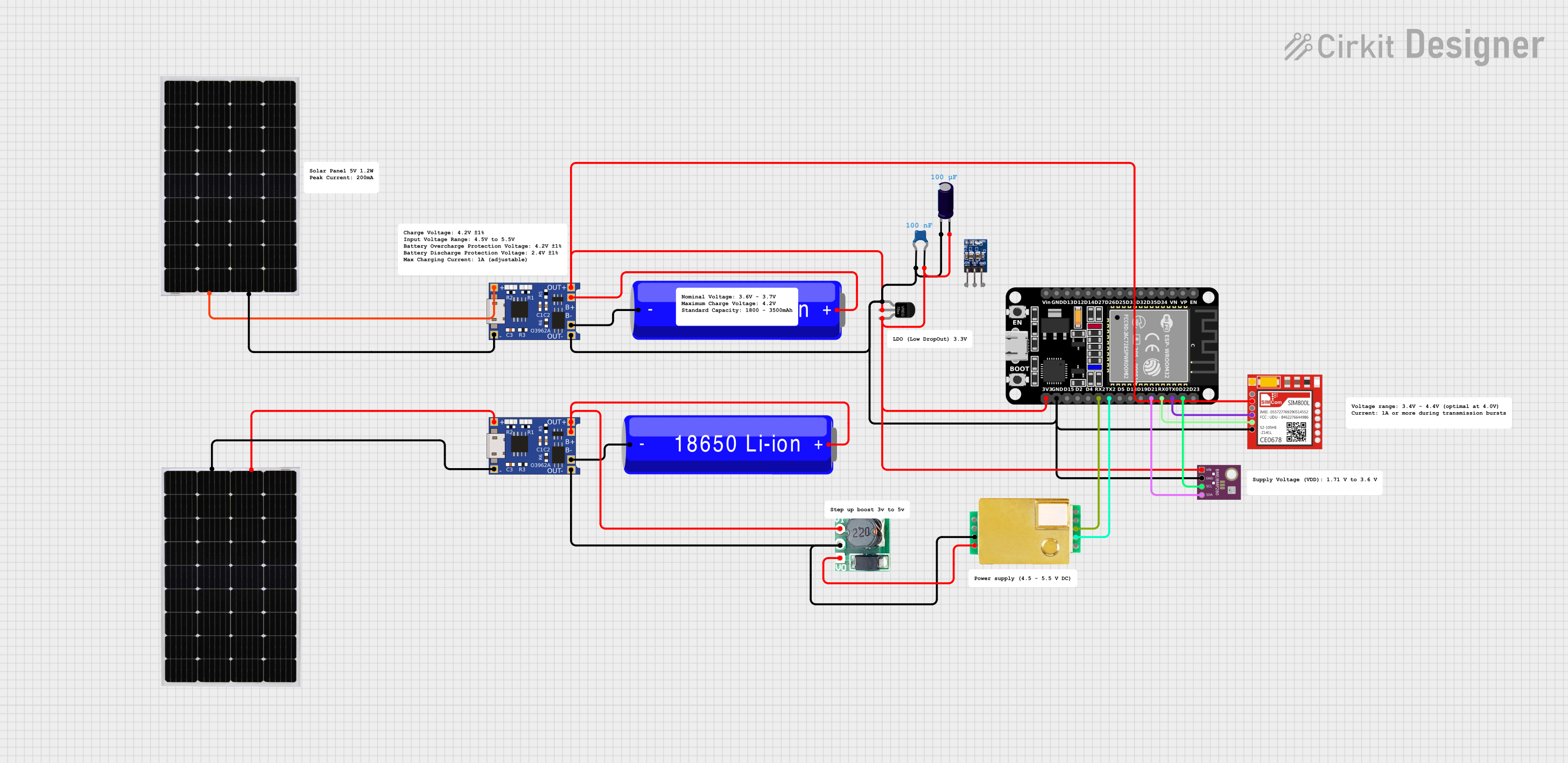 Open Project in Cirkit Designer
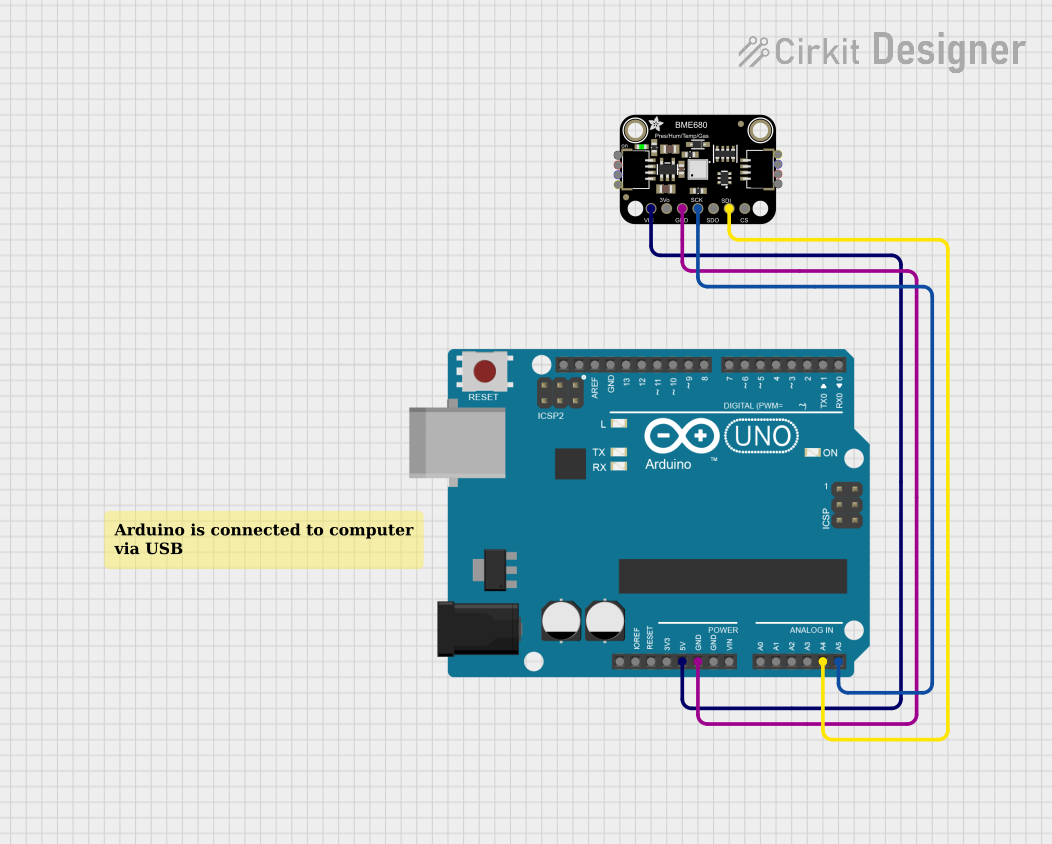 Open Project in Cirkit Designer
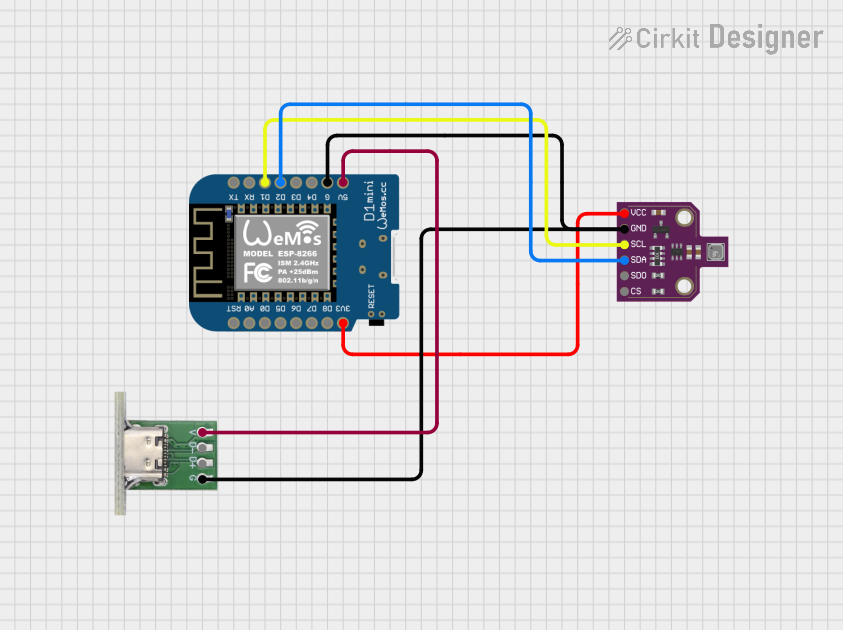 Open Project in Cirkit Designer
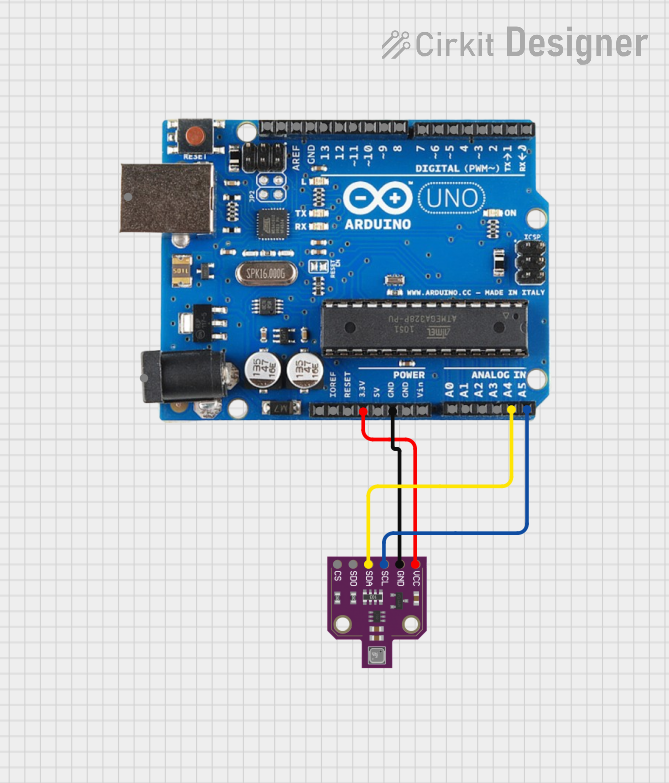 Open Project in Cirkit Designer
Explore Projects Built with bme680
Open Project in Cirkit DesignerOpen Project in Cirkit DesignerOpen Project in Cirkit DesignerOpen Project in Cirkit DesignerCommon Applications
- Indoor air quality monitoring
- Smart home automation
- Weather stations
- Wearable devices
- IoT-enabled environmental sensing
Technical Specifications
Key Technical Details
| Parameter | Value |
|---|---|
| Supply Voltage | 1.71V to 3.6V |
| Operating Current | 2.1 µA (sleep mode), 0.09 mA (low power) |
| Temperature Range | -40°C to +85°C |
| Humidity Range | 0% to 100% RH |
| Pressure Range | 300 hPa to 1100 hPa |
| Gas Measurement Range | 0 to 500 ppm (VOCs) |
| Interface | I2C and SPI |
| Dimensions | 3.0 mm x 3.0 mm x 0.93 mm |
Pin Configuration and Descriptions
| Pin Name | Pin Number | Description |
|---|---|---|
| VDD | 1 | Power supply input (1.71V to 3.6V) |
| GND | 2 | Ground |
| SCL/SPC | 3 | I2C clock / SPI clock input |
| SDA/SDI | 4 | I2C data / SPI data input |
| SDO | 5 | SPI data output / I2C address selection |
| CSB | 6 | SPI chip select (active low) |
Usage Instructions
How to Use the BME680 in a Circuit
- Power Supply: Connect the VDD pin to a 3.3V power source and the GND pin to ground.
- Communication Interface: Choose between I2C or SPI:
- For I2C, connect the SCL and SDA pins to the corresponding I2C pins on your microcontroller. Use a pull-up resistor (typically 4.7kΩ) on both lines.
- For SPI, connect the SCL, SDA, SDO, and CSB pins to the appropriate SPI pins on your microcontroller.
- I2C Address Selection: The I2C address can be set by connecting the SDO pin to either GND (address 0x76) or VDD (address 0x77).
- Gas Sensor Warm-Up: Allow the sensor to warm up for a few minutes to stabilize gas readings.
Important Considerations
- Power Supply: Ensure the supply voltage is within the specified range to avoid damage.
- Calibration: The sensor is factory-calibrated, but for precise applications, additional calibration may be required.
- Placement: Avoid placing the sensor near heat sources or in direct sunlight, as this may affect temperature and gas readings.
- Ventilation: Ensure proper airflow around the sensor for accurate gas and humidity measurements.
Example Code for Arduino UNO
Below is an example of how to interface the BME680 with an Arduino UNO using the I2C protocol. This code uses the Adafruit BME680 library, which can be installed via the Arduino Library Manager.
#include <Wire.h>
#include <Adafruit_Sensor.h>
#include <Adafruit_BME680.h>

// Create an instance of the BME680 sensor
Adafruit_BME680 bme;

// Setup function to initialize the sensor
void setup() {
  Serial.begin(9600); // Start serial communication at 9600 baud
  while (!Serial);    // Wait for the serial monitor to open

  // Initialize the BME680 sensor
  if (!bme.begin(0x76)) { // Use 0x77 if SDO is connected to VDD
    Serial.println("Could not find a valid BME680 sensor, check wiring!");
    while (1); // Halt execution if sensor initialization fails
  }

  // Configure sensor settings
  bme.setTemperatureOversampling(BME680_OS_8X);
  bme.setHumidityOversampling(BME680_OS_2X);
  bme.setPressureOversampling(BME680_OS_4X);
  bme.setIIRFilterSize(BME680_FILTER_SIZE_3);
  bme.setGasHeater(320, 150); // 320°C for 150 ms
}

// Loop function to read and display sensor data
void loop() {
  if (!bme.performReading()) {
    Serial.println("Failed to perform reading!");
    return; // Skip the rest of the loop if reading fails
  }

  // Print sensor readings to the serial monitor
  Serial.print("Temperature = ");
  Serial.print(bme.temperature);
  Serial.println(" °C");

  Serial.print("Humidity = ");
  Serial.print(bme.humidity);
  Serial.println(" %");

  Serial.print("Pressure = ");
  Serial.print(bme.pressure / 100.0);
  Serial.println(" hPa");

  Serial.print("Gas = ");
  Serial.print(bme.gas_resistance / 1000.0);
  Serial.println(" kOhms");

  Serial.println(); // Add a blank line for readability
  delay(2000); // Wait 2 seconds before the next reading
}
Troubleshooting and FAQs
Common Issues
Sensor Not Detected:
- Ensure the wiring is correct and matches the selected communication protocol (I2C or SPI).
- Verify the I2C address (0x76 or 0x77) and update the code accordingly.
- Check for loose connections or damaged wires.
Incorrect Readings:
- Ensure the sensor is not exposed to extreme environmental conditions (e.g., high humidity or temperature).
- Allow the sensor to warm up for a few minutes before taking gas readings.
- Verify that the sensor is properly ventilated.
Communication Errors:
- Check the pull-up resistors on the I2C lines (SCL and SDA).
- Ensure the microcontroller and sensor share a common ground.
Tips for Troubleshooting
- Use a multimeter to verify the voltage at the VDD pin.
- Test the I2C or SPI communication using a logic analyzer to ensure proper signal levels.
- Refer to the datasheet for detailed timing and electrical characteristics.
By following this documentation, you should be able to successfully integrate the BME680 sensor into your project and troubleshoot common issues effectively.