
How to Use Single Brushed DC Motor Driver Carrier: Examples, Pinouts, and Specs
 Design with Single Brushed DC Motor Driver Carrier in Cirkit Designer
Introduction
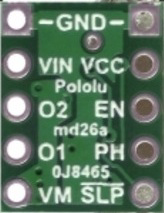
The Pololu DRV8838 Single Brushed DC Motor Driver Carrier is a compact and efficient module designed to control the speed and direction of a single brushed DC motor. It is based on the Texas Instruments DRV8838 motor driver IC and is ideal for applications requiring precise motor control with minimal space requirements. The module supports control via PWM signals, making it easy to interface with microcontrollers such as Arduino, Raspberry Pi, or other embedded systems.
Explore Projects Built with Single Brushed DC Motor Driver Carrier
 Open Project in Cirkit Designer
 Open Project in Cirkit Designer
 Open Project in Cirkit Designer
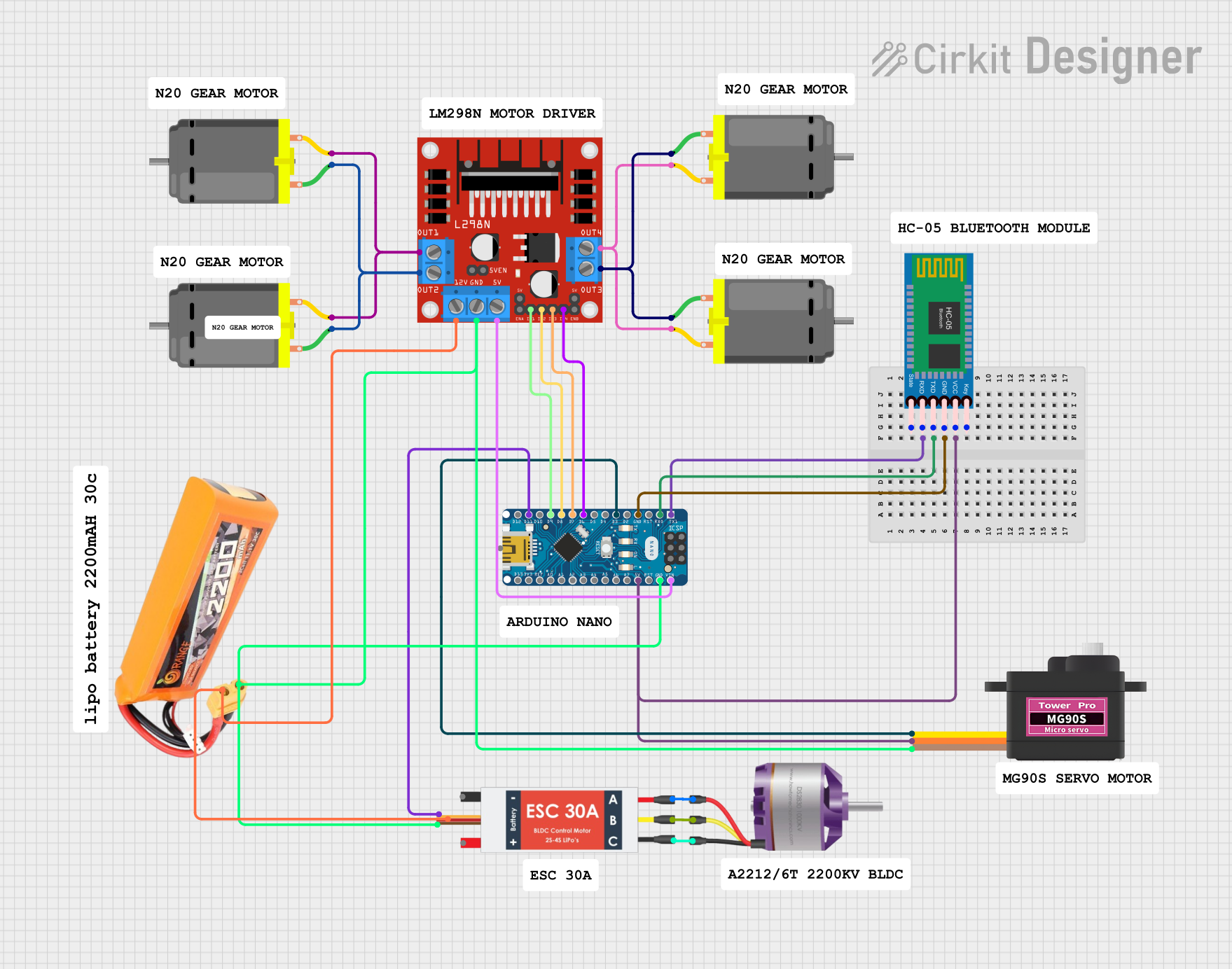 Open Project in Cirkit Designer
Explore Projects Built with Single Brushed DC Motor Driver Carrier
Open Project in Cirkit DesignerOpen Project in Cirkit DesignerOpen Project in Cirkit DesignerOpen Project in Cirkit DesignerCommon Applications
- Robotics and automation
- Small motorized vehicles
- Conveyor belts and actuators
- DIY electronics projects
- Educational kits for motor control
Technical Specifications
The following table outlines the key technical details of the Pololu DRV8838 motor driver carrier:
| Parameter | Value |
|---|---|
| Operating Voltage (VCC) | 0 V to 11 V |
| Motor Voltage (VM) | 0 V to 11 V |
| Continuous Output Current | Up to 1.7 A |
| Peak Output Current | 1.8 A (for short durations) |
| Control Interface | PWM, DIR (direction control) |
| Logic Voltage Range | 1.8 V to 7 V |
| Protection Features | Overcurrent protection, thermal shutdown, undervoltage lockout |
| Dimensions | 0.6" × 0.8" × 0.1" (15 mm × 20 mm × 3 mm) |
| Weight | 0.5 g |
Pin Configuration and Descriptions
The DRV8838 motor driver carrier has six pins. The table below describes each pin:
| Pin Name | Type | Description |
|---|---|---|
| VIN | Power Input | Motor power supply (0 V to 11 V). Connect to the positive terminal of the motor power source. |
| GND | Ground | Ground connection for both logic and motor power. |
| VCC | Power Input | Logic power supply (1.8 V to 7 V). Connect to the microcontroller's logic voltage. |
| IN1 | Logic Input | Motor control input 1. Used for PWM or direction control. |
| IN2 | Logic Input | Motor control input 2. Used for PWM or direction control. |
| OUT1, OUT2 | Motor Outputs | Connect to the two terminals of the brushed DC motor. |
Usage Instructions
Connecting the DRV8838 to a Circuit
- Power Supply: Connect the motor power supply to the
VINpin and ground to theGNDpin. Ensure the voltage is within the specified range (0 V to 11 V). - Logic Power: Connect the microcontroller's logic voltage (1.8 V to 7 V) to the
VCCpin. - Motor Connections: Attach the two terminals of the brushed DC motor to the
OUT1andOUT2pins. - Control Pins: Use the
IN1andIN2pins to control the motor's speed and direction:- Apply a PWM signal to
IN1for speed control. - Use
IN2to set the motor's direction (HIGH or LOW).
- Apply a PWM signal to
Example Arduino Code
Below is an example of how to control the DRV8838 with an Arduino UNO:
// Define motor control pins
const int IN1 = 9; // PWM pin for speed control
const int IN2 = 8; // Direction control pin

void setup() {
  // Set motor control pins as outputs
  pinMode(IN1, OUTPUT);
  pinMode(IN2, OUTPUT);
}

void loop() {
  // Rotate motor forward at 50% speed
  analogWrite(IN1, 128); // PWM value (0-255) for speed
  digitalWrite(IN2, LOW); // Set direction to forward
  delay(2000); // Run for 2 seconds

  // Rotate motor backward at 75% speed
  analogWrite(IN1, 192); // PWM value (0-255) for speed
  digitalWrite(IN2, HIGH); // Set direction to backward
  delay(2000); // Run for 2 seconds

  // Stop the motor
  analogWrite(IN1, 0); // Set speed to 0
  delay(1000); // Wait for 1 second
}
Important Considerations
- Ensure the motor's current requirements do not exceed the driver's maximum continuous current rating (1.7 A).
- Use a decoupling capacitor across the motor power supply (
VINandGND) to reduce noise and voltage spikes. - Avoid reversing the polarity of the power supply connections, as this may damage the module.
- For optimal performance, ensure proper heat dissipation, especially when operating near the maximum current rating.
Troubleshooting and FAQs
Common Issues and Solutions
Motor Does Not Spin
- Verify that the power supply is connected and providing the correct voltage.
- Check the connections to the motor and ensure they are secure.
- Confirm that the control signals (
IN1andIN2) are being sent correctly from the microcontroller.
Motor Spins in the Wrong Direction
- Swap the connections to the motor terminals (
OUT1andOUT2). - Alternatively, reverse the logic level on the
IN2pin.
- Swap the connections to the motor terminals (
Driver Overheats
- Ensure the motor's current draw does not exceed 1.7 A continuously.
- Add a heatsink or improve ventilation around the driver.
PWM Control Not Working
- Verify that the PWM signal is being generated correctly by the microcontroller.
- Ensure the PWM frequency is within the recommended range (typically 20 kHz or higher).
FAQs
Q: Can I use this driver with a 12 V motor?
A: No, the maximum motor voltage supported by the DRV8838 is 11 V. Using a 12 V motor may damage the driver.
Q: What happens if the motor stalls?
A: The DRV8838 includes overcurrent protection, which will disable the outputs if the current exceeds the limit. Reduce the load on the motor to prevent stalling.
Q: Can I control the motor without PWM?
A: Yes, you can set IN1 to HIGH or LOW for full-speed operation and use IN2 to control the direction.
Q: Is this driver compatible with 3.3 V logic?
A: Yes, the DRV8838 supports logic voltages as low as 1.8 V, making it compatible with 3.3 V systems.
By following this documentation, you can effectively integrate the Pololu DRV8838 Single Brushed DC Motor Driver Carrier into your projects for reliable and precise motor control.