
How to Use esp32: Examples, Pinouts, and Specs
 Design with esp32 in Cirkit Designer
Introduction
The ESP32, manufactured by Espressif Systems, is a low-cost, low-power system on a chip (SoC) with integrated Wi-Fi and Bluetooth capabilities. It is widely used in Internet of Things (IoT) applications, embedded systems, and smart devices due to its versatility, high performance, and energy efficiency. The ESP32 is based on a dual-core Xtensa LX6 microprocessor and includes a rich set of peripherals, making it suitable for a wide range of applications.
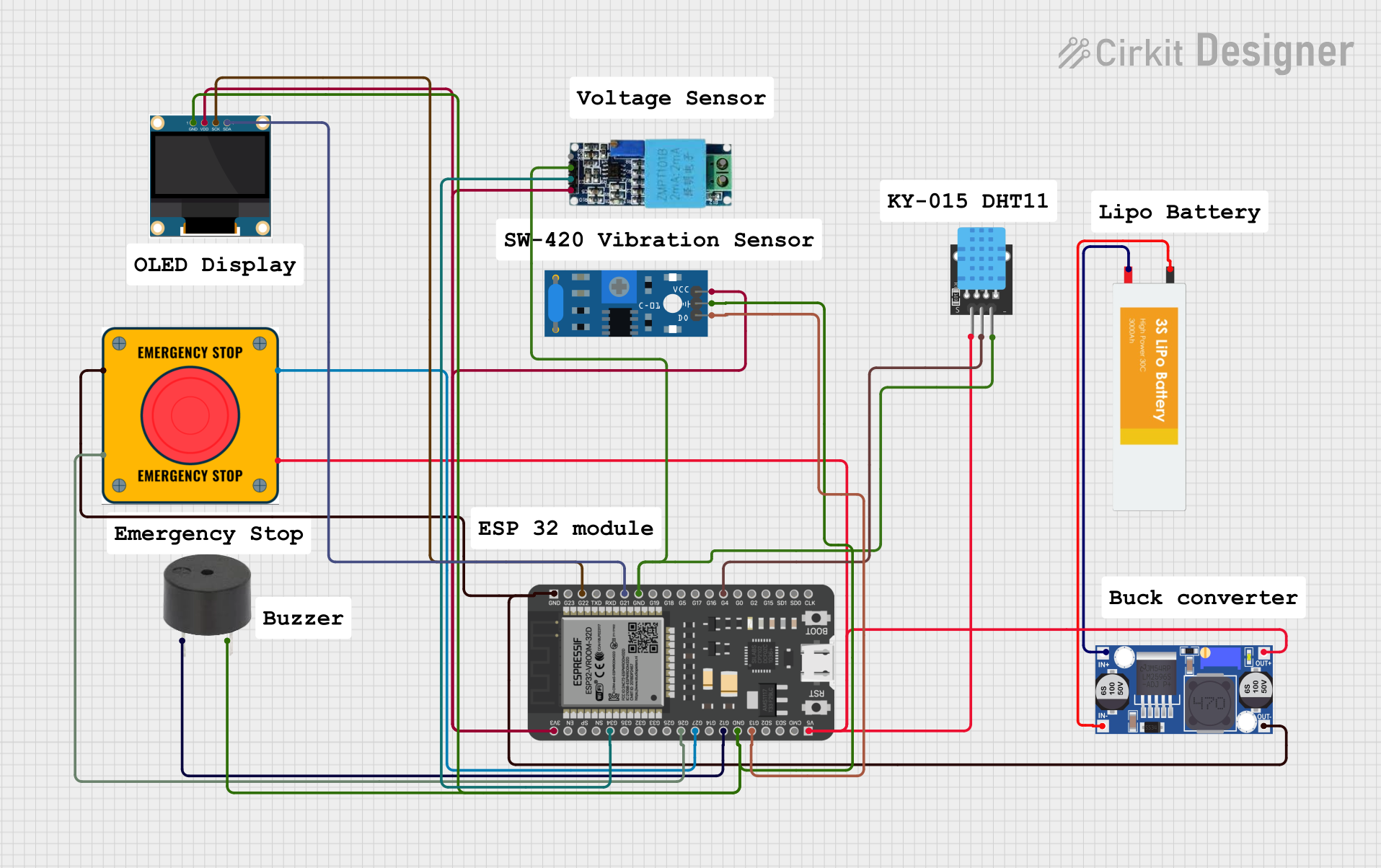
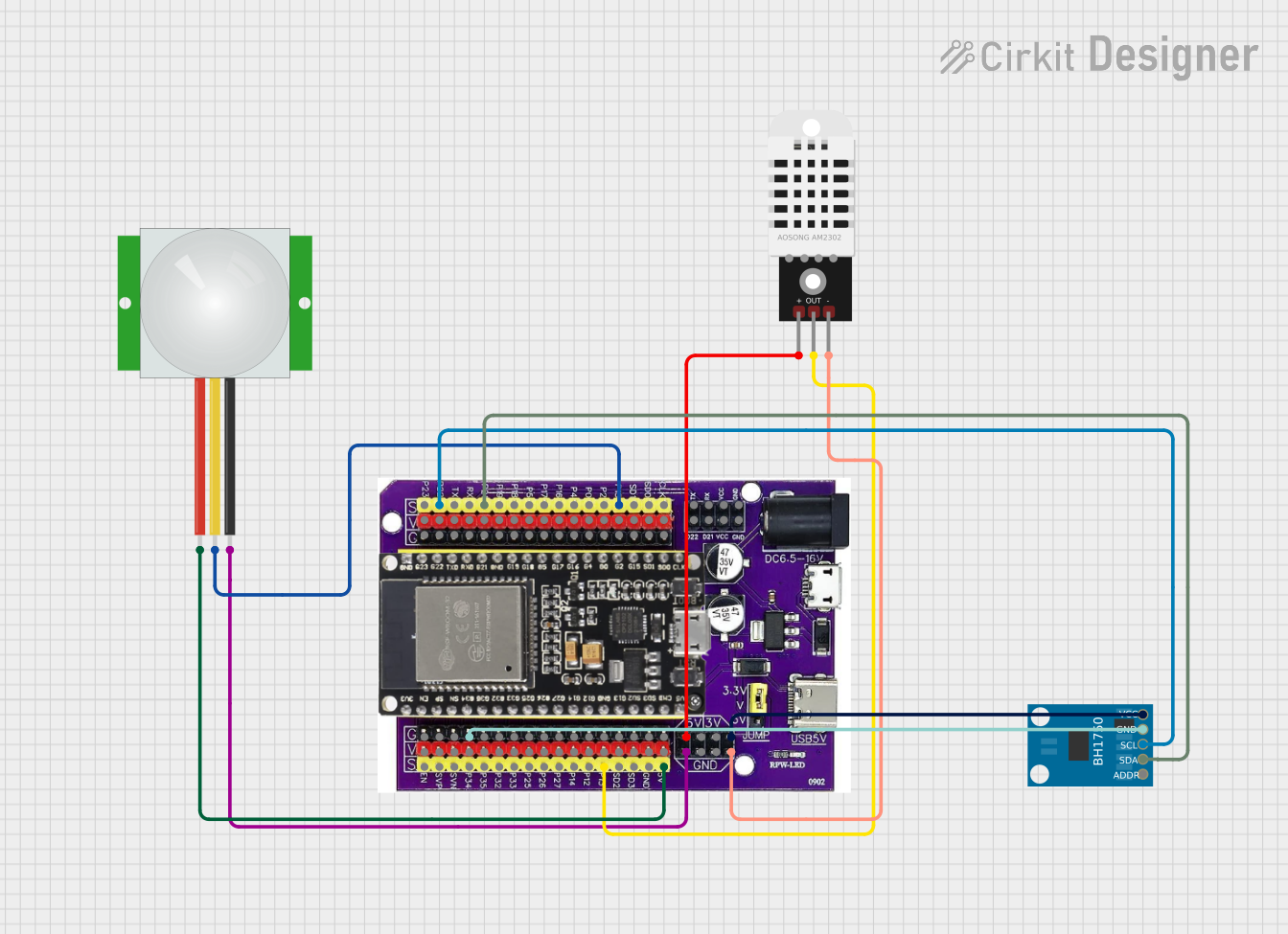
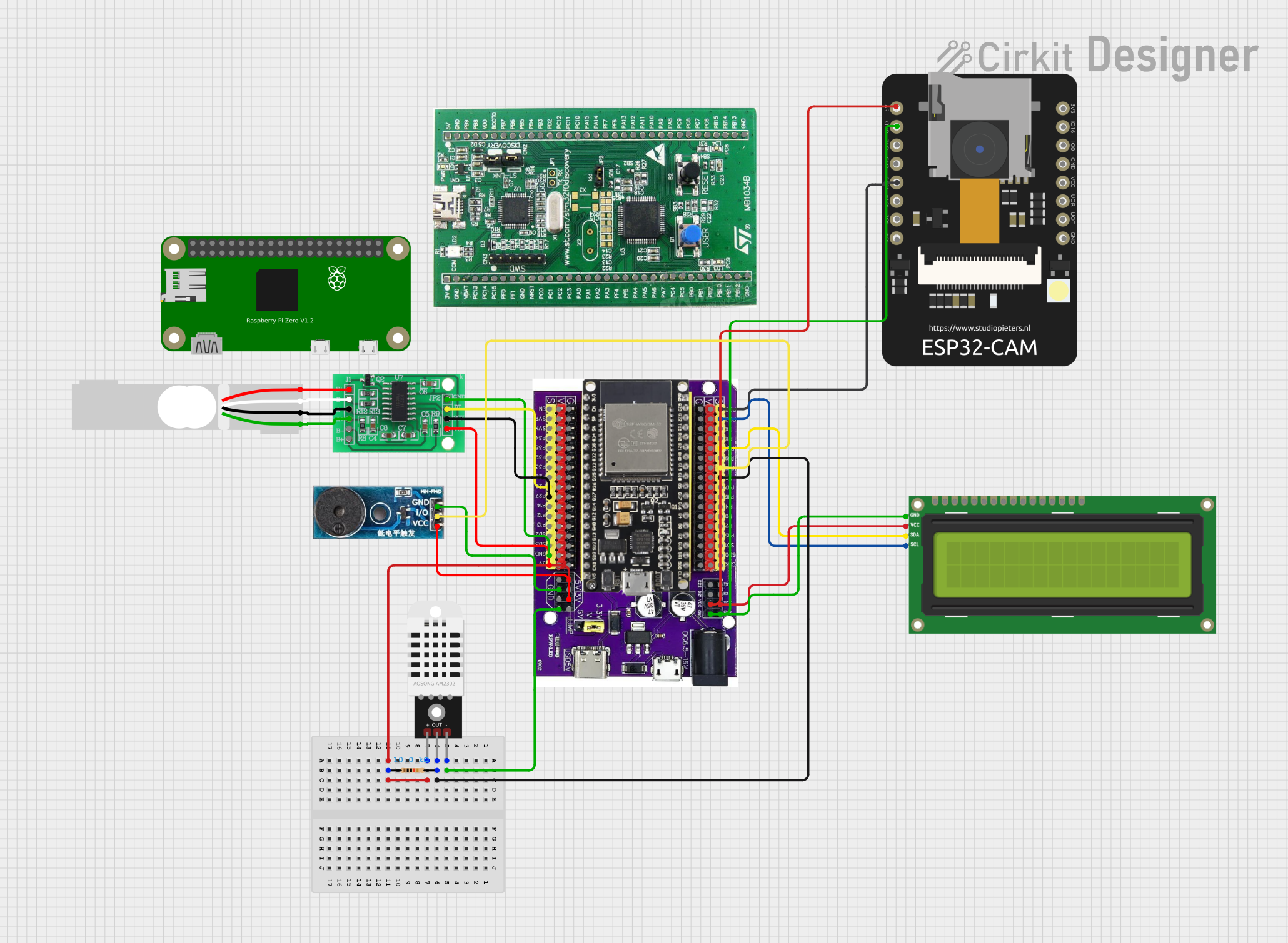
Explore Projects Built with esp32
 Open Project in Cirkit Designer
 Open Project in Cirkit Designer
 Open Project in Cirkit Designer
 Open Project in Cirkit Designer
Explore Projects Built with esp32
Open Project in Cirkit DesignerOpen Project in Cirkit DesignerOpen Project in Cirkit DesignerOpen Project in Cirkit DesignerCommon Applications and Use Cases
- IoT devices and smart home automation
- Wearable electronics
- Wireless sensor networks
- Industrial automation
- Robotics and drones
- Prototyping and development of connected devices
Technical Specifications
The ESP32 (WROOM-32) module offers a comprehensive set of features and specifications that make it a powerful choice for developers.
Key Technical Details
| Specification | Value |
|---|---|
| Microcontroller | Dual-core Xtensa LX6 |
| Clock Speed | Up to 240 MHz |
| Flash Memory | 4 MB (external SPI flash) |
| SRAM | 520 KB |
| Wi-Fi | 802.11 b/g/n (2.4 GHz) |
| Bluetooth | Bluetooth 4.2 and BLE |
| Operating Voltage | 3.0V to 3.6V |
| GPIO Pins | 34 |
| ADC Channels | 18 (12-bit resolution) |
| DAC Channels | 2 |
| Communication Interfaces | UART, SPI, I2C, I2S, CAN, PWM |
| Power Consumption (Active) | ~160 mA (Wi-Fi active) |
| Deep Sleep Current | ~10 µA |
| Operating Temperature Range | -40°C to +85°C |
| Dimensions | 18 mm x 25.5 mm |
Pin Configuration and Descriptions
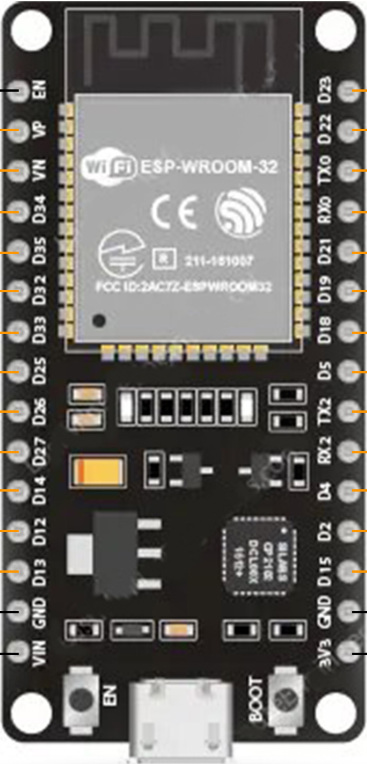
The ESP32 WROOM-32 module has 38 pins. Below is a summary of the key pins and their functions:
| Pin Number | Pin Name | Description |
|---|---|---|
| 1 | EN | Enable pin. Active high to enable the chip. |
| 2 | IO0 | GPIO0. Used for boot mode selection. |
| 3 | IO2 | GPIO2. General-purpose I/O. |
| 4 | IO4 | GPIO4. General-purpose I/O. |
| 5 | IO5 | GPIO5. General-purpose I/O. |
| 6 | IO12 | GPIO12. General-purpose I/O. |
| 7 | IO13 | GPIO13. General-purpose I/O. |
| 8 | IO14 | GPIO14. General-purpose I/O. |
| 9 | IO15 | GPIO15. General-purpose I/O. |
| 10 | IO16 | GPIO16. General-purpose I/O. |
| 11 | IO17 | GPIO17. General-purpose I/O. |
| 12 | GND | Ground pin. |
| 13 | 3V3 | 3.3V power supply. |
| 14 | TXD0 | UART0 Transmit pin. |
| 15 | RXD0 | UART0 Receive pin. |
For a complete pinout diagram, refer to the official Espressif datasheet.
Usage Instructions
How to Use the ESP32 in a Circuit
- Power Supply: Provide a stable 3.3V power supply to the
3V3pin. Ensure the current rating of the power source is sufficient for the ESP32's operation, especially during Wi-Fi transmission. - Boot Mode: To upload code, connect GPIO0 to GND and reset the module. After uploading, disconnect GPIO0 from GND.
- Connections: Use the UART pins (
TXD0andRXD0) for serial communication with a computer or microcontroller. Connect peripherals to the GPIO pins as needed. - Programming: The ESP32 can be programmed using the Arduino IDE, Espressif's ESP-IDF, or other development environments.
Important Considerations and Best Practices
- Voltage Levels: The ESP32 operates at 3.3V logic levels. Avoid connecting 5V signals directly to its GPIO pins.
- Decoupling Capacitors: Place decoupling capacitors near the power pins to ensure stable operation.
- Antenna Placement: Ensure the onboard antenna has sufficient clearance from metal objects to avoid interference.
- Deep Sleep Mode: Use deep sleep mode to conserve power in battery-powered applications.
Example Code for Arduino UNO
Below is an example of how to blink an LED connected to GPIO2 of the ESP32 using the Arduino IDE:
// Example: Blink an LED connected to GPIO2 of the ESP32

#define LED_PIN 2  // GPIO2 is connected to the LED

void setup() {
  pinMode(LED_PIN, OUTPUT);  // Set GPIO2 as an output pin
}

void loop() {
  digitalWrite(LED_PIN, HIGH);  // Turn the LED on
  delay(1000);                 // Wait for 1 second
  digitalWrite(LED_PIN, LOW);   // Turn the LED off
  delay(1000);                 // Wait for 1 second
}
Troubleshooting and FAQs
Common Issues and Solutions
ESP32 Not Detected by Computer:
- Ensure the correct USB driver for the ESP32 is installed.
- Check the USB cable for damage or try a different cable.
- Verify that the ESP32 is in boot mode when uploading code.
Wi-Fi Connection Fails:
- Double-check the SSID and password in your code.
- Ensure the Wi-Fi network is operating on the 2.4 GHz band (ESP32 does not support 5 GHz).
GPIO Pins Not Responding:
- Verify that the pins are not being used by other peripherals (e.g., ADC, UART).
- Check for proper pull-up or pull-down resistors if required.
High Power Consumption:
- Use deep sleep mode to reduce power consumption in battery-powered applications.
- Disable unused peripherals in your code.
FAQs
Q: Can the ESP32 be powered directly from a 5V source?
A: No, the ESP32 operates at 3.3V. Use a voltage regulator to step down 5V to 3.3V.
Q: How many devices can the ESP32 connect to via Bluetooth?
A: The ESP32 supports up to 7 simultaneous Bluetooth connections in classic mode.
Q: Can I use the ESP32 with a 5V logic microcontroller?
A: Yes, but you will need level shifters to safely interface the 5V logic with the ESP32's 3.3V logic.
Q: What is the maximum range of the ESP32's Wi-Fi?
A: The range depends on environmental factors but is typically up to 100 meters in open space.
For additional support, refer to the official Espressif documentation or community forums.