
How to Use Pushbutton: Examples, Pinouts, and Specs
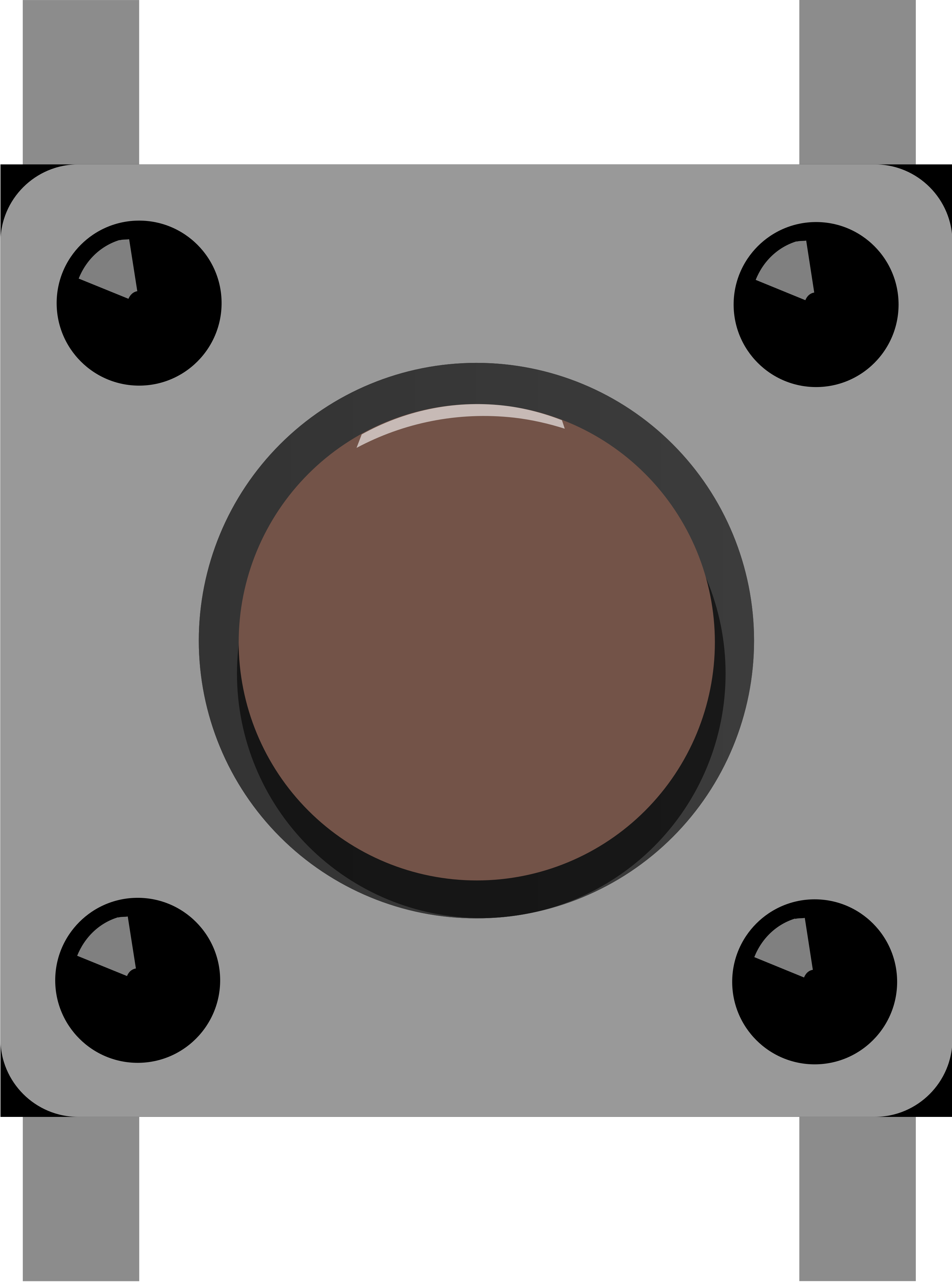
 Design with Pushbutton in Cirkit Designer
Introduction
A pushbutton is a momentary switch that completes a circuit when pressed and breaks the circuit when released. It is a simple yet essential component in electronics, commonly used for user input in devices such as calculators, remote controls, and microcontroller-based projects. Pushbuttons are available in various sizes and designs, making them versatile for a wide range of applications.
Explore Projects Built with Pushbutton
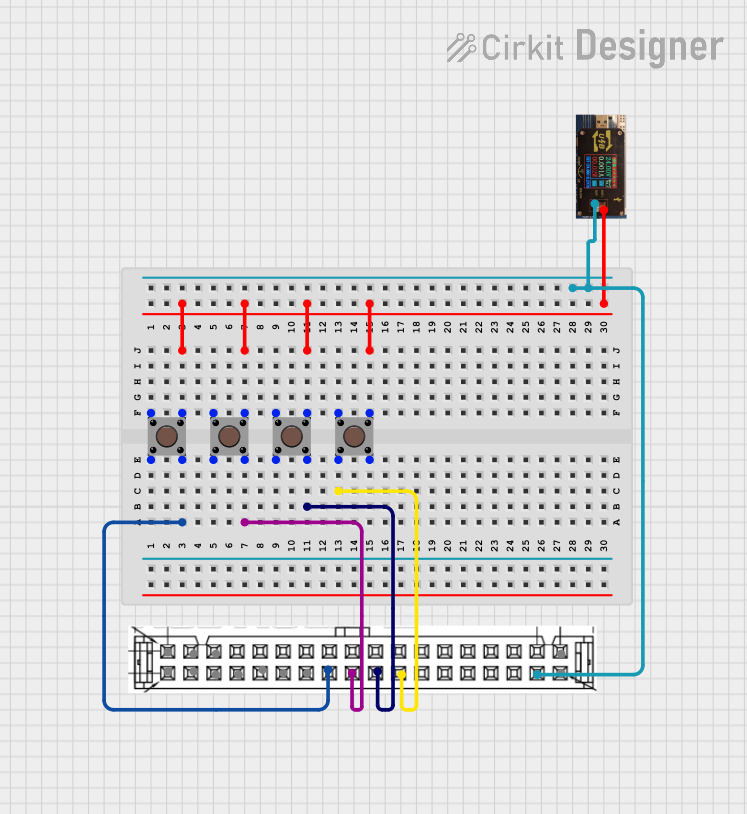 Open Project in Cirkit Designer
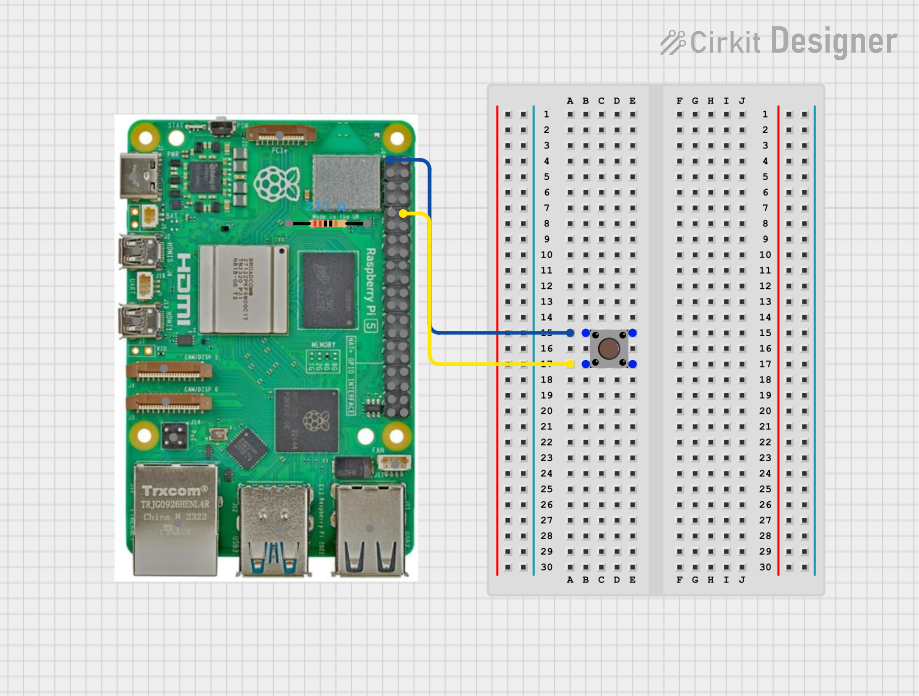 Open Project in Cirkit Designer
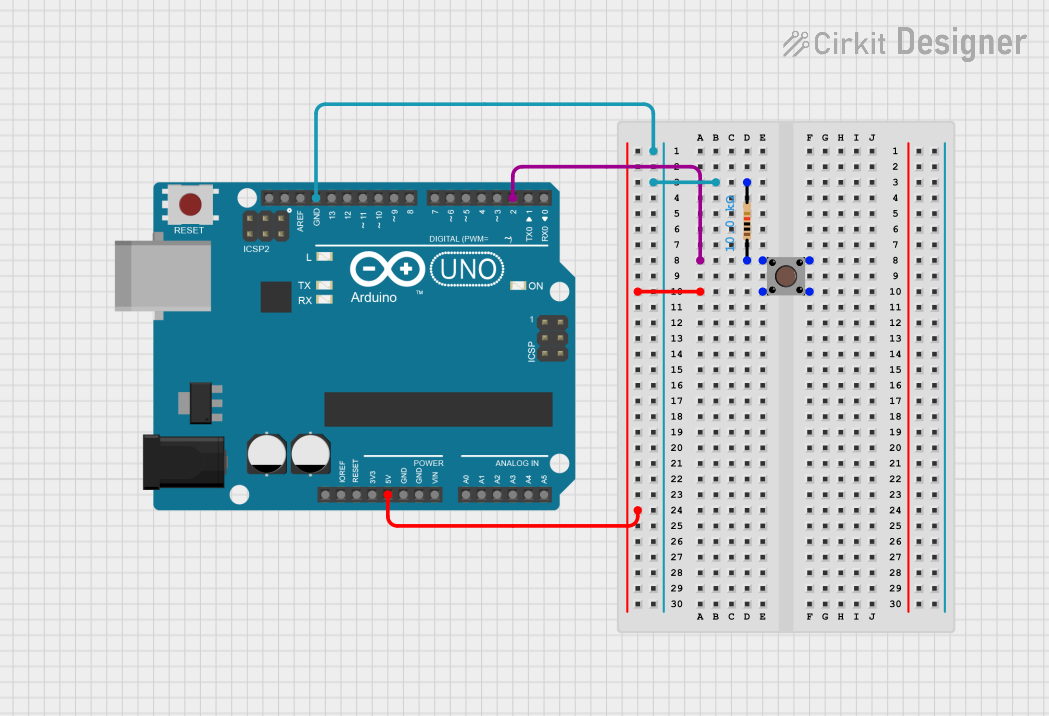 Open Project in Cirkit Designer
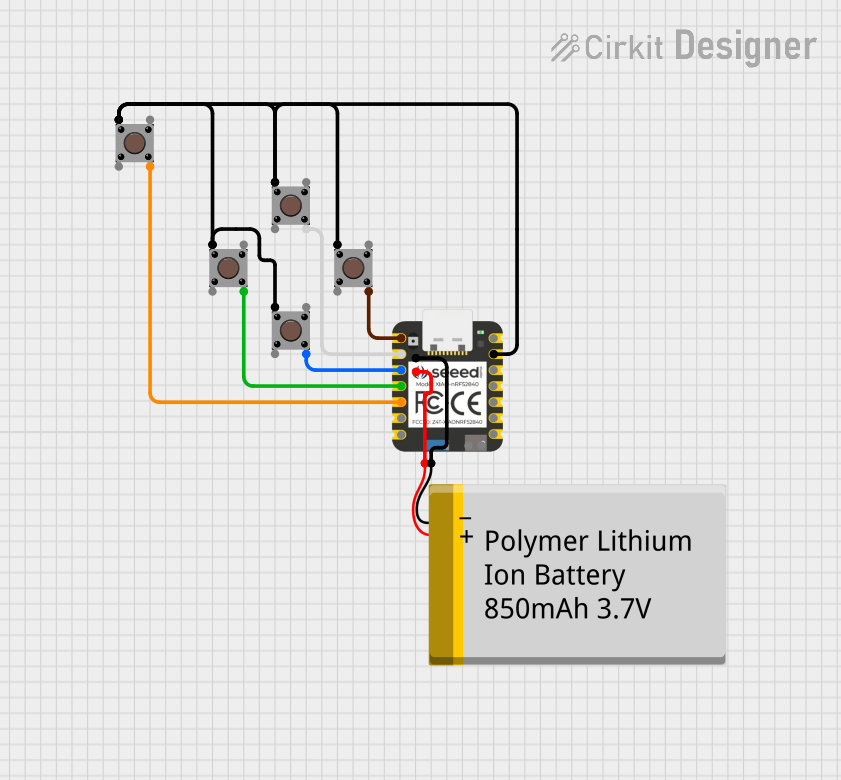 Open Project in Cirkit Designer
Explore Projects Built with Pushbutton
Open Project in Cirkit DesignerOpen Project in Cirkit DesignerOpen Project in Cirkit DesignerOpen Project in Cirkit DesignerCommon Applications and Use Cases
- User input for microcontroller projects (e.g., Arduino, Raspberry Pi)
- Reset or power buttons in electronic devices
- Control panels for appliances and machinery
- Prototyping and testing circuits
- Interactive projects such as games or toys
Technical Specifications
Below are the general technical specifications for a standard pushbutton:
- Type: Momentary switch (normally open or normally closed)
- Voltage Rating: Typically 3V to 24V (varies by model)
- Current Rating: Typically 50mA to 500mA
- Contact Resistance: < 100 mΩ
- Insulation Resistance: > 100 MΩ
- Debounce Time: ~5ms to 20ms (varies by design)
- Mechanical Life: ~100,000 to 1,000,000 actuations
Pin Configuration and Descriptions
A standard 4-pin pushbutton is commonly used in breadboard and prototyping applications. The pin configuration is as follows:
| Pin Number | Description |
|---|---|
| 1 | Terminal 1 of the switch contact |
| 2 | Terminal 2 of the switch contact |
| 3 | Terminal 3 (internally connected to 1) |
| 4 | Terminal 4 (internally connected to 2) |
Note: Pins 1 and 3 are internally connected, as are pins 2 and 4. This allows the pushbutton to be used in either orientation.
Usage Instructions
How to Use the Pushbutton in a Circuit
- Connect the Pushbutton: Place the pushbutton on a breadboard. Ensure that the pins are properly aligned with the breadboard rows.
- Wiring:
- Connect one terminal (e.g., Pin 1) to a digital input pin of a microcontroller or to the input of another circuit.
- Connect the opposite terminal (e.g., Pin 2) to ground (GND).
- Use a pull-up resistor (typically 10kΩ) between the input pin and the positive voltage (Vcc) to ensure a stable HIGH signal when the button is not pressed.
- Debouncing: Pushbuttons may produce multiple signals (bouncing) when pressed or released. Use hardware (capacitors) or software (debounce code) to filter out these unwanted signals.
Example Circuit with Arduino UNO
Below is an example of how to connect and use a pushbutton with an Arduino UNO:
Circuit Diagram
- Connect one terminal of the pushbutton to Arduino digital pin 2.
- Connect the other terminal to GND.
- Add a 10kΩ pull-up resistor between digital pin 2 and 5V.
Arduino Code
// Define the pin connected to the pushbutton
const int buttonPin = 2;  // Pushbutton connected to digital pin 2
const int ledPin = 13;    // Built-in LED on Arduino

void setup() {
  pinMode(buttonPin, INPUT_PULLUP); // Set button pin as input with internal pull-up
  pinMode(ledPin, OUTPUT);         // Set LED pin as output
}

void loop() {
  int buttonState = digitalRead(buttonPin); // Read the button state

  if (buttonState == LOW) { // Button pressed (LOW due to pull-up resistor)
    digitalWrite(ledPin, HIGH); // Turn on the LED
  } else {
    digitalWrite(ledPin, LOW);  // Turn off the LED
  }
}
Important Considerations and Best Practices
- Always use a pull-up or pull-down resistor to avoid floating input states.
- For mechanical pushbuttons, consider implementing software debouncing to ensure reliable operation.
- Avoid exceeding the voltage and current ratings of the pushbutton to prevent damage.
- Use a multimeter to verify the internal connections of the pushbutton before integrating it into your circuit.
Troubleshooting and FAQs
Common Issues and Solutions
Pushbutton Not Responding:
- Cause: Incorrect wiring or loose connections.
- Solution: Double-check the wiring and ensure all connections are secure.
Unstable or Erratic Behavior:
- Cause: Signal bouncing due to mechanical contacts.
- Solution: Implement software or hardware debouncing.
Pushbutton Always Reads HIGH or LOW:
- Cause: Missing pull-up or pull-down resistor.
- Solution: Add a pull-up resistor (to Vcc) or pull-down resistor (to GND) as needed.
Pushbutton Feels Stuck or Hard to Press:
- Cause: Mechanical wear or debris inside the button.
- Solution: Replace the pushbutton or clean it carefully if possible.
FAQs
Q: Can I use a pushbutton without a pull-up resistor?
A: While it is possible, the input pin may float and produce unreliable readings. It is highly recommended to use a pull-up or pull-down resistor.
Q: How do I debounce a pushbutton in software?
A: You can use a delay or a state-checking algorithm in your code to filter out rapid changes in the button state. Many libraries, such as the Arduino Bounce2 library, can simplify this process.
Q: Can I use a pushbutton to control high-power devices?
A: No, pushbuttons are not designed to handle high currents or voltages. Use a relay or transistor as an intermediary to control high-power devices.
Q: What is the difference between a normally open (NO) and normally closed (NC) pushbutton?
A: A normally open (NO) pushbutton completes the circuit when pressed, while a normally closed (NC) pushbutton breaks the circuit when pressed.
By following this documentation, you can effectively integrate a pushbutton into your electronic projects and troubleshoot common issues with ease.