
How to Use Module RCWL-0516: Examples, Pinouts, and Specs
 Design with Module RCWL-0516 in Cirkit Designer
Introduction
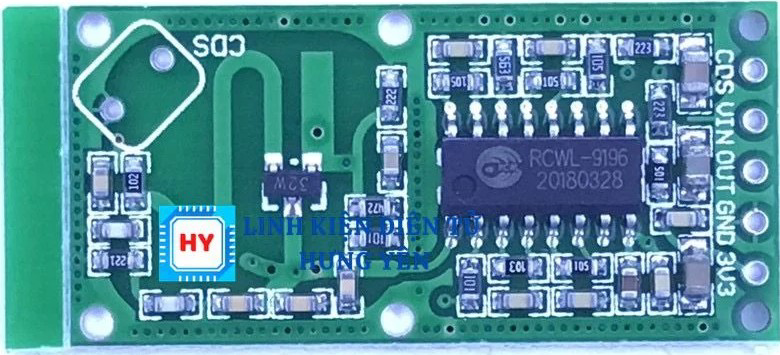
The RCWL-0516 is a microwave radar motion sensor module designed to detect motion by emitting microwave signals and analyzing the reflection from moving objects. Unlike traditional PIR (Passive Infrared) sensors, the RCWL-0516 is not affected by temperature changes or environmental light, making it highly reliable in various conditions. This module is widely used in security systems, automatic lighting, robotics, and other applications requiring motion detection.
Key features of the RCWL-0516 include:
- High sensitivity and long detection range (up to 7 meters).
- Wide operating voltage range.
- Compact size and easy integration into electronic projects.
Explore Projects Built with Module RCWL-0516
 Open Project in Cirkit Designer
 Open Project in Cirkit Designer
 Open Project in Cirkit Designer
 Open Project in Cirkit Designer
Explore Projects Built with Module RCWL-0516
Open Project in Cirkit DesignerOpen Project in Cirkit DesignerOpen Project in Cirkit DesignerOpen Project in Cirkit DesignerTechnical Specifications
Below are the key technical details of the RCWL-0516 module:
| Parameter | Value |
|---|---|
| Operating Voltage | 4.0V to 28.0V DC |
| Operating Current | ~3 mA |
| Detection Range | Up to 7 meters |
| Operating Frequency | 3.2 GHz |
| Output Voltage (High) | 3.3V |
| Output Voltage (Low) | 0V |
| Output Signal Duration | ~2 seconds (adjustable) |
| Dimensions | 36mm x 17mm |
Pin Configuration and Descriptions
The RCWL-0516 module has 5 pins. The table below describes each pin:
| Pin | Name | Description |
|---|---|---|
| 1 | VIN | Power input (4.0V to 28.0V DC). Connect to the power supply. |
| 2 | GND | Ground. Connect to the ground of the power supply or circuit. |
| 3 | OUT | Output signal. Goes HIGH (3.3V) when motion is detected, LOW (0V) otherwise. |
| 4 | CDS (optional) | Light sensor input. Can be used to disable the module in bright environments. |
| 5 | 3V3 (optional) | 3.3V output. Can be used to power external components. |
Usage Instructions
How to Use the RCWL-0516 in a Circuit
- Power the Module: Connect the
VINpin to a DC power supply (4.0V to 28.0V) and theGNDpin to ground. - Connect the Output: Use the
OUTpin to read the motion detection signal. When motion is detected, the pin outputs 3.3V (HIGH); otherwise, it outputs 0V (LOW). - Optional Connections:
- Connect a photoresistor to the
CDSpin if you want the module to disable itself in bright environments. - Use the
3V3pin to power low-power external components if needed.
- Connect a photoresistor to the
Important Considerations and Best Practices
- Avoid Metal Obstructions: Do not place the module near metal objects, as they can interfere with the microwave signals.
- Mounting Orientation: Ensure the module is mounted with the flat side facing the area to be monitored for optimal detection.
- Power Supply: Use a stable power supply to avoid false triggers.
- Interference: Keep the module away from other high-frequency devices to minimize interference.
Example: Connecting RCWL-0516 to Arduino UNO
Below is an example of how to connect the RCWL-0516 to an Arduino UNO and read motion detection signals.
Circuit Diagram
- Connect the
VINpin of the RCWL-0516 to the 5V pin of the Arduino UNO. - Connect the
GNDpin of the RCWL-0516 to the GND pin of the Arduino UNO. - Connect the
OUTpin of the RCWL-0516 to digital pin 2 of the Arduino UNO.
Arduino Code
// RCWL-0516 Motion Sensor Example with Arduino UNO
// This code reads the motion detection signal from the RCWL-0516 module
// and turns on the built-in LED on the Arduino UNO when motion is detected.

const int motionPin = 2;  // Pin connected to the OUT pin of RCWL-0516
const int ledPin = 13;    // Built-in LED pin on Arduino UNO

void setup() {
  pinMode(motionPin, INPUT);  // Set motionPin as input
  pinMode(ledPin, OUTPUT);    // Set ledPin as output
  Serial.begin(9600);         // Initialize serial communication
}

void loop() {
  int motionState = digitalRead(motionPin);  // Read the motion sensor output

  if (motionState == HIGH) {
    // Motion detected
    digitalWrite(ledPin, HIGH);  // Turn on the LED
    Serial.println("Motion detected!");
  } else {
    // No motion detected
    digitalWrite(ledPin, LOW);   // Turn off the LED
    Serial.println("No motion.");
  }

  delay(500);  // Wait for 500ms before reading again
}
Troubleshooting and FAQs
Common Issues and Solutions
False Triggers:
- Cause: Electrical noise or interference from nearby devices.
- Solution: Use decoupling capacitors (e.g., 0.1µF) across the power supply pins to reduce noise.
No Detection:
- Cause: Incorrect orientation or obstructions in the detection path.
- Solution: Ensure the module is mounted correctly and there are no metal objects blocking the signal.
Output Signal Stuck HIGH or LOW:
- Cause: Faulty wiring or insufficient power supply.
- Solution: Double-check all connections and ensure the power supply meets the module's requirements.
FAQs
Q: Can the detection range be adjusted?
A: No, the detection range is fixed at up to 7 meters. However, you can limit the detection area by using physical barriers or enclosures.
Q: Can the module detect through walls?
A: Yes, the RCWL-0516 can detect motion through thin, non-metallic walls. However, detection accuracy may decrease.
Q: Is the module affected by temperature or light?
A: No, the RCWL-0516 is not affected by temperature changes or ambient light, unlike PIR sensors.
Q: Can I use the module outdoors?
A: The module is not weatherproof. If used outdoors, it must be enclosed in a waterproof housing.