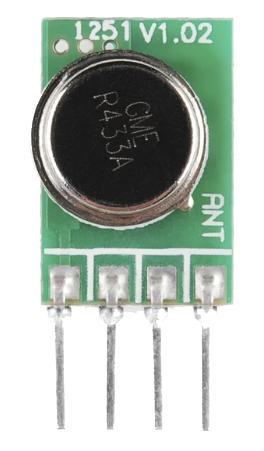
The RF Link Transmitter - 434MHz by WENSHING is a compact and efficient device designed to transmit radio frequency signals at a frequency of 434 MHz. It is widely used in wireless communication systems, including remote controls, sensor networks, and other short-range data transmission applications. This transmitter is ideal for projects requiring low power consumption and reliable communication over moderate distances.
Explore Projects Built with RF Link Transmitter - 434MHz
Use Cirkit Designer to design, explore, and prototype these projects online. Some projects support real-time simulation. Click "Open Project" to start designing instantly!
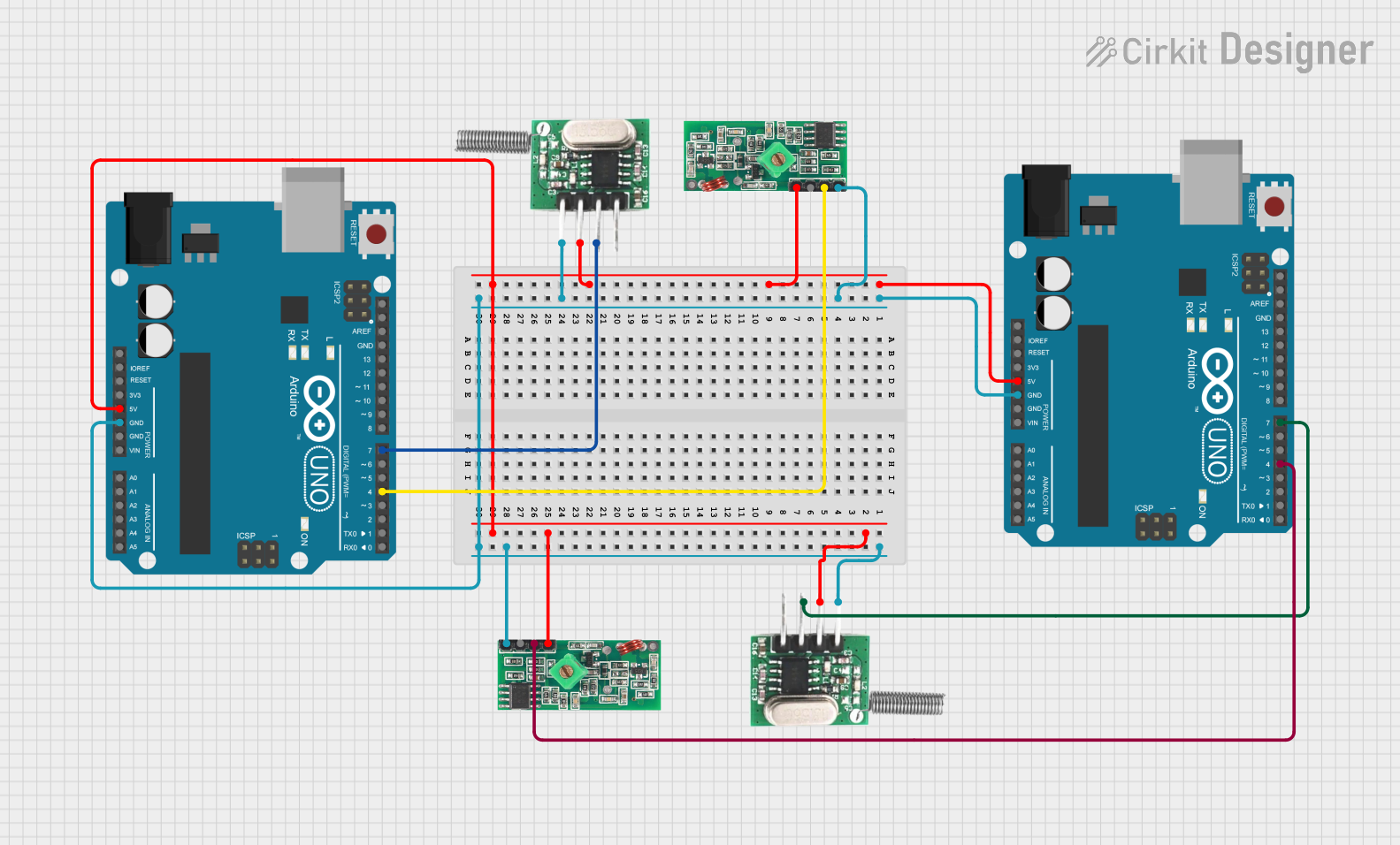
This circuit consists of two Arduino UNO microcontrollers, each connected to an RF 433 MHz Transmitter and a 433 MHz RF Receiver Module. The setup allows for wireless communication between the two Arduinos, enabling them to send and receive data over a 433 MHz RF link.
This circuit comprises an ESP32 microcontroller connected to a 433 MHz RF transmitter and receiver pair. The ESP32 is programmed to receive and decode RF signals through the receiver module, as well as send RF signals via the transmitter module. Additionally, the ESP32 can communicate with a Bluetooth device to exchange commands and data, and it uses an LED for status indication.
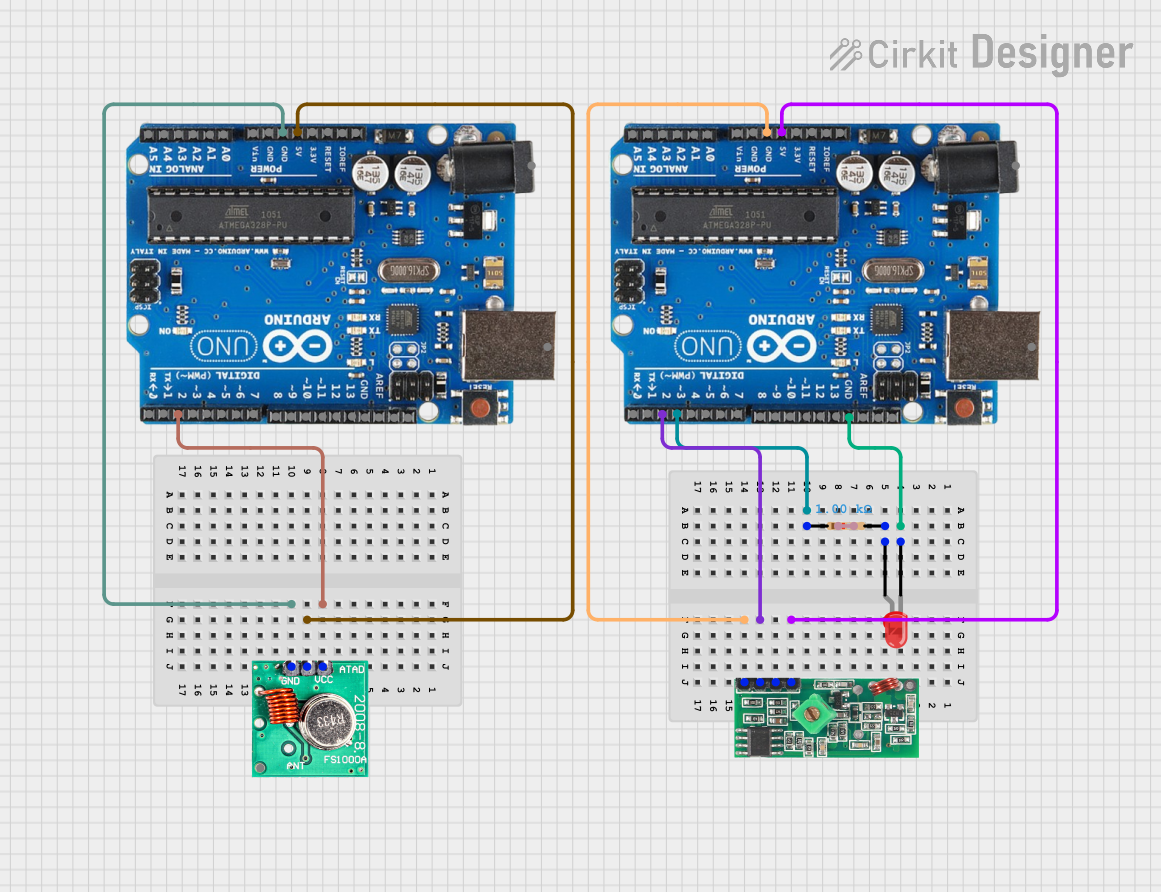
This circuit consists of two Arduino Uno R3 microcontrollers communicating wirelessly using 433 MHz RF modules. One Arduino is connected to an RF transmitter to send data, while the other Arduino is connected to an RF receiver to receive data and control an LED based on the received signal.
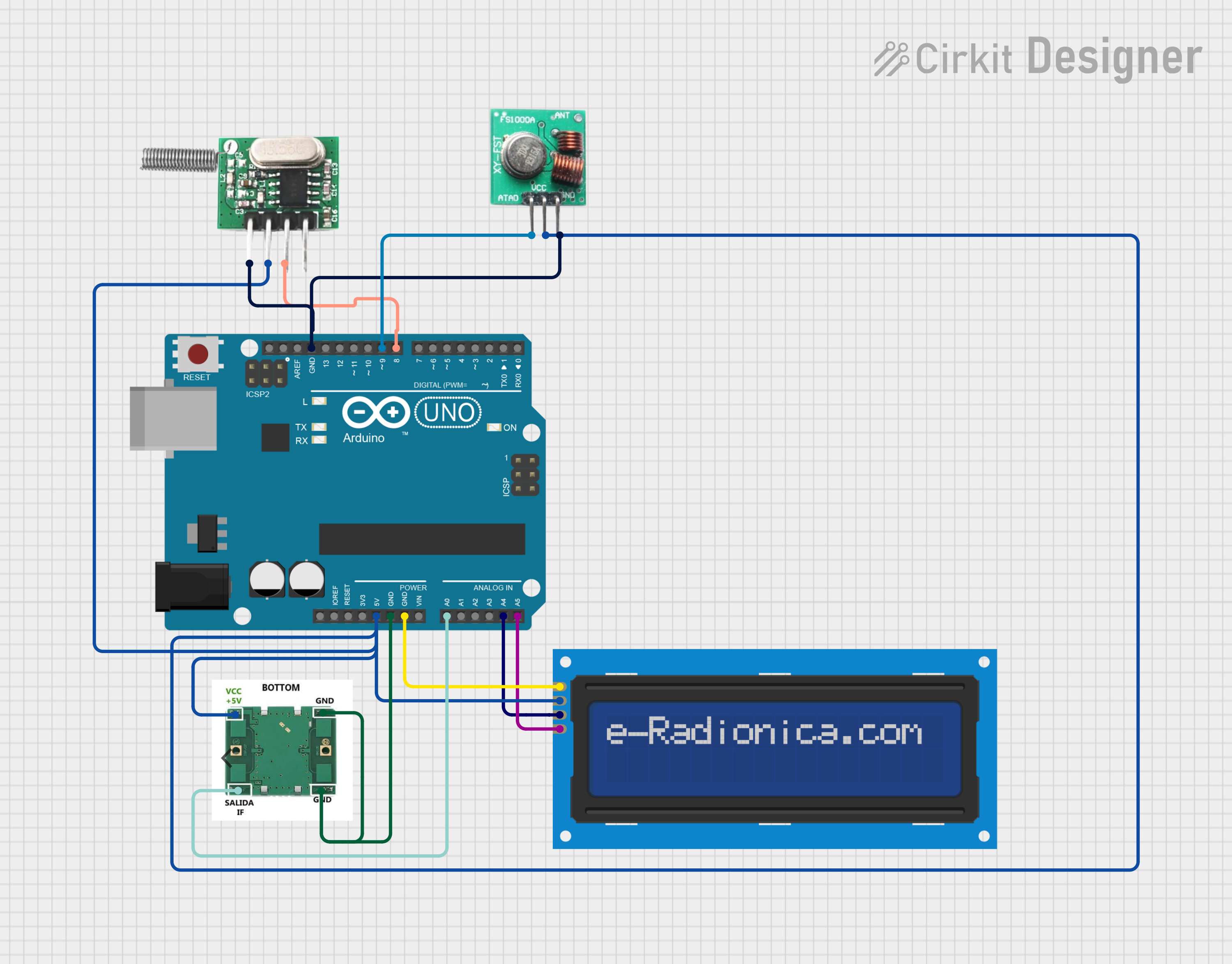
This circuit features an Arduino UNO microcontroller interfaced with an RF 433 MHz Transmitter, a Transmitter RF Module, an LCD screen with I2C communication, and a doppler radar sensor. The Arduino controls the RF transmission and processes the doppler radar's signal, likely for motion detection purposes. The LCD screen is used to display information or statuses, and the RF modules enable wireless communication, possibly to transmit the processed radar data.
Wireless remote control systems (e.g., garage doors, home automation)
Sensor data transmission in IoT networks
Wireless communication between microcontrollers
Robotics and drone control systems
Alarm and security systems
Technical Specifications
Below are the key technical details of the RF Link Transmitter - 434MHz:
Parameter
Value
Operating Frequency
434 MHz
Operating Voltage
3.3V - 12V
Operating Current
9 mA (typical at 5V)
Transmission Range
Up to 100 meters (line of sight)
Modulation Type
Amplitude Shift Keying (ASK)
Data Rate
Up to 10 kbps
Dimensions
19mm x 19mm x 7mm
Pin Configuration and Descriptions
The RF Link Transmitter has four pins, as described in the table below:
Pin
Name
Description
1
VCC
Power supply pin. Connect to a voltage source between 3.3V and 12V.
2
DATA
Data input pin. Connect to the microcontroller or data source.
3
GND
Ground pin. Connect to the ground of the circuit.
4
ANT
Antenna pin. Connect to a 17.3 cm wire or a suitable 434 MHz antenna for best performance.
Usage Instructions
How to Use the RF Link Transmitter in a Circuit
Power Supply: Connect the VCC pin to a regulated power source (3.3V to 12V). Ensure the power supply is stable to avoid transmission issues.
Data Input: Connect the DATA pin to the output pin of a microcontroller or other data source. The transmitter will modulate the input signal and transmit it wirelessly.
Ground Connection: Connect the GND pin to the ground of your circuit.
Antenna: Attach a 17.3 cm wire or a pre-made 434 MHz antenna to the ANT pin for optimal signal transmission.
Important Considerations and Best Practices
Antenna Design: Use a properly tuned antenna (17.3 cm for 434 MHz) to maximize range and signal quality.
Power Supply: Avoid noisy power supplies, as they can interfere with the transmitted signal.
Data Rate: Ensure the data rate does not exceed 10 kbps for reliable communication.
Line of Sight: For maximum range, maintain a clear line of sight between the transmitter and receiver.
Decoupling Capacitor: Add a 0.1 µF capacitor near the VCC pin to filter out power supply noise.
Example: Connecting to an Arduino UNO
Below is an example of how to use the RF Link Transmitter with an Arduino UNO to send data wirelessly:
Circuit Connections
Connect the VCC pin of the transmitter to the 5V pin on the Arduino.
Connect the GND pin of the transmitter to the GND pin on the Arduino.
Connect the DATA pin of the transmitter to digital pin 12 on the Arduino.
Attach a 17.3 cm wire to the ANT pin for the antenna.
Arduino Code
// Example code to send data using the RF Link Transmitter - 434MHz
// Ensure the receiver is set up to decode the transmitted signal.

#define TRANSMITTER_PIN 12  // Pin connected to the DATA pin of the transmitter

void setup() {
  pinMode(TRANSMITTER_PIN, OUTPUT);  // Set the transmitter pin as an output
}

void loop() {
  // Transmit a HIGH signal for 1 second
  digitalWrite(TRANSMITTER_PIN, HIGH);
  delay(1000);  // Wait for 1 second

  // Transmit a LOW signal for 1 second
  digitalWrite(TRANSMITTER_PIN, LOW);
  delay(1000);  // Wait for 1 second
}
Troubleshooting and FAQs
Common Issues and Solutions
No Signal Transmission
Cause: Incorrect wiring or loose connections.
Solution: Double-check all connections, especially the VCC, GND, and DATA pins.
Short Transmission Range
Cause: Poor antenna design or obstructions in the signal path.
Solution: Use a properly tuned 17.3 cm antenna and ensure a clear line of sight.
Interference with Other Devices
Cause: Overlapping frequencies with nearby devices.
Solution: Ensure no other devices are operating at 434 MHz in the vicinity.
Unstable Signal
Cause: Noisy power supply or exceeding the data rate limit.
Solution: Use a decoupling capacitor near the VCC pin and keep the data rate below 10 kbps.
FAQs
Q1: Can I use this transmitter with a 3.3V microcontroller?
A1: Yes, the transmitter operates at voltages as low as 3.3V. Ensure the data signal is also 3.3V compatible.
Q2: What is the maximum range of this transmitter?
A2: The maximum range is approximately 100 meters in an open area with a clear line of sight.
Q3: Do I need a specific receiver for this transmitter?
A3: Yes, you need a compatible 434 MHz RF receiver to decode the transmitted signals.
Q4: Can I transmit audio or video signals with this transmitter?
A4: No, this transmitter is designed for low-speed digital data transmission (up to 10 kbps).
By following this documentation, you can effectively integrate the RF Link Transmitter - 434MHz into your wireless communication projects.

 Open Project in Cirkit Designer