
How to Use DY-SV8F Sound Module: Examples, Pinouts, and Specs
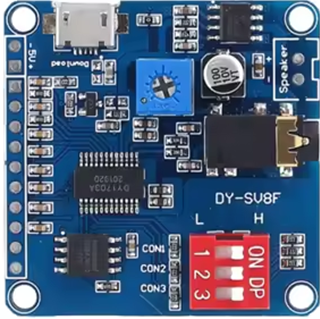
 Design with DY-SV8F Sound Module in Cirkit Designer
Introduction
The DY-SV8F is a compact audio playback module designed for projects requiring sound effects, voice prompts, or music playback. It supports multiple audio formats, including MP3 and WAV, and can store audio files on a microSD card or internal flash memory. The module is easy to integrate with microcontrollers like Arduino, Raspberry Pi, or other embedded systems, making it ideal for applications such as interactive displays, alarm systems, and voice-guided systems.
Explore Projects Built with DY-SV8F Sound Module
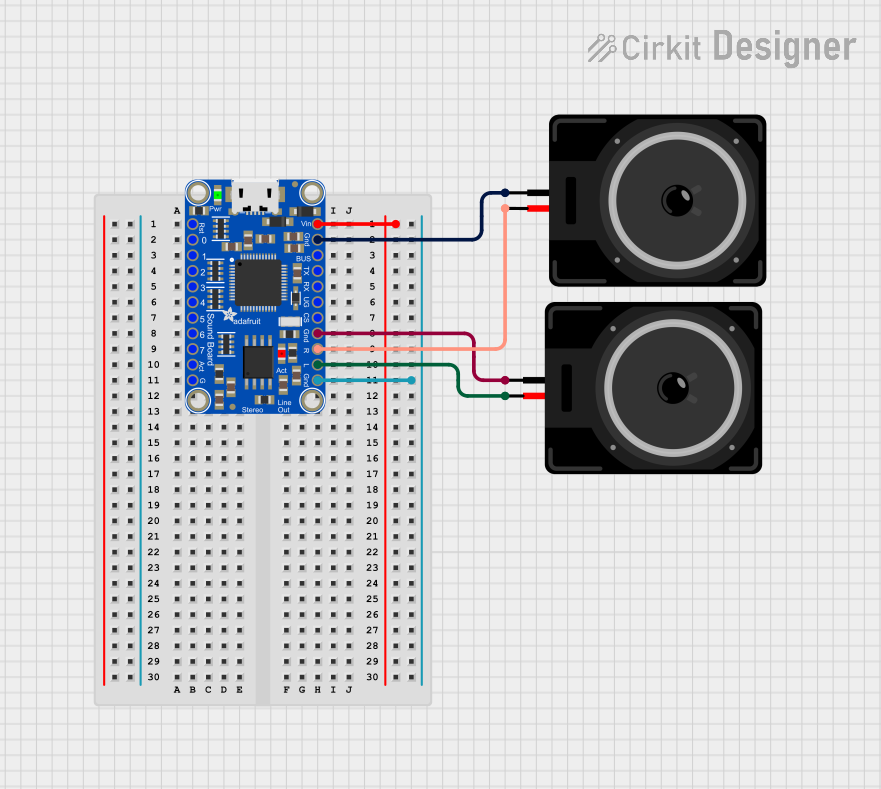 Open Project in Cirkit Designer
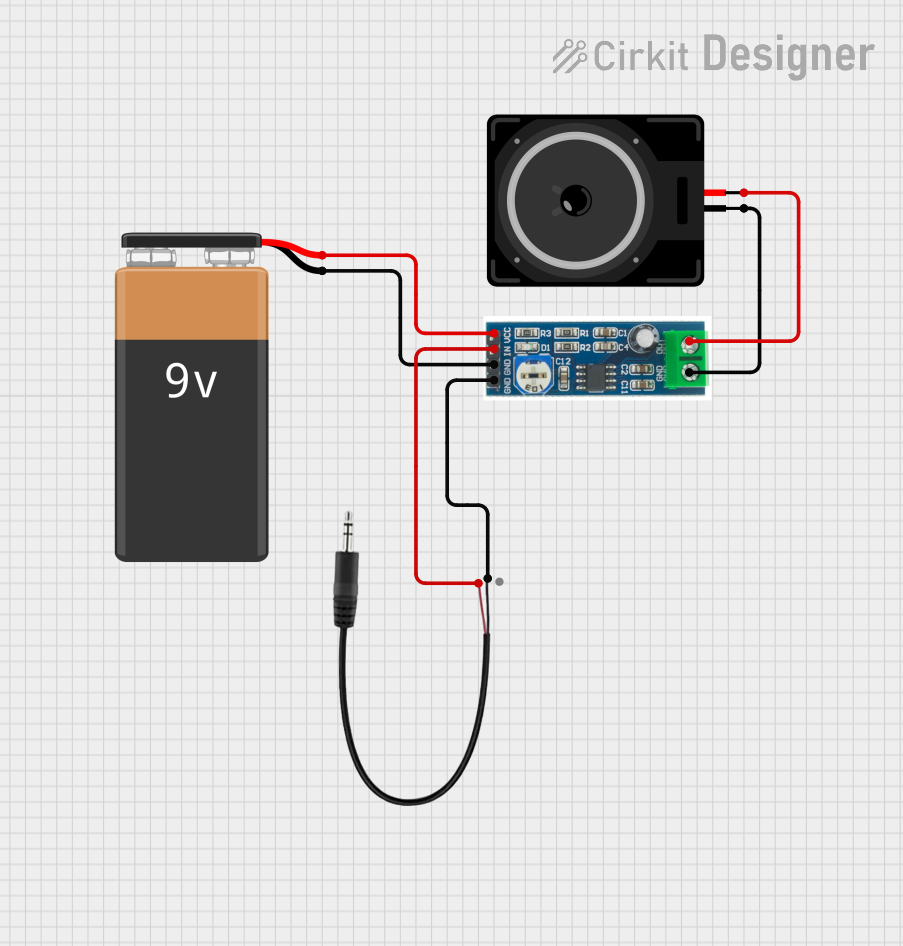 Open Project in Cirkit Designer
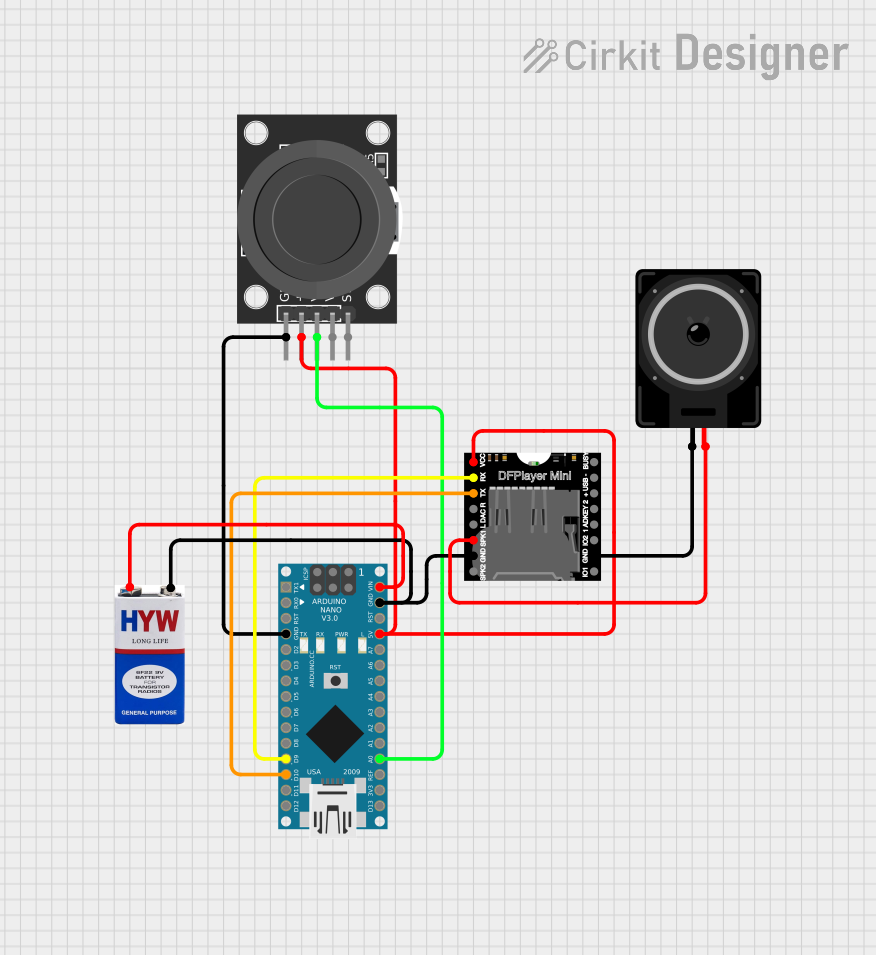 Open Project in Cirkit Designer
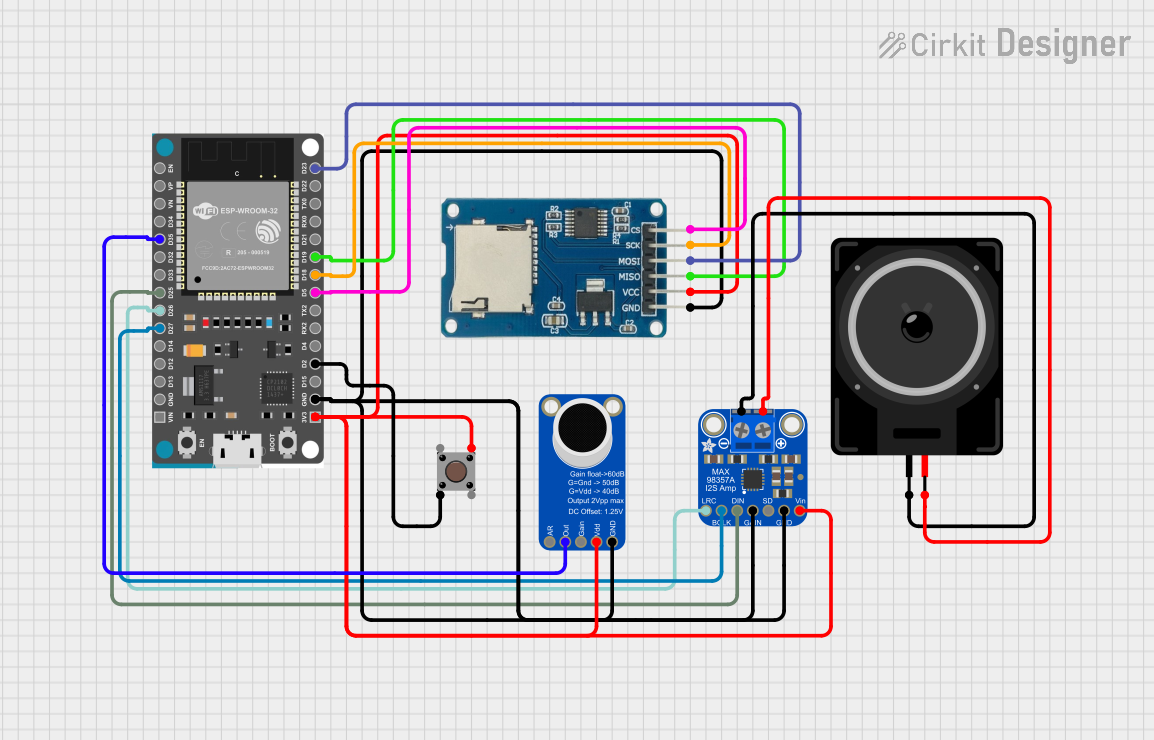 Open Project in Cirkit Designer
Explore Projects Built with DY-SV8F Sound Module
Open Project in Cirkit DesignerOpen Project in Cirkit DesignerOpen Project in Cirkit DesignerOpen Project in Cirkit DesignerCommon Applications
- Interactive kiosks and displays
- Alarm and notification systems
- Voice-guided devices
- Toys and educational tools
- Home automation systems
Technical Specifications
The DY-SV8F module is designed for simplicity and versatility. Below are its key technical details:
| Parameter | Specification |
|---|---|
| Operating Voltage | 3.3V to 5.0V |
| Operating Current | 20mA to 30mA |
| Audio Formats | MP3, WAV |
| Storage Options | microSD card (up to 32GB), internal flash memory |
| Communication Protocol | UART, GPIO trigger |
| Audio Output | Mono (speaker) or stereo (headphones) |
| Dimensions | 30mm x 22mm x 10mm |
Pin Configuration
The DY-SV8F module has a simple pinout for easy integration. Below is the pin configuration:
| Pin | Name | Description |
|---|---|---|
| 1 | VCC | Power supply input (3.3V to 5.0V) |
| 2 | GND | Ground |
| 3 | TX | UART Transmit pin (for communication with MCU) |
| 4 | RX | UART Receive pin (for communication with MCU) |
| 5 | SPK+ | Positive terminal for speaker output |
| 6 | SPK- | Negative terminal for speaker output |
| 7 | IO1 | GPIO trigger input 1 (play specific audio file) |
| 8 | IO2 | GPIO trigger input 2 (play specific audio file) |
Usage Instructions
How to Use the DY-SV8F in a Circuit
- Power the Module: Connect the
VCCpin to a 3.3V or 5.0V power source and theGNDpin to ground. - Audio Output: Connect a speaker to the
SPK+andSPK-pins. For headphones or external amplifiers, use the stereo output (if available). - Control Options:
- UART Communication: Connect the
TXandRXpins to the corresponding UART pins on your microcontroller for serial communication. - GPIO Trigger: Use the
IO1andIO2pins to trigger specific audio files directly.
- UART Communication: Connect the
- Load Audio Files: Store audio files in MP3 or WAV format on a microSD card or upload them to the module's internal flash memory.
Important Considerations
- Ensure the audio files are named correctly (e.g.,
0001.mp3,0002.mp3) for proper playback. - Use a regulated power supply to avoid damaging the module.
- If using UART communication, configure the baud rate to 9600 bps (default setting).
- For GPIO triggering, connect the IO pins to push buttons or other input devices.
Example: Using DY-SV8F with Arduino UNO
Below is an example of how to control the DY-SV8F module using UART communication with an Arduino UNO:
#include <SoftwareSerial.h>

// Define RX and TX pins for SoftwareSerial
SoftwareSerial mySerial(10, 11); // RX = Pin 10, TX = Pin 11

void setup() {
  // Initialize serial communication
  Serial.begin(9600); // For debugging
  mySerial.begin(9600); // For communication with DY-SV8F

  Serial.println("DY-SV8F Sound Module Test");

  // Play the first audio file (0001.mp3)
  playAudio(1);
}

void loop() {
  // Add your main code here
}

// Function to send play command to DY-SV8F
void playAudio(int fileNumber) {
  mySerial.write(0xAA); // Start byte
  mySerial.write(0x07); // Command: Play file
  mySerial.write(0x02); // Data length
  mySerial.write((fileNumber >> 8) & 0xFF); // High byte of file number
  mySerial.write(fileNumber & 0xFF); // Low byte of file number
  mySerial.write(0xAB); // End byte

  Serial.print("Playing file: ");
  Serial.println(fileNumber);
}
Notes:
- Connect the
TXpin of the DY-SV8F to theRXpin of the Arduino (pin 10 in this example). - Connect the
RXpin of the DY-SV8F to theTXpin of the Arduino (pin 11 in this example). - Ensure the audio file
0001.mp3is loaded onto the microSD card or internal memory.
Troubleshooting and FAQs
Common Issues and Solutions
No Sound Output:
- Ensure the speaker is properly connected to the
SPK+andSPK-pins. - Verify that the audio file format is supported (MP3 or WAV).
- Check the power supply voltage (3.3V to 5.0V).
- Ensure the speaker is properly connected to the
Module Not Responding to UART Commands:
- Confirm the baud rate is set to 9600 bps on both the module and the microcontroller.
- Check the wiring of the
TXandRXpins.
Audio File Not Playing:
- Ensure the file is named correctly (e.g.,
0001.mp3). - Verify the microSD card is formatted as FAT32 and is properly inserted.
- Ensure the file is named correctly (e.g.,
Distorted Sound:
- Use a speaker with an appropriate impedance (4Ω or 8Ω recommended).
- Avoid exceeding the module's power supply voltage.
FAQs
Can I use the DY-SV8F without a microcontroller? Yes, you can trigger audio files using the GPIO pins (
IO1andIO2) with push buttons or other input devices.What is the maximum storage capacity supported? The module supports microSD cards up to 32GB.
Can I adjust the volume? Yes, volume can be adjusted via UART commands or by using specific GPIO configurations.
Does the module support stereo output? The module primarily supports mono output for speakers, but stereo output may be available for headphones or external amplifiers.
This concludes the documentation for the DY-SV8F Sound Module.