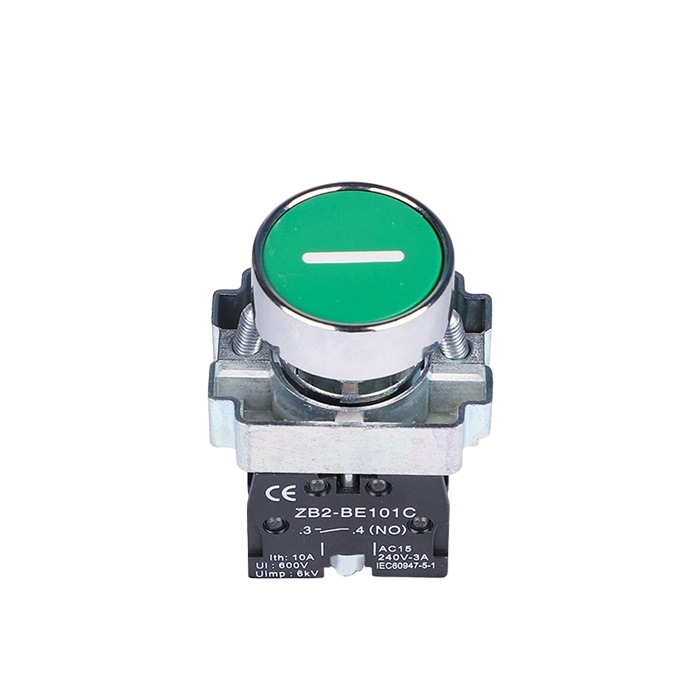
A pushbutton is a momentary switch that completes a circuit when pressed and breaks the circuit when released. It is commonly used for user input in electronic devices, such as turning devices on/off, resetting systems, or triggering specific actions. The Pushbutton START is a versatile and reliable component, ideal for applications requiring tactile user interaction.
Explore Projects Built with Pushbutton START
Use Cirkit Designer to design, explore, and prototype these projects online. Some projects support real-time simulation. Click "Open Project" to start designing instantly!
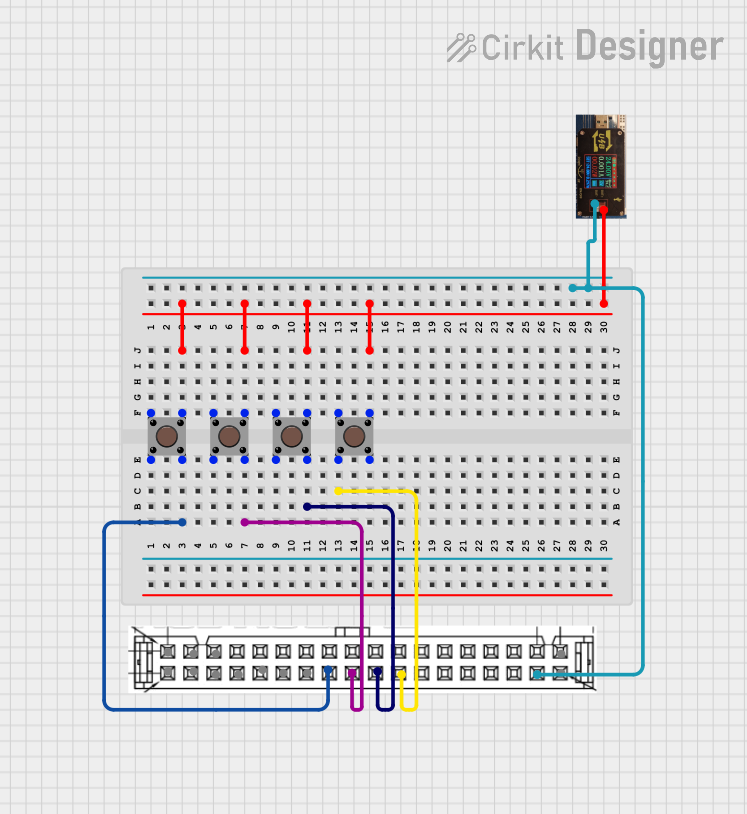
This circuit consists of a 40-pin connector interfacing with four pushbuttons and a UBS power supply. The pushbuttons are used as inputs to the connector, which then relays the signals to other components or systems. The UBS power supply provides the necessary 24V power to the pushbuttons and the common ground for the circuit.
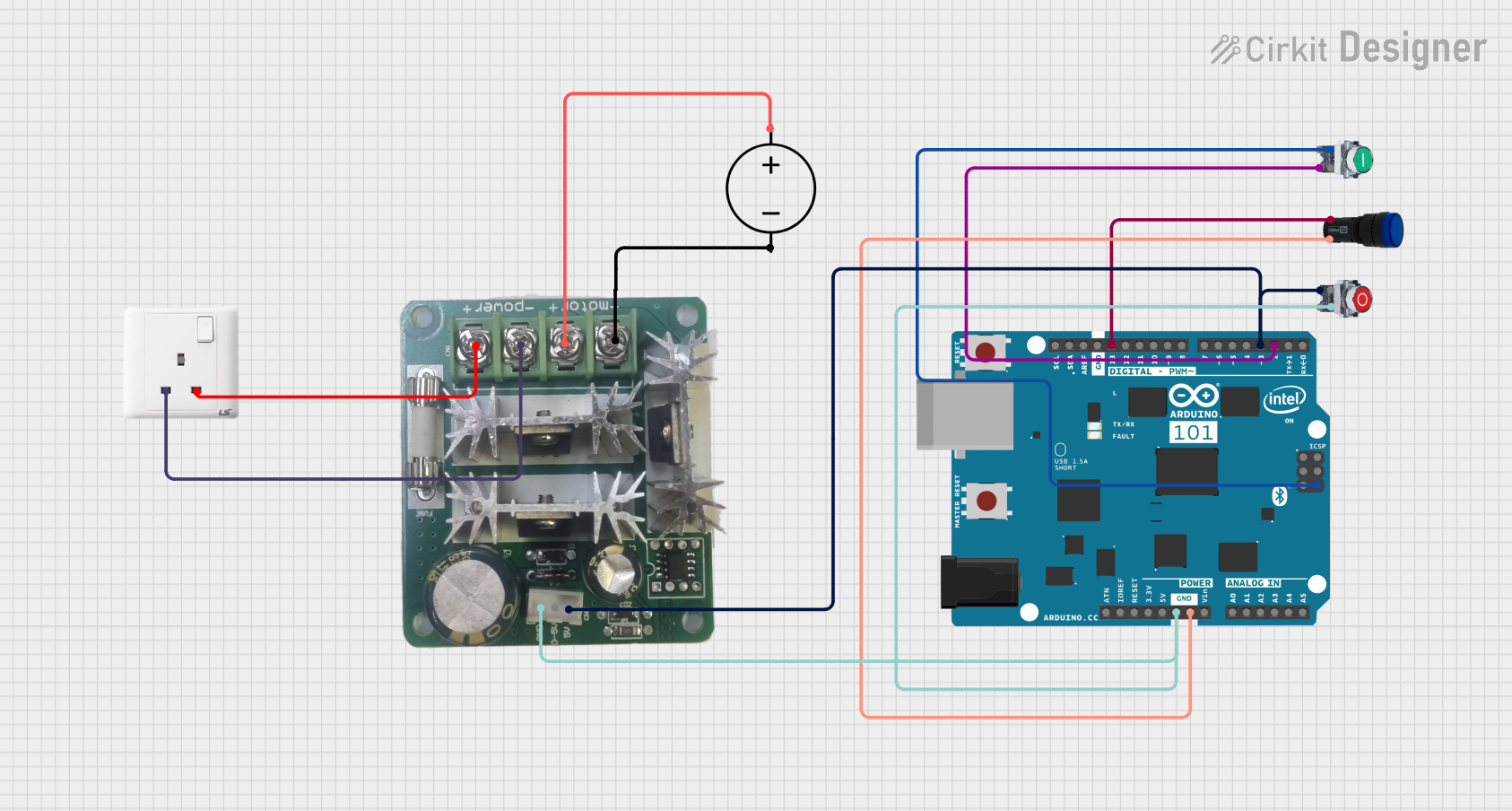
This circuit is a motor control system using an Arduino 101, which interfaces with start and stop pushbuttons to control a DC motor via a PWM motor controller. A blue pilot lamp indicates the status, and the motor controller is powered through a socket and a DC power source.
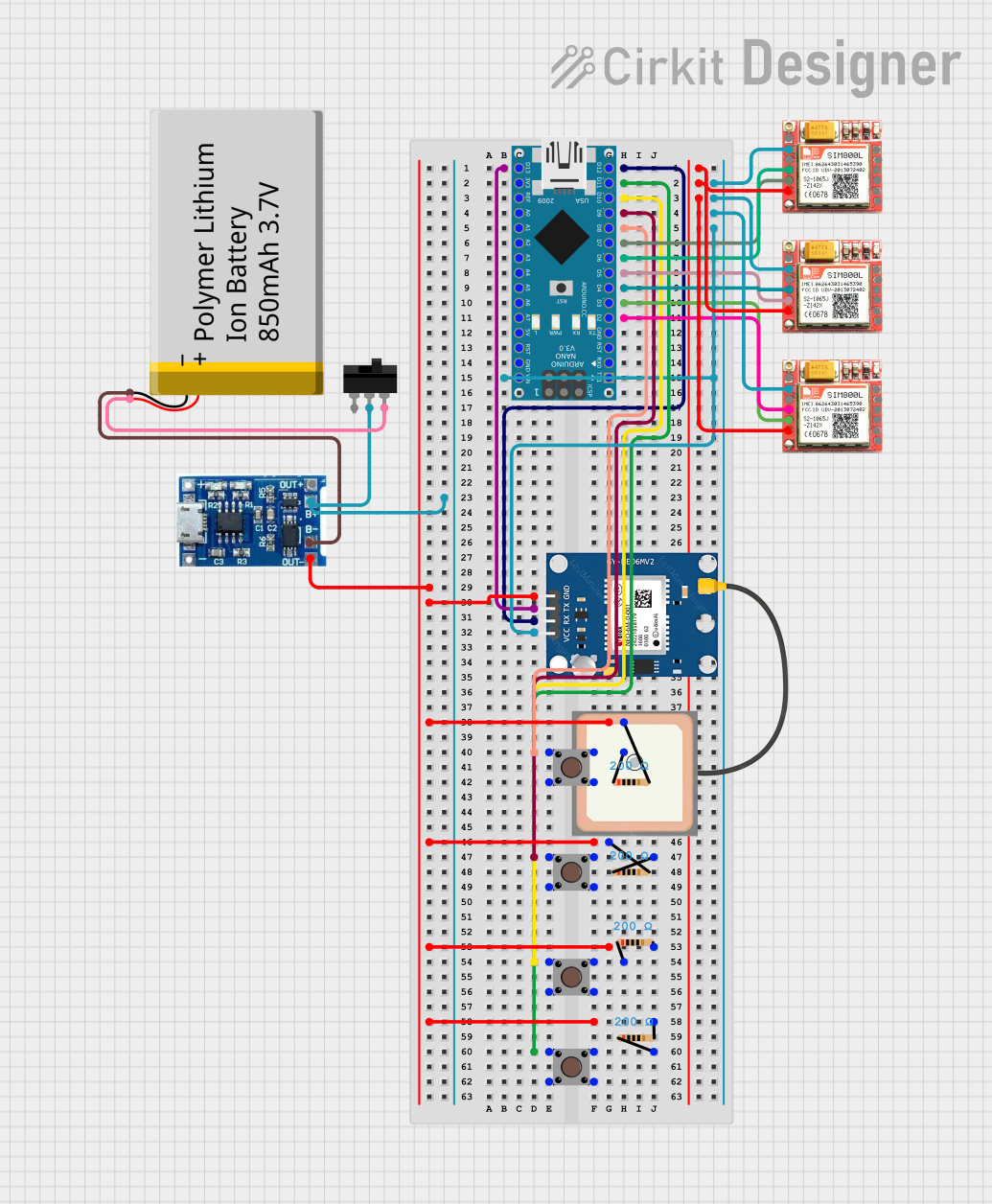
This circuit is designed as a panic button system featuring an Arduino Nano interfaced with a NEO6MV2 GPS module and three SIM800L GSM modules. It includes four pushbuttons, each assigned to trigger a call to a specific emergency service (hospital, fire department, police) or to send the GPS location. The system is powered by a lithium battery with a charging module, and it can send the GPS location to a predefined number or alongside an emergency call when the corresponding buttons are pressed simultaneously.
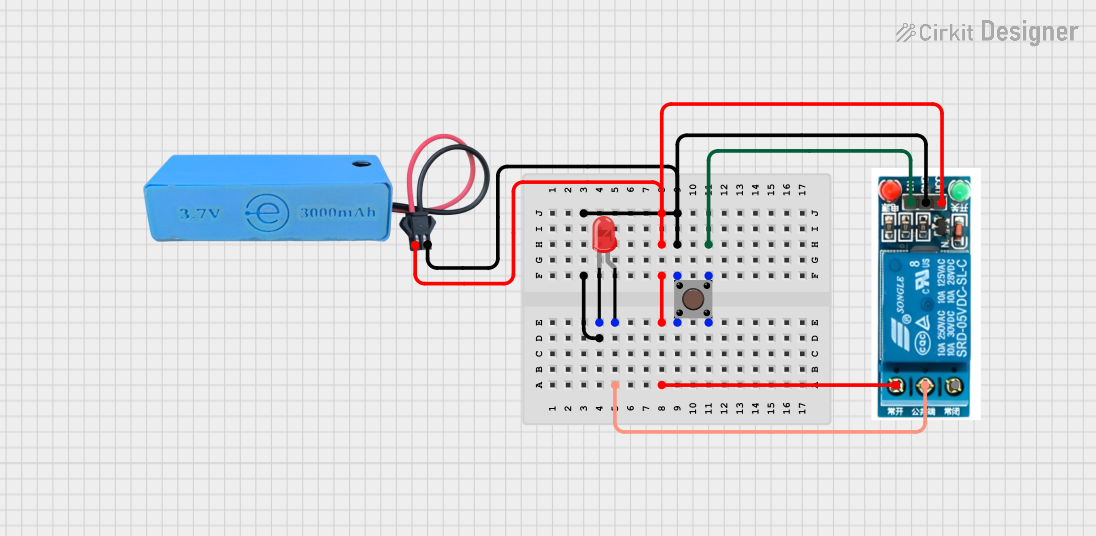
This circuit uses a pushbutton to control a 5V relay, which in turn powers a red LED. The MAHIR 1.mini module provides the necessary 3.7V power supply, and the relay switches the LED on and off based on the pushbutton input.
The Pushbutton START is a simple, low-power component designed for ease of use in a variety of circuits. Below are its key specifications:
Parameter
Value
Operating Voltage
3.3V to 12V
Maximum Current Rating
50mA
Contact Resistance
≤ 50mΩ
Insulation Resistance
≥ 100MΩ
Operating Temperature
-20°C to +70°C
Mechanical Durability
100,000 cycles
Pin Configuration and Descriptions
The Pushbutton START typically has four pins, arranged in a square configuration. The pins are internally connected in pairs, as shown below:
Pin Number
Description
1 and 2
Connected internally (shorted)
3 and 4
Connected internally (shorted)
Note: When the button is pressed, pins 1-2 are connected to pins 3-4, completing the circuit.
Usage Instructions
How to Use the Pushbutton START in a Circuit
Identify the Pins: Use a multimeter to confirm the internal connections between pins 1-2 and 3-4.
Connect to Circuit:
Connect one pair of pins (e.g., 1-2) to the input signal or power source.
Connect the other pair (e.g., 3-4) to the load or microcontroller input.
Debounce the Signal: Pushbuttons can produce noise or "bouncing" when pressed. Use a capacitor (e.g., 0.1µF) or software debounce techniques to ensure stable operation.
Test the Circuit: Verify that pressing the button completes the circuit and triggers the desired action.
Important Considerations and Best Practices
Voltage and Current Ratings: Ensure the button operates within its specified voltage and current limits to avoid damage.
Debouncing: Always implement hardware or software debouncing to prevent erratic behavior.
Mounting: Secure the pushbutton firmly to avoid accidental disconnections during operation.
Pull-Up or Pull-Down Resistors: When interfacing with microcontrollers, use a pull-up or pull-down resistor (typically 10kΩ) to ensure a defined logic state when the button is not pressed.
Example: Connecting to an Arduino UNO
Below is an example of how to use the Pushbutton START with an Arduino UNO to toggle an LED:
// Define pin connections
const int buttonPin = 2;  // Pushbutton connected to digital pin 2
const int ledPin = 13;    // LED connected to digital pin 13

// Variable to store button state
int buttonState = 0;

void setup() {
  pinMode(buttonPin, INPUT_PULLUP); // Set button pin as input with internal pull-up
  pinMode(ledPin, OUTPUT);         // Set LED pin as output
}

void loop() {
  // Read the state of the pushbutton
  buttonState = digitalRead(buttonPin);

  // If button is pressed (LOW due to pull-up resistor)
  if (buttonState == LOW) {
    digitalWrite(ledPin, HIGH); // Turn on the LED
  } else {
    digitalWrite(ledPin, LOW);  // Turn off the LED
  }
}
Note: The internal pull-up resistor is enabled in the code to simplify the circuit.
Troubleshooting and FAQs
Common Issues and Solutions
Button Not Responding:
Cause: Incorrect wiring or loose connections.
Solution: Double-check the pin connections and ensure the button is securely mounted.
Erratic Behavior (Multiple Triggers):
Cause: Signal bouncing when the button is pressed.
Solution: Add a capacitor (e.g., 0.1µF) across the button terminals or implement software debouncing.
Microcontroller Not Detecting Button Press:
Cause: Missing pull-up or pull-down resistor.
Solution: Use a 10kΩ pull-up or pull-down resistor to define the logic state when the button is not pressed.
Button Feels Stuck or Unresponsive:
Cause: Mechanical wear or debris inside the button.
Solution: Clean the button or replace it if it has exceeded its mechanical durability.
FAQs
Q: Can I use the Pushbutton START with a 5V system?
A: Yes, the Pushbutton START is compatible with 5V systems, as its operating voltage range is 3.3V to 12V.
Q: Do I need an external resistor for the button to work with an Arduino?
A: No, you can use the Arduino's internal pull-up resistor by configuring the pin as INPUT_PULLUP.
Q: How do I debounce the button in software?
A: You can use a delay or a state-change detection algorithm to filter out bouncing signals. For example, check the button state after a short delay (e.g., 10ms) to confirm a stable press.
Q: Can I use the Pushbutton START for high-power applications?
A: No, the Pushbutton START is designed for low-power applications with a maximum current rating of 50mA. Use a relay or transistor for high-power circuits.
By following this documentation, you can effectively integrate the Pushbutton START into your projects and troubleshoot any issues that arise.

 Open Project in Cirkit Designer