
How to Use Battery 955565P 10000mah 3.7V: Examples, Pinouts, and Specs
 Design with Battery 955565P 10000mah 3.7V in Cirkit Designer
Introduction
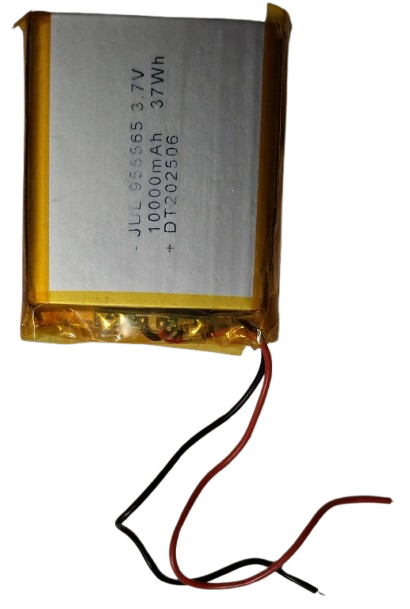
The Battery 955565P is a rechargeable lithium-ion battery with a high capacity of 10000mAh and a nominal voltage of 3.7V. It is designed to provide a reliable and long-lasting power supply for a wide range of portable electronic devices. Its compact size and high energy density make it an ideal choice for applications such as power banks, handheld devices, IoT gadgets, and other battery-powered systems.
Explore Projects Built with Battery 955565P 10000mah 3.7V
 Open Project in Cirkit Designer
 Open Project in Cirkit Designer
 Open Project in Cirkit Designer
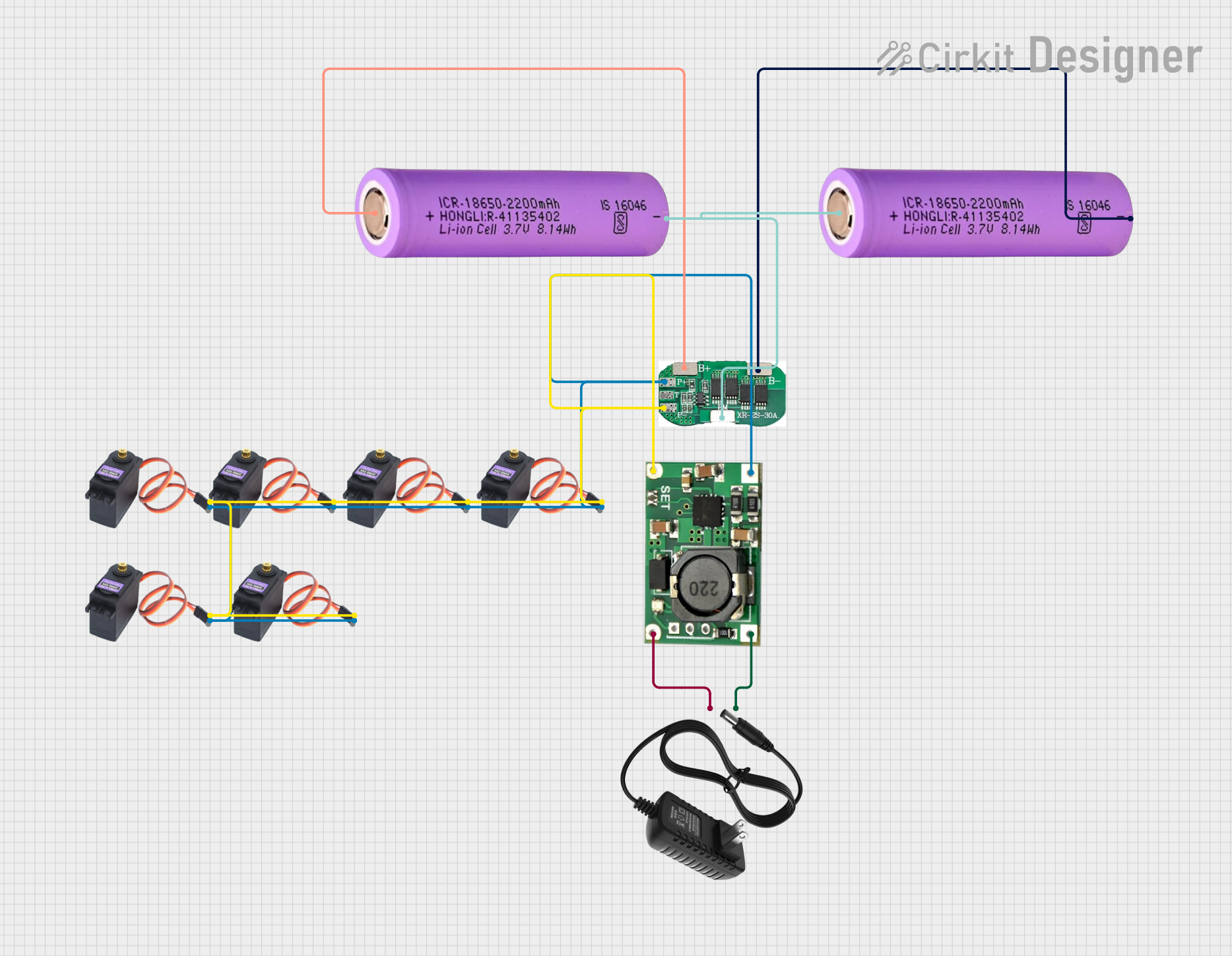 Open Project in Cirkit Designer
Explore Projects Built with Battery 955565P 10000mah 3.7V
Open Project in Cirkit DesignerOpen Project in Cirkit DesignerOpen Project in Cirkit DesignerOpen Project in Cirkit DesignerCommon Applications and Use Cases
- Power banks and portable chargers
- Handheld electronic devices (e.g., GPS units, cameras)
- IoT devices and smart home systems
- Wearable technology
- Robotics and small-scale drones
- Backup power for embedded systems
Technical Specifications
The following table outlines the key technical details of the Battery 955565P:
| Parameter | Specification |
|---|---|
| Nominal Voltage | 3.7V |
| Capacity | 10000mAh |
| Battery Type | Lithium-Ion (Li-Ion) |
| Charging Voltage | 4.2V (maximum) |
| Discharge Cutoff Voltage | 2.75V (minimum) |
| Maximum Discharge Current | 2C (20A) |
| Standard Charge Current | 0.5C (5A) |
| Dimensions (L x W x H) | 95mm x 55mm x 6.5mm |
| Weight | ~200g |
| Protection Circuit | Built-in (overcharge, over-discharge, short circuit) |
Pin Configuration and Descriptions
The Battery 955565P typically comes with two wires for connection. The pin configuration is as follows:
| Wire Color | Function | Description |
|---|---|---|
| Red | Positive Terminal (+) | Connect to the positive side of the circuit/load. |
| Black | Negative Terminal (-) | Connect to the negative side of the circuit/load. |
Usage Instructions
How to Use the Battery in a Circuit
- Connection:
- Connect the red wire to the positive terminal of your circuit or load.
- Connect the black wire to the negative terminal of your circuit or load.
- Charging:
- Use a compatible lithium-ion battery charger with a constant current/constant voltage (CC/CV) charging profile.
- Ensure the charging voltage does not exceed 4.2V and the charging current does not exceed 5A (standard charge current).
- Discharging:
- Ensure the load does not draw more than the maximum discharge current of 20A.
- Avoid discharging the battery below 2.75V to prevent damage.
- Protection Circuit:
- The built-in protection circuit helps prevent overcharging, over-discharging, and short circuits. However, always use the battery within its specified limits.
Important Considerations and Best Practices
- Temperature Range: Operate the battery within the recommended temperature range (0°C to 45°C for charging, -20°C to 60°C for discharging).
- Storage: Store the battery in a cool, dry place at around 50% charge for long-term storage.
- Safety: Do not puncture, crush, or expose the battery to fire or water.
- Balancing: If using multiple batteries in series or parallel, ensure proper balancing to avoid uneven charging/discharging.
Example: Connecting to an Arduino UNO
The Battery 955565P can be used to power an Arduino UNO via its VIN pin. Below is an example circuit and code:
Circuit:
- Connect the red wire of the battery to the VIN pin of the Arduino UNO.
- Connect the black wire of the battery to the GND pin of the Arduino UNO.
- Use a step-up or step-down voltage regulator if the Arduino requires a stable 5V input.
Code Example:
// Example code to blink an LED on pin 13 using power from the Battery 955565P
void setup() {
  pinMode(13, OUTPUT); // Set pin 13 as an output
}

void loop() {
  digitalWrite(13, HIGH); // Turn the LED on
  delay(1000);            // Wait for 1 second
  digitalWrite(13, LOW);  // Turn the LED off
  delay(1000);            // Wait for 1 second
}
Troubleshooting and FAQs
Common Issues and Solutions
Battery Not Charging:
- Cause: Charger not compatible or damaged.
- Solution: Use a charger designed for lithium-ion batteries with a 4.2V output.
Battery Drains Quickly:
- Cause: Excessive load or battery degradation.
- Solution: Check the load current and ensure it is within the specified limits. Replace the battery if it is old or damaged.
Battery Overheats:
- Cause: Overcharging or excessive discharge current.
- Solution: Ensure the charging current and voltage are within the specified range. Reduce the load current.
No Output Voltage:
- Cause: Protection circuit activated due to over-discharge or short circuit.
- Solution: Recharge the battery to reset the protection circuit.
FAQs
Q1: Can I use this battery in series or parallel configurations?
A1: Yes, but ensure proper balancing and use a battery management system (BMS) to prevent overcharging or over-discharging.
Q2: How long does it take to fully charge the battery?
A2: With a standard charge current of 5A, it takes approximately 2–3 hours to fully charge the battery.
Q3: Is the battery safe for air travel?
A3: Lithium-ion batteries are generally allowed in carry-on luggage, but check airline regulations for specific restrictions.
Q4: Can I replace the built-in protection circuit?
A4: The built-in protection circuit is not user-replaceable. If it fails, consider replacing the entire battery.