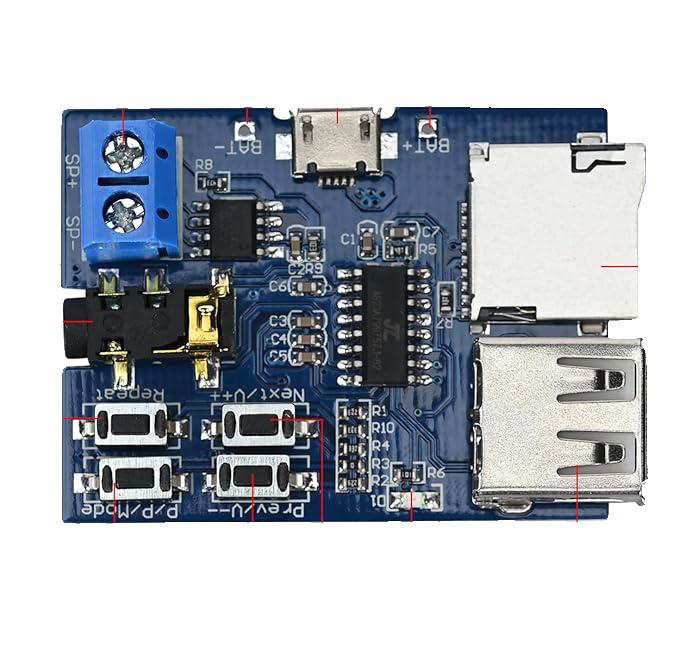
The TF Card U Disk Play MP3 Decoder by Podazz (Manufacturer Part ID: Audio Decoding Player) is a compact and versatile module designed for audio playback applications. It supports MP3 audio files stored on TF (microSD) cards or USB flash drives, making it an ideal choice for DIY audio projects, portable speaker systems, and embedded audio solutions. The module features onboard buttons for basic playback control and can be integrated into larger systems for automated audio playback.
Explore Projects Built with TF Card U Disk Play MP3 Decoder
Use Cirkit Designer to design, explore, and prototype these projects online. Some projects support real-time simulation. Click "Open Project" to start designing instantly!
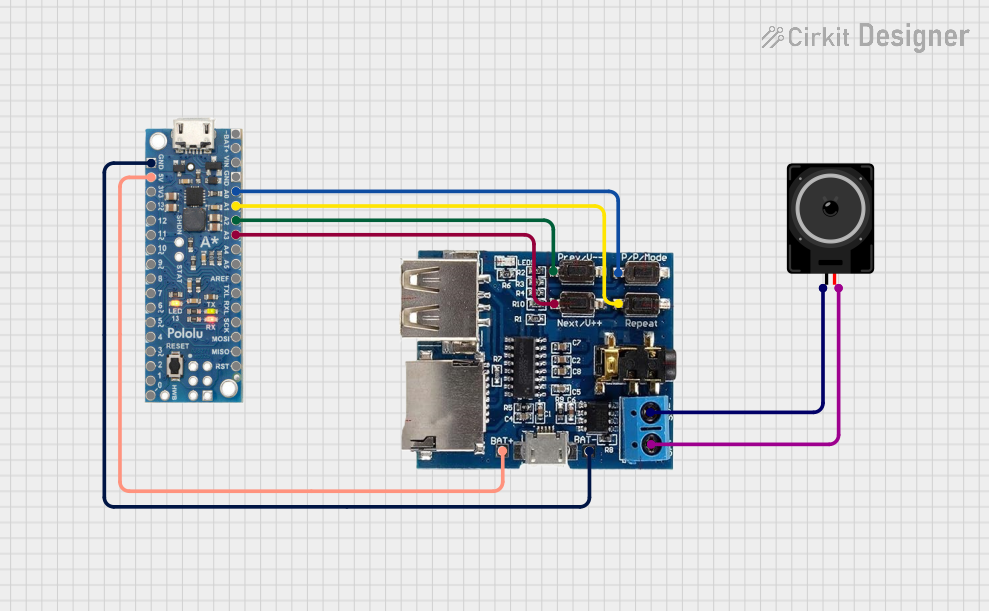
This circuit integrates an A-Star 32U4 Mini microcontroller with an MP3 Decoder Player Module to create a basic MP3 player system. The microcontroller is likely used to control playback functions such as mode selection and track navigation, as indicated by the connections to the Mode, Repeat, Prev/V--, and Next/V++ pins of the MP3 module. The Loudspeaker is connected to the MP3 module to output the audio signal.
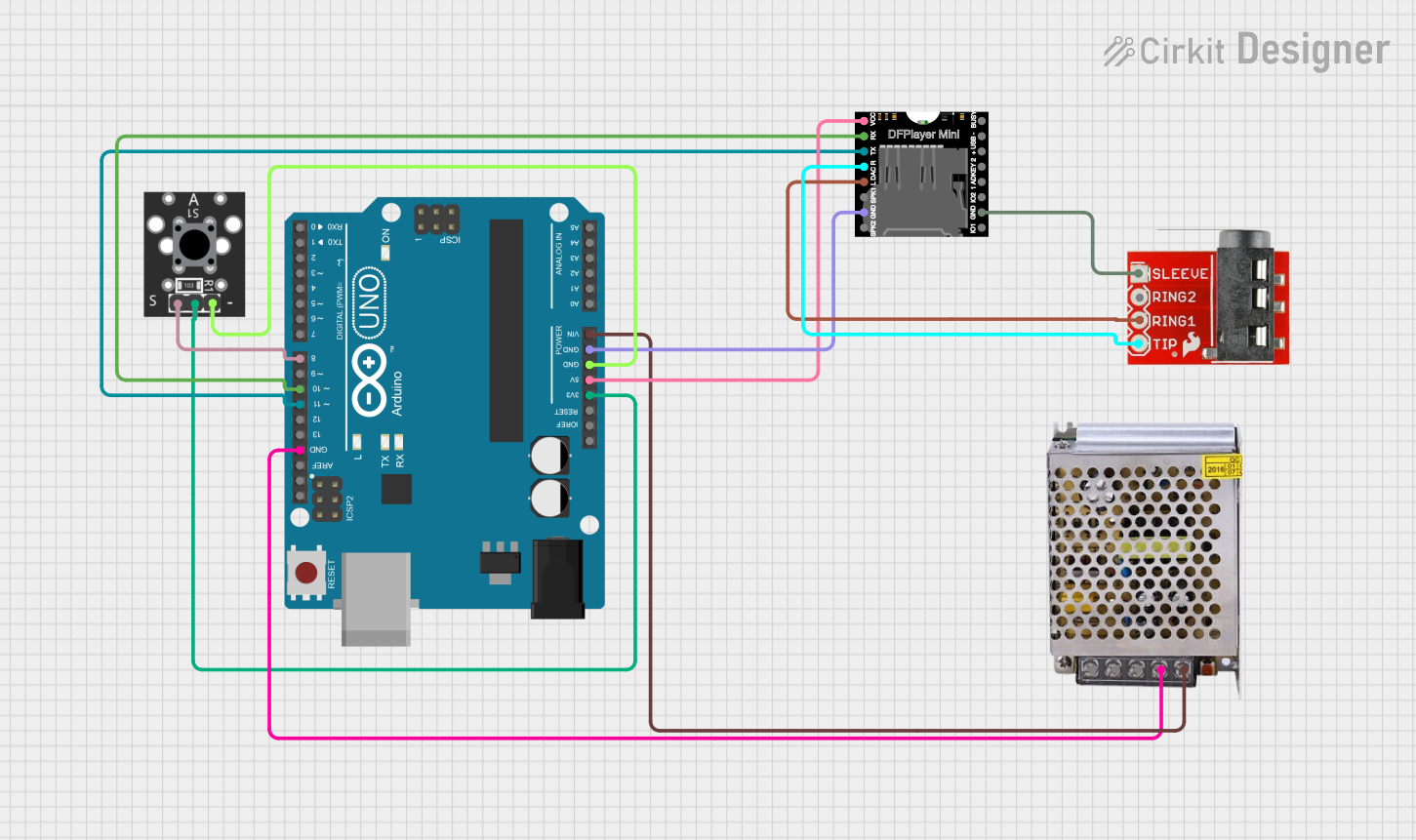
This circuit is a simple audio playback system controlled by an Arduino UNO. It uses a DFPlayer Mini to play audio files from an SD card, which are output through a TRRS 3.5mm jack. A button connected to the Arduino triggers the playback of the first audio file when pressed.
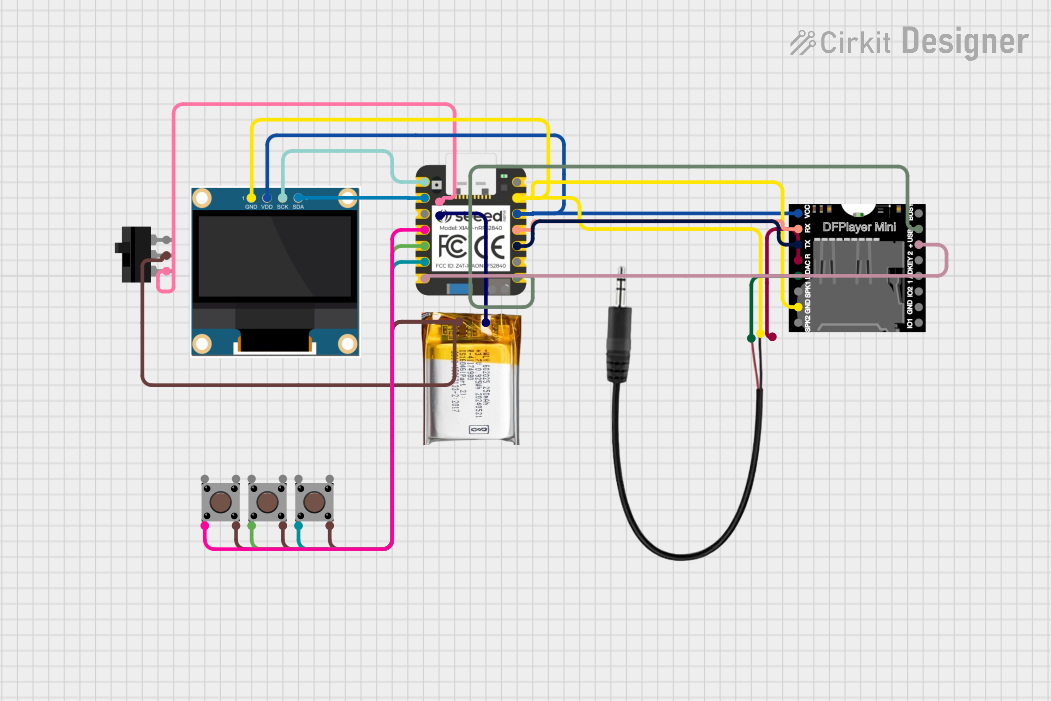
This circuit is an MP3 player system controlled by a Seeed Studio nRF52840 microcontroller. It includes a DFPlayer MINI for audio playback, a 0.96" OLED display for visual feedback, and multiple pushbuttons for user interaction. The system is powered by a 3.7V LiPo battery and outputs audio through a 3.5mm audio jack.
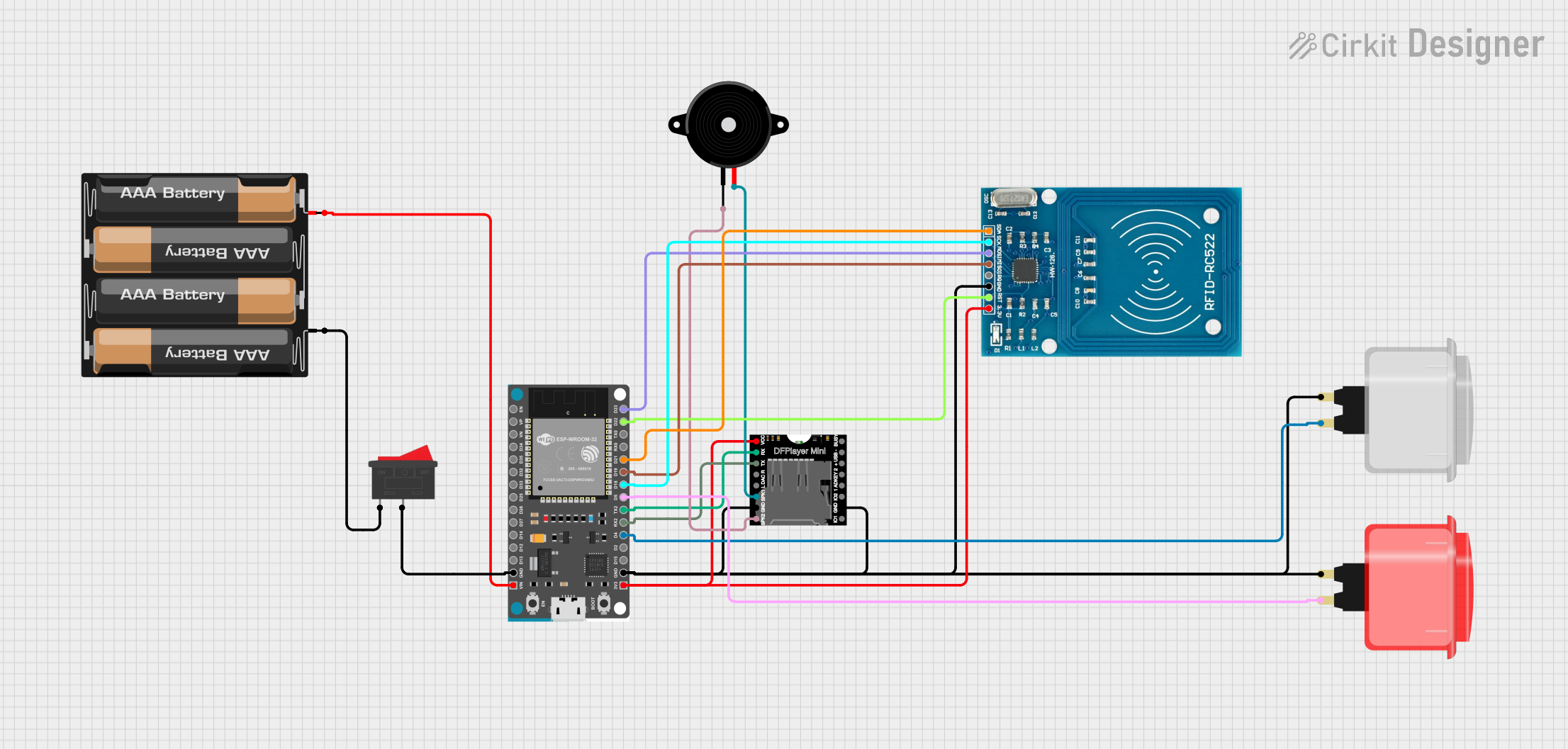
This circuit features an ESP32 Devkit V1 microcontroller interfaced with a DFPlayer Mini MP3 player module, an RFID-RC522 reader, a piezo speaker, and two arcade buttons. The ESP32 controls audio playback through the DFPlayer Mini, which is connected to the speaker, and uses the RFID reader to trigger specific audio tracks based on RFID tag data. The arcade buttons are used to control playback and adjust volume, while a rocker switch and battery mount provide power management.
The following table outlines the key technical details of the TF Card U Disk Play MP3 Decoder module:
Parameter
Specification
Operating Voltage
5V DC
Operating Current
≤ 30mA
Audio Format Support
MP3
Storage Media
TF (microSD) card, USB flash drive
Maximum Storage Size
Up to 32GB (FAT32 file system)
Audio Output
Stereo (3.5mm headphone jack or speaker)
Control Interface
Onboard buttons, GPIO pins
Dimensions
45mm x 36mm x 12mm
Pin Configuration and Descriptions
The module includes a set of pins for external control and audio output. The pin configuration is as follows:
Pin Name
Description
VCC
Power input (5V DC)
GND
Ground
RX
UART receive pin for external control
TX
UART transmit pin for external control
SPK+
Positive terminal for speaker output
SPK-
Negative terminal for speaker output
LOUT
Left channel audio output (line out)
ROUT
Right channel audio output (line out)
Usage Instructions
How to Use the Component in a Circuit
Power the Module: Connect the VCC pin to a 5V DC power source and the GND pin to ground.
Insert Storage Media: Insert a TF card or USB flash drive containing MP3 files formatted in FAT32.
Connect Audio Output:
For headphones or external amplifiers, use the LOUT and ROUT pins or the 3.5mm audio jack.
For direct speaker output, connect a speaker to the SPK+ and SPK- pins.
Playback Control:
Use the onboard buttons to play, pause, skip tracks, or adjust volume.
Alternatively, connect the RX and TX pins to a microcontroller (e.g., Arduino) for UART-based control.
Important Considerations and Best Practices
Ensure the storage media is formatted as FAT32 and does not exceed 32GB.
Use a regulated 5V power supply to avoid damaging the module.
Avoid connecting both the speaker output and line output simultaneously to prevent audio distortion.
For UART control, use a baud rate of 9600 bps unless otherwise specified.
Example: Connecting to an Arduino UNO
The following example demonstrates how to control the module using an Arduino UNO via UART:
#include <SoftwareSerial.h>

// Define RX and TX pins for communication with the MP3 decoder
SoftwareSerial mp3Serial(10, 11); // RX = Pin 10, TX = Pin 11

void setup() {
  mp3Serial.begin(9600); // Initialize UART communication at 9600 bps
  Serial.begin(9600);    // For debugging via Serial Monitor

  // Send a command to play the first track
  playTrack(1);
}

void loop() {
  // Add your custom logic here (e.g., play/pause based on input)
}

// Function to send a play command to the MP3 decoder
void playTrack(int trackNumber) {
  byte command[] = {0x7E, 0x03, 0xA0, (byte)trackNumber, 0x7E};
  mp3Serial.write(command, sizeof(command));
  Serial.println("Play command sent.");
}
Troubleshooting and FAQs
Common Issues and Solutions
No Audio Output:
Ensure the storage media is properly inserted and contains MP3 files.
Verify the audio output connections (e.g., speaker or headphone jack).
Check the power supply voltage (must be 5V DC).
Playback Does Not Start:
Confirm the storage media is formatted as FAT32.
Ensure the MP3 files are not corrupted and are in the root directory of the storage media.
Distorted Audio:
Avoid connecting both the speaker and line outputs simultaneously.
Check the speaker impedance (recommended: 4Ω or 8Ω).
UART Commands Not Working:
Verify the RX and TX connections between the module and microcontroller.
Ensure the baud rate is set to 9600 bps in your code.
FAQs
Q: Can I use this module with a 3.7V Li-ion battery?
A: No, the module requires a stable 5V DC power supply. Use a step-up converter if necessary.
Q: Does the module support other audio formats like WAV or WMA?
A: No, the module only supports MP3 audio files.
Q: Can I control the module without a microcontroller?
A: Yes, the onboard buttons allow basic playback control without external devices.
Q: What is the maximum speaker power output?
A: The module is designed for low-power speakers (≤3W). For higher power, use an external amplifier.
This concludes the documentation for the TF Card U Disk Play MP3 Decoder.

 Open Project in Cirkit Designer