
How to Use XIAO ESP32C3: Examples, Pinouts, and Specs
 Design with XIAO ESP32C3 in Cirkit Designer
Introduction
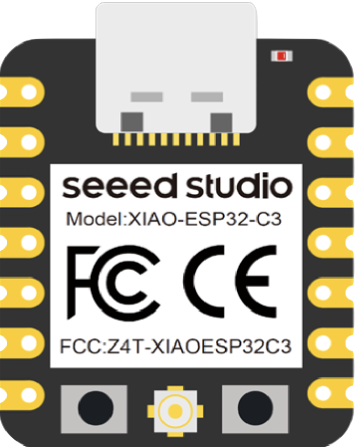
The XIAO ESP32C3 is a compact microcontroller board developed by Seeed. It is powered by the ESP32-C3 chip, which integrates Wi-Fi and Bluetooth Low Energy (BLE) capabilities. This board is designed for Internet of Things (IoT) applications, wearable devices, and rapid prototyping. Its small form factor and low power consumption make it ideal for space-constrained projects.
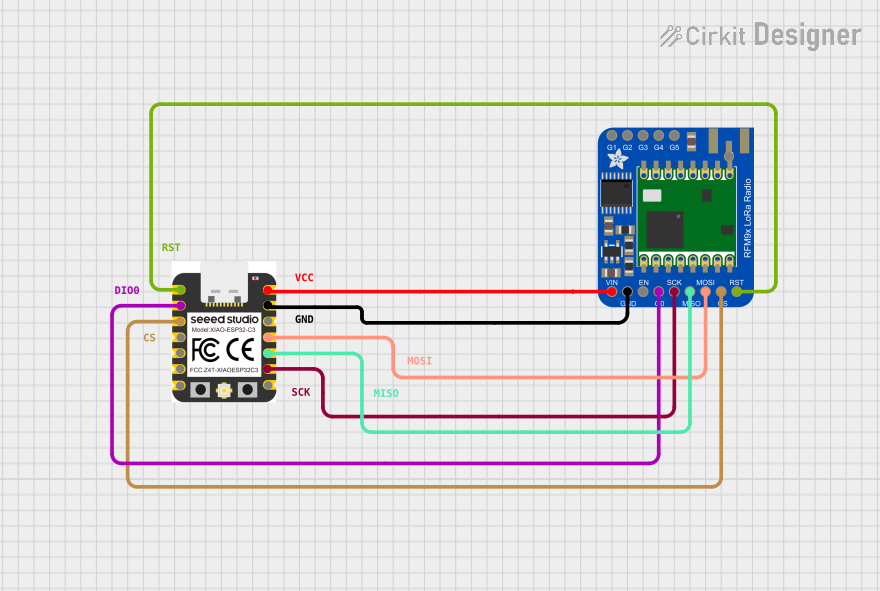
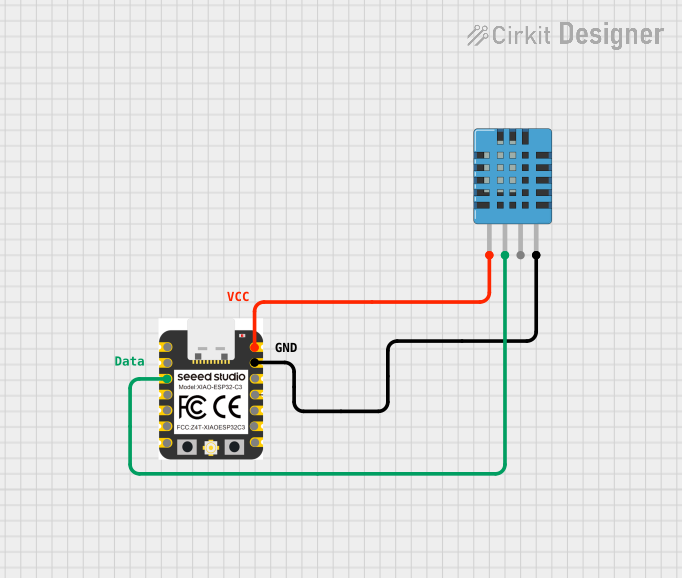
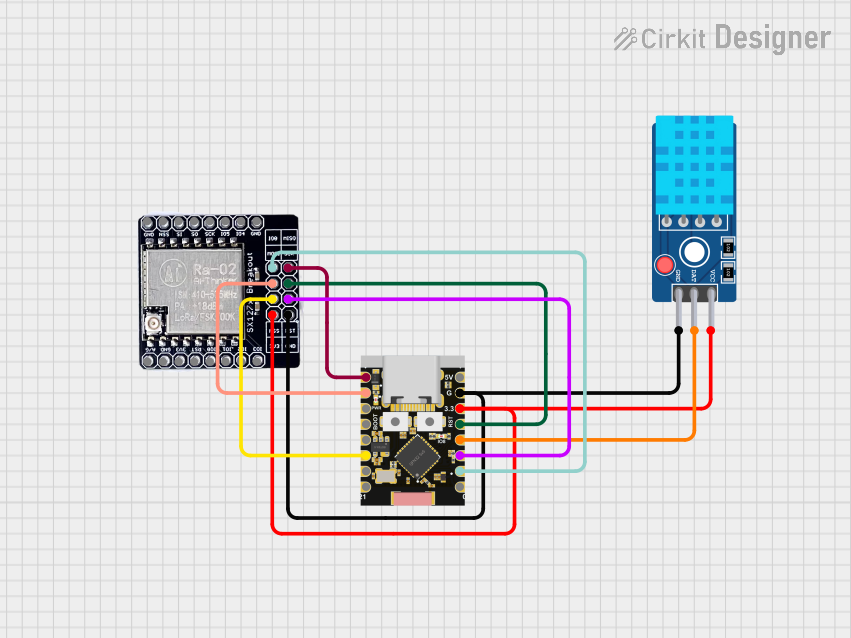
Explore Projects Built with XIAO ESP32C3
 Open Project in Cirkit Designer
 Open Project in Cirkit Designer
 Open Project in Cirkit Designer
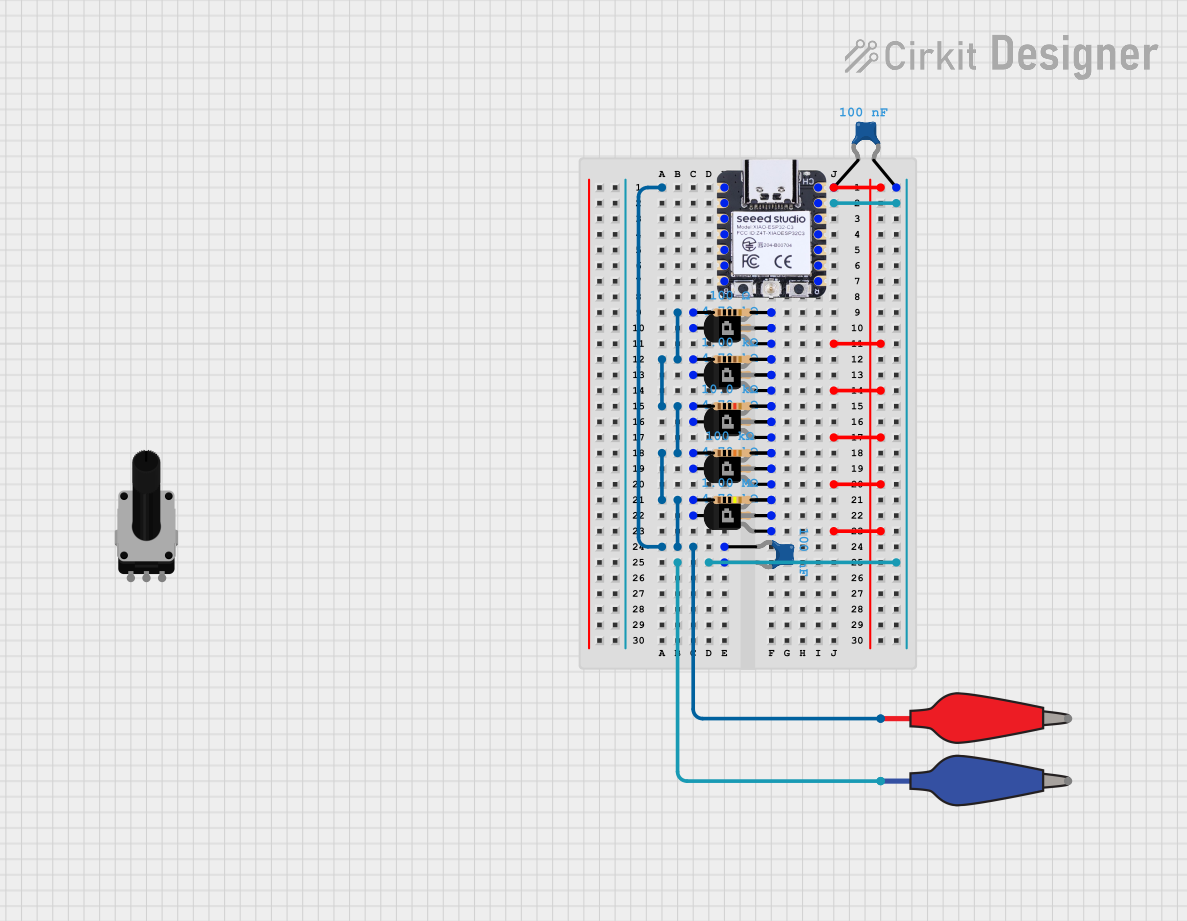 Open Project in Cirkit Designer
Explore Projects Built with XIAO ESP32C3
Open Project in Cirkit DesignerOpen Project in Cirkit DesignerOpen Project in Cirkit DesignerOpen Project in Cirkit DesignerCommon Applications
- IoT devices and smart home systems
- Wearable technology
- Wireless sensor networks
- Prototyping for Bluetooth and Wi-Fi-enabled projects
- Robotics and automation systems
Technical Specifications
The following table outlines the key technical details of the XIAO ESP32C3:
| Specification | Details |
|---|---|
| Microcontroller | ESP32-C3 RISC-V single-core processor |
| Clock Speed | Up to 160 MHz |
| Flash Memory | 4 MB |
| SRAM | 400 KB |
| Wireless Connectivity | Wi-Fi 802.11 b/g/n (2.4 GHz), Bluetooth 5.0 LE |
| Operating Voltage | 3.3V |
| Input Voltage Range | 5V (via USB-C) |
| GPIO Pins | 11 (including ADC, PWM, I2C, SPI, UART) |
| ADC Resolution | 12-bit |
| Dimensions | 21 x 17.5 mm |
| Power Consumption | Ultra-low power consumption in deep sleep mode |
| USB Interface | USB-C (supports programming and power supply) |
| Operating Temperature | -40°C to 85°C |
Pin Configuration and Descriptions
The XIAO ESP32C3 features a total of 11 GPIO pins, which are multifunctional. Below is the pinout description:
| Pin | Name | Function |
|---|---|---|
| 1 | 3V3 | 3.3V power output |
| 2 | GND | Ground |
| 3 | D0 | GPIO0, ADC, PWM, UART RX |
| 4 | D1 | GPIO1, ADC, PWM, UART TX |
| 5 | D2 | GPIO2, ADC, PWM |
| 6 | D3 | GPIO3, ADC, PWM |
| 7 | D4 | GPIO4, ADC, PWM |
| 8 | D5 | GPIO5, ADC, PWM |
| 9 | D6 | GPIO6, ADC, PWM |
| 10 | D7 | GPIO7, ADC, PWM |
| 11 | RST | Reset pin |
Usage Instructions
How to Use the XIAO ESP32C3 in a Circuit
Powering the Board:
- Use a USB-C cable to connect the board to a power source (e.g., a computer or USB adapter).
- Alternatively, supply 3.3V directly to the 3V3 pin.
Programming the Board:
- Install the Arduino IDE and add the ESP32 board package.
- Select "Seeed XIAO ESP32C3" as the board in the Arduino IDE.
- Connect the board via USB-C and upload your code.
Connecting Peripherals:
- Use the GPIO pins to connect sensors, actuators, or other peripherals.
- Ensure the voltage levels of connected devices are compatible with the 3.3V logic of the board.
Important Considerations
- Voltage Levels: The GPIO pins operate at 3.3V. Avoid connecting 5V devices directly to the pins without a level shifter.
- Power Supply: If powering the board via the 3V3 pin, ensure the power source is stable and capable of supplying sufficient current.
- Deep Sleep Mode: Utilize the deep sleep mode for battery-powered applications to minimize power consumption.
Example Code for Arduino IDE
The following example demonstrates how to blink an LED connected to GPIO2:
// Define the GPIO pin for the LED
const int ledPin = 2;

void setup() {
  // Initialize the LED pin as an output
  pinMode(ledPin, OUTPUT);
}

void loop() {
  // Turn the LED on
  digitalWrite(ledPin, HIGH);
  delay(1000); // Wait for 1 second

  // Turn the LED off
  digitalWrite(ledPin, LOW);
  delay(1000); // Wait for 1 second
}
Example Code for Wi-Fi Connection
The following example demonstrates how to connect the XIAO ESP32C3 to a Wi-Fi network:
#include <WiFi.h>

// Replace with your network credentials
const char* ssid = "Your_SSID";
const char* password = "Your_PASSWORD";

void setup() {
  // Start the serial communication
  Serial.begin(115200);

  // Connect to Wi-Fi
  Serial.print("Connecting to Wi-Fi");
  WiFi.begin(ssid, password);

  // Wait until connected
  while (WiFi.status() != WL_CONNECTED) {
    delay(500);
    Serial.print(".");
  }

  // Print the IP address once connected
  Serial.println("\nConnected to Wi-Fi!");
  Serial.print("IP Address: ");
  Serial.println(WiFi.localIP());
}

void loop() {
  // Add your main code here
}
Troubleshooting and FAQs
Common Issues
The board is not detected by the computer:
- Ensure the USB-C cable supports data transfer (not just charging).
- Check if the correct drivers are installed for the ESP32-C3.
Upload errors in Arduino IDE:
- Verify that the correct board and port are selected in the Arduino IDE.
- Press the reset button on the board before uploading the code.
Wi-Fi connection fails:
- Double-check the SSID and password.
- Ensure the Wi-Fi network operates on the 2.4 GHz band (not 5 GHz).
Solutions and Tips
- Debugging: Use the Serial Monitor in the Arduino IDE to print debug messages and identify issues.
- Firmware Updates: Ensure the board's firmware is up to date for optimal performance.
- Power Supply: Use a stable power source to avoid unexpected resets or malfunctions.
By following this documentation, you can effectively utilize the XIAO ESP32C3 for your IoT and prototyping projects.