
How to Use 2200 mh lipo 11.1V: Examples, Pinouts, and Specs
 Design with 2200 mh lipo 11.1V in Cirkit Designer
2200mAh LiPo Battery (11.1V) Documentation
1. Introduction
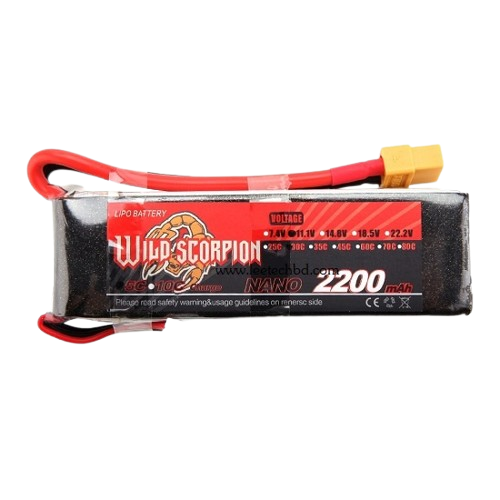
The 2200mAh LiPo Battery (11.1V) is a lightweight, high-performance lithium polymer battery designed for applications requiring high energy density and reliable power delivery. With a nominal voltage of 11.1V and a capacity of 2200mAh, this battery is widely used in remote-controlled (RC) vehicles, drones, robotics, and other portable electronic devices. Its compact size and ability to deliver high current make it an ideal choice for demanding applications.
Common Applications:
- RC Vehicles: Cars, boats, and planes requiring lightweight, high-capacity power sources.
- Drones: Provides extended flight times and stable power for quadcopters and other UAVs.
- Robotics: Powers motors, sensors, and controllers in mobile robots.
- Portable Electronics: Used in DIY projects, Arduino-based systems, and other custom electronics.
2. Technical Specifications
The following table outlines the key technical details of the 2200mAh LiPo battery:
| Parameter | Specification |
|---|---|
| Nominal Voltage | 11.1V (3S configuration) |
| Capacity | 2200mAh |
| Cell Configuration | 3S (3 cells in series) |
| Discharge Rate | Typically 20C to 30C (varies by model) |
| Max Continuous Current | 44A (20C) to 66A (30C) |
| Max Burst Current | 88A (20C) to 132A (30C) |
| Charging Voltage | 12.6V (4.2V per cell) |
| Cutoff Voltage | 9.0V (3.0V per cell) |
| Connector Type | XT60, Deans, or JST (varies by model) |
| Weight | ~180g to 200g |
| Dimensions | ~105mm x 35mm x 25mm |
Pin Configuration and Descriptions
The battery typically has two connectors:
- Main Power Connector: Supplies power to the load (e.g., XT60 or Deans).
- Balance Connector: Used for charging and monitoring individual cell voltages.
| Pin | Description |
|---|---|
| Pin 1 | Cell 1 positive terminal |
| Pin 2 | Cell 1 negative / Cell 2 positive |
| Pin 3 | Cell 2 negative / Cell 3 positive |
| Pin 4 | Cell 3 negative |
3. Usage Instructions
Connecting the Battery
- Main Power Connection: Connect the main power connector (e.g., XT60) to the input of your device or electronic speed controller (ESC).
- Balance Connector: When charging, connect the balance connector to a compatible LiPo charger to ensure all cells are charged evenly.
Charging Instructions
- Use a LiPo-compatible charger with a balance charging mode.
- Set the charger to the correct voltage (11.1V) and capacity (2200mAh).
- Ensure the charging current does not exceed 1C (2.2A) to prevent overheating or damage.
Important Considerations
- Avoid Overcharging: Never charge above 12.6V (4.2V per cell).
- Avoid Over-Discharging: Do not let the voltage drop below 9.0V (3.0V per cell).
- Storage: Store the battery at ~3.8V per cell (11.4V total) for long-term storage.
- Temperature: Do not charge or discharge the battery in extreme temperatures (below 0°C or above 45°C).
Example Circuit with Arduino UNO
The 2200mAh LiPo battery can be used to power an Arduino UNO via a voltage regulator or a DC-DC step-down converter to ensure the voltage is within the Arduino's operating range (5V or 7-12V).
4. Safety Guidelines
Lithium polymer batteries are sensitive to improper handling. Follow these safety guidelines to ensure safe operation:
- Do not puncture or crush the battery.
- Do not short-circuit the terminals.
- Always use a fireproof LiPo bag when charging.
- Monitor the battery during charging to prevent overheating.
- Dispose of damaged or swollen batteries properly.
5. Troubleshooting and FAQs
Common Issues and Solutions
| Issue | Possible Cause | Solution |
|---|---|---|
| Battery not charging | Faulty charger or connection | Check charger and connectors. |
| Battery swelling | Overcharging or over-discharging | Stop using the battery immediately. |
| Low runtime | Battery capacity degraded | Replace the battery. |
| Device shuts off unexpectedly | Voltage dropped below cutoff threshold | Recharge the battery. |
FAQs
Q1: Can I use this battery directly with an Arduino UNO?
A1: No, the Arduino UNO operates at 5V or 7-12V. Use a voltage regulator or DC-DC step-down converter to safely power the Arduino.
Q2: How do I know when the battery is fully charged?
A2: The charger will indicate a full charge when the voltage reaches 12.6V (4.2V per cell).
Q3: What happens if I over-discharge the battery?
A3: Over-discharging can permanently damage the battery. Use a low-voltage alarm or cutoff circuit to prevent this.
Q4: Can I use this battery for high-current applications?
A4: Yes, this battery supports high discharge rates (20C to 30C), making it suitable for motors and other high-current devices.
6. Example Code for Arduino UNO
If you are using the 2200mAh LiPo battery to power an Arduino-based project, you can monitor the battery voltage using a voltage divider circuit and the Arduino's analog input. Below is an example code snippet:
// Example code to monitor LiPo battery voltage using Arduino UNO
// Ensure a voltage divider is used to step down the 11.1V to a safe range (0-5V).

const int voltagePin = A0;  // Analog pin connected to the voltage divider
const float dividerRatio = 5.7;  // Adjust based on your resistor values
const float referenceVoltage = 5.0;  // Arduino's reference voltage (5V)

void setup() {
  Serial.begin(9600);  // Initialize serial communication
}

void loop() {
  int rawValue = analogRead(voltagePin);  // Read the analog input
  float batteryVoltage = (rawValue / 1023.0) * referenceVoltage * dividerRatio;

  Serial.print("Battery Voltage: ");
  Serial.print(batteryVoltage);
  Serial.println(" V");

  delay(1000);  // Wait for 1 second before the next reading
}
Note: Use appropriate resistor values in the voltage divider to ensure the input voltage to the Arduino does not exceed 5V.
7. Conclusion
The 2200mAh LiPo Battery (11.1V) is a versatile and powerful energy source for a wide range of applications. By following the usage instructions and safety guidelines provided in this documentation, you can maximize the performance and lifespan of your battery while ensuring safe operation. Whether you're powering an RC vehicle, drone, or Arduino project, this battery is a reliable choice for your energy needs.
Explore Projects Built with 2200 mh lipo 11.1V
 Open Project in Cirkit Designer
 Open Project in Cirkit Designer
 Open Project in Cirkit Designer
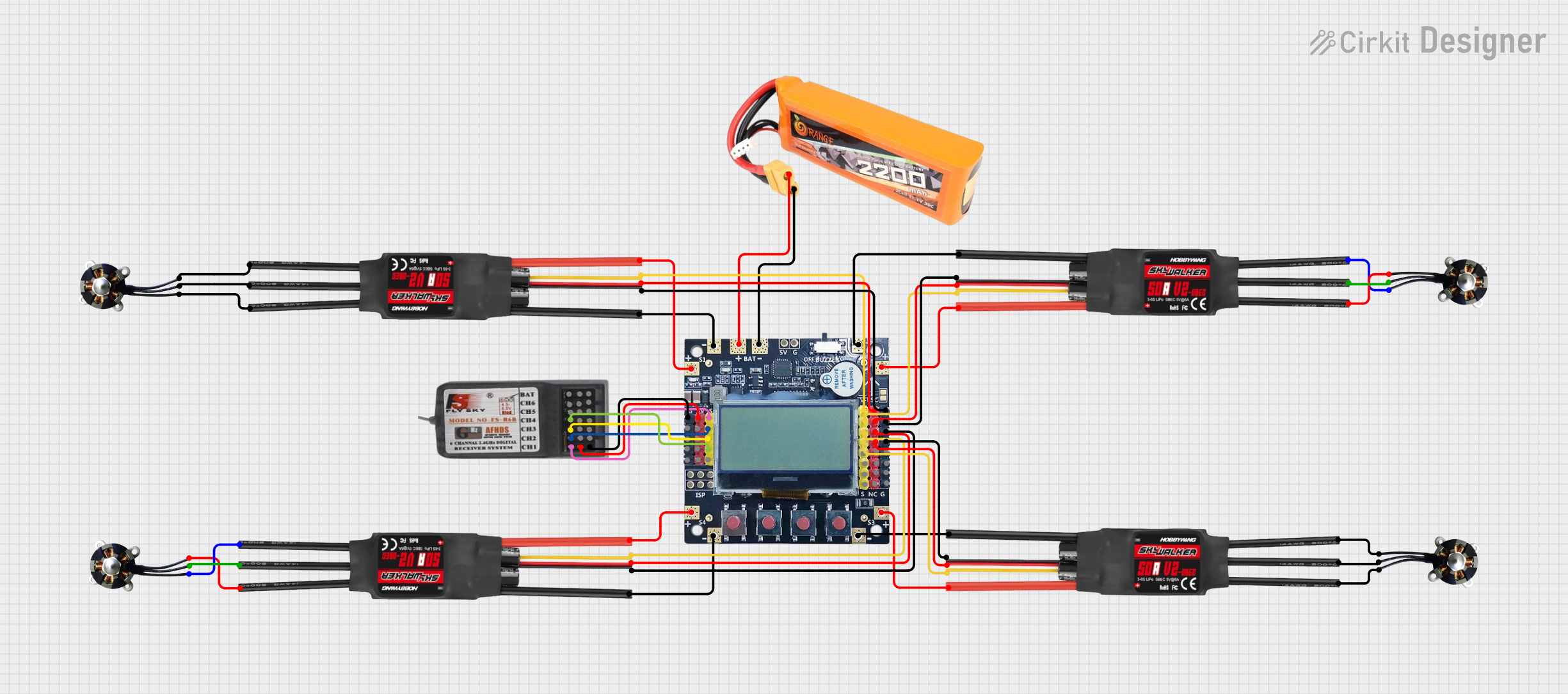 Open Project in Cirkit Designer
Explore Projects Built with 2200 mh lipo 11.1V
Open Project in Cirkit DesignerOpen Project in Cirkit DesignerOpen Project in Cirkit DesignerOpen Project in Cirkit Designer