The Youmile Step Up Boost Power Converter is a versatile and efficient adjustable voltage regulator designed to step up a lower input voltage to a higher, stable output voltage. This component is widely used in applications requiring a regulated power supply, such as battery-powered devices, portable electronics, and DIY projects. Its compact design and adjustable output make it ideal for hobbyists and professionals alike.
Common applications include:
Powering devices requiring a higher voltage than the input source (e.g., USB-powered devices).
Battery voltage regulation for lithium-ion or alkaline batteries.
DIY electronics projects and prototyping.
Solar-powered systems requiring voltage boosting.
Explore Projects Built with Step Up Boost Power Converter, Adjustable Voltage Regulator
Use Cirkit Designer to design, explore, and prototype these projects online. Some projects support real-time simulation. Click "Open Project" to start designing instantly!
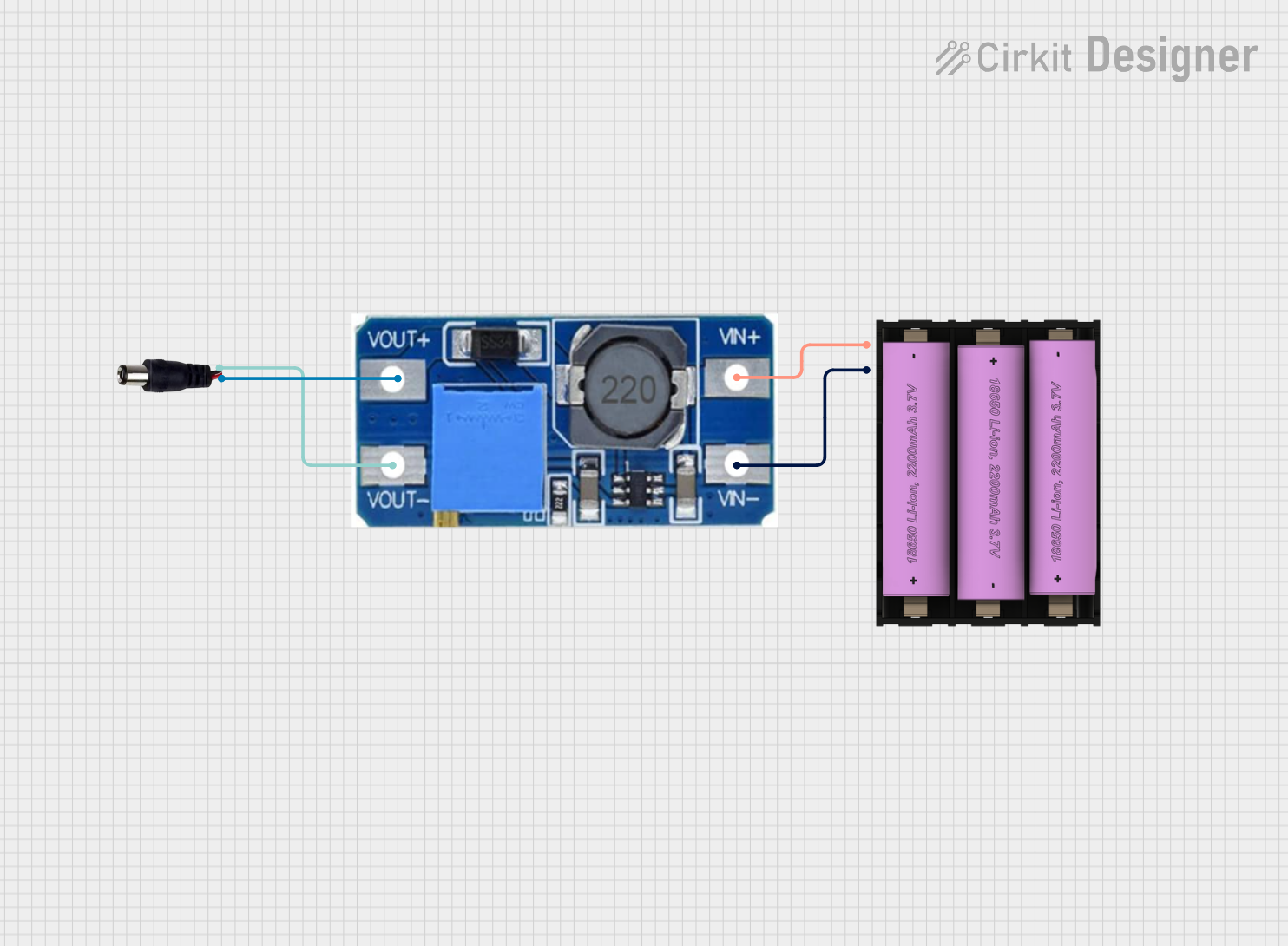
This circuit takes a 7V input from a battery and uses a Step Up Boost Power Converter to increase the voltage to a higher, adjustable level. The boosted voltage is then supplied to a power jack for external use.
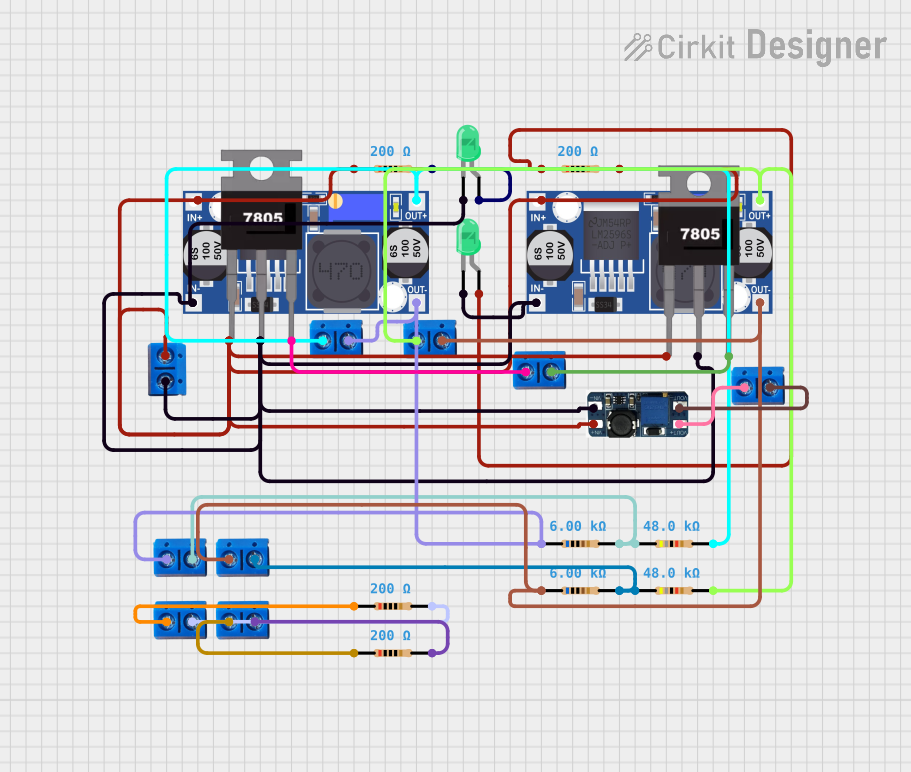
This circuit is designed for power management, featuring buck and boost converters for voltage adjustment, and linear regulators for stable voltage output. It includes LEDs for status indication, and terminal blocks for external connections.
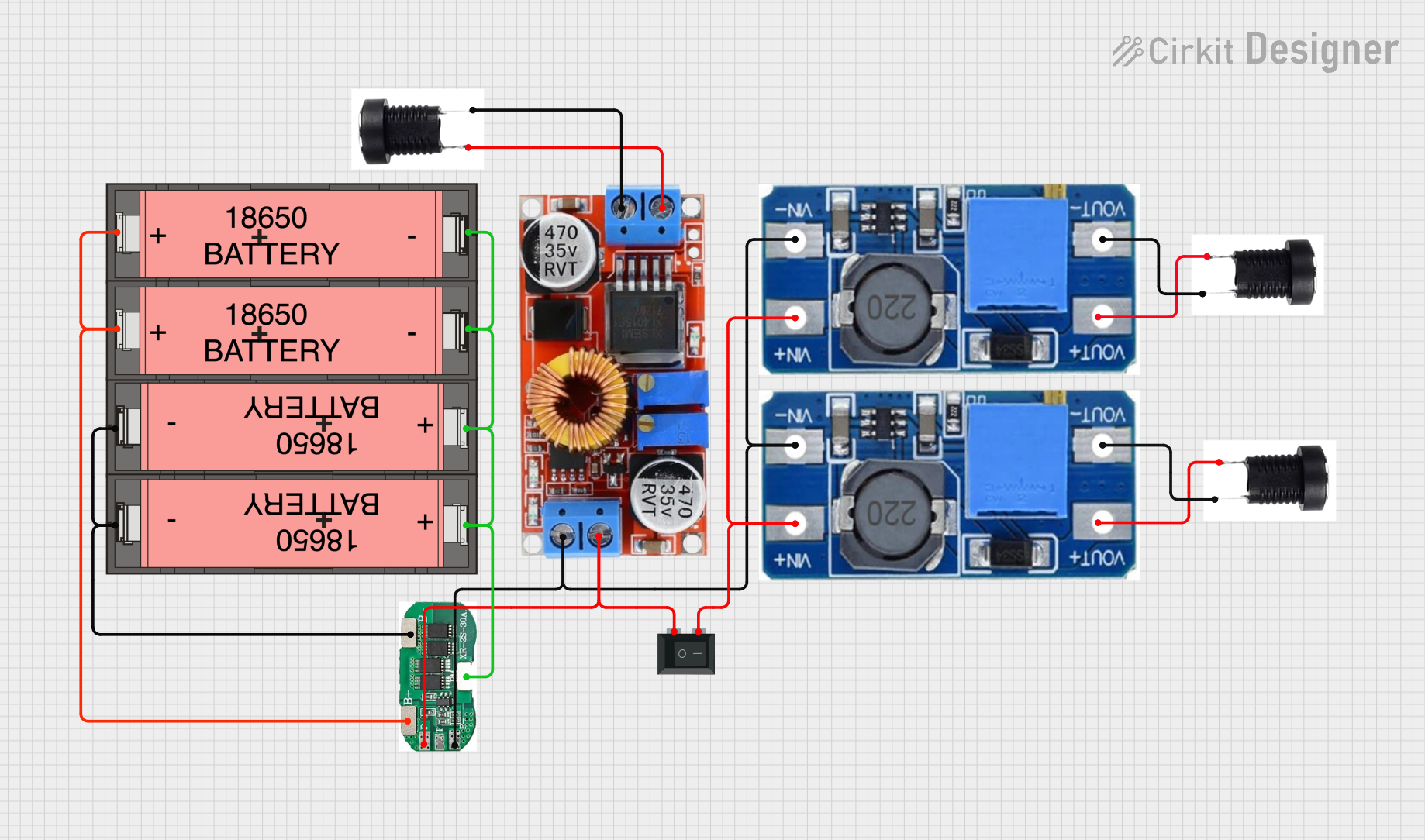
This circuit is a power management system that uses four Li-ion 18650 batteries connected to a 2S 30A BMS for battery management and protection. The system includes step-up and step-down voltage regulators to provide adjustable output voltages, controlled by a rocker switch, and multiple DC jacks for power input and output.
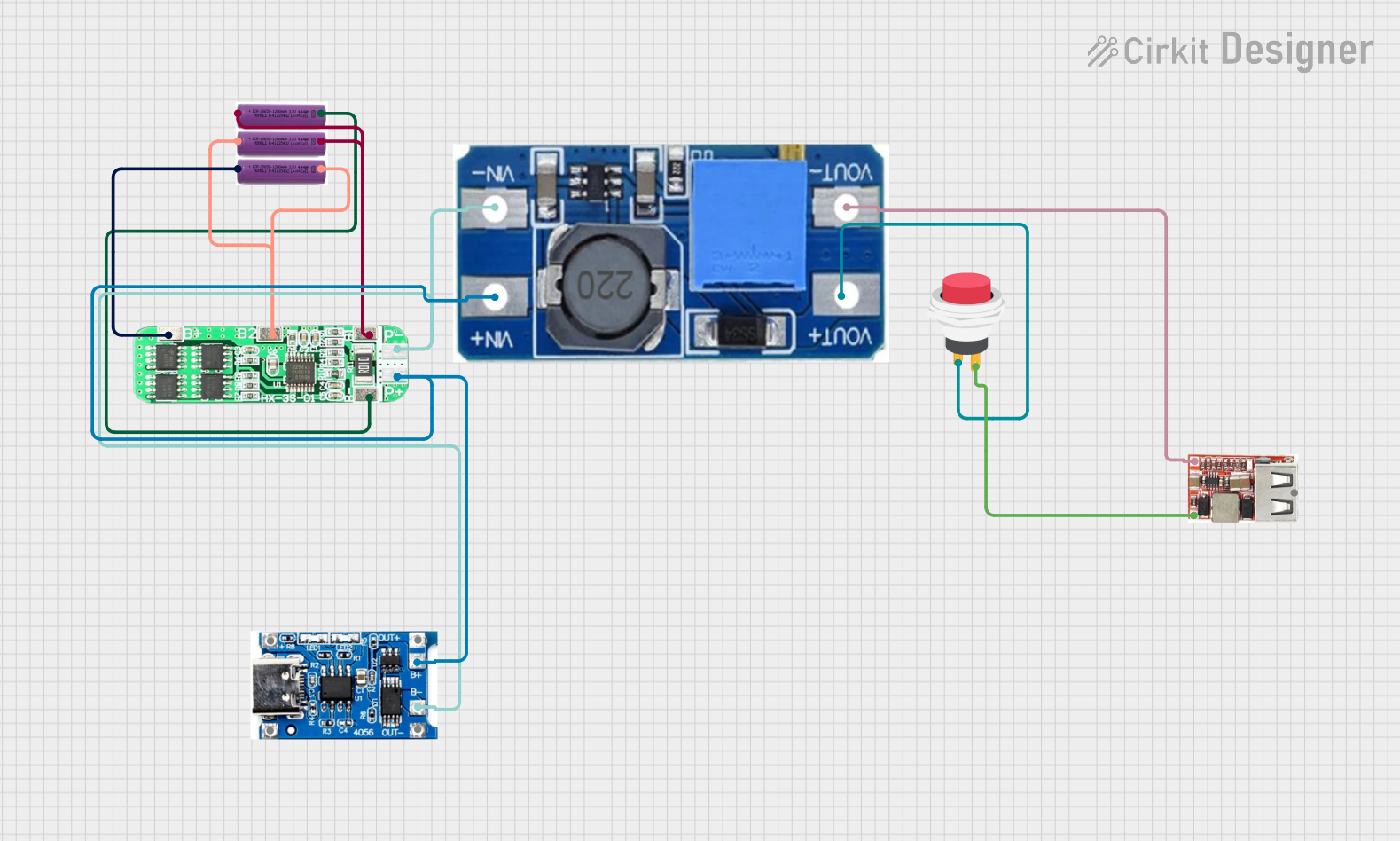
This circuit is a battery management and power supply system that uses three 3.7V batteries connected to a 3S 10A Li-ion 18650 Charger Protection Board Module for balanced charging and protection. The system includes a TP4056 Battery Charging Protection Module for additional charging safety, a Step Up Boost Power Converter to regulate and boost the voltage, and a USB regulator to provide a stable 5V output, controlled by a push switch.
The following are the key technical details of the Youmile Step Up Boost Power Converter:
Parameter
Specification
Input Voltage Range
3V to 35V
Output Voltage Range
4V to 40V (adjustable via potentiometer)
Maximum Output Current
2A (continuous), 3A (peak)
Conversion Efficiency
Up to 92% (depending on input/output)
Switching Frequency
150 kHz
Operating Temperature
-40°C to +85°C
Dimensions
43mm x 21mm x 14mm
Pin Configuration and Descriptions
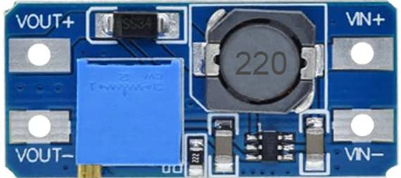
The module has four main pins for input and output connections:
Pin Name
Description
VIN+
Positive input voltage terminal (3V to 35V).
VIN-
Negative input voltage terminal (ground).
VOUT+
Positive output voltage terminal (4V to 40V).
VOUT-
Negative output voltage terminal (ground).
Usage Instructions
How to Use the Component in a Circuit
Connect the Input Voltage:
Connect the positive terminal of your power source to the VIN+ pin.
Connect the negative terminal of your power source to the VIN- pin.
Connect the Output Load:
Connect the positive terminal of your load to the VOUT+ pin.
Connect the negative terminal of your load to the VOUT- pin.
Adjust the Output Voltage:
Use a small screwdriver to turn the onboard potentiometer.
Turn clockwise to increase the output voltage or counterclockwise to decrease it.
Use a multimeter to measure the output voltage while adjusting.
Power On:
Once all connections are secure, power on the input source.
Verify the output voltage and ensure it matches your load requirements.
Important Considerations and Best Practices
Input Voltage Limitations: Ensure the input voltage is within the specified range (3V to 35V). Exceeding this range may damage the module.
Output Voltage Adjustment: Always measure the output voltage with a multimeter before connecting your load to avoid overvoltage damage.
Heat Dissipation: For high current applications, ensure proper ventilation or add a heatsink to prevent overheating.
Polarity Protection: Double-check the polarity of your connections to avoid damaging the module.
Example: Using with an Arduino UNO
The Step Up Boost Power Converter can be used to power an Arduino UNO from a lower voltage source, such as a 3.7V lithium-ion battery. Below is an example setup:
Connect the battery's positive terminal to VIN+ and negative terminal to VIN-.
Adjust the output voltage to 5V using the potentiometer.
Connect VOUT+ to the Arduino's 5V pin and VOUT- to the GND pin.
Here is a simple Arduino sketch to verify the setup:
// This sketch blinks the onboard LED to confirm the Arduino is powered
void setup() {
  pinMode(LED_BUILTIN, OUTPUT); // Set the onboard LED pin as output
}

void loop() {
  digitalWrite(LED_BUILTIN, HIGH); // Turn the LED on
  delay(1000);                     // Wait for 1 second
  digitalWrite(LED_BUILTIN, LOW);  // Turn the LED off
  delay(1000);                     // Wait for 1 second
}
Troubleshooting and FAQs
Common Issues and Solutions
No Output Voltage:
Cause: Incorrect input connections or insufficient input voltage.
Solution: Verify the input connections and ensure the input voltage is within the specified range.
Output Voltage Not Adjustable:
Cause: Faulty potentiometer or incorrect adjustment.
Solution: Ensure the potentiometer is not damaged and adjust it carefully while monitoring with a multimeter.
Overheating:
Cause: Excessive current draw or poor ventilation.
Solution: Reduce the load current or add a heatsink to the module.
Load Not Powering On:
Cause: Output voltage is too low or too high for the load.
Solution: Measure and adjust the output voltage to match the load's requirements.
FAQs
Q: Can this module step down voltage as well?
A: No, this is a boost converter and can only step up the input voltage. For step-down functionality, use a buck converter.
Q: What happens if I exceed the maximum input voltage?
A: Exceeding the input voltage range (35V) can permanently damage the module. Always stay within the specified range.
Q: Can I use this module with a solar panel?
A: Yes, as long as the solar panel's output voltage is within the input range of the module. Ensure the output voltage is adjusted to match your load.
Q: Is the module protected against reverse polarity?
A: No, the module does not have built-in reverse polarity protection. Double-check your connections before powering on.
By following this documentation, you can effectively use the Youmile Step Up Boost Power Converter in your projects.

 Open Project in Cirkit Designer