
How to Use Buck Converter 3A: Examples, Pinouts, and Specs
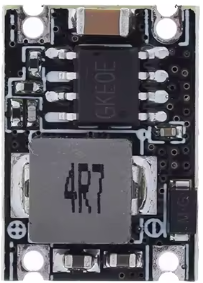
 Design with Buck Converter 3A in Cirkit Designer
Introduction
A buck converter, also known as a step-down DC-DC converter, is an electronic component designed to reduce a higher input voltage to a lower output voltage while maintaining high efficiency. The Buck Converter 3A, manufactured in China, is capable of delivering a maximum output current of 3A, making it ideal for powering devices that require lower voltage and moderate current. Its compact size and high efficiency make it a popular choice for battery-powered systems, embedded devices, and other low-voltage applications.
Explore Projects Built with Buck Converter 3A
 Open Project in Cirkit Designer
 Open Project in Cirkit Designer
 Open Project in Cirkit Designer
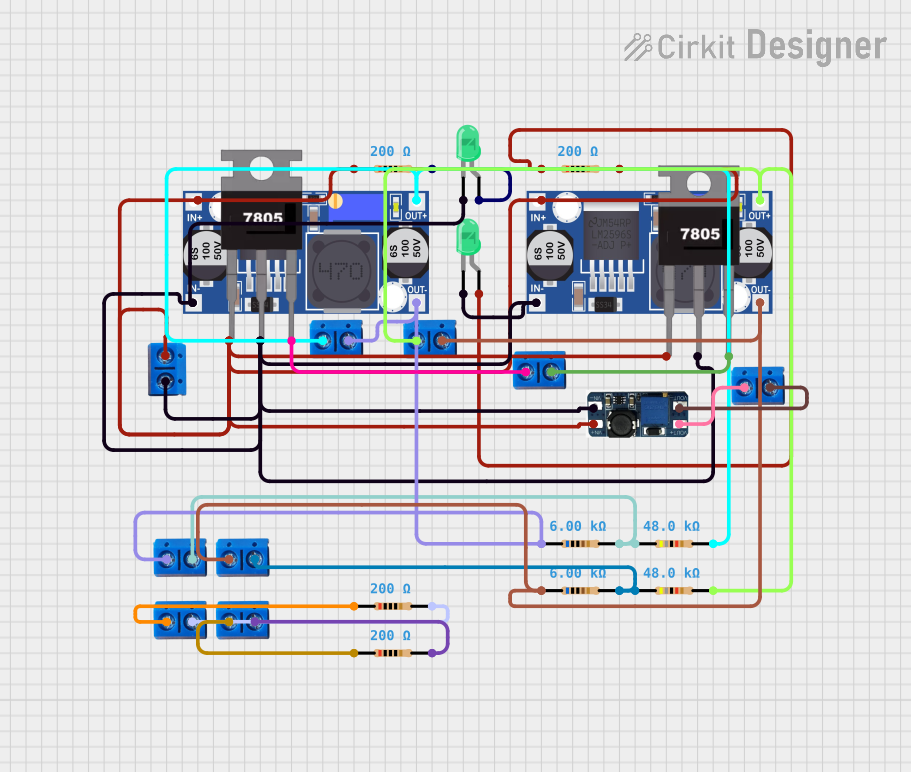 Open Project in Cirkit Designer
Explore Projects Built with Buck Converter 3A
Open Project in Cirkit DesignerOpen Project in Cirkit DesignerOpen Project in Cirkit DesignerOpen Project in Cirkit DesignerCommon Applications and Use Cases
- Powering microcontrollers, sensors, and modules in embedded systems
- Voltage regulation for battery-powered devices
- Supplying power to LED strips and low-voltage motors
- Step-down voltage conversion in robotics and IoT projects
- Efficient power delivery in portable electronics
Technical Specifications
The Buck Converter 3A is designed to provide reliable and efficient voltage regulation. Below are its key technical specifications:
| Parameter | Value |
|---|---|
| Input Voltage Range | 4.5V to 28V |
| Output Voltage Range | 0.8V to 20V (adjustable) |
| Maximum Output Current | 3A |
| Efficiency | Up to 92% (depending on load) |
| Switching Frequency | 150 kHz |
| Operating Temperature | -40°C to +85°C |
| Dimensions | Typically 22mm x 17mm x 4mm |
Pin Configuration and Descriptions
The Buck Converter 3A typically has the following pin configuration:
| Pin Name | Description |
|---|---|
| VIN | Input voltage pin. Connect to the positive terminal of the input power source. |
| GND | Ground pin. Connect to the negative terminal of the input power source. |
| VOUT | Output voltage pin. Provides the regulated output voltage. |
| ADJ (optional) | Adjustment pin. Used to set the output voltage (if adjustable). |
Usage Instructions
How to Use the Buck Converter 3A in a Circuit
- Connect the Input Voltage:
- Connect the VIN pin to the positive terminal of your power source (e.g., a battery or DC power supply).
- Connect the GND pin to the negative terminal of your power source.
- Set the Output Voltage (if adjustable):
- Use the onboard potentiometer (if available) to adjust the output voltage. Turn the potentiometer clockwise or counterclockwise while monitoring the output voltage with a multimeter.
- Connect the Load:
- Connect the VOUT pin to the positive terminal of your load (e.g., a microcontroller or LED strip).
- Connect the GND pin to the negative terminal of your load.
- Power On:
- Turn on the input power source and verify the output voltage using a multimeter before connecting sensitive devices.
Important Considerations and Best Practices
- Ensure the input voltage is within the specified range (4.5V to 28V) to avoid damaging the converter.
- Do not exceed the maximum output current of 3A to prevent overheating or failure.
- Use appropriate heat dissipation methods (e.g., a heatsink) if operating near the maximum current limit.
- Place decoupling capacitors near the input and output pins to reduce noise and improve stability.
- If using the converter with an Arduino UNO or similar microcontroller, ensure the output voltage matches the microcontroller's operating voltage (e.g., 5V or 3.3V).
Example: Using the Buck Converter 3A with an Arduino UNO
Below is an example of how to connect the Buck Converter 3A to an Arduino UNO:
- Set the output voltage of the buck converter to 5V using the onboard potentiometer.
- Connect the VIN and GND pins of the buck converter to a 12V DC power source.
- Connect the VOUT pin of the buck converter to the 5V pin of the Arduino UNO.
- Connect the GND pin of the buck converter to the GND pin of the Arduino UNO.
Here is a simple Arduino code example to blink an LED using the regulated 5V output:
// This code blinks an LED connected to pin 13 of the Arduino UNO.
// Ensure the buck converter is providing a stable 5V to the Arduino.

void setup() {
  pinMode(13, OUTPUT); // Set pin 13 as an output pin
}

void loop() {
  digitalWrite(13, HIGH); // Turn the LED on
  delay(1000);            // Wait for 1 second
  digitalWrite(13, LOW);  // Turn the LED off
  delay(1000);            // Wait for 1 second
}
Troubleshooting and FAQs
Common Issues and Solutions
No Output Voltage:
- Verify that the input voltage is within the specified range (4.5V to 28V).
- Check all connections to ensure they are secure and correctly wired.
- Inspect the onboard potentiometer (if adjustable) to ensure it is not set to 0V.
Overheating:
- Ensure the load does not exceed the maximum output current of 3A.
- Use a heatsink or active cooling if operating near the maximum current limit.
Output Voltage Fluctuations:
- Add decoupling capacitors (e.g., 10µF and 0.1µF) near the input and output pins.
- Check for loose connections or poor solder joints.
Load Not Powering On:
- Verify that the output voltage matches the load's required operating voltage.
- Check the load's current requirements to ensure they do not exceed 3A.
FAQs
Q: Can I use the Buck Converter 3A with a 24V input to power a 5V device?
A: Yes, the converter can step down 24V to 5V as long as the input voltage is within the 4.5V to 28V range and the load current does not exceed 3A.
Q: Is the output voltage stable enough for sensitive electronics?
A: Yes, the Buck Converter 3A provides a stable output voltage with high efficiency. Adding decoupling capacitors can further improve stability.
Q: Can I use this converter to charge a battery?
A: While it is possible, ensure the output voltage and current are suitable for the specific battery type. A dedicated battery charging circuit is recommended for optimal safety and performance.
Q: What happens if I exceed the 3A current limit?
A: Exceeding the current limit may cause the converter to overheat, shut down, or fail. Always ensure the load current is within the specified limit.