
How to Use Decoder (IC): Examples, Pinouts, and Specs
 Design with Decoder (IC) in Cirkit Designer
Introduction
The 74138 Decoder, manufactured by Semiconductor, is a high-performance integrated circuit designed to convert binary information from its input lines into a maximum of (2^n) unique output lines. This IC is commonly used in digital systems for tasks such as address decoding, data routing, and enabling specific outputs based on binary input combinations.
Explore Projects Built with Decoder (IC)
 Open Project in Cirkit Designer
 Open Project in Cirkit Designer
 Open Project in Cirkit Designer
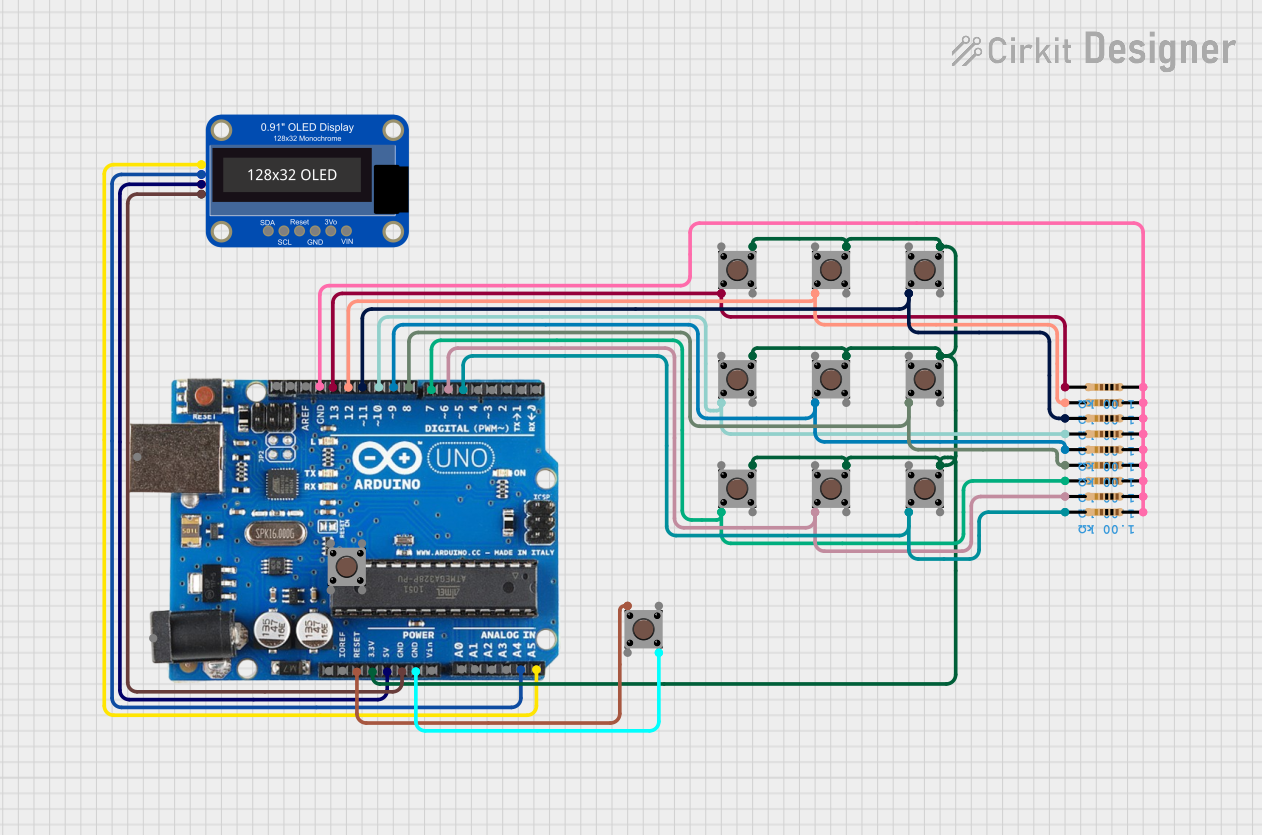 Open Project in Cirkit Designer
Explore Projects Built with Decoder (IC)
Open Project in Cirkit DesignerOpen Project in Cirkit DesignerOpen Project in Cirkit DesignerOpen Project in Cirkit DesignerCommon Applications and Use Cases
- Memory address decoding in microprocessor systems
- Selection of specific devices in multiplexed systems
- Data demultiplexing
- Logic circuit design for enabling/disabling specific outputs
- Signal routing in digital communication systems
Technical Specifications
The 74138 Decoder is a 3-to-8 line decoder/demultiplexer with active-low outputs. Below are its key technical details:
Key Technical Details
- Operating Voltage (Vcc): 4.75V to 5.25V (typical 5V)
- Input Voltage (VIH - High): Minimum 2V
- Input Voltage (VIL - Low): Maximum 0.8V
- Output Voltage (VOH - High): Minimum 2.4V
- Output Voltage (VOL - Low): Maximum 0.4V
- Maximum Output Current (IOL): 16mA
- Propagation Delay: 15ns (typical)
- Power Dissipation: 32mW (typical)
- Temperature Range: 0°C to 70°C (commercial grade)
Pin Configuration and Descriptions
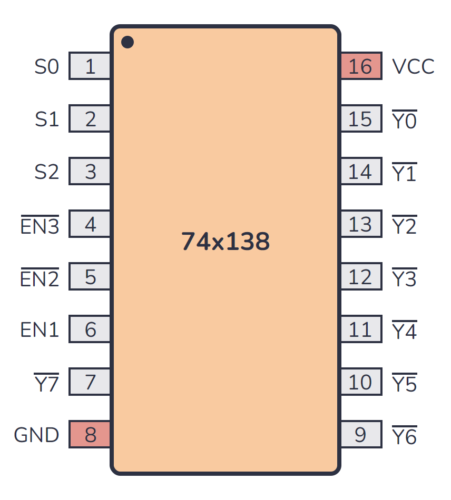
The 74138 Decoder comes in a 16-pin Dual In-line Package (DIP). Below is the pin configuration:
| Pin Number | Pin Name | Description |
|---|---|---|
| 1 | G2A | Enable Input (Active High) |
| 2 | G2B | Enable Input (Active High) |
| 3 | G1 | Enable Input (Active Low) |
| 4 | A | Input A (Least Significant Bit) |
| 5 | B | Input B |
| 6 | C | Input C (Most Significant Bit) |
| 7 | Y7 | Output 7 (Active Low) |
| 8 | GND | Ground |
| 9 | Y6 | Output 6 (Active Low) |
| 10 | Y5 | Output 5 (Active Low) |
| 11 | Y4 | Output 4 (Active Low) |
| 12 | Y3 | Output 3 (Active Low) |
| 13 | Y2 | Output 2 (Active Low) |
| 14 | Y1 | Output 1 (Active Low) |
| 15 | Y0 | Output 0 (Active Low) |
| 16 | Vcc | Power Supply (5V) |
Usage Instructions
How to Use the Component in a Circuit
- Power Supply: Connect the Vcc pin (Pin 16) to a 5V power supply and the GND pin (Pin 8) to ground.
- Enable Inputs:
- Ensure that G1 (Pin 3) is set to logic LOW (active-low enable).
- Set G2A (Pin 1) and G2B (Pin 2) to logic HIGH (active-high enables).
- Input Lines: Connect the binary input signals to pins A (Pin 4), B (Pin 5), and C (Pin 6). These inputs determine which output line is activated.
- Output Lines: The outputs (Y0 to Y7) are active-low, meaning the selected output will go LOW while all others remain HIGH.
Example Circuit
Below is an example of connecting the 74138 Decoder to an Arduino UNO for address decoding:
// Arduino UNO example for controlling the 74138 Decoder
// Connect the 74138 pins as follows:
// A -> Pin 4, B -> Pin 5, C -> Pin 6 on the 74138
// G1 -> GND, G2A -> 5V, G2B -> 5V
// Y0 to Y7 connected to LEDs for demonstration

// Define Arduino pins connected to the 74138 inputs
const int pinA = 2; // Arduino pin connected to A
const int pinB = 3; // Arduino pin connected to B
const int pinC = 4; // Arduino pin connected to C

void setup() {
  // Set pins as outputs
  pinMode(pinA, OUTPUT);
  pinMode(pinB, OUTPUT);
  pinMode(pinC, OUTPUT);
}

void loop() {
  // Cycle through all 8 output combinations
  for (int i = 0; i < 8; i++) {
    digitalWrite(pinA, (i & 0x01)); // Set A to LSB of i
    digitalWrite(pinB, (i & 0x02) >> 1); // Set B to second bit of i
    digitalWrite(pinC, (i & 0x04) >> 2); // Set C to MSB of i
    delay(500); // Wait for 500ms before changing output
  }
}
Important Considerations and Best Practices
- Ensure that the enable inputs (G1, G2A, G2B) are correctly configured; otherwise, the decoder will not function.
- Use pull-up or pull-down resistors on input lines to avoid floating inputs.
- Avoid exceeding the maximum current rating of the outputs to prevent damage to the IC.
- Decoupling capacitors (e.g., 0.1µF) should be placed near the Vcc pin to reduce noise.
Troubleshooting and FAQs
Common Issues and Solutions
No Output Activation:
- Verify that the enable inputs (G1, G2A, G2B) are correctly set (G1 = LOW, G2A = HIGH, G2B = HIGH).
- Check the power supply connections (Vcc and GND).
Incorrect Output Activation:
- Ensure that the binary inputs (A, B, C) are correctly connected and receiving the expected signals.
- Check for loose or faulty connections on the input and output pins.
All Outputs Remain HIGH:
- Confirm that the active-low outputs are correctly interpreted (LOW = active, HIGH = inactive).
- Verify that the IC is not damaged by testing with a multimeter.
FAQs
Q1: Can the 74138 Decoder be used with a 3.3V system?
A1: No, the 74138 is designed for a 5V system. Using it with 3.3V may result in unreliable operation.
Q2: What happens if multiple enable inputs are not configured correctly?
A2: If G1 is HIGH or G2A/G2B are LOW, all outputs will remain inactive (HIGH).
Q3: Can the outputs drive LEDs directly?
A3: Yes, but ensure that the current through each output does not exceed 16mA. Use current-limiting resistors with LEDs.
This concludes the documentation for the 74138 Decoder.