
How to Use CTVIB01 0-5V to 4-20mA Converter: Examples, Pinouts, and Specs
 Design with CTVIB01 0-5V to 4-20mA Converter in Cirkit Designer
Introduction
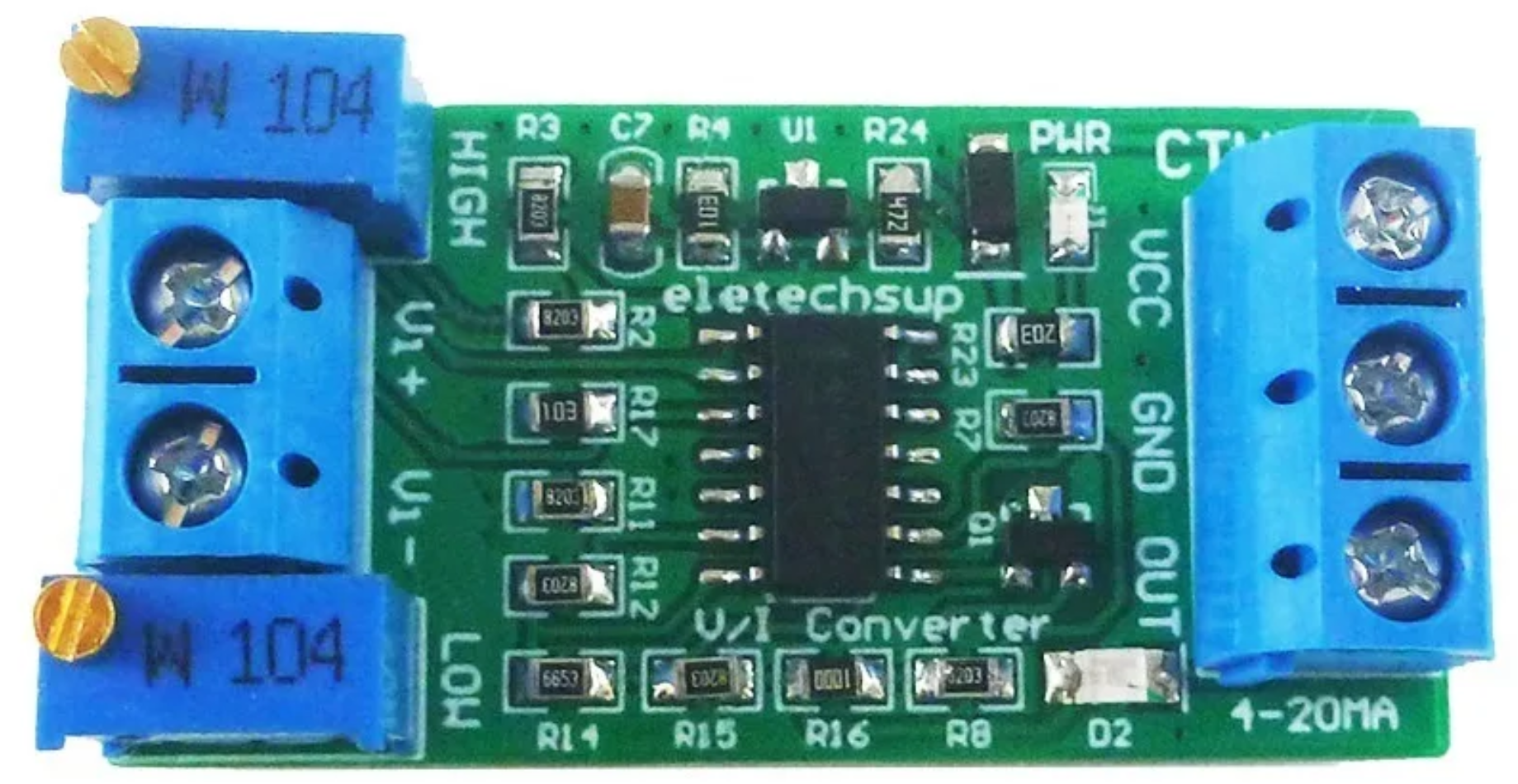
The CTVIB01 is a precision device manufactured by ELETECHSUP designed to convert a 0-5V voltage signal into a 4-20mA current signal. This conversion is essential in industrial and automation systems where current signals are preferred for transmitting data over long distances due to their resilience to noise and voltage drops.
Explore Projects Built with CTVIB01 0-5V to 4-20mA Converter
 Open Project in Cirkit Designer
 Open Project in Cirkit Designer
 Open Project in Cirkit Designer
 Open Project in Cirkit Designer
Explore Projects Built with CTVIB01 0-5V to 4-20mA Converter
Open Project in Cirkit DesignerOpen Project in Cirkit DesignerOpen Project in Cirkit DesignerOpen Project in Cirkit DesignerCommon Applications and Use Cases
- Industrial Automation: Transmitting sensor data (e.g., temperature, pressure, or flow) to a central controller.
- Process Control Systems: Interfacing with Programmable Logic Controllers (PLCs) or Distributed Control Systems (DCS).
- Remote Monitoring: Sending signals over long distances in harsh environments.
- Analog Signal Conditioning: Converting voltage outputs from sensors to current signals for compatibility with industrial equipment.
Technical Specifications
The following table outlines the key technical details of the CTVIB01:
| Parameter | Specification |
|---|---|
| Input Voltage Range | 0-5V DC |
| Output Current Range | 4-20mA |
| Power Supply Voltage | 12-24V DC |
| Accuracy | ±0.1% of Full Scale |
| Operating Temperature | -20°C to 70°C |
| Input Impedance | ≥ 10 kΩ |
| Output Load Resistance | ≤ 500 Ω (at 24V supply) |
| Dimensions | 50mm x 25mm x 15mm |
| Mounting Type | PCB Mount or DIN Rail (with adapter) |
Pin Configuration and Descriptions
The CTVIB01 has a simple pinout for easy integration into circuits. The pin configuration is as follows:
| Pin Number | Pin Name | Description |
|---|---|---|
| 1 | V+ | Positive power supply input (12-24V DC) |
| 2 | GND | Ground connection for power supply and signal |
| 3 | VIN | Voltage input signal (0-5V DC) |
| 4 | IOUT | Current output signal (4-20mA) |
Usage Instructions
How to Use the CTVIB01 in a Circuit
- Power Supply: Connect a 12-24V DC power supply to the
V+andGNDpins. Ensure the power supply is stable and within the specified range. - Input Signal: Connect the 0-5V voltage signal source (e.g., a sensor or microcontroller) to the
VINpin. The input impedance of the CTVIB01 is high, so it will not load the signal source. - Output Signal: Connect the
IOUTpin to the current loop receiver (e.g., a PLC or analog input module). Ensure the load resistance does not exceed 500 Ω at 24V supply. - Testing: Verify the output current corresponds to the input voltage. For example:
- 0V input → 4mA output
- 2.5V input → 12mA output
- 5V input → 20mA output
Important Considerations and Best Practices
- Power Supply: Use a regulated DC power supply to avoid fluctuations in the output signal.
- Grounding: Ensure all components in the circuit share a common ground to prevent signal interference.
- Load Resistance: Keep the load resistance within the specified range to maintain accuracy.
- Wiring: Use shielded cables for long-distance connections to minimize noise.
- Calibration: If precise accuracy is required, calibrate the system using a known voltage source and a current meter.
Example: Connecting to an Arduino UNO
The CTVIB01 can be used with an Arduino UNO to convert a PWM signal into a 4-20mA current signal. Below is an example code snippet:
// Example: Using Arduino UNO with CTVIB01
// This code generates a 0-5V signal using PWM to control the CTVIB01 output.

// Define the PWM pin
const int pwmPin = 9;

void setup() {
  pinMode(pwmPin, OUTPUT); // Set the PWM pin as output
}

void loop() {
  // Generate a 0-5V signal by varying the PWM duty cycle
  for (int dutyCycle = 0; dutyCycle <= 255; dutyCycle++) {
    analogWrite(pwmPin, dutyCycle); // Write PWM signal
    delay(50); // Wait for 50ms
  }

  for (int dutyCycle = 255; dutyCycle >= 0; dutyCycle--) {
    analogWrite(pwmPin, dutyCycle); // Write PWM signal
    delay(50); // Wait for 50ms
  }
}
Note: Use a low-pass filter (e.g., RC filter) on the PWM output to smooth the signal into a stable 0-5V DC voltage before connecting it to the
VINpin of the CTVIB01.
Troubleshooting and FAQs
Common Issues and Solutions
No Output Current
- Cause: Power supply not connected or incorrect voltage.
- Solution: Verify the power supply is connected to
V+andGNDand is within the 12-24V range.
Incorrect Output Current
- Cause: Input voltage signal is out of range or noisy.
- Solution: Check the input signal at the
VINpin using a multimeter or oscilloscope. Ensure it is within the 0-5V range and stable.
Output Current Exceeds 20mA
- Cause: Load resistance too high.
- Solution: Ensure the load resistance is ≤ 500 Ω at 24V supply.
Signal Interference
- Cause: Long-distance wiring or improper grounding.
- Solution: Use shielded cables and ensure all components share a common ground.
FAQs
Q1: Can the CTVIB01 handle input signals above 5V?
A1: No, the input voltage range is strictly 0-5V. Exceeding this range may damage the device.
Q2: What happens if the load resistance exceeds 500 Ω?
A2: The output current may become inaccurate or the device may fail to drive the load properly.
Q3: Can I use the CTVIB01 in outdoor environments?
A3: The device is not weatherproof. Use an appropriate enclosure to protect it from moisture and extreme temperatures.
Q4: Is calibration required before use?
A4: The CTVIB01 is factory-calibrated, but you can perform additional calibration if higher accuracy is needed.
By following this documentation, users can effectively integrate the CTVIB01 into their systems for reliable voltage-to-current signal conversion.