
How to Use ESP32-WROOM-32: Examples, Pinouts, and Specs
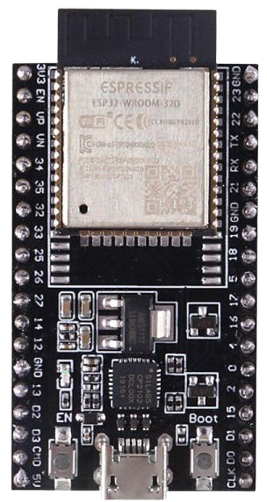
 Design with ESP32-WROOM-32 in Cirkit Designer
Introduction
The ESP32-WROOM-32 is a powerful Wi-Fi and Bluetooth microcontroller module designed for IoT applications and embedded systems. It features dual-core processing, integrated Wi-Fi and Bluetooth capabilities, and a wide range of peripherals, making it a versatile choice for developers. Its compact size and robust performance make it ideal for smart home devices, wearables, industrial automation, and more.
Explore Projects Built with ESP32-WROOM-32
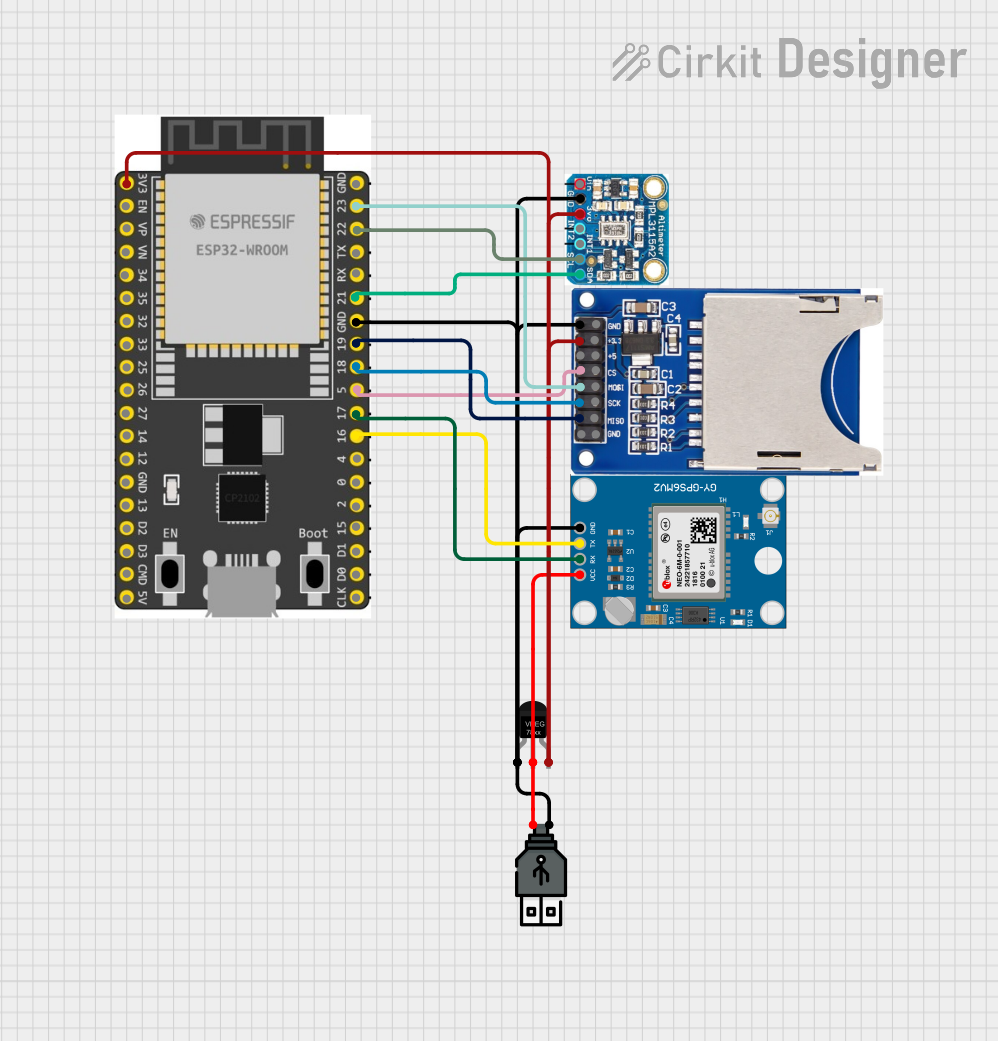 Open Project in Cirkit Designer
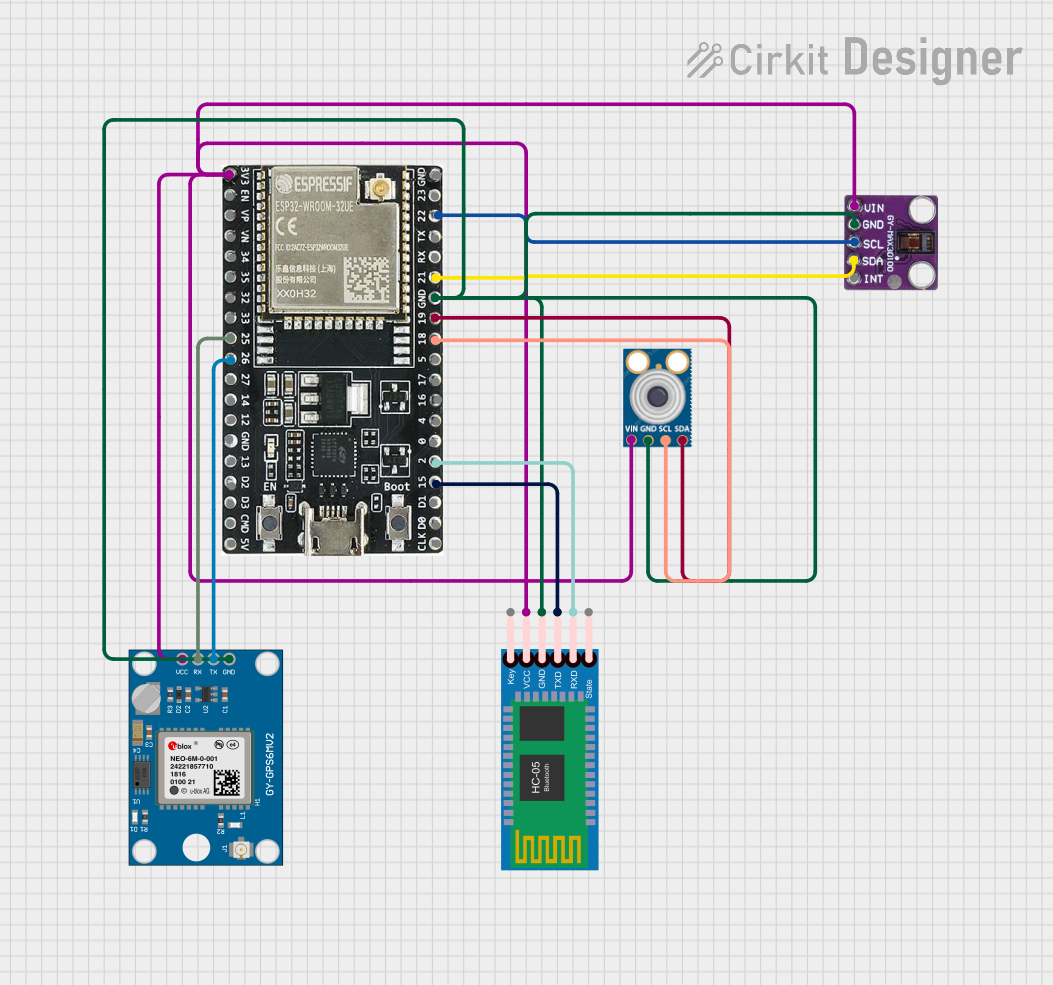 Open Project in Cirkit Designer
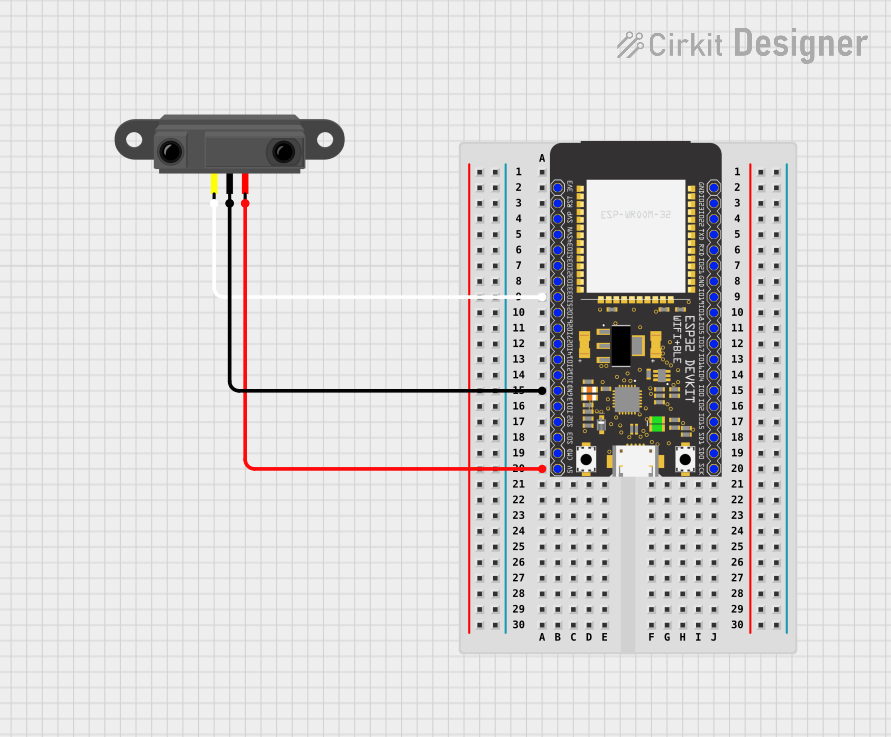 Open Project in Cirkit Designer
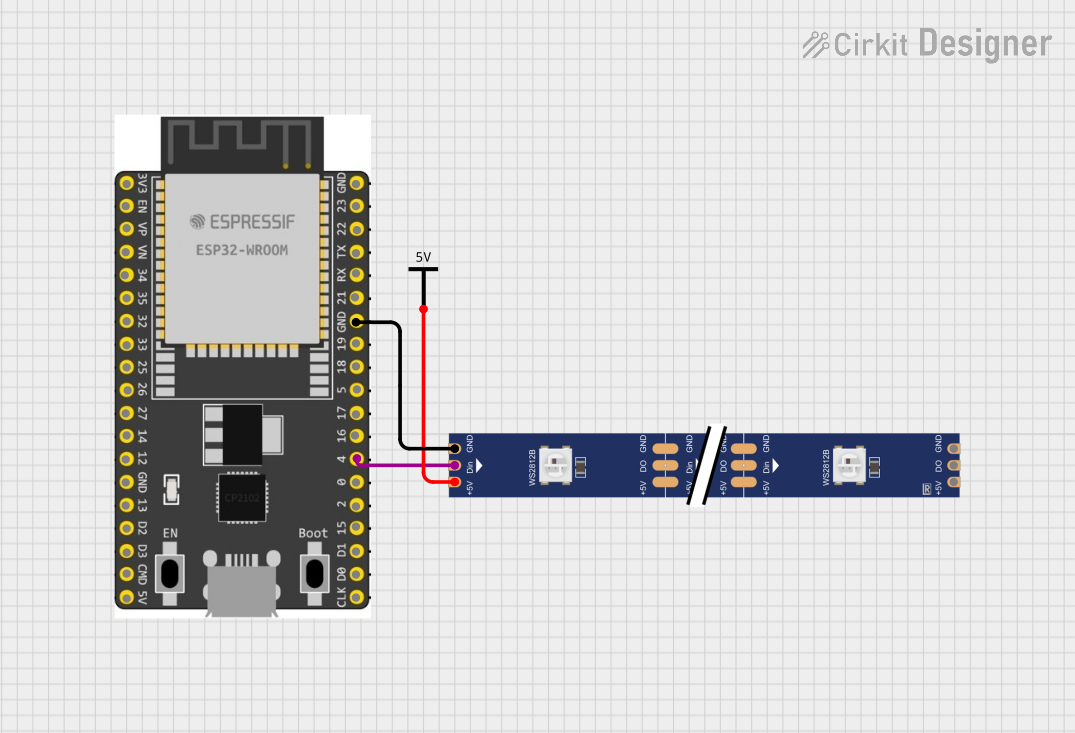 Open Project in Cirkit Designer
Explore Projects Built with ESP32-WROOM-32
Open Project in Cirkit DesignerOpen Project in Cirkit DesignerOpen Project in Cirkit DesignerOpen Project in Cirkit DesignerCommon Applications
- IoT devices and smart home automation
- Wearable electronics
- Industrial control systems
- Wireless sensor networks
- Robotics and drones
- Prototyping and educational projects
Technical Specifications
Key Technical Details
| Specification | Value |
|---|---|
| Microcontroller | ESP32-D0WDQ6 |
| Architecture | 32-bit dual-core Xtensa LX6 |
| Clock Speed | Up to 240 MHz |
| Flash Memory | 4 MB (external SPI flash) |
| SRAM | 520 KB |
| Wireless Connectivity | Wi-Fi 802.11 b/g/n, Bluetooth v4.2 BR/EDR |
| Operating Voltage | 3.0V to 3.6V |
| GPIO Pins | 34 |
| ADC Channels | 18 (12-bit resolution) |
| DAC Channels | 2 |
| Communication Interfaces | UART, SPI, I2C, I2S, CAN, PWM |
| Operating Temperature Range | -40°C to +85°C |
| Dimensions | 25.5 mm x 18 mm x 3.1 mm |
Pin Configuration and Descriptions
| Pin Number | Pin Name | Description |
|---|---|---|
| 1 | EN | Enable pin (active high) |
| 2 | IO0 | GPIO0, used for boot mode selection |
| 3 | IO1 | GPIO1, UART TXD |
| 4 | IO2 | GPIO2, ADC2 channel 2 |
| 5 | IO3 | GPIO3, UART RXD |
| ... | ... | ... (Refer to the full datasheet for all) |
Note: The ESP32-WROOM-32 has multiple pins with multiplexed functions. Refer to the official datasheet for a complete pinout and detailed descriptions.
Usage Instructions
How to Use the ESP32-WROOM-32 in a Circuit
- Power Supply: Provide a stable 3.3V power supply to the module. Avoid exceeding 3.6V to prevent damage.
- Boot Mode: Connect GPIO0 to GND during power-up to enter bootloader mode for programming.
- Communication: Use UART, SPI, or I2C interfaces to communicate with other devices.
- Antenna: Ensure the onboard antenna has sufficient clearance from metallic objects to maintain signal strength.
- Programming: Use the Arduino IDE or ESP-IDF (Espressif IoT Development Framework) for programming.
Example: Connecting to an Arduino UNO
To use the ESP32-WROOM-32 with an Arduino UNO, connect the following pins:
- ESP32
TXto ArduinoRX - ESP32
RXto ArduinoTX - ESP32
GNDto ArduinoGND - ESP32
3.3Vto Arduino3.3V
Example Code: Blink an LED
// This example code blinks an LED connected to GPIO2 of the ESP32-WROOM-32.
// Ensure the LED's anode is connected to GPIO2 and the cathode to GND.

#define LED_PIN 2  // Define the GPIO pin for the LED

void setup() {
  pinMode(LED_PIN, OUTPUT);  // Set GPIO2 as an output pin
}

void loop() {
  digitalWrite(LED_PIN, HIGH);  // Turn the LED on
  delay(1000);                  // Wait for 1 second
  digitalWrite(LED_PIN, LOW);   // Turn the LED off
  delay(1000);                  // Wait for 1 second
}
Best Practices
- Use level shifters if interfacing with 5V logic devices.
- Add decoupling capacitors near the power pins to reduce noise.
- Avoid placing the module near high-frequency components to minimize interference.
Troubleshooting and FAQs
Common Issues
Module Not Responding
- Cause: Incorrect power supply or wiring.
- Solution: Verify the power supply voltage (3.3V) and check all connections.
Wi-Fi Connection Fails
- Cause: Incorrect SSID or password.
- Solution: Double-check the Wi-Fi credentials in your code.
Programming Errors
- Cause: Incorrect boot mode or COM port not selected.
- Solution: Ensure GPIO0 is connected to GND during programming and select the correct COM port in the IDE.
Overheating
- Cause: Excessive current draw or poor ventilation.
- Solution: Check the circuit for shorts and ensure proper airflow around the module.
FAQs
Q: Can the ESP32-WROOM-32 operate on 5V?
A: No, the module operates on 3.3V. Use a voltage regulator or level shifter for 5V systems.Q: How do I reset the module?
A: Pull the EN pin low momentarily to reset the module.Q: Can I use the ESP32-WROOM-32 for Bluetooth audio?
A: Yes, the module supports Bluetooth audio via the I2S interface.Q: What is the maximum Wi-Fi range?
A: The range depends on the environment but typically extends up to 100 meters in open space.
By following this documentation, you can effectively integrate the ESP32-WROOM-32 into your projects and troubleshoot common issues with ease.